

Agenticonstraints checkout has crossed an important threshold: what was once a demo-room thought experiment is now live across multiple major AI platforms, and the technology is reshaping how discovery, selection, payment, and post‑purchase flows are stitched together inside conversational interfaces. Over the past 12–18 months leading into early 2026, OpenAI, Google, Microsoft, Perplexity and Amazon have each moved to let AI agents not only recommend products but actively assemble carts, marshal payment credentials and complete purchases — often without sending the buyer to a merchant’s storefront page. These launches rest on two converging technical innovations: machine‑readable, canonical product feeds and tokenized/delegated payment primitives that keep merchants as the merchant‑of‑record while allowing agents to initiate settlement. The result is agentic checkout — a new commerce surface where the agent is the interface.
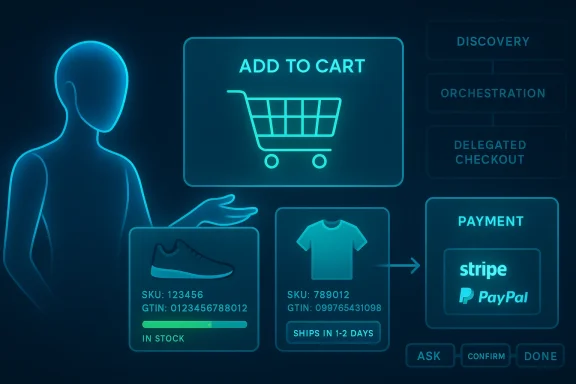
Agentic checkout describes systems where an AI agent manages multiple steps of a shopping journey end‑to‑end: from eliciting constraints (budget, size, delivery window) to comparing live inventory, presenting options, asking clarifying questions, and then initiating or completing payment inside the same conversational surface. This is distinct from earlier in‑app or marketplace checkouts because the conversation itself — not a product page — becomes the full transaction environment. That shift compresses the funnel: “ask → confirm → done” replaces “search → click → checkout.” The technical plumbing that makes agentic checkout practical includes:
Practical, security‑minded adoption will win the day. Merchants and platform teams should focus on catalog integrity, tokenized payment testing, explicit opt‑in/opt‑out governance, and close collaboration with payment partners to map new fraud signals. For platform engineers and product leaders, interoperability (protocol compatibility, provenance, identity linking) and transparent commercial terms will determine whether agentic commerce evolves into a healthy ecosystem or a concentrated gatekeeper model.
The next 6–12 months will determine whether agentic checkout becomes a routine channel in retail or remains a high‑growth, tightly controlled platform play. The technical building blocks are in place — ACP, UCP, tokenized checkouts, and agent runtimes — but execution, merchant economics and regulatory choices will shape whether conversational commerce benefits many sellers and consumers or merely concentrates purchasing power in the large platforms.
Key reporting and documentation referenced in this analysis were drawn from vendor announcements and platform documentation (OpenAI, Stripe, Google UCP materials, Microsoft Copilot marketing), Perplexity and PayPal operational docs, Shopify Editions and help center updates, and independent technology reporting that verified adoption claims and industry signals. Some company rollout targets and “coming soon” volumes are forward‑looking and should be treated as vendor guidance until formal activation notices and documented timelines are published.
Source: thekeyword.co Agentic checkout grows across major AI platforms
 Background / Overview
Agentic checkout describes systems where an AI agent manages multiple steps of a shopping journey end‑to‑end: from eliciting constraints (budget, size, delivery window) to comparing live inventory, presenting options, asking clarifying questions, and then initiating or completing payment inside the same conversational surface. This is distinct from earlier in‑app or marketplace checkouts because the conversation itself — not a product page — becomes the full transaction environment. That shift compresses the funnel: “ask → confirm → done” replaces “search → click → checkout.” The technical plumbing that makes agentic checkout practical includes:- Canonical, machine‑readable product metadata (SKUs, GTINs, images, live inventory, shipping windows, return policies).
- A conversational orchestration/runtime that manages tool calls, clarifying dialog, provenance logging and fallbacks.
- Tokenized or delegated payment primitives (short‑lived tokens, scoped virtual instruments) so agents can trigger settlement without ever seeing raw PANs (Primary Account Numbers).
Who’s doing what today: platform-by-platform
OpenAI — Instant Checkout and the Agentic Commerce Protocol (ACP)
OpenAI launched Instant Checkout beginning with a U.S. pilot that let ChatGPT users buy from Etsy sellers directly in chat, and announced plans to expand to “more than one million” Shopify merchants. The feature is built on the Agentic Commerce Protocol (ACP) — a tokenized, merchant‑friendly standard developed with Stripe — that articulates how product data, session tokens and provenance information are exchanged between assistants, payment processors and merchant backends. Instant Checkout initially supports single‑item purchases with multi‑item carts signaled as planned for a later phase. Key operational notes:- The assistant collects or confirms shipping and payment selection in the chat, then hands a scoped payment token to the merchant/payment processor to complete settlement.
- OpenAI’s public messaging positions merchants as the merchant of record; Stripe and other processors handle settlement and risk checks.
- Early rollouts focused on Etsy sellers, with Shopify expansion described as imminent but phased.
Perplexity — Instant Buy with PayPal
Perplexity introduced Instant Buy, enabling users to purchase directly inside the chatbot experience, with PayPal acting as the payment partner and checkout flow. Perplexity’s help documentation and PayPal’s press release confirm the in‑chat checkout capability and promotional launches timed around the 2025 holiday season. The product pulls real‑time catalog entries from supported merchants and completes payment in‑platform through PayPal’s delegated commerce services. Operational detail: Perplexity’s Instant Buy identifies “Instant Buy”‑eligible items and routes checkout through PayPal’s identity verification and payment protections; merchant surfaces are discoverable via platform partnerships (Wayfair, BigCommerce merchants, etc.. Promotional tie‑ins (cashback or reward points) have been used to seed adoption.Google — Universal Commerce Protocol (UCP) and native buy buttons
At NRF 2026 Google unveiled the Universal Commerce Protocol (UCP) — an open, transport‑agnostic standard intended to let agents and merchants interoperate across discovery, checkout and post‑purchase support. Google positions UCP as complementary to existing agent protocols (Agent Payments Protocol/AP2, Agent2Agent/A2A, Model Context Protocol/MCP) and says UCP is already endorsed and co‑developed with large retailers and platform partners including Shopify, Walmart, Wayfair, Target and Etsy. Google also committed to making in‑chat/buy‑button experiences available in AI Mode for Search and the Gemini app. Why UCP matters: agentic commerce scales poorly if each assistant needs bespoke merchant integrations. UCP attempts to standardize cart lifecycle semantics, identity linking (loyalty/discounts), delegated checkout tokens and provenance information — enabling many agents and wallets to interoperate with merchant backends without bespoke connectors. That reduces engineering overhead and makes multi‑assistant discovery feasible at scale.Microsoft — Copilot Checkout and Brand Agents
Microsoft rolled out Copilot Checkout in early January 2026, embedding a checkout widget inside Copilot conversations. The company emphasizes seller continuity: merchants remain merchant of record, while payments and fraud/risk checks are handled via partners such as PayPal, Stripe and Shopify. Microsoft also introduced Brand Agents, enabling merchants to host brand‑calibrated conversational experiences that keep voice and product guidance consistent. Shopify merchants were told they will be automatically eligible for Copilot Checkout after an opt‑out window, while non‑Shopify merchants can apply for onboarding via payment partners. Operational nuance: Copilot Checkout supports both in‑chat completion and handoffs depending on merchant integration maturity; the platform’s initial rollouts prioritized U.S. availability and selected retail partners.Amazon — in‑ecosystem assistant and vertical integration
Amazon’s approach looks familiar: make the assistant deeply aware of its own marketplace inventory and let buyers complete purchases entirely within Amazon. Amazon’s “Rufus” shopping assistant and other in‑app agentic features enhance discovery, suggest reorders from past activity and can add items to carts for review and checkout inside Amazon’s environment. Unlike multi‑platform efforts, Amazon already controls discovery, payment and fulfillment en model that reduces interoperability concerns but increases competitive friction with platforms enabling cross‑merchant discovery.How agentic checkout actually works — technical anatomy
Three-layer architecture
- Discovery and canonicalization
- Merchants publish machine‑readable product catalogs (Shopify Catalog, Merchant Center attributes for Google, feed formats for other platforms).
- These feeds include price, stock, variants, GTINs, images, policy text and brand guidance so agents can ground recommendations in authoritative data.
- Conversational orchestration
- An agent runtime interprets intent, asks clarifying questions (size, color, quickest ship), and constructs a cart or scoped order object while logging provenance for audits and dispute resolution. This orchestration manages retries, fallbacks and tool selection across payment and fulfillment APIs.
- Delegated checkout / tokenized settlement
- The agent requests a short‑lived, scoped payment token from a payments partner (Stripe, PayPal, Shop Pay), which is then transacted by the merchant’s payment processor. The agent never receives full card data; merchants continue to handle fulfillment, returns and customer support as merchant‑of‑record.
Why tokenization matters
Tokenized payments reduce the scope of credential exposure and limit agent liability for stored payment instruments. They also enable payments platforms to apply fraud, underwriting and chargeback heuristics before final settlement. These mechanics are central to claims that agentic checkout can scale without forcing agents to become payment processors.Business implications for merchants and platforms
Upside: conversion, reach, and new monetization
- Shorter funnels and clarifying dialog can mversion rates: Shopify reported large multipliers in AI referral and conversion rates (industry‑reported figures indicated 7x growth in AI traffic and 11x growth in AI‑attributed orders versus a January baseline). Those numbers underline why platforms and payment firms are racing to be the agentic surface.
- For merchants, agentic channels offer new paths to discovery and reduced friction, especially if merchant catalogs are properly canonicalized and enriched for agent consumption. Shopify’s Agentic Storefronts aim to be this syndication layer, letting merchants “set up once” and appear across multiple assistants while preserving brand voice and control over channel toggles.
- Platforms can monetize distribution through transaction fees, featured placement, or conversion‑based monetization models — a lucrative business if agents capture the moment of purchase.
Risk: control, margins, and operational overhead
- Visibility vs. control: when agents curate and present a narrow set of options, merchants risk ceding discovery and initial brand engagement to the platform’s ranking logic. Even if the merchant remains merchant of record, the platform controls the first impression and can influence buy decisions.
- Fee transparency and margin pressure: platform fees on in‑chat checkout were announced as a commercial model in some rollouts (OpenAI, for example, said merchants would pay a fee per completed purchase); differing fee models across platforms can erode margins and complicate multi‑channel attribution.
- Fraud dynamics and underwriting: agent‑initiated purchases introduce new fraud vectors and underwriting considerations for acquirers and PSPs. Expect evolving chargeback patterns, new fraud signals tied to agent provenance, and possibly tightened underwriting for channels with atypical risk profiles. Payments partners have highlighted the importance of risk tooling and token semantics as they onboard agentic flows.
- Data flows and privacy: shopping conversations surface a lot of personal context. Who can log and reuse conversational context, buyer preferences, and identity links (wallets, loyalty IDs) matters both commercially and legally. Protocols like UCP and ACP include identity linking semantics, but operational governance will determine real‑world data flows.
Standards and interoperability — a fragile truce
The industry is converging on shared primitives but not a single standard. OpenAI and Stripe published the Agentic Commerce Protocol (ACP); Google unveiled the Universal Commerce Protocol (UCP) at NRF 2026; other agent protocols (AP2, A2A, MCP) aim to handle agent payments, model context and agent‑to‑agent interactions. The immediate effect is a multi‑protocol ecosystem where compatibility and translation layers will matter. Why this matters for merchants:- Protocol endorsement by major retailers and payment processors accelerates adoption but does not guarantee identical developer or commercial experiences across platforms.
- Interoperability reduces bespoke engineering costs, but contractual terms, default channel enrollment and feature parity will determine merchant economics.
- Merchants should treat early protocol endorsements as opportunity signals, not immediate guarantees of universal availability.
Practical steps for IT, e‑commerce and product teams
Merchants that want to participate in agentic channels profit most from methodical preparation. A short checklist:- Catalog hygiene and canonicalization
- Ensure GTINs, SKU mapping, live inventory, shipping windows and clear return policies are machine‑readable and up to date.
- Opt‑in/opt‑out and channel controls
- Verify platform defaults: some platforms make storefronts agent‑ready by default (Shopify Agentic Storefronts active by default for eligible stores) while others require merchant enrollment. Confirm opt‑out mechanics and timing.
- Payments and reconciliation testing
- Test tokenized settlement flows, reconcile attribution across channels, and monitor chargeback patterns separately for agentic checkout.
- Brand and policy governance
- Provide agent‑facing brand voice content, FAQs and policy text to reduce misinformation or misattribution in conversational contexts.
- Fraud and underwriting coordination
- Work with payment partners to map agentic signals to existing risk scoring and to establish dispute resolution processes that include conversation provenance.
- Legal and regulatory readiness
- Prepare for increased scrutiny on opt‑in defaults, fee disclosures and consumer protection given that the agent mediates the purchase decision.
Governance, consumer protection and likely regulatory angles
Agentic checkout raises regulatory and policy issues that will attract scrutiny:- Default enrollment and disclosure: regulators may question whether merchants or consumers are given clear, affirmative choices when agents surface purchasable inventory and whether platforms disclose fees or ranking rules.
- Liability and merchant‑of‑record semantics: though platforms claim merchants remain merchant of record, disputes may hinge on whether the agent’s presentation or bundling materially changed expectations or led to consumer harm.
- Payment and data protection: delegated payment tokens and identity linking must comply with PCI and data‑protection regimes; cross‑border agentic flows add complexity for compliance teams.
Strengths, weaknesses and hard tradeoffs
Strengths
- Friction reduction: by collapsing steps into conversation, agentic checkout can substantially increase conversion velocity.
- Distribution gain: merchants that appear in agentic assistants get access to new discovery surfaces and buyer intent moments.
- Protocol momentum: collaborative standards (ACP, UCP) reduce one‑off engineering work and promise scale if broadly adopted.
Weaknesses / risks
- Platform gatekeeping: discovery and purchase exposure may shift leverage to assistants, compressing merchants’ negotiating power.
- Fee and attribution complexity: inconsistent fee models and differing attribution windows across agents can complicate economics.
- Fraud & operational risk: novel chargeback patterns and underwriting changes increase payment operations workload.
- Partial interoperability: multiple protocols and vendor‑specific extensions create integration fragmentation in practice.
Tradeoffs merchants face
- Join early and potentially capture outsized conversion but accept platform fee and control tradeoffs.
- Delay and retain full customer acquisition control but risk missing buyers increasingly accustomed to agentic flows.
What to watch next (short and medium term)
- Rollout cadence and enrollment mechanics: how quickly the “more than one million” Shopify merchant promise becomes reality in ChatGPT and Copilot; whether merchant activation defaults (opt‑in vs opt‑out) change. OpenAI and partners have signaled scale plans but precise timelines remain phased.
- Interoperability tests: whether UCP, ACP and related agent protocols interoperate cleanly in production between Google, OpenAI, Microsoft, Perplexity and merchant platforms.
- Payment and fraud policy updates: how PSPs refine underwriting and chargeback handling for agentic flows; look for updated terms from Stripe, PayPal and card networks.
- Regulatory reaction: expect consumer protection bodies and competition authorities to scrutinize default practices and fee models as agentic commerce increases in volume.
Final assessment and guidance
Agentic checkout is no longer an R&D curiosity; it is an active battleground where platforms are racing to own a moment that historically belonged to merchants and marketplaces. The promise is real: faster conversions, simpler UX, and a new surface for personalized buying. The risks are equally tangible: margin pressure, shifting control of discovery, evolving fraud patterns and regulatory scrutiny.Practical, security‑minded adoption will win the day. Merchants and platform teams should focus on catalog integrity, tokenized payment testing, explicit opt‑in/opt‑out governance, and close collaboration with payment partners to map new fraud signals. For platform engineers and product leaders, interoperability (protocol compatibility, provenance, identity linking) and transparent commercial terms will determine whether agentic commerce evolves into a healthy ecosystem or a concentrated gatekeeper model.
The next 6–12 months will determine whether agentic checkout becomes a routine channel in retail or remains a high‑growth, tightly controlled platform play. The technical building blocks are in place — ACP, UCP, tokenized checkouts, and agent runtimes — but execution, merchant economics and regulatory choices will shape whether conversational commerce benefits many sellers and consumers or merely concentrates purchasing power in the large platforms.
Key reporting and documentation referenced in this analysis were drawn from vendor announcements and platform documentation (OpenAI, Stripe, Google UCP materials, Microsoft Copilot marketing), Perplexity and PayPal operational docs, Shopify Editions and help center updates, and independent technology reporting that verified adoption claims and industry signals. Some company rollout targets and “coming soon” volumes are forward‑looking and should be treated as vendor guidance until formal activation notices and documented timelines are published.
Source: thekeyword.co Agentic checkout grows across major AI platforms
