

Shopify’s latest product pivot places conversational AI — not the storefront — at the center of modern retail, turning chat agents into discovery and checkout surfaces through a set of interoperable standards and partnerships that include Google and Microsoft. The company’s Winter ’26 “Agentic Storefronts” and expanded Shopify Catalog are designed to make merchant inventories machine‑readable for assistants like ChatGPT, Microsoft Copilot and other AI helpers, while tokenized checkout rails and attribution tooling aim to preserve merchants as the merchant of record. This is a deliberate bet that commerce will move from links to actions: AI agents will recommend, compare and — where allowed — complete purchases inside conversation threads.
Shopify’s public messaging frames this as a structural shift: build one canonical store catalog that any assistant can read, normalize product data at scale, and expose delegated, tokenized checkout primitives so agents can finish transactions without exposing raw payment credentials. The company ties these product moves to an emerging set of standards and protocols collectively referred to in press and industry briefings as the Agentic Commerce Protocol (ACP) or similar agent‑to‑merchant handshakes. Those primitives — machine‑readable product data, delegated/tokenized payments, and auditable provenance — are the building blocks Shopify and its partners use to argue agent‑driven shopping can be reliable at scale.
Shopify has also announced or deepened partnerships with major platform players to accelerate distribution: integrations with OpenAI’s Instant Checkout pilots, Microsoft’s Copilot initiatives (including Copilot Checkout and Brand Agents), and mentions of Google experiments with agentic payments give the posture of a platform aiming to become the plumbing that underpins many assistants’ shopping flows. Those platform relationships matter because they determine which agents will surface a merchant’s products and on what commercial terms.
Key practical capabilities:
Technical claims about product features — canonical catalog feeds, checkout tokenization, agentic storefront toggles, and Sidekick upgrades — are corroborated across Shopify product posts and multiple independent write‑ups that summarize the Winter ’26 edition. The presence of OpenAI’s Instant Checkout pilots and Microsoft’s Copilot Checkout confirms the pattern is being piloted in the wild, but commercial terms, fee schedules and visibility algorithms for how agents rank merchants remain asymmetric and largely controlled by each assistant provider. Those details will materially affect merchant economics and should be verified against partner documentation and merchant agreements during onboarding.
If a claim in press coverage is not accompanied by a clear protocol spec, contract clause or independent audit, treat it as a product‑level assertion that requires merchant due diligence before relying on it for revenue forecasts or security guarantees. Several briefings explicitly note that enrollment models and default opt‑in/opt‑out flows differ by partner — Microsoft, for example, has described an opt‑out enrollment window for Shopify merchants in some activations — which raises operational questions for merchant consent and control.
This architecture also concentrates power: assistants and payments partners will significantly shape visibility and economics. That makes governance, monitoring and staged experimentation essential. Merchants should prepare, test and measure before relying on agentic channels for material revenue growth. The technical plumbing exists and pilots are underway, but substantial commercial, regulatory and operational questions remain unresolved and deserve cautious attention as agentic shopping moves from demo to daily reality.
If adopted thoughtfully, agentic commerce could reduce friction and create new buyer journeys; if adopted without governance, it could create new dependency, privacy and fraud risks. The distinguishing factor will be who controls the metadata, the tokenized rails and the attribution: in this race, Shopify has placed a large bet to become that plumbing — a bet that merchants, platforms and regulators will together test and refine over the months ahead.
Source: The Globe and Mail Shopify embraces agentic AI with Google, Microsoft partnerships
Source: The Logic Shopify makes a play to set the standard for AI shopping - The Logic
 Background
Shopify’s public messaging frames this as a structural shift: build one canonical store catalog that any assistant can read, normalize product data at scale, and expose delegated, tokenized checkout primitives so agents can finish transactions without exposing raw payment credentials. The company ties these product moves to an emerging set of standards and protocols collectively referred to in press and industry briefings as the Agentic Commerce Protocol (ACP) or similar agent‑to‑merchant handshakes. Those primitives — machine‑readable product data, delegated/tokenized payments, and auditable provenance — are the building blocks Shopify and its partners use to argue agent‑driven shopping can be reliable at scale.Shopify has also announced or deepened partnerships with major platform players to accelerate distribution: integrations with OpenAI’s Instant Checkout pilots, Microsoft’s Copilot initiatives (including Copilot Checkout and Brand Agents), and mentions of Google experiments with agentic payments give the posture of a platform aiming to become the plumbing that underpins many assistants’ shopping flows. Those platform relationships matter because they determine which agents will surface a merchant’s products and on what commercial terms.
What Shopify announced — the core features explained
Agentic Storefronts and Shopify Catalog
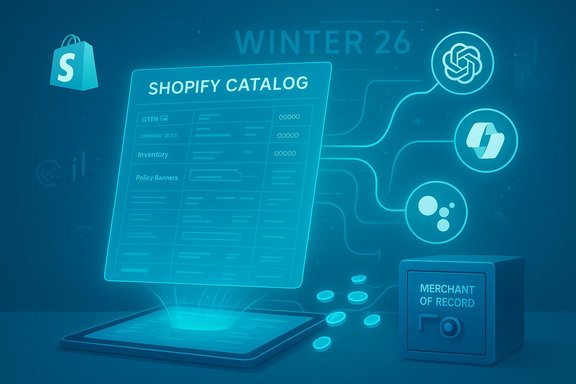
At the product layer, Shopify introduced Agentic Storefronts, a syndication layer that converts a merchant’s catalog into structured, canonical records that conversational AIs can query reliably. The Shopify Catalog is designed to deduplicate SKUs, infer categories and normalize attributes (size, color, materials, GTINs, images, live inventory and shipping windows), while merchant‑managed policy and FAQ content is exposed to agents so responses remain brand‑consistent. This is pitched as a configure once, distribute everywhere model to avoid merchants building bespoke integrations for each assistant.Key practical capabilities:
- A canonical, machine‑readable catalog feed per merchant for agent ingestion.
- Channel toggles so merchants can choose which assistants may access their storefronts.
- Knowledge base and policy exposure to reduce hallucinations and enforce brand tone.
- Deduplication and variant clustering to improve result quality inside agent responses.
Checkout Kit, Universal Cart and Tokenized Payments
Shopify’s checkout primitives are central to the value proposition. The company offers a Checkout Kit and universal cart semantics so agents can create or hand off carts and then initiate payments using scoped, short‑lived tokens — a pattern already piloted by OpenAI’s Instant Checkout. Tokenized payments let agents trigger purchases without ever handling raw card data, creating an auditable trail and a pathway for dispute resolution while allowing the merchant to remain the merchant of record. This tokenization is the security backbone of in‑chat commerce.Sidekick, Flow and Merchant Productivity Tools
Shopify also upgraded Sidekick, its merchant‑facing assistant, and bundled merchant productivity features (prompt‑driven app scaffolding, automations via Shopify Flow, and proactive “Pulse” recommendations). These tools are meant to lower the operational cost for merchants to become agent‑ready by automating catalog hygiene tasks and surfacing high‑impact fixes. The upgrades are presented as complementing the outward‑facing distribution play by reducing the friction of participation.Why this matters: the business and technical logic
From search to agents: a change in discovery
Conversational agents ask clarifying questions, apply constraints and return tightly ranked options — a UX that shortens the funnel from intent to purchase. When paired with canonical product metadata and tokenized payments, that flow can convert more efficiently than traditional link‑based discovery because it reduces friction in the comparison and checkout steps. Shopify argues that having every merchant present in agent answers at scale translates into a meaningful distribution advantage if agents become primary research surfaces.Platform leverage: payments, scale and distribution
Shopify’s existing payments footprint (Shop Pay, Shopify Payments) and massive merchant base are the company’s levers. When checkouts originating from agents route through Shop Pay or tokenized rails, Shopify benefits from payment processing revenue, higher conversion rates from frictionless flows, and richer attribution signals to refine recommendation models. The combination of catalog control plus checkout rails is what Shopify frames as its durable competitive advantage in agentic commerce.Standards and protocols: ACP, AP2 and the open ecosystem
The industry is converging on protocol‑style approaches: agents request canonical product metadata, create or request ephemeral checkout sessions via payment partners, and hand off orders while preserving auditable provenance. OpenAI’s Instant Checkout and the Agentic Commerce Protocol (ACP) are prominent early designs; Google and Microsoft are pursuing similar agent‑payments primitives (Google’s AP2 and Microsoft’s contributions to the space). These competing but overlapping standards aim to make agentic flows interoperable across assistants and merchants.Verification and what is (and isn’t) independently verifiable
Shopify has publicly stated high‑level adoption and growth signals — for example, management reported a multi‑fold increase in AI‑driven traffic and orders (figures such as ~7× traffic and ~11× orders were cited in investor commentary). Those multipliers are company‑reported and are directional; they are not GAAP metrics and depend heavily on internal attribution definitions and baselines. Treat these numbers as meaningful signals of momentum rather than independently audited facts.Technical claims about product features — canonical catalog feeds, checkout tokenization, agentic storefront toggles, and Sidekick upgrades — are corroborated across Shopify product posts and multiple independent write‑ups that summarize the Winter ’26 edition. The presence of OpenAI’s Instant Checkout pilots and Microsoft’s Copilot Checkout confirms the pattern is being piloted in the wild, but commercial terms, fee schedules and visibility algorithms for how agents rank merchants remain asymmetric and largely controlled by each assistant provider. Those details will materially affect merchant economics and should be verified against partner documentation and merchant agreements during onboarding.
If a claim in press coverage is not accompanied by a clear protocol spec, contract clause or independent audit, treat it as a product‑level assertion that requires merchant due diligence before relying on it for revenue forecasts or security guarantees. Several briefings explicitly note that enrollment models and default opt‑in/opt‑out flows differ by partner — Microsoft, for example, has described an opt‑out enrollment window for Shopify merchants in some activations — which raises operational questions for merchant consent and control.
Strengths — what Shopify brings to agentic commerce
- Scale of sellers and SKUs: Shopify’s merchant base and aggregate product signals provide a dataset that makes canonicalization feasible at scale; that data is valuable for agents and protocol designers.
- Integrated payments: Shop Pay and existing tokenization partners like Stripe and PayPal give Shopify a ready path to capture transaction revenue and provide the secure rails agents require.
- Developer and merchant tooling: Sidekick, Flow integrations, and catalog APIs aim to lower the barrier for merchants to prepare high‑fidelity metadata and implement opt‑in toggles. This reduces the engineering cost of being agent‑ready.
- Neutral plumbing play: A single syndication layer is attractive to merchants who want broad reach without building one integration per assistant — if Shopify executes as advertised, it can save merchants time and cost while centralizing control.
Risks and weaknesses — where caution is warranted
Vendor lock‑in and dependency on assistant platforms
The economic value of agentic distribution depends on how assistants rank products and how they share fees or attribution with merchants. If assistants favor certain payment rails or present products with their own monetization overlays, merchant economics could be squeezed. The concentration of discovery power in a few assistants raises classic platform governance risks.Privacy, data sharing and regulatory scrutiny
Exposing machine‑readable catalogs and merchant policies to multiple agents increases the surface for data leakage or misuse (e.g., scraped content repurposed without consent). Regulatory attention — especially on consumer protection and payments routing — is likely to follow as agentic flows scale. Merchants should anticipate compliance work and new disclosure requirements when agents collect user signals and initiate tokenized payments.Fraud, disputes and the new attack surface
Agentic automation creates new fraud vectors: automated purchases, credential reuse across tokenization schemes, and complex dispute trails when an agent mediates the conversation. Tokenization reduces raw credential exposure but does not remove fraud risk; payments networks and issuers will need to extend fraud models to account for agent behavior. Merchants must expect refined fraud prevention tooling and stronger chargeback investigation workflows.Attribution ambiguity and commercial terms
Shopify’s reported growth multipliers are directional signals, but how much revenue ultimately accrues to merchants vs. platforms depends on commercial contracts, fee splits on instant checkouts and visibility algorithms. These terms remain partially opaque in early pilots and will materially affect merchant ROI from agentic channels.Operational readiness and metadata hygiene
The push to canonicalized metadata is necessary but nontrivial. Many merchants lack GTINs, consistent SKUs, or accurate shipping windows. Poor catalog hygiene will make products invisible to agents or produce bad CX (wrong sizes, wrong inventory), which harms conversion and brand reputation. Shopify’s tooling helps, but the human and process work is the critical path.Practical checklist for merchants and IT teams
- Audit and normalize product metadata
- Ensure GTINs/UPC/EAN where applicable, canonical SKUs, accurate dimensions and up‑to‑date inventory signals.
- Create clear, machine‑readable policy pages and FAQs for return windows, shipping and warranty claims.
- Test tokenized checkout flows in staging
- Work with Shop Pay, Stripe or PayPal test tokens to verify fulfillment, attribution and refund workflows.
- Simulate agent‑initiated purchases to validate order mapping in your ERP and fulfillment systems.
- Review commercial terms and opt‑in/opt‑out policies
- Read partner enrollment notices carefully (some activations will auto‑enroll merchants with opt‑out windows).
- Negotiate or clarify fee schedules for agent‑originated purchases and the attribution reporting you will receive.
- Harden fraud and dispute controls
- Extend fraud rules to account for tokenized sessions and unusual agent‑origin patterns.
- Confirm chargeback and dispute handling where an agent mediates the buyer experience.
- Operationalize provenance and analytics
- Ensure your admin receives clear attribution traces from agentic flows for lifetime value tracking and marketing optimization.
- Build dashboards that separate agentic traffic from regular channels for robust ROI analysis.
- Plan phased rollouts, not big bangs
- Start with a subset of SKUs and measure conversion, return rates and dispute rates.
- Use A/B tests and the new rollout tooling to limit exposure during experimentation.
Strategic questions for merchants and platform teams
- How much value will agentic channels add versus the cost of compliance, catalog cleanup and potential fee sharing?
- Which assistants provide the best buyer match for your products and brand — and what controls exist to preserve brand voice and policy visibility?
- Will you accept default enrollment or require explicit opt‑in for each partner? How will you handle cross‑platform opt‑outs?
- How will you reconcile customer relationship ownership when an agent-owned UI mediates post‑purchase support and returns?
The regulatory, competitive and market landscape
Agentic commerce accelerates conversations already happening among networks, processors and platforms about token standards, provenance and consumer protection. Payments partners (Stripe, PayPal, card networks) are rapidly building supporting tooling, and platform players (Microsoft, OpenAI, Google) are experimenting with checkout experiences that keep the user inside the assistant. This fast cadence raises competition and privacy questions that regulators are likely to examine — for example, whether assistants act as gatekeepers that can steer traffic or impose fee structures that disadvantage independent merchants. Early merchant backlash to certain aggregation models elsewhere in the market (where platforms re‑listed merchants without consent) is a cautionary tale: consent and control matter and may attract policy scrutiny.Bottom line: a pragmatic take for WindowsForum readers
Shopify’s Agentic Storefronts and the broader agentic commerce thesis represent an ambitious, plausible architecture for the next phase of e‑commerce: make product data machine‑readable at scale, give agents secure ways to complete purchases, and funnel orders back into merchant systems with attribution. For IT teams and merchants, the opportunity is real — lower friction in discovery and conversion can lift revenue — but the execution bar is operationally high. Catalog hygiene, checkout testing, fraud mitigation and careful contract review are nonnegotiable.This architecture also concentrates power: assistants and payments partners will significantly shape visibility and economics. That makes governance, monitoring and staged experimentation essential. Merchants should prepare, test and measure before relying on agentic channels for material revenue growth. The technical plumbing exists and pilots are underway, but substantial commercial, regulatory and operational questions remain unresolved and deserve cautious attention as agentic shopping moves from demo to daily reality.
If adopted thoughtfully, agentic commerce could reduce friction and create new buyer journeys; if adopted without governance, it could create new dependency, privacy and fraud risks. The distinguishing factor will be who controls the metadata, the tokenized rails and the attribution: in this race, Shopify has placed a large bet to become that plumbing — a bet that merchants, platforms and regulators will together test and refine over the months ahead.
Source: The Globe and Mail Shopify embraces agentic AI with Google, Microsoft partnerships
Source: The Logic Shopify makes a play to set the standard for AI shopping - The Logic
