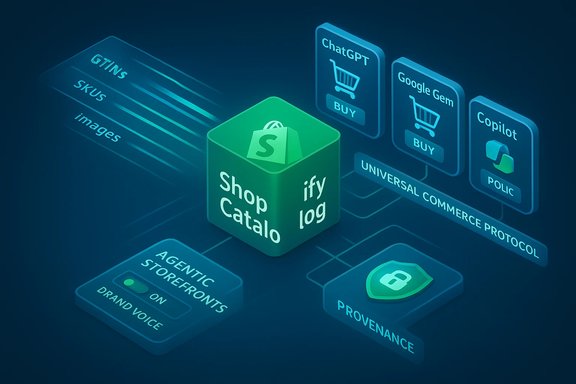
Shopify’s move to put commerce directly inside AI conversations is more than a marketing line — it’s an architectural bet that the next major retail surface will be agentic, not merely browser-based, and that merchants need a unified plumbing layer to survive and thrive when assistants can buy on users’ behalf.
The core announcement is twofold: an open interoperability specification called the Universal Commerce Protocol (UCP), co-developed with Google, and a set of product changes on Shopify’s side — notably Agentic Storefronts, an expanded Shopify Catalog, and a commercial plan that lets non-Shopify merchants participate in agent-driven channels. Those moves are intended to let conversational AIs discover products, build carts, apply rules (discounts, loyalty, subscriptions) and complete delegated checkouts without each merchant wiring bespoke integrations to every assistant.
This development accelerates a shift that already had momentum: experiments in in‑chat checkout (OpenAI’s Instant Checkout, early Copilot pilots and platform-level tests) are converging on common technical patterns — canonical product feeds, tokenized/delegated payments, and auditable provenance — and UCP is meant to codify those patterns so agents and merchants can interoperate at scale.
Why it matters: incorrect availability or price presented by an assistant leads directly to failed orders and disputes. Shopify’s catalog enrichment and deduplication aim to reduce that risk.
Why it matters: token semantics — scope, expiry, amount limits and merchant scoping — determine how secure and auditable an in‑chat purchase can be. PSPs (Stripe, PayPal, Shopify Payments) are central to the model.
Strengths of the move are clear: interoperability, reduced integration cost, and faster time to presence inside high‑intent moments. Material risks are equally clear: data quality, fraud, opt‑out governance, exposure to platform economics and an uncertain regulatory landscape. The sensible merchant strategy is not wholesale adoption or reflexive rejection; it is measured piloting with rigorous instrumentation, contractual clarity and an insistence on auditability and provenance.
Agentic commerce is now stepping out of labs and demos and into standards and pilots. For merchants and marketing teams, UCP is not a hypothetical future — it’s a practical set of tradeoffs to evaluate now. The merchants who treat catalog hygiene, token testing and dispute‑readiness as strategic investments will have an advantage when conversational assistants become the place where purchase intent meets execution.
Source: MarTech https://martech.org/shopify-wants-to-put-commerce-inside-every-ai-conversation/
 Overview
The core announcement is twofold: an open interoperability specification called the Universal Commerce Protocol (UCP), co-developed with Google, and a set of product changes on Shopify’s side — notably Agentic Storefronts, an expanded Shopify Catalog, and a commercial plan that lets non-Shopify merchants participate in agent-driven channels. Those moves are intended to let conversational AIs discover products, build carts, apply rules (discounts, loyalty, subscriptions) and complete delegated checkouts without each merchant wiring bespoke integrations to every assistant.This development accelerates a shift that already had momentum: experiments in in‑chat checkout (OpenAI’s Instant Checkout, early Copilot pilots and platform-level tests) are converging on common technical patterns — canonical product feeds, tokenized/delegated payments, and auditable provenance — and UCP is meant to codify those patterns so agents and merchants can interoperate at scale.
Background: why a protocol matters
Conversational assistants behave differently from browsers. They synthesize knowledge, ask clarifying questions, and — increasingly — take actions for users. That changes the failure modes and incentives for commerce:- Agents must avoid hallucinating product attributes or availability; they need canonical, machine‑readable product records.
- Checkouts must preserve security and disputeability; assistants cannot touch raw card data.
- Merchants need control of offers, pricing rules and fulfillment so the agent’s action doesn’t break contracts or returns flows.
What Shopify actually announced
Universal Commerce Protocol (UCP)
UCP is presented as an open, transport‑agnostic specification for agent-to-merchant commerce interactions. It covers:- Canonical product representation (variants, GTINs, images, shipping windows, return rules).
- Cart lifecycle messages (create, update, validate, confirm).
- Delegated payment sessions / short‑lived tokens.
- Provenance metadata and audit trails to link agent recommendations to orders.
Agentic Storefronts and the Shopify Catalog
Agentic Storefronts convert a merchant’s product feed into a normalized, machine‑readable Shopify Catalog record. Core goals:- Deduplicate SKUs and cluster variants.
- Infer missing attributes and enrich product data for search/ranking.
- Expose brand voice, policies and FAQ content to agents to reduce hallucinations.
- Provide channel toggles and attribution reporting inside Shopify Admin.
Native platform integrations
- Google: Gemini and AI Mode in Search will surface native checkout experiences via UCP; Google has also piloted Direct Offers, letting brands surface moment‑of‑intent discounts inside AI conversations.
- Microsoft: Copilot Checkout embeds a branded checkout widget inside Copilot, using delegated tokens and partner PSPs (PayPal, Stripe, Shopify) to complete settlement; Shopify merchants will be automatically enrolled unless they opt out.
- OpenAI/ChatGPT: earlier experiments (Instant Checkout) and partner pilots demonstrate the same pattern: agents obtain scoped checkout tokens from PSPs, allowing assistants to trigger payments without holding raw credentials.
Technical anatomy: the three primitives that must work
To make agentic commerce reliable, three technical primitives are essential — and each brings its own operational requirements.1) Canonical, machine‑readable catalogs
Products must expose structured metadata that agents can trust at the point of decision. That means high‑quality SKUs, GTINs, images, inventory and shipping windows, plus policy and warranty text that agents can quote.Why it matters: incorrect availability or price presented by an assistant leads directly to failed orders and disputes. Shopify’s catalog enrichment and deduplication aim to reduce that risk.
2) Delegated, tokenized payments
Tokenization is the security backbone: agents request a short‑lived payment token (or delegated checkout session) from a PSP; the PSP and merchant finalize settlement and run fraud checks. This keeps PCI exposure away from conversational surfaces while preserving an auditable flow for chargebacks.Why it matters: token semantics — scope, expiry, amount limits and merchant scoping — determine how secure and auditable an in‑chat purchase can be. PSPs (Stripe, PayPal, Shopify Payments) are central to the model.
3) Conversational orchestration and provenance
Agents need to link each recommendation and step to the canonical catalog entry and persist an auditable trail: what was shown, which discounts were applied, what clarifying questions were asked, and which token created the settlement. Provenance is essential for dispute resolution and regulatory compliance. Microsoft and other platform partners explicitly require provenance logs in their implementations.Why marketers and merchants should care
Agentic commerce changes the funnel in three predictable ways:- Reduced friction: collapsing discovery and checkout into a single conversational flow can reduce drop‑off from redirect and context switching.
- New placement and attribution: assistants can surface direct offers and exclusive, in‑moment promotions; attribution flows back to merchants’ admin for analytics.
- Reach without rebuild: the promise of “configure once, distribute everywhere” reduces engineering cost for merchants who want to appear in multiple assistants.
Risks, operational challenges and governance
The technical elegance of UCP masks several hard operational and commercial problems merchants and platforms must solve.Data hygiene and coverage
Poor product metadata produces failures. Smaller merchants with thin catalogs or inconsistent SKUs will either be invisible to agents or contribute disproportionally to failed orders and disputes. Catalog enrichment helps, but the operational lift is non‑trivial.Fraud and velocity exploitation
Agents can assemble and execute many micro‑checkouts quickly. Tokenization reduces exposure, but PSPs, merchants and platforms must adapt anti‑fraud controls to this new pattern. Without strict velocity limits and fraud scoring tuned for agentic flows, attackers could exploit rapid automation.Liability, chargebacks and merchant of record complexity
Being “merchant of record” in principle does not eliminate complex cross‑platform liability questions. Contracts and SLAs will determine who bears fraud losses, how refunds are processed, and how disputed descriptions are reconciled. Merchants must insist on explicit terms covering chargeback workflows, settlement windows, and responsibility boundaries with Shopify and other platform partners.Opt‑in vs automatic enrollment
Shopify’s strategy to accelerate coverage includes automatic enrollment with opt‑out windows for Shopify merchants into some partner checkouts. That model scales fast but can surprise merchants who weren’t prepared for how their offers and loyalty programs behave inside agentic flows. Merchants must monitor default settings and available toggles closely.Economic exposure and discoverability economics
Whoever controls the default assistant experience can extract fees or visibility rules. Agents that become primary purchase surfaces will also become valuable ad real estate; merchants should expect evolving economics around placement priority, featured offers and visibility — all of which can compress margins if not negotiated.Regulatory and disclosure risks
Regulators are still defining how AI recommendations, sponsored placements, and in‑chat advertising must be disclosed. Transparency requirements — about whether a recommendation is sponsored and how agentic decisions were made — will likely tighten. Merchants and platforms must prepare for emerging disclosure regimes.Practical implementation checklist for merchants (operational steps)
- Audit your catalog and SKU hygiene: ensure GTINs, images, inventory, weight/dimensions, and return policies are accurate and machine‑readable.
- Run narrow pilots: start with simple SKUs (single‑variant, well‑described items) before expanding to complex or configurable products.
- Instrument provenance and attribution: demand timestamped logs that map agent answers and UI state to your canonical SKU and the checkout token used.
- Test tokenized payment flows: validate token expiry, scope, and refund handling with your PSP (Shopify Payments, Stripe, PayPal).
- Negotiate commercial terms: confirm fee structures for agentic placements, opt‑out mechanics, and SLAs for dispute handling and refunds.
- Harden fraud controls: work with your PSP to set velocity limits and updated fraud rules tailored to agent-driven patterns.
- Update customer support and returns scripts: make the post‑purchase path explicit for agentic purchases (who handles returns, warranty claims, timelines).
- Execute controlled A/B tests: measure conversion lift, average order value, return rate, and dispute incidence versus your baseline. Treat vendor claims as directional until validated.
Payments, security and dispute mechanics explained
- Token semantics: Unified token models must specify the token’s issuer (PSP), scope (merchant id, amount range), expiry and audit trail. Short‑lived tokens with tight scoping minimize misuse risk.
- PSP responsibilities: The PSP executes settlement, fraud checks, and chargeback management. Platforms and assistants orchestrate the UI and token request lifecycle.
- Merchant of record: When merchants are merchant of record, they retain responsibility for tax, fulfillment, refunds and chargebacks, even if the agent initiated the checkout. Contractual clarity is critical.
Strategic implications: who wins and who risks losing
- Shopify: Positions itself as the commerce layer — the syndicator of canonical product data — and benefits if UCP becomes the de facto protocol. Its Agentic plan for non‑Shopify merchants extends this influence.
- Platforms (Google, Microsoft, OpenAI): Each platform wants to own the discovery-to-purchase surface. UCP lets them interoperate with merchants without bespoke per-merchant engineering, but platforms will still control placement economics and UX.
- PSPs (Stripe, PayPal, Shopify Payments): PSPs that support delegated token models and robust fraud tooling become critical infrastructure and will capture transaction revenue and risk management fees.
- Large merchants: Early adopters gain preferential visibility and pilot learning; smaller merchants risk being aggregated unless they proactively prepare their data and negotiate terms.
What to watch next (near term signals)
- Merchant participation rates and opt‑out behavior: high opt‑out rates will indicate merchant distrust or poor default mechanics. Low opt‑out indicates rapid scale but raises governance questions.
- Independent performance studies: conversion, return/dispute rates, and lifetime value comparisons from neutral third parties will be necessary to validate vendor claims. Vendor-supplied multipliers are directional signals, not definitive proof.
- PSP and card network support: how token semantics, chargeback rules and settlement windows are standardized across card networks will influence fraud and reconciliation costs.
- Regulatory guidance: disclosure requirements for AI recommendations, advertising classification inside agents, and consumer protections for agent‑initiated purchases will shape acceptable practices.
Strategic recommendations for marketing and IT leaders
- Treat agentic commerce as a new channel with distinct SLOs: conversion, dispute rate and fulfillment accuracy must be monitored separately from web channel metrics.
- Prioritize catalog hygiene as a competitive advantage: accurate metadata is the price of admission to agentic surfaces.
- Negotiate clear commercial terms before enabling in‑chat offers: get written clarity on fees, visibility rules and dispute workflows.
- Design UX disclosures for trust: make it explicit who the merchant is, who handles returns, and how offers and loyalty are applied inside the assistant UI.
- Build provenance and audit logging into your incident playbook: your ability to reconstruct the user experience will be essential for refunds and regulatory auditability.
Final appraisal
UCP and Shopify’s Agentic Storefronts are pragmatic responses to an imminent structural change in retail: when assistants become purchase-capable surfaces, merchants cannot realistically build bespoke integrations to every agent. The standardization of cart semantics, delegated payments, and canonical catalogs reduces engineering overhead and promises to make in‑chat commerce broadly accessible — but the value will only materialize if execution tackles the hard operational, security and legal questions.Strengths of the move are clear: interoperability, reduced integration cost, and faster time to presence inside high‑intent moments. Material risks are equally clear: data quality, fraud, opt‑out governance, exposure to platform economics and an uncertain regulatory landscape. The sensible merchant strategy is not wholesale adoption or reflexive rejection; it is measured piloting with rigorous instrumentation, contractual clarity and an insistence on auditability and provenance.
Agentic commerce is now stepping out of labs and demos and into standards and pilots. For merchants and marketing teams, UCP is not a hypothetical future — it’s a practical set of tradeoffs to evaluate now. The merchants who treat catalog hygiene, token testing and dispute‑readiness as strategic investments will have an advantage when conversational assistants become the place where purchase intent meets execution.
Source: MarTech https://martech.org/shopify-wants-to-put-commerce-inside-every-ai-conversation/