

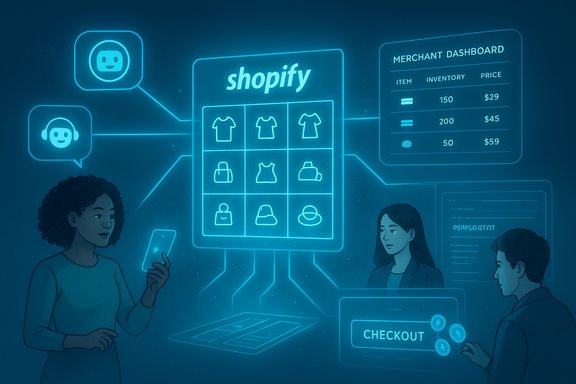
Shopify’s Winter ’26 rollout moves AI product discovery from experiment to operational plumbing by letting merchants publish structured product data that generative AI assistants can read — and by enabling shoppers to complete purchases inside chat interfaces such as ChatGPT, Perplexity, and Microsoft Copilot.
Shopify’s Winter ’26 Edition bundles more than 150 updates but places Agentic Storefronts at the center of a strategic shift: treat conversational AI as a first‑class discovery and commerce surface. The company describes Agentic Storefronts as a “configure once, distribute everywhere” model that turns existing product catalogs into machine‑readable, agent-friendly feeds that plug into multiple AI platforms.
The feature set is designed to do three tightly coupled things: publish canonical product metadata and merchant policies, expose live pricing and inventory to assistants, and support tokenized or delegated checkout primitives so agents can complete purchases without breaking the merchant‑of‑record relationship. Those building blocks are familiar in principle — product feeds, APIs, and tokenized payments — but they are now being stitched together specifically for agentic commerce.
Early signs show these interactions convert well: Shopify has reported substantial relative increases in AI-originated traffic and orders, and platforms such as OpenAI have already piloted in‑chat checkout experiences (Instant Checkout). Those movements create a compelling path from intent to purchase that can materially shorten conversion funnels.
That said, the most consequential changes are not technological novelty but systemic: discovery shifts from ranking pages to being included in AI answers, and product feeds evolve into structured feeds purpose‑built for generative agents. The result is new optimization disciplines — from SEO to Answer Engine Optimization (AEO) and Generative Engine Optimization (GEO) — and new ad surfaces inside AI chats.
Strategically, the important axis is payments and data. Shopify’s Shop Pay and tokenization strategy gives it leverage if in‑chat purchases route through its payment rails. Other players (payment processors, marketplaces, and native platform assistants) are likely to respond with competing primitives and commercial models.
The opportunity is real: shorter funnels, broader discovery, and new conversion pathways can materially help merchants that invest in data hygiene and fulfillment readiness. The risks are equally real: attribution opacity, gatekeeper economics, operational strain, and new fraud vectors require defensive planning and careful measurement. Shopify’s reported multipliers for AI traffic and orders are promising but should be read with caution until independently auditable definitions and baselines are available.
For merchants, the actionable path is clear: clean your catalog, test selectively, instrument analytics, and preserve owned channels while exploring agentic revenues. For the broader ecommerce ecosystem, Agentic Storefronts marks the moment when AI product discovery stops being a novelty and becomes a distributed, monetizable channel — one that will reward operational rigor, data accuracy, and smart commercial negotiation.
Source: Practical Ecommerce Shopify Integrates AI Product Discovery
 Background
Shopify’s Winter ’26 Edition bundles more than 150 updates but places Agentic Storefronts at the center of a strategic shift: treat conversational AI as a first‑class discovery and commerce surface. The company describes Agentic Storefronts as a “configure once, distribute everywhere” model that turns existing product catalogs into machine‑readable, agent-friendly feeds that plug into multiple AI platforms.The feature set is designed to do three tightly coupled things: publish canonical product metadata and merchant policies, expose live pricing and inventory to assistants, and support tokenized or delegated checkout primitives so agents can complete purchases without breaking the merchant‑of‑record relationship. Those building blocks are familiar in principle — product feeds, APIs, and tokenized payments — but they are now being stitched together specifically for agentic commerce.
What Shopify shipped: Agentic Storefronts in plain terms
At a practical level, Agentic Storefronts offers merchants:- A standardized Shopify Catalog that normalizes attributes, variants, GTINs, images, descriptions, and policies so AI agents can reliably interpret product data.
- Channel toggles so merchants can opt into which AI assistants may surface their products (Shopify initially names ChatGPT/OpenAI, Perplexity, and Microsoft Copilot among the endpoints).
- Checkout integration via Checkout Kit and universal cart tokens so an assistant can hand off, embed, or complete a checkout while keeping Shopify as the merchant of record and returning order details to the merchant admin.
Why this matters: the rise of agentic commerce
Agentic commerce is the term for flows where an AI agent performs discovery, comparison, and checkout steps on behalf of a shopper. Instead of surfacing links, the agent provides focused recommendations, answers follow‑ups, and — when permitted — initiates a tokenized express checkout inside the conversation.Early signs show these interactions convert well: Shopify has reported substantial relative increases in AI-originated traffic and orders, and platforms such as OpenAI have already piloted in‑chat checkout experiences (Instant Checkout). Those movements create a compelling path from intent to purchase that can materially shorten conversion funnels.
That said, the most consequential changes are not technological novelty but systemic: discovery shifts from ranking pages to being included in AI answers, and product feeds evolve into structured feeds purpose‑built for generative agents. The result is new optimization disciplines — from SEO to Answer Engine Optimization (AEO) and Generative Engine Optimization (GEO) — and new ad surfaces inside AI chats.
Technical anatomy: the plumbing behind Agentic Storefronts
1. Canonicalized, machine‑readable product data
The single most important requirement for reliable agentic commerce is high‑fidelity, structured product data: accurate SKUs, dimensions, availability windows, shipping rules, return policies, and canonical variant records. Shopify Catalog aims to create that canonicalization at scale so assistants avoid hallucinating features or serving stale listings.2. Tokenized and delegated checkout primitives
In‑chat purchases rely on short‑lived tokens and delegated payment sessions so agents can initiate payments without the merchant exposing raw payment credentials. This tokenization is the safety and auditability backbone of agentic checkout flows and is already a pattern in OpenAI’s Instant Checkout pilots.3. Orchestration, provenance, and attribution
A usable agentic commerce stack must tie the conversation to an auditable chain of actions: which prompts and constraints produced the recommendation, which product record was selected, and how the checkout was authorized and completed. Shopify’s approach embeds attribution metadata so merchants can see order origins and preserve first‑party capture.4. Performance and developer primitives
Making product search and checkout available to third‑party agents requires low latency, robust APIs, and consistent developer primitives (Catalog APIs, Checkout Kit, universal cart semantics). Shopify’s Winter ’26 developer notes emphasize server‑side performance improvements to handle agent queries at scale.Discovery shifts: from SEO and product feeds to AEO and GEO
For three decades merchants optimized for organic search, paid search, and product feeds. Agentic commerce keeps many of the same principles — accuracy, relevance, and speed — but recasts them for conversational contexts.- Organic discovery → AEO/GEO: Visibility becomes inclusion in an assistant’s recommended answer rather than a high SERP ranking. Structured answers and clear product context matter more than link‑centric page signals.
- Product feeds → Agentic feeds: Instead of only producing Google Merchant Center-style feeds, merchants must provide catalog records that AI agents can query and reason over. Shopify’s Catalog is intended to be that canonical feed.
- Paid placements → In‑chat advertisements: Expect paid placements and ad‑like affordances inside AI responses; ad buying will pivot from keyword auctions to buying intent and conversational context.
Advertising and monetization: why ads still matter
Advertising remains the most predictable way to generate traffic and sales. Shopify’s move doesn’t eliminate ads; it creates new ad surfaces inside generative assistants. Ecommerce marketers will adapt by:- Learning how to bid or buy placements inside AI chats and assistant recommendation flows.
- Measuring intent signals differently — focusing on conversational context and prompt intent.
- Maintaining diversified acquisition channels because gatekeeper power can concentrate quickly.
Benefits for merchants — and why small sellers matter
Agentic Storefronts deliberately lowers the engineering bar for small merchants by offering a single setup that syndicates their catalog across multiple AI agents. Practical benefits include:- Expanded discovery without bespoke integrations: merchants can appear in AI chats without building agent‑specific connectors.
- Conversion improvements: shorter funnels and tokenized checkouts can reduce abandonment and increase conversion velocity when done correctly.
- Operational productivity: Sidekick and automation tools in Winter ’26 help merchants keep content and metadata in shape, which is essential for agentic visibility.
Risks, tradeoffs, and unresolved questions
Agentic Storefronts is powerful, but the rollout also crystallizes several material risks and open issues merchants should plan for.Attribution and measurement ambiguity
Shopify has reported very large relative increases in AI‑sourced traffic and orders (figures such as “AI traffic up ~7×” and “AI‑attributed orders up ~11×” have been quoted in public commentary), but those are company‑provided telemetry and depend heavily on definitions, baselines, and attribution windows. Treat those multipliers as directional and verify them against your own analytics before assuming similar growth.Gatekeeper power and platform economics
If a few assistants become dominant discovery surfaces, they acquire outsized leverage over visibility and payments. That can shrink merchant margins through fees or opaque ranking rules. Shopify’s hope is to preserve merchants as merchant of record, but commercial terms and fee models for in‑chat placements will be a key battleground.Operational strain and fulfillment risk
Agentic commerce rewards accurate, real‑time inventory and reliable fulfillment. Smaller merchants with manual inventory processes may face order cancellations and higher chargebacks if AI‑driven demand spikes beyond their operational capacity. Shopify’s Product Network and SimGym are designed to help merchants simulate and prepare, but the risk remains real.Fraud, disputes, and new vectors
Conversational checkouts introduce new fraud vectors — social engineering during confirmation steps, token misuse, and disputes tied to ambiguous conversational context. Tokenization mitigates exposure but does not eliminate dispute complexity. Merchants will need updated fraud rules and reconciliation workflows for agent-originated orders.Data sharing and privacy concerns
Agentic interactions mean richer signals flow between merchants, Shopify, and third‑party assistants. That raises privacy, consent, and regulatory questions, especially in jurisdictions with strict data handling rules. Clear disclosure, opt‑in controls, and governance controls will be important.Competitive and platform landscape
Shopify is positioning Agentic Storefronts as a multi‑platform syndication layer that plugs into several major assistants. The public rollout names ChatGPT/OpenAI, Perplexity, and Microsoft Copilot as initial endpoints, and other platforms (including Google’s generative search work) are building adjacent capabilities. That multi‑partner approach recognizes that agentic commerce will be multi‑platform in the near term.Strategically, the important axis is payments and data. Shopify’s Shop Pay and tokenization strategy gives it leverage if in‑chat purchases route through its payment rails. Other players (payment processors, marketplaces, and native platform assistants) are likely to respond with competing primitives and commercial models.
Practical checklist: What merchants should do now
- Audit and clean product metadata
- Ensure accurate SKUs, GTINs, dimensions, images, and variant canonicalization. Agents need clean data to match user queries reliably.
- Publish clear shipping, returns, and FAQ content
- Agents surface policies; make sure policies reduce friction and set correct expectations.
- Enable real‑time inventory and fulfillment signals
- Tokenized checkouts only work if inventory is accurate; connect systems or set conservative buffers.
- Opt into Agentic Storefronts selectively and test volumes
- Start with lower‑risk SKUs and closely monitor cancellation and dispute metrics. Use SimGym to simulate shopper behavior if available.
- Update fraud and reconciliation processes
- Add rules for agent‑originated sessions and ensure tokens are auditable.
- Maintain owned channels and diversify acquisition
- Continue investing in email lists, apps, and SEO to avoid over‑reliance on any single assistant.
- Track attribution carefully and verify Shopify metrics against your analytics
- Compare internal conversion metrics and test whether AI referrals convert differently for your catalog.
Policy and governance considerations
Agentic commerce sharpens long‑running debates about algorithmic transparency, ad disclosure, and data use. Regulators and industry organizations will be watching for:- How assistants disclose sponsored placements or merchant compensation inside answers.
- How provenance and audit trails are maintained for agentic recommendations.
- Whether tokenization and payment flows meet financial regulator standards for attribution and dispute handling.
Conclusion: a pragmatic, high‑impact transition
Shopify’s Agentic Storefronts converts a conceptual trend — conversation‑first commerce — into merchant‑ready plumbing that can scale across millions of storefronts. By exposing standardized product metadata, live inventory, and tokenized checkout primitives to multiple AI platforms, Shopify is lowering the bar for merchants to appear and sell inside chat assistants.The opportunity is real: shorter funnels, broader discovery, and new conversion pathways can materially help merchants that invest in data hygiene and fulfillment readiness. The risks are equally real: attribution opacity, gatekeeper economics, operational strain, and new fraud vectors require defensive planning and careful measurement. Shopify’s reported multipliers for AI traffic and orders are promising but should be read with caution until independently auditable definitions and baselines are available.
For merchants, the actionable path is clear: clean your catalog, test selectively, instrument analytics, and preserve owned channels while exploring agentic revenues. For the broader ecommerce ecosystem, Agentic Storefronts marks the moment when AI product discovery stops being a novelty and becomes a distributed, monetizable channel — one that will reward operational rigor, data accuracy, and smart commercial negotiation.
Source: Practical Ecommerce Shopify Integrates AI Product Discovery
