Shopify’s Winter ’26 roll‑out makes AI-driven commerce not just a feature but an operating model — Agentic Storefronts, the expanded Shopify Catalog, and a suite of merchant tools knit product discovery, attribution, and in‑chat checkout into a single commerce ecosystem that could materially alter how merchants find customers and how investors value Shopify.
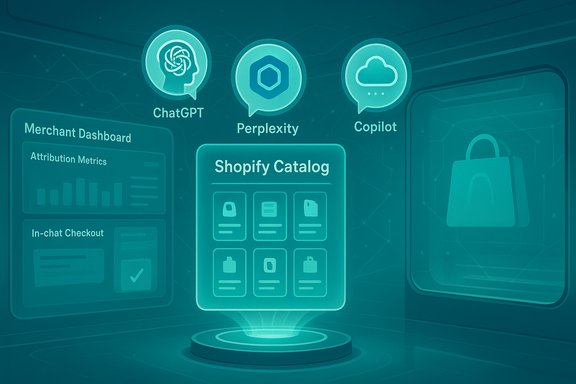
Shopify’s Winter ’26 Edition is a broad release that the company frames as a move from AI experiments to production‑grade commerce capabilities across merchant operations. The package includes more than 150 updates, ranging from store‑building AI assistants and new theme tooling to the headline feature, Agentic Storefronts, which syndicates merchant catalogs directly into AI chat platforms such as ChatGPT, Perplexity, and Microsoft Copilot. The company says merchants can set up once and have their products discoverable and purchasable inside multiple AI conversations while retaining the merchant‑of‑record relationship and checkout control. Those changes matter because several AI platforms are already experimenting with commerce flows that keep customers inside conversational interfaces. Shopify’s product play is to standardize how product metadata, availability, pricing, and policies are presented to agents so AI discovery surfaces the right item and routes the purchase back through Shopify checkout. The company also points to internal and merchant metrics indicating meaningful AI engagement: management has reported multi‑fold increases in AI‑driven traffic and orders year‑to‑date, which Shopify frames as an early signal of agentic commerce traction. This article explains exactly what Shopify shipped, evaluates the business and investment implications, cross‑checks the main claims against independent reporting and earnings commentary, and highlights the risks that could blunt upside for merchants and shareholders alike.
If the Catalog and metadata tooling deliver consistent results across millions of SKUs, Shopify would be less dependent on referral traffic and more likely to be the default supplier of reliable commerce data for agentic platforms. That represents a non‑trivial competitive advantage that’s hard for spot players to replicate quickly.
This virtuous loop is the growth narrative underpinning optimistic analyst models: aggregate adoption plus monetization of payments and merchant services can justify material revenue acceleration if retention and pricing are preserved. However, the upside is model‑sensitive and depends on sustained platform economics.
If competing protocols prioritize agent ownership of the relationship or limit attribution fidelity, Shopify could face a squeeze: merchants would still need Shopify’s tooling for checkout and fulfillment, but the value‑capture dynamics (how much revenue Shopify derives from discovery and payments) could be altered by platform rules.
Practical action for merchants and investors is the same: test, instrument, and measure. Merchants should prioritize metadata hygiene and pilot agentic flows; investors should watch the five KPIs above for evidence that agentic commerce is moving from promising pilot to material revenue driver. The Winter ’26 rollout changes the calculus — it raises the baseline for Shopify’s competitive case — but it leaves open enough dependency on external platforms and economics that sober scenario analysis remains essential.
Source: simplywall.st Shopify’s New AI Commerce Ecosystem Might Change The Case For Investing In Shopify (SHOP) - Simply Wall St News
 Background / Overview
Shopify’s Winter ’26 Edition is a broad release that the company frames as a move from AI experiments to production‑grade commerce capabilities across merchant operations. The package includes more than 150 updates, ranging from store‑building AI assistants and new theme tooling to the headline feature, Agentic Storefronts, which syndicates merchant catalogs directly into AI chat platforms such as ChatGPT, Perplexity, and Microsoft Copilot. The company says merchants can set up once and have their products discoverable and purchasable inside multiple AI conversations while retaining the merchant‑of‑record relationship and checkout control. Those changes matter because several AI platforms are already experimenting with commerce flows that keep customers inside conversational interfaces. Shopify’s product play is to standardize how product metadata, availability, pricing, and policies are presented to agents so AI discovery surfaces the right item and routes the purchase back through Shopify checkout. The company also points to internal and merchant metrics indicating meaningful AI engagement: management has reported multi‑fold increases in AI‑driven traffic and orders year‑to‑date, which Shopify frames as an early signal of agentic commerce traction. This article explains exactly what Shopify shipped, evaluates the business and investment implications, cross‑checks the main claims against independent reporting and earnings commentary, and highlights the risks that could blunt upside for merchants and shareholders alike.What Shopify actually shipped in Winter ’26
Agentic Storefronts and the Catalog / Checkout stack
Agentic Storefronts is a packaging of three capabilities:- Syndication: the Shopify Catalog standardizes billions of product attributes so AI agents can understand and rank items for conversational queries.
- Merchandising and identity: tools to control schema, FAQs, and knowledge base content so brands maintain tone, policy visibility, and product context inside agent responses.
- Checkout integration: the Checkout Kit and universal cart APIs let agents hand off, embed, or complete checkouts while keeping Shopify as the merchant of record.
Complementary improvements: Sidekick, SimGym, Rollouts, Product Network
Winter ’26 also includes upgrades designed to boost merchant productivity and reduce friction in adopting new channels:- Sidekick evolves from a reactive assistant to a more proactive collaborator (voice, screen sharing, code generation), intended to speed store setup and marketing tasks.
- SimGym simulates shopper behavior using aggregated purchase data to stress‑test launches and merchandising.
- Rollouts adds A/B scheduling and release controls embedded in the admin and theme editor.
- Product Network and AI discovery features provide cross‑merchant recommendations and richer Shop app experiences.
Why this could matter to merchants and to investors
1) Expanded discovery channels at massive scale
AI chat interfaces are becoming common first‑touches for research and shopping. Reported internal figures presented by Shopify’s leadership suggest AI‑driven traffic to Shopify stores is up roughly 7x year‑to‑date and that orders attributed to AI searches have grown ~11x. If these trends persist and scale across enterprise and SMB merchants, Shopify’s catalog and checkout plumbing could capture incremental GMV and payments revenue without requiring merchants to individually engineer integrations. Those metrics were discussed publicly on recent company calls and reported by multiple outlets. From an investor perspective, incremental GMV flowing through Shopify can grow revenue in both Subscription and Merchant Solutions segments: visibility and conversions support subscription upgrades, app usage, and payments volume. Agentic Storefronts directly links discovery to Shopify’s checkout and attribution — a value capture pathway that’s concrete rather than hypothetical.2) Defensive moat built on structured product data
Shopify’s claim is that its years of catalog experience — billions of product configurations — lets it clean, infer, and cluster product data in ways that generic crawlers or small merchants cannot. This matters because agentic discovery is extremely sensitive to structured attributes: missing or messy metadata equals zero visibility.If the Catalog and metadata tooling deliver consistent results across millions of SKUs, Shopify would be less dependent on referral traffic and more likely to be the default supplier of reliable commerce data for agentic platforms. That represents a non‑trivial competitive advantage that’s hard for spot players to replicate quickly.
3) Faster merchant onboarding and lower execution risk
The Winter ’26 tooling — AI store builders, Sidekick improvements, theme blocks, SimGym and Rollouts — reduces the time and cost for merchants to test agentic channels. Faster onboarding means more merchants become discoverable, which strengthens network effects: more products improve agent recommendations, which makes agents more useful, which drives more shoppers back to Shopify‑syndicated products.This virtuous loop is the growth narrative underpinning optimistic analyst models: aggregate adoption plus monetization of payments and merchant services can justify material revenue acceleration if retention and pricing are preserved. However, the upside is model‑sensitive and depends on sustained platform economics.
Financial and valuation context — what the numbers say
Shopify’s recent results and third‑party forecasts provide concrete anchors for assessing Winter ’26’s impact.- Recent quarter performance: Shopify reported revenue of roughly $2.68 billion and GMV near $87.8 billion, with merchant solutions and subscription growth cited as drivers in mid‑2025 reporting. Those results led management to project continued high‑teens to mid‑20s percent growth in subsequent quarters.
- Street and community models: some analyst frameworks incorporated by aggregators assume Shopify can grow into a scenario of ~$18.5 billion revenue and $2.7 billion earnings by 2028, implying roughly 22.6% annual revenue growth from current bases. Those projections are model‑dependent and assume successful monetization of new channels and continued margin expansion or stability. Simply Wall St highlights this version of the narrative as one plausible future.
- To reach the more bullish revenue/earnings paths requires sustained, multi‑year scaling of AI channels and a high multiple for future earnings (analyst scenarios sometimes imply an elevated terminal P/E).
- The Winter ’26 feature set reduces execution risk on the product side but does not guarantee adoption by all AI platforms or merchant cohorts.
- Short‑term results are more likely to show operational benefits (higher conversion rates, faster merchant onboarding) than immediate, large revenue line items — the latter will require months to quarters of adoption and reporting refinements.
Competition and platform risk — who stands in Shopify’s way?
The real fight is for discovery and checkout control
Agentic commerce is a battleground because whoever controls discovery inside widely used agents gains significant influence over product selection and checkout flow. Several players are moving aggressively:- OpenAI / ChatGPT has rolled out in‑chat checkout experiments and agentic shopping features that integrate merchant checkouts directly in conversation experiences.
- Google and Microsoft are developing agentic shopping protocols and merchant programs that could favor their own ecosystems.
- Marketplaces like Amazon, with deep logistic and data assets, remain default destinations for many shoppers.
Standards and fragmentation risk
Agentic commerce today is fragmented: different platforms are experimenting with varying protocols for product discovery, payments, privacy, and returns. Shopify’s universal cart, Catalog API, and Checkout Kit are designed to abstract that fragmentation, but universal standards may still evolve in ways that favor in‑house platform players (agents or marketplaces) or impose new requirements on merchants.If competing protocols prioritize agent ownership of the relationship or limit attribution fidelity, Shopify could face a squeeze: merchants would still need Shopify’s tooling for checkout and fulfillment, but the value‑capture dynamics (how much revenue Shopify derives from discovery and payments) could be altered by platform rules.
Practical implications for merchants
- Merchants should audit and fix product metadata now. Agentic discovery favors structured attributes; missing data equals invisibility. Tools that mass‑clean and harmonize attributes will be a practical near‑term ROI.
- Control brand voice and policies in Knowledge Base and schema. Agentic storefronts give the ability to control how products and policies are described in AI responses; merchants should map FAQ coverage and refund/return language to avoid surprises.
- Plan for in‑chat vs out‑of‑chat checkout. Merchants must decide whether to accept in‑chat checkouts (which can increase conversion but may change the checkout UX) or redirect to owned storefronts. Either choice has trade‑offs for data capture, email acquisition, and post‑purchase experiences.
- Track attribution carefully. Shopify claims to deliver AI channel attribution, but merchants should validate analytics and reconcile agentic orders with internal KPIs.
Risks and unanswered questions
Attribution fidelity and data ownership caveats
Shopify’s promise of complete attribution and ownership of customer relationships depends on the cooperation and technical interfaces offered by AI platforms. If an agent performs discovery and controls the conversation without passing identifiable signals back to merchants, claiming a direct customer relationship may be more complex than Shopify’s marketing suggests. This is both a technical and a contractual issue with agent partners — it bears watching as integrations roll out.Fee and revenue share uncertainty
Agents that host checkout flows may seek fees, commissions, or preferential treatment for certain merchants. If agentic platforms monetize discovery aggressively, merchant economics could be pressured, which in turn could limit Shopify’s ability to monetize increased GMV without degrading merchant margins. The history of platform economics on mobile app stores and marketplaces suggests negotiation over fees will be sticky and visible.Standards, policy, and regulatory scrutiny
Conversational agents surface recommendations based on models that can be opaque. Regulators increasingly scrutinize algorithmic recommendations, ad disclosure, and data privacy. If regulators impose transparency or fairness obligations on agentic commerce, integration complexity and compliance costs could rise. This is a systemic risk across the industry, not just for Shopify.Execution and merchant heterogeneity
SMBs vary widely in catalog quality, margins, and logistics sophistication. The benefits of Agentic Storefronts accrue unevenly; enterprise merchants with disciplined metadata teams and inventory practices will likely capture the lion’s share of agentic visibility early on. That asymmetry could produce winner‑take‑most outcomes in verticals, concentrating GMV and dampening broad‑based merchant monetization.What this means for Shopify’s investment case
- Winter ’26 materially strengthens Shopify’s product narrative: it turns the company’s claim of being central to agentic commerce into an operational product suite that is deployable at scale. That reduces some execution risk for the upside scenario.
- However, valuation sensitivity is high. Public models that extrapolate current trends into very high revenue and earnings outcomes require both (a) sustained GAAP/adjusted margin expansion and (b) favorable platform economics for checkout and payments. Aggregator forecasts that imply Shopify must hit roughly $18.5 billion in revenue and $2.7 billion of earnings by 2028 represent one path, but those scenarios are contingent on massive adoption and favorable monetization. Investors should treat such models as scenario outputs, not certainties.
- The timeline for meaningful revenue recognition from Agentic Storefronts is multi‑quarter: discovery gains may show up quickly in GMV and traffic metrics, but durable uplift to recurring revenue or payments revenue will lag adoption, contract terms with agents, and merchant behavior changes.
Strategic checklist — metrics to watch over the next 12 months
- Product discovery KPIs: growth in AI‑attributed traffic and conversion rates versus organic/search channels.
- Payments and checkout economics: share of orders completed via agentic in‑chat checkout and any revenue share terms disclosed with agents.
- Merchant adoption: percentage of active merchants who enable Agentic Storefronts and the distribution of that adoption by store size and vertical.
- Catalog quality improvements: decreases in SKU‑level mismatch, attribute completion rates, and listing deduplication metrics.
- Third‑party platform behavior: changes in agent protocols, fee announcements, or preferential placement agreements.
Conclusion
Shopify’s Winter ’26 Edition crystallizes a strategic bet: that the future of retail discovery will be conversational and that a company that standardizes product data, syndicates catalogs, and anchors checkout will retain centrality in merchants’ businesses. Agentic Storefronts and the supporting Catalog and Checkout APIs make that strategy practical — they lower the integration cost for millions of merchants and create a single product path to multiple AI ecosystems. That practicality is meaningful, but it does not eliminate the key investor questions. Adoption by AI platforms and merchants, the economics of in‑chat checkout, attribution fidelity, competitor and regulator behavior, and evolving agent protocols will all determine whether Agentic Storefronts is a competitive advantage or a necessary defense. Investors should treat Winter ’26 as a de‑risking product milestone rather than a guarantee of outsized financial upside; the feature set improves the probability of Shopify maintaining platform centrality, but the ultimate payoff depends on a set of interlocking market developments that will play out over several quarters.Practical action for merchants and investors is the same: test, instrument, and measure. Merchants should prioritize metadata hygiene and pilot agentic flows; investors should watch the five KPIs above for evidence that agentic commerce is moving from promising pilot to material revenue driver. The Winter ’26 rollout changes the calculus — it raises the baseline for Shopify’s competitive case — but it leaves open enough dependency on external platforms and economics that sober scenario analysis remains essential.
Source: simplywall.st Shopify’s New AI Commerce Ecosystem Might Change The Case For Investing In Shopify (SHOP) - Simply Wall St News