Agentic commerce has moved out of concept slides and into live rollouts: conversational assistants can now not only recommend products but also complete purchases inside the chat window, powered by new standards, tokenized payments, and platform partnerships that promise frictionless buying — and a host of novel operational, security, and regulatory headaches for merchants, platforms and IT teams.
Agentic commerce describes a model where autonomous, goal‑driven AI agents act on a user’s behalf to discover, compare and complete transactions. Unlike traditional chatbots or recommendation widgets that end with a link to a merchant site, agentic agents orchestrate multi‑step flows — query multiple data sources, validate inventory and pricing, request user confirmation, and execute payment — producing a completed order as the final state of a conversation. This is a structural shift in how discovery, intent and checkout interact.
Three technical primitives have emerged as the plumbing of this shift:
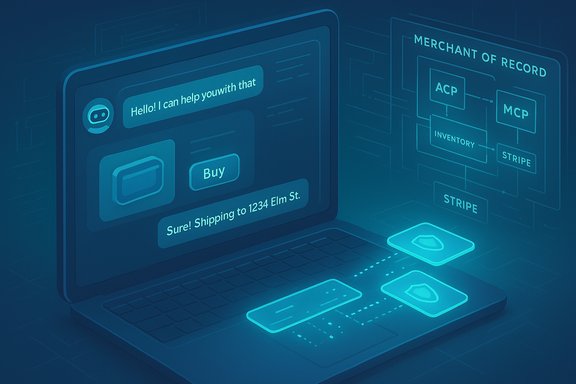
OpenAI’s Instant Checkout demo and the associated Agentic Commerce Protocol (ACP) illustrate the pattern: a conversational assistant presents purchasable items, the user taps to buy, confirms shipping and payment details inside the chat, and the assistant initiates a tokenized checkout session with the merchant backend. The merchant remains the merchant of record — responsible for fulfillment, returns and customer service — while the agent acts as the discovery and checkout surface. Early rollouts targeted U.S. Etsy sellers and named Shopify as a major channel for broader merchant participation.
Payments infrastructure partners (Stripe, PayPal, card networks) and standards bodies are converging on techniques for agentic payments: ephemeral tokens, constrained authorization windows, and clear audit trails that link agent actions to transactions. These approaches attempt to reconcile convenience with traceability and dispute resolution.
From an engineering and operations standpoint, the user experience relies on accurate, machine‑readable product data, near‑real‑time inventory and shipping metadata, and robust token exchange mechanisms between agents, payment processors and merchant platforms. If any of those linkages fail — stale stock, mismatched SKUs, token expiration — the UX degrades fast and becomes a support burden.
However, the model amplifies operational fragility: bad metadata, stale inventory or token misconfigurations lead to poor experiences and costly support. It also concentrates distribution power and exposes new fraud and regulatory attack surfaces. Company‑reported growth metrics are promising but should be validated through controlled experiments, careful measurement and independent verification where possible.
In short: agentic commerce is no longer a laboratory curiosity — it’s a real channel that requires real engineering, governance and measurement discipline. Treat pilots as production problems and instrument them accordingly.
Agentic commerce is the next major battleground for e‑commerce and platform strategy. The immediate winners will be those that treat this as an engineering problem — product feeds, tokenized payments, observability and robust governance — rather than a marketing headline. Done right, conversational assistants will make shopping dramatically easier; done poorly, they will be an operational liability and a regulatory headache. The challenge for merchants, platforms and IT leaders is to capture the convenience without sacrificing control, auditability or customer trust.
Source: ADWEEK ADWEEK
 Background / Overview
Agentic commerce describes a model where autonomous, goal‑driven AI agents act on a user’s behalf to discover, compare and complete transactions. Unlike traditional chatbots or recommendation widgets that end with a link to a merchant site, agentic agents orchestrate multi‑step flows — query multiple data sources, validate inventory and pricing, request user confirmation, and execute payment — producing a completed order as the final state of a conversation. This is a structural shift in how discovery, intent and checkout interact.Three technical primitives have emerged as the plumbing of this shift:
- Agentic Commerce Protocols (ACP/MCP): machine‑readable APIs that let an assistant query product metadata, request checkout sessions, and reconcile order provenance while preserving merchant control of fulfillment.
- Tokenized / delegated payments (Agentic Tokens): ephemeral credentials or scoped virtual cards that allow an agent to trigger payment without ever seeing raw card data, reducing credential exposure and enabling auditable agent‑initiated transactions.
- Stateful agent orchestration: agent runtimes that manage planning, tool selection, retries and fallbacks across multiple APIs and services (search, inventory, payments, shipping).
What changed: chat becomes checkout
Until recently, the standard conversational commerce pattern ended with a deep link or referral to a merchant website. The new generation of agentic commerce embeds the transaction itself inside the assistant.OpenAI’s Instant Checkout demo and the associated Agentic Commerce Protocol (ACP) illustrate the pattern: a conversational assistant presents purchasable items, the user taps to buy, confirms shipping and payment details inside the chat, and the assistant initiates a tokenized checkout session with the merchant backend. The merchant remains the merchant of record — responsible for fulfillment, returns and customer service — while the agent acts as the discovery and checkout surface. Early rollouts targeted U.S. Etsy sellers and named Shopify as a major channel for broader merchant participation.
Payments infrastructure partners (Stripe, PayPal, card networks) and standards bodies are converging on techniques for agentic payments: ephemeral tokens, constrained authorization windows, and clear audit trails that link agent actions to transactions. These approaches attempt to reconcile convenience with traceability and dispute resolution.
The new UX: fewer clicks, more decisions by agents
From the shopper’s perspective, the value proposition is immediate: faster conversions, less context switching and personalized assistance that remembers preferences and constraints across turns. Agents can ask clarifying questions (size, color, urgency), prune options, and — critically — remove the friction of navigating separate product pages and checkout flows. Where this works well, conversion rates and average order values can spike because the assistant filters noise and drives directly to buyable inventory.From an engineering and operations standpoint, the user experience relies on accurate, machine‑readable product data, near‑real‑time inventory and shipping metadata, and robust token exchange mechanisms between agents, payment processors and merchant platforms. If any of those linkages fail — stale stock, mismatched SKUs, token expiration — the UX degrades fast and becomes a support burden.
The ecosystem players and live pilots
Multiple companies are moving in parallel, each exposing portions of the new commerce stack and forming partnerships that accelerate adoption:- OpenAI: introduced Instant Checkout and published ACP to enable in‑chat single‑item purchases and to create a reference protocol for agent‑to‑merchant interactions. Early pilots included U.S. Etsy sellers, with Shopify merchant onboarding promised.
- Stripe: has documented agentic commerce patterns and provides the tokenization and payment rails that make delegated payments feasible.
- Shopify: has publicly signaled that AI‑driven traffic to Shopify merchants has increased dramatically (company‑reported multipliers like 7× traffic and 11× AI‑attributed orders were used in industry briefings), and the company is building integrations and internal AI tooling to serve agentic scenarios. Those figures should be read as directional company metrics rather than independently audited facts.
- PayPal / Mastercard / card networks: launched programs (Agent Pay, Agentic Tokens) and pilots to provide trust layers and dispute frameworks for agentic payments, signaling that payments networks view agentic commerce as a payments problem that can be standardized.
- Retail partners: Walmart, Etsy and other merchants have experimented with conversational integration and in‑chat checkout pilots that show the model can scale to large catalogs if the product feed plumbing is robust.
Technical underpinnings explained
Agentic Commerce Protocols and Model Context Protocols
Protocols like the Agentic Commerce Protocol (ACP) and the Model Context Protocol (MCP) standardize the exchange of structured product and fulfillment metadata and define how models access external tools and services in an auditable way. These protocols enable:- Machine‑readable catalog queries (price, SKU, stock, shipping windows).
- Checkout session orchestration (create session, return authoritative cart state).
- Payment token exchange and revocation.
Tokenized payments and delegated credentials
Agentic payments avoid exposing full payment instruments to AI agents by issuing scoped, ephemeral tokens — virtual cards, delegated payment tokens or one‑time payment links. Tokens are constrained by merchant, amount, category and time window. Payment processors and card networks have been developing these primitives as part of agentic payment programs. The token model reduces the attack surface and enables clearer forensic trails if disputes arise.Merchant as merchant of record
A central architectural choice across pilots is to keep merchants as the merchant of record. That preserves brand relationships, returns handling and regulatory accountability; the agent simply acts as a convenience layer. It’s a pragmatic compromise to avoid full platform disintermediation while still offering the user a frictionless interface.Business implications and economics
Agentic commerce creates new distribution channels and monetization levers, but also raises thorny questions about fees, ranking and merchant economics.- Platforms can monetize via transaction fees on Instant Checkout, paid placements inside assistant results, and revenue shares on apps and integrations. Early announcements hint at commissions on completed sales, but precise fee schedules are often undisclosed in public materials.
- Merchants that optimize for agentic discoverability — clean metadata, quick fulfillment SLAs and high‑quality images and trust signals — will benefit from higher visibility. Those that don’t risk permanent invisibility inside agentic channels because agents typically present a tiny, curated set of options to buyers.
- Company‑reported growth multipliers (Shopify’s 7× AI traffic and 11× AI‑attributed orders) are meaningful directional signals but must be treated with skepticism until the definitions and baselines are disclosed or independently verified. These headline figures can inform strategy but not replace rigorous A/B testing and measurement on merchant systems.
Security, privacy and fraud: new threat surfaces
Agentic commerce reduces friction — and in doing so introduces new risks:- Credential scope and token misuse: Improperly constrained tokens could be replayed, or phishing/prompt‑injection attacks might trick agents into authorizing unintended purchases if authorization flows aren’t robust. Token revocation and strict scoping are essential mitigations.
- Account takeover and social engineering: Agents that can act on linked accounts increase the value of account credentials for attackers. Strong user authentication, multifactor authentication and session monitoring are baseline controls.
- Operational failure modes: Stale inventory or mismatch between agent recommendations and merchant reality leads to cancellations, refunds and reputational damage. Real‑time inventory syncs and clear user confirmations help, but incident volume could spike during rollouts.
- Regulatory and consumer protection gaps: Agents change where disclosures must be placed (inside chat flows rather than on web pages). Regulators will likely demand clear disclosures for AI‑driven recommendations, paid placements and automated purchases — and consumer protections for in‑chat refunds and disputes.
Measured skepticism: what to believe and what to verify
Many of the most optimistic numbers in agentic commerce reporting are company‑provided and early. That doesn’t make them wrong, but it does make them incomplete:- Treat headline multipliers as directional. Shopify’s reported 7× and 11× figures illustrate the potential of AI channels but are not yet independently audited. Companies often define attribution windows and “AI traffic” in ways that favor their thesis; until earnings transcripts or third‑party analytics corroborate, use those metrics to justify experiments, not wholesale shifts.
- Verify checkout mechanics in your own sandbox. Token lifetimes, revocation behavior and edge‑case flows (partial fulfillment, backorders, returns) behave differently in production systems. Test thoroughly.
- Expect regional and regulatory gating. Many initial pilots are U.S.‑centric; EU and other jurisdictions with stricter privacy or AI rules will present both technical and legal challenges for in‑chat checkout.
What merchants and IT teams must do now (practical checklist)
Agentic commerce is operational — not theoretical. The basic playbook is straightforward but requires investment.- Normalize and publish machine‑readable product data:
- Canonical SKUs, GTIN/ASIN/EAN where possible.
- Structured fields for size, color, material, shipping windows and return policies.
- High‑quality images and short machine‑parsable summaries.
- Implement near‑real‑time inventory syncs and define freshness SLAs:
- Outline behaviors for out‑of‑stock, price changes and partial shipments.
- Integrate agentic endpoints and payment tokens in sandbox:
- Test delegated payment flows, token expiration, revocation and dispute scenarios.
- Harden authentication and account linking:
- Require MFA for account links.
- Provide clear consent screens describing what the agent can do on behalf of the user.
- Instrument observability and attribution:
- Correlate agent prompts → recommendations → checkout → fulfillment → returns.
- Reconcile agent‑originated orders to understand lifetime value and returns behavior.
- Build support and dispute playbooks:
- Train customer service to handle agent‑originated orders and reconcile pricing mismatches or token errors quickly.
- Preserve diversified discovery:
- Maintain SEO, marketplace listings and direct sales channels while experimenting with agents to avoid single‑channel dependence.
Enterprise and IT governance implications
For enterprises exposing internal catalogs or procurement flows to agentic automation, governance is a must:- RBAC and allow‑lists for connectors and memory persistence ensure agents can’t access sensitive corpora without explicit approvals.
- Policy controls for agent actions: define maximum per‑transaction limits, permitted merchant categories and escalation workflows requiring human approval for high‑value purchases.
- Audit trails and provenance: log agent decision paths, tool invocations and token usage for compliance and forensic needs.
- Staged rollouts and human‑in‑the‑loop: start with low‑risk categories and add human approvals for high‑value or complex procurements.
Competitive and regulatory scenarios
Three broad outcomes are plausible as agentic commerce scales:- Platform dominance: A small number of assistants (embedded in major OS or widely used apps) control discovery and capture transaction take rates, forcing merchants to negotiate platform economics or be excluded.
- Federated open ecosystem: Broad adoption of open protocols (ACP/MCP) lets multiple agents interoperate with merchant feeds, enabling a competitive, cross‑platform agent ecosystem.
- Brand‑centric resilience: Large retailers and brands deploy white‑label agents or deeply integrated experiences to protect brand voice and data, balancing convenience with control.
Strengths, limitations and final assessment
Agentic commerce is compelling because it compresses discovery, recommendation and checkout into a single surface, which can materially reduce friction and improve conversion when implemented correctly. Platforms and payment networks moving to standardize protocols and tokens is a healthy sign that the industry is trying to manage risk while enabling the convenience users want.However, the model amplifies operational fragility: bad metadata, stale inventory or token misconfigurations lead to poor experiences and costly support. It also concentrates distribution power and exposes new fraud and regulatory attack surfaces. Company‑reported growth metrics are promising but should be validated through controlled experiments, careful measurement and independent verification where possible.
In short: agentic commerce is no longer a laboratory curiosity — it’s a real channel that requires real engineering, governance and measurement discipline. Treat pilots as production problems and instrument them accordingly.
Actionable roadmap for WindowsForum readers and IT leaders
- Short term (30–90 days):
- Audit and normalize product metadata; publish machine‑readable feeds.
- Run tokenized payment experiments in sandbox with your payment provider.
- Define support flows for agent‑originated orders and test recovery scenarios.
- Medium term (3–9 months):
- Integrate ACP/MCP endpoints as applicable and run A/B tests measuring AI channel lift and LTV.
- Harden governance: roles for account linking, MFA enforcement and allowed agent scopes.
- Long term (9–18 months):
- Decide on channel strategy: platform‑first, federated or brand‑centric; invest in whichever path aligns with margins and customer lifetime value.
- Prepare for evolving regulation on AI recommendations and in‑chat commerce disclosure.
Agentic commerce is the next major battleground for e‑commerce and platform strategy. The immediate winners will be those that treat this as an engineering problem — product feeds, tokenized payments, observability and robust governance — rather than a marketing headline. Done right, conversational assistants will make shopping dramatically easier; done poorly, they will be an operational liability and a regulatory headache. The challenge for merchants, platforms and IT leaders is to capture the convenience without sacrificing control, auditability or customer trust.
Source: ADWEEK ADWEEK