

Google Cloud’s sweep of NRF 2026 was not a minor product update—it was a full-court strategic thrust that stitches together models, infrastructure, commerce protocols and partner ecosystems into a single narrative: agentic commerce is arriving, and cloud providers intend to own the rails.
Google used the National Retail Federation’s Big Show to unveil a multi-layered retail play built around Gemini Enterprise for Customer Experience, enhancements to Vertex AI, expanded Distributed Cloud capabilities, and a standards-first approach to commerce through what it and partners call the Universal Commerce Protocol (UCP). These announcements position Google Cloud to supply both the brain (advanced LLM-based agents) and the spine (scalable, compliant infrastructure and open plumbing) for retailers that want AI to do more than answer questions—AI that can reason, act and transact. At NRF, Google and its partners also highlighted real-world pilots and customer outcomes—metrics that, if taken at face value, show measurable operational wins from early agent deployments. Those case studies (Best Buy, Virgin Media O2, Wayfair) were used to illustrate how agentic automation can reduce friction, accelerate time-to-market and lower costs. These claims are largely vendor-reported and should be tested in independent deployments, but they frame the potential business case for adoption.
For retailers, the opportunity is real: agentic automation can reduce repetitive service work, accelerate catalog operations and shorten the conversion funnel. But the path to production is an operational one—catalog hygiene, payment tokenization, dispute readiness and governance are the unsung elements that will determine success.
The prudent stance for retail leaders is clear: pilot narrowly, instrument ruthlessly, insist on contractual and audit transparency, and design for portability across assistants. If the early vendor claims hold up under independent measurement, agentic commerce will be a generational change in how customers discover, buy and interact—delivering convenience while forcing retailers to become better engineers of trust.
Source: WebProNews Google Cloud Unveils AI Innovations for Retail at NRF 2026
 Background / Overview
Google used the National Retail Federation’s Big Show to unveil a multi-layered retail play built around Gemini Enterprise for Customer Experience, enhancements to Vertex AI, expanded Distributed Cloud capabilities, and a standards-first approach to commerce through what it and partners call the Universal Commerce Protocol (UCP). These announcements position Google Cloud to supply both the brain (advanced LLM-based agents) and the spine (scalable, compliant infrastructure and open plumbing) for retailers that want AI to do more than answer questions—AI that can reason, act and transact. At NRF, Google and its partners also highlighted real-world pilots and customer outcomes—metrics that, if taken at face value, show measurable operational wins from early agent deployments. Those case studies (Best Buy, Virgin Media O2, Wayfair) were used to illustrate how agentic automation can reduce friction, accelerate time-to-market and lower costs. These claims are largely vendor-reported and should be tested in independent deployments, but they frame the potential business case for adoption. What Google announced at NRF 2026
Gemini Enterprise for Customer Experience: agentic CX at scale
- Gemini Enterprise for CX is presented as a pre-built and configurable set of agentic components that let retailers deploy agents across discovery, checkout and post-purchase workflows.
- Google positioned Gemini Enterprise as an enterprise-grade layer that reasons, plans and executes—not merely a scripted FAQ bot—integrating into merchant data sources and fulfillment systems.
- Product discovery and recommendation agents that maintain provenance to canonical product records.
- Post-purchase and support agents that can reschedule deliveries, process returns and resolve common policy questions.
- In-app and in-store assistants (edge-capable agents) that enhance phygital experiences.
Vertex AI enhancements and retail-specialized agents
- Vertex AI now includes preconfigured agent templates for retail tasks such as demand forecasting, supply chain optimization and conversational commerce.
- The addition of agent runtimes, observability and tool integrations is meant to shorten time-to-production for business-critical AI workloads while maintaining model-grounding against canonical data sources.
Distributed Cloud + NVIDIA: bringing models to the edge
- Google emphasized its Distributed Cloud footprint and NVIDIA partnership so retailers can run Gemini-derived workloads closer to where events occur—stores, kiosks and warehouses—without moving sensitive data to uncontrolled environments.
- This addresses two perennial retail needs: low-latency in-store experiences and stronger controls for regulated data.
Universal Commerce Protocol (UCP) and partner standards
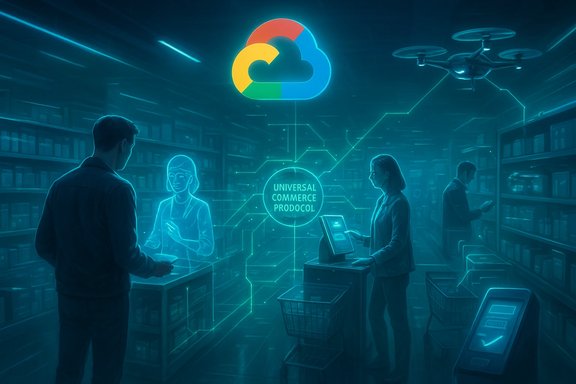
- Google and Shopify co-developed an open protocol (UCP) intended to standardize how agents interact with merchants: canonical product records, cart semantics, delegated payment tokens and provenance trails.
- UCP’s goal is pragmatic: avoid N×N bespoke integrations and let multiple assistants (Gemini, Copilot, ChatGPT and others) safely and scalably initiate purchases while preserving merchant-of-record responsibilities.
Why the announcements matter — strategic analysis
1) The platform play: models + tooling + distribution
Google is packaging three ingredients retailers need to adopt agentic commerce:- Capabilities: agent models (Gemini) that can reason across multiple steps.
- Tooling: Vertex AI templates, observability, and merchant toolkits.
- Distribution: partnerships and an open protocol to push commerce into assistant surfaces.
2) Protocols win if economics and operations align
The Universal Commerce Protocol answers a practical engineering problem—agents need canonical, live product signals and auditable checkout flows to avoid hallucinations and disputes. But technical standards only win when:- Merchant onboarding and catalog hygiene are affordable and fast.
- Payment providers and PSPs embrace delegated token models at scale.
- Commercial terms (placement fees, telemetry sharing, dispute handling) are transparent.
3) Edge + compliance = business continuity for stores
Retailers must run reliable systems in stores even if cloud connectivity blips. Google’s Distributed Cloud + NVIDIA partnership makes it practically possible to run inference and low-latency agents locally while retaining centralized governance—an important differentiator for regulated markets (payments, PII) and for in-person experiences. This architecture mitigates one of the central objections to agentic commerce: handing sensitive workflow decisions to a remote black box.Real-world evidence: what the early pilots claim (and what to believe)
Vendors and early adopters were explicit about benefits; the most-cited outcomes at NRF included:- Best Buy: a claimed 200% increase in customers rescheduling deliveries via self-service and a 30% rise in resolved queries through a generative AI virtual agent. These numbers appear in Google communications about Gemini Enterprise and were repeated in conference materials; they represent vendor-reported operational outcomes. Independent verification remains limited and these should be treated as directional indicators for potential value rather than definitive proof.
- Virgin Media O2: reported time-to-market and cost efficiencies from BigQuery and Analytics Hub—examples include dramatically shorter deployment/testing cycles and an approximately 30% reduction in TCO for equivalent on-prem solutions by moving analytics workloads to BigQuery. These outcomes are backed by Google Cloud case studies and customer narratives about Analytics Hub.
- Wayfair: cited accelerated product tagging and launch velocity improvements from Gemini on Vertex AI—public statements indicate multi-fold speedups for catalog enrichment tasks, reducing costs and accelerating go-to-market for product updates. This is consistent with vendor case studies and Google product blogs.
Competitive landscape: Microsoft, OpenAI, Amazon and the pluralistic future
NRF made clear this is a multi-front contest:- Microsoft launched Copilot Checkout, enabling in-chat purchases inside Copilot with partners such as PayPal, Stripe and Shopify—an enterprise-forward strategy that emphasizes merchant control and integration with existing enterprise stacks. Coverage from independent outlets confirmed the feature and early merchant participants.
- OpenAI and Shopify had previously advanced Instant Checkout and complementary protocols; OpenAI’s approach favors a single-surface checkout inside ChatGPT while preserving merchant-of-record duties via tokenization and PSP integrations.
- Amazon continues to leverage its full-stack control (catalog, fulfillment and payments) with its own assistant features, and remains a formidable incumbent where integrated logistics are a competitive advantage.
Integration and operational challenges
Data quality and catalog hygiene
Agentic commerce amplifies the classic data problem: agents act on what they are given. Inaccurate or incomplete GTINs, SKU mappings, shipping windows and return policies create fraud, returns and poor CX.- Practical merchant steps: invest in MDM, canonical product representation, automated enrichment pipelines and observability to link conversational prompts to canonical SKU IDs. Industry tool partners and MDM vendors emphasized this at NRF.
Payments, fraud and litigation risk
Delegated payment tokens reduce PCI exposure for assistants, but they transfer fraud, chargeback and mandate-proofing complexity to PSPs and merchants. Contractual clarity about liability and dispute remediation will be essential; expect PSPs to insist on stronger identity proofs and provenance trails.Governance, privacy and customer trust
Agents with “memory” or persistent shopper profiles increase convenience but also centralize sensitive preference and purchase data. Retailers will need:- Clear consent models.
- Audit trails for agent decisions.
- Strong data minimization and deletion controls.
Cost and skills
Mid-market retailers face two thorny barriers:- Upfront engineering and catalog work needed to expose reliable, canonical data.
- Operational changes to reconcile agent-origin orders, returns and multi-channel inventory conflicts.
A practical playbook for retailers (what to do next)
- Audit and canonicalize product data
- GTIN coverage, SKU normalization, images, dimensions and return policy fields must be accurate.
- Pilot an agentic storefront with a clear business case
- Start with a narrowly scoped use case (e.g., rescheduling, simple consumables, reorders).
- Test delegated payments and dispute flows
- Simulate chargebacks and returns for agent-origin orders to validate PSP responsibilities.
- Instrument provenance and observability
- Capture conversational prompts, canonical SKU IDs, decision traces and token receipts for every agent-origin transaction.
- Negotiate explicit commercial and telemetry terms
- Clarify attribution, placement fees, telemetry sharing, and opt-in/opt-out controls with platform partners.
- Build governance and consent playbooks
- Document memory policies, deletion controls and escalation paths for agent decisions.
Ecosystem and partner dynamics: who benefits
- Large omnichannel retailers (Walmart, Target, Wayfair) gain the most immediate value: they have inventory, logistics, catalog teams and brand power to test and scale agentic features. Partnerships like Walmart + Gemini and Wing drone expansion showcase integrated experimentations across discovery to last-mile.
- Platform providers (Shopify, payments partners) stand to monetize new discovery and checkout surfaces—but success depends on merchant trust and friction-free onboarding. Shopify’s Agentic Storefronts and UCP aim to place the platform in the middle of that value chain.
- Edge and infrastructure vendors (Scale Computing, NVIDIA) gain from the push to run AI at stores and distribution centers. Their value proposition centers on reliability, low latency and compliance for in-place AI workloads.
Regulatory and public-policy considerations
Agentic commerce raises several regulatory flashpoints:- Consumer protection: agents must not misrepresent merchant obligations (delivery times, returns) or mis-execute purchases without explicit consent.
- Payment liability: delegated tokens reduce assistant exposure but leave ambiguity about who bears fraud or chargebacks.
- Data privacy: memory features and cross-channel personalization require clear consent and transparent deletion controls.
Strengths, risks and where the balance lies
Notable strengths
- End-to-end vision: Google’s combination of Gemini, Vertex AI, Distributed Cloud and protocol-level work creates a coherent story from models to merchant checkout.
- Practical interoperability: UCP and partner engagements (Shopify, PayPal, Walmart) reduce bespoke connector work—if the protocol gains traction.
- Edge-first architecture: Local inference models and Distributed Cloud reduce latency and improve compliance posture for in-store experiences.
Key risks
- Vendor-sourced metrics: Early performance numbers (e.g., Best Buy’s 200% rescheduling improvement) are largely vendor-reported. They are valuable signals but require independent validation before procurement decisions rely on them.
- Operational complexity: Catalog cleanup, PSP integration, dispute handling and SLAs introduce non-trivial implementation overheads.
- Commercial dependence: Platforms that control discovery and in-chat checkout can extract new fees or placement rules—merchants must protect margins and data rights during contracting.
What the next 12–24 months will reveal
- Merchant adoption velocity: Will mid-market merchants find the onboarding cost worth the incremental conversion lift? Watch enrollment rates from Shopify and merchant testimonials as the best early signals.
- PSP and dispute mechanics: Expect PSPs (Stripe, PayPal, Shopify Payments) to refine mandate proofs and short‑lived token patterns—these will determine whether in-chat checkout is practically reliable at scale.
- Independent audits of pilot metrics: Until third-party verification appears, treat vendor case studies as directional; buyers should require baseline/post-deployment KPIs in contracts.
- Regulatory responses: Consumer protection and payments regulators will ask whether agent-initiated purchases expose buyers to new risks; proactive governance will be a competitive asset.
Conclusion
Google Cloud’s NRF 2026 program is ambitious, pragmatic and ecosystem-minded. By combining Gemini Enterprise, Vertex AI, Distributed Cloud and an open commerce protocol, Google and its partners are not only selling tools; they are attempting to redesign the operating model for retail in an age where agents can convert intent into action.For retailers, the opportunity is real: agentic automation can reduce repetitive service work, accelerate catalog operations and shorten the conversion funnel. But the path to production is an operational one—catalog hygiene, payment tokenization, dispute readiness and governance are the unsung elements that will determine success.
The prudent stance for retail leaders is clear: pilot narrowly, instrument ruthlessly, insist on contractual and audit transparency, and design for portability across assistants. If the early vendor claims hold up under independent measurement, agentic commerce will be a generational change in how customers discover, buy and interact—delivering convenience while forcing retailers to become better engineers of trust.
Source: WebProNews Google Cloud Unveils AI Innovations for Retail at NRF 2026
