

The era of agentic business applications has arrived in earnest, and the announcements at Convergence 2025 make clear that this is no longer a theoretical roadmap — it is an operational shift that will touch ERP, CRM, productivity, and how organizations govern data and decisions.
Microsoft framed Convergence 2025 around a simple but consequential promise: move enterprises from systems of record to systems of action by combining three pillars — data, Copilot, and agents — into a single, governed platform. The core message is that when business systems are connected, continuously governed, and surfaced to AI agents, routine tasks that once took hours can be enacted automatically, insights can be translated into actions immediately, and processes can continuously optimize themselves.
This shift is not limited to point automation. The product changes announced leading into Convergence — most notably the evolution of the Dynamics 365 Model Context Protocol (MCP) server from a static catalog to a dynamic framework and the expansion of Copilot Studio’s agent capabilities — are designed to make enterprise applications agent-ready. In practical terms, Microsoft says this enables agents to reason over live operational data, open forms, perform actions under existing permission models, and surface analytic metrics directly into the flows people use every day.
What Microsoft presented is a broad, integrated stack:
Microsoft’s approach centers on Dynamics 365 and Dataverse as the canonical, governed stores for business data. Dataverse acts as more than a storage layer: it generates managed lakehouse endpoints and a SQL surface so analytics teams can use Fabric (or Synapse-like tooling) to run near-real-time analysis without breaking governance. This integration is intended to let agents reason over the same definitions and metric semantics that finance and operations already trust.
Key capabilities highlighted at Convergence and in recent updates include:
Marketing language occasionally stretches to describe “massive scale” or "millions" of possible ERP actions for agent-driven scenarios. The precise, verifiable statements from product documentation and technical posts reference hundreds of thousands of functions and make the analytics MCP server available in public preview in December 2025. Where vendor messaging says “millions,” organizations should treat that as aspirational or marketing shorthand until technical specifications and endpoint documentation confirm exact counts for their tenant customizations.
Microsoft also announced a Product Change Management Agent Template in public preview — designed for manufacturers to automate product and equipment change workflows and reduce approval cycle times.
Practical countermeasures:
Mitigations include:
Controls to implement:
However, runway-to-value depends on non-technical factors: process clarity, data hygiene, stakeholder alignment, and a governance-first approach. Organizations should avoid thinking of agentic tech as a plug-and-play replacement for process redesign. Instead, consider agents as catalysts — they accelerate and amplify existing processes, but they also expose process gaps rapidly.
Workforce effects are nuanced. Agents can free employees from low-value tasks and enable them to focus on higher-order activities, but this requires reskilling, role redesign, and clear change management. Employers that treat agents purely as cost-cutting tools will likely encounter resistance and limited adoption.
This is a breakthrough in capability, but not an on-ramp for rushed rollouts. The technology will deliver most value to organizations that prepare their data estate, treat agent identities and permissions as first-class citizens, and start with bounded, high-value processes. Security teams must be part of the planning team from day one. Finance and operations must define metrics and audit trails so decisions made by agents are traceable and reversible when needed.
Agentic business applications promise speed, scale, and real operational autonomy — but they also demand operational discipline. For organizations willing to invest in clean data, rigorous governance, and thoughtful pilots, the era of agents opens a new chapter in enterprise efficiency. For the rest, the risk is that automation amplifies their existing process and data problems rather than resolving them.
Source: Microsoft The era of agentic business applications arrives at Convergence 2025 - Microsoft Dynamics 365 Blog
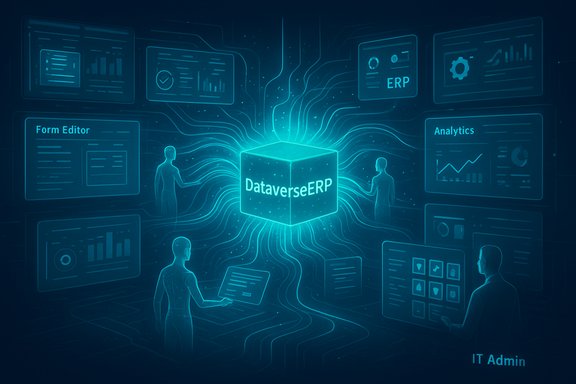 Background / Overview
Microsoft framed Convergence 2025 around a simple but consequential promise: move enterprises from systems of record to systems of action by combining three pillars — data, Copilot, and agents — into a single, governed platform. The core message is that when business systems are connected, continuously governed, and surfaced to AI agents, routine tasks that once took hours can be enacted automatically, insights can be translated into actions immediately, and processes can continuously optimize themselves.This shift is not limited to point automation. The product changes announced leading into Convergence — most notably the evolution of the Dynamics 365 Model Context Protocol (MCP) server from a static catalog to a dynamic framework and the expansion of Copilot Studio’s agent capabilities — are designed to make enterprise applications agent-ready. In practical terms, Microsoft says this enables agents to reason over live operational data, open forms, perform actions under existing permission models, and surface analytic metrics directly into the flows people use every day.
What Microsoft presented is a broad, integrated stack:
- Dynamics 365 (ERP + CRM) and Dataverse as the operational data and process backbone.
- Microsoft Fabric and Dataverse mirroring for near-real-time analytics.
- Microsoft Copilot Studio and Microsoft 365 Copilot as the maker and surface layer for agents.
- Model Context Protocol (MCP) servers that translate business logic, data, and UI actions into agent-accessible tools.
Data: the foundation of agent autonomy
Why data quality and continuity matter
Agents can only act meaningfully if they have reliable, governed access to the right data. Finance close, order-to-cash, supply chain planning, field service scheduling and HR workflows all depend on a consistent view of entities across the business: customers, suppliers, inventory, transactions, and policies. Where data is fragmented, agents either fail to act or act incorrectly; that produces risk rather than benefit.Microsoft’s approach centers on Dynamics 365 and Dataverse as the canonical, governed stores for business data. Dataverse acts as more than a storage layer: it generates managed lakehouse endpoints and a SQL surface so analytics teams can use Fabric (or Synapse-like tooling) to run near-real-time analysis without breaking governance. This integration is intended to let agents reason over the same definitions and metric semantics that finance and operations already trust.
What changed at Convergence
The announcements reinforce three engineering priorities:- Improve data gravity for agents by making Dataverse and Dynamics 365 the center of both transaction processing and analytics.
- Provide a live analytics bridge (Fabric + Mirrored Dataverse) so agents can use near-real-time metrics rather than stale exports.
- Maintain auditable, role-based access such that an agent’s actions inherit the same permissioning and logging controls as a human operator.
Copilot Studio and Microsoft 365 Copilot: the connective tissue
Copilot moves from assistant to orchestrator
Copilot has evolved beyond a query-and-answer assistant into an orchestration layer that can combine conversational intent with actions across systems. Copilot Studio is the authoring and governance environment where makers build agents, define knowledge sources, wire in tools (connectors and MCP endpoints), and configure autonomous triggers.Key capabilities highlighted at Convergence and in recent updates include:
- Autonomous agents and triggers: Agents can be configured to react to events and run flows without manual intervention, surfacing actions and escalating when rules require human approval.
- Multi-agent orchestration: Agents can coordinate, hand off tasks, and divide responsibilities across HR, finance, supply chain, and other domains.
- “Computer use” and UI-based actions: When APIs aren’t available, agents can interact with applications and web pages in a user-like way to perform actions — useful for legacy apps but increasing test, reliability, and security complexity.
- Model and engine integrations: Copilot Studio supports multi-model sourcing and brings custom models into agent reasoning, allowing organizations to tune behavior and responses.
Governance features in Copilot Studio
Microsoft has introduced controls that are critical when agents can act autonomously:- Agent identities assigned in the same identity system as humans, giving admins visibility and control over what an agent can do.
- Information protection integration to classify and restrict copying or sharing of sensitive data in agent outputs.
- Activity analytics so makers and admins can see how knowledge sources are used and where agents fail to find grounding.
The Model Context Protocol (MCP): from static tools to a dynamic ERP surface
What MCP does
MCP defines a protocol and runtime that exposes application actions, forms, and analytic metrics to agents in a standardized way. The original, static ERP MCP shipped with a small, curated set of actions for Finance and Supply Chain to prove concepts. The big change announced is the dynamic ERP MCP server, which can discover and present forms, fields, and actions dynamically — effectively giving agents access to the same server-side operations a human user can perform through the ERP UI.Scale and scope: verified claims and caveats
Microsoft’s published materials consistently describe the dynamic MCP server unlocking hundreds of thousands of ERP functions across forms and modules. This is a dramatic increase from the earlier limited catalog. Microsoft also announced an MCP for analytics to provide governed access to measures, dimensions and semantic models so agent reasoning uses the same metric definitions as BI.Marketing language occasionally stretches to describe “massive scale” or "millions" of possible ERP actions for agent-driven scenarios. The precise, verifiable statements from product documentation and technical posts reference hundreds of thousands of functions and make the analytics MCP server available in public preview in December 2025. Where vendor messaging says “millions,” organizations should treat that as aspirational or marketing shorthand until technical specifications and endpoint documentation confirm exact counts for their tenant customizations.
Migration and enterprise readiness
Microsoft has communicated an intent to migrate existing agents and tools from the earlier static MCP to the dynamic server on a defined timeline. For enterprises, this raises three operational tasks:- Inventory current agent integrations and any custom connectors that depend on static APIs.
- Plan migration testing — ensure agents behave consistently under the dynamic MCP and that permissions, workflows and audit trails remain intact.
- Validate performance under load: dynamic discovery and form navigation at enterprise scale require robust testing to ensure acceptable latency and throughput.
Agent use-cases and partner ecosystem
First-party and embedded agents
Dynamics 365 Business Central and Dynamics 365 Finance & Operations are shipping embedded agents for everyday processes: sales order creation and validation, vendor invoice processing, payables reconciliations, time and expense entry, supplier outreach, and field technician scheduling. These agents aim to reduce manual entry, handle exceptions, and keep work moving across systems.Microsoft also announced a Product Change Management Agent Template in public preview — designed for manufacturers to automate product and equipment change workflows and reduce approval cycle times.
Partner-built agents
Microsoft showcased partner examples that illustrate how agents can extend domain workflows:- Agents that surface shop-floor production signals and manage quality checks.
- Finance-focused agents that analyze incoming vendor queries and reply with live payment statuses.
- Traceability and recall coordination agents that map quality issues through inventory and shipments.
- Cross-system integrations that let a single Copilot interface request and reconcile financial records across partner systems.
Security, governance, and operational risk — what could go wrong
The technology is powerful, but agentic systems raise real risks that require careful mitigation.Identity and token theft risks
Agents act as principals in the tenant. If an agent’s identity or OAuth tokens are compromised, attackers can gain broad access. Recent security research has shown attackers can craft supply-chain-like social engineering flows to trick people into granting permissions to malicious agents. This is not a theoretical vector — it has led to active advisories and product mitigations.Practical countermeasures:
- Require admin approval for application consent where possible.
- Enforce conditional access and multi-factor authentication.
- Use tight, explicit least-privilege scopes for agent identities and regularly audit granted permissions.
- Monitor for anomalous app registrations and revoke tokens that look suspicious.
Reliability and “car crash” failure modes
Autonomous agents can produce surprising outcomes. Early deployments of advanced transactional agents have shown both impressive automations and dramatic failures when agents misinterpret edge cases or when UI-driven interactions change unexpectedly. Some internal demos have been described as “stunning” and other times “car crash” moments — a reminder that agents are not infallible.Mitigations include:
- Start with bounded agents that handle well-defined processes and fail safely (notify, escalate, or create human checkpoints).
- Build comprehensive test suites with synthetic and production-like data.
- Log actions with full traceability and enable rollback where possible.
Data leakage and compliance
Agents that synthesize information or export results to productivity surfaces can leak sensitive content if not properly constrained. Integration with enterprise data protection tools helps, but governance must be enforced at design time.Controls to implement:
- Classify and tag sensitive data sources with automatic masking or redaction.
- Enforce data protection policies at agent configuration time (deny certain outputs or destinations).
- Use human-in-the-loop workflows for high-risk operations such as financial transactions or legal communications.
Adoption and organizational risk
Adoption is not guaranteed. Large vendor pilots show impressive efficiency figures and ROI claims, but independent reporting indicates that AI projects — particularly those that touch transactional systems — face adoption resistance, integration complexity, and extended sales cycles. There are early reports of customers pushing back on broad consumption or delaying deployments due to complexity or integration concerns. Expect realistic adoption curves, intense change management, and a need for measurable KPIs to justify expansion.How to approach agentic transformation — a pragmatic playbook
For IT and business leaders considering agentic applications, a staged, disciplined approach reduces risk and accelerates value.- Start with a high-value, low-risk process
- Pick areas where data is clean, processes are repeatable, and error costs are low (e.g., routine reconciliations, simple approvals, standard order processing).
- Build the data foundation
- Standardize master data, align metric definitions, and ensure Dataverse/Fabric mirroring is configured so agents reason over trustworthy data.
- Apply strong identity and governance controls
- Register agent identities centrally, use conditional access and least-privilege scopes, and configure Purview-like protections for knowledge sources.
- Pilot with bounded autonomy
- Use triggers and agent flows that include human approvals for non-routine decisions. Test failure and rollback scenarios.
- Measure impact and iterate
- Track throughput, error rates, cycle time reductions, and user satisfaction. Use these metrics to expand agent scope.
- Engage partners and specialists for complex integrations
- Where agent capability touches specialized hardware or on-prem systems, work with proven integrators who have experience with MCP and Copilot Studio.
- Maintain continuous security posture
- Rotate keys, audit token grants, and monitor agent activity logs for anomalous behavior.
Business implications: productivity, change management, and the workforce
Agentic applications offer tangible upside: shortened approval cycles, fewer manual exceptions, faster reconciliation, and the ability to act on insights immediately. For finance, supply chain, and customer-facing operations, these translate into reduced cycle times and potential cost savings.However, runway-to-value depends on non-technical factors: process clarity, data hygiene, stakeholder alignment, and a governance-first approach. Organizations should avoid thinking of agentic tech as a plug-and-play replacement for process redesign. Instead, consider agents as catalysts — they accelerate and amplify existing processes, but they also expose process gaps rapidly.
Workforce effects are nuanced. Agents can free employees from low-value tasks and enable them to focus on higher-order activities, but this requires reskilling, role redesign, and clear change management. Employers that treat agents purely as cost-cutting tools will likely encounter resistance and limited adoption.
Strengths, shortcomings, and unverifiable claims
- Strengths:
- Integration across ERP, Dataverse, Fabric, and productivity surfaces is a compelling architecture for enterprise-scale agentic apps.
- Model Context Protocol (MCP) provides a standardized way to expose governed actions and metrics to agents, simplifying integration complexity.
- Copilot Studio’s low-code/no-code capabilities lower the barrier for business teams to build and manage agents.
- Shortcomings and risks:
- Security and identity hygiene are more critical than ever; new attack vectors tied to agent identities exist and must be actively managed.
- Reliability concerns remain for UI-driven or highly customized ERP interactions; organizations should expect significant testing.
- Adoption friction and integration complexity mean ROI timelines are rarely immediate for large, customized enterprises.
- Unverifiable or inconsistent claims:
- Marketing references to “millions of ERP actions supported” are not consistently documented in technical product materials. Official product messaging more conservatively describes the dynamic MCP exposing hundreds of thousands of ERP functions. Treat “millions” as aspirational until verified in product documentation for your specific tenant and customizations.
- Vendor case studies highlight compelling improvements, but published ROI numbers should be validated through a pilot in your environment, given variance in customizations, data quality, and user readiness.
Conclusion
Convergence 2025 made clear that agentic business applications have moved from conceptual demos into mainstream vendor stacks. The combination of Dynamics 365, Dataverse, Microsoft Fabric, Copilot Studio, and MCP offers a coherent platform for agents that can reason, act, and coordinate across enterprise systems — with governance and analytics baked in.This is a breakthrough in capability, but not an on-ramp for rushed rollouts. The technology will deliver most value to organizations that prepare their data estate, treat agent identities and permissions as first-class citizens, and start with bounded, high-value processes. Security teams must be part of the planning team from day one. Finance and operations must define metrics and audit trails so decisions made by agents are traceable and reversible when needed.
Agentic business applications promise speed, scale, and real operational autonomy — but they also demand operational discipline. For organizations willing to invest in clean data, rigorous governance, and thoughtful pilots, the era of agents opens a new chapter in enterprise efficiency. For the rest, the risk is that automation amplifies their existing process and data problems rather than resolving them.
Source: Microsoft The era of agentic business applications arrives at Convergence 2025 - Microsoft Dynamics 365 Blog
