

This year’s sweeping push from Microsoft transforms Copilot from a helpful drafting assistant into the backbone of what vendors and CIOs are now calling the agentic enterprise — fleets of identity-bound AI agents that plan, act, and are managed like software services. Cloud Wars’ roundup of the top 2025 Copilot and agent advances neatly captures that shift and the product threads Microsoft pulled together across Ignite, Copilot Studio, Azure Foundry, and Windows — from a tenant-level control plane to model upgrades and a browser that “acts” instead of waiting for clicks.
This feature unpacks the Cloud Wars analysis, verifies key technical claims against vendor and independent reporting, cross-references important claims with multiple sources, and offers a critical, practical assessment for IT leaders preparing to pilot or scale agents in 2026. The article highlights the advances, explains how they fit into one coherent architecture, calls out unresolved risks and blind spots, and finishes with concrete steps enterprises should adopt before delegating work to agents.
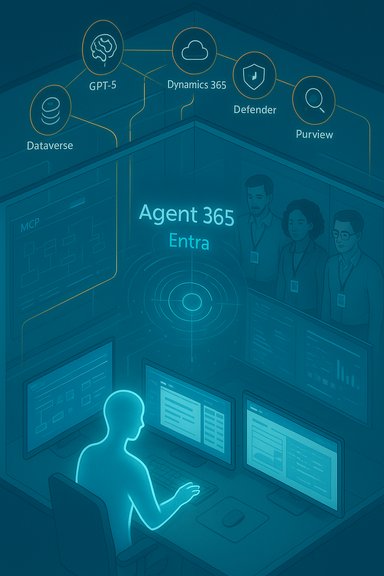
Microsoft’s 2025 product narrative centers on a single strategic idea: agents are not features — they are first-class, identity-bound workers that must be discoverable, auditable, and governable. That narrative was the running theme across Ignite and product updates: Copilot Studio for authoring, Azure AI Foundry for model and runtime choice, Agent 365 as the tenant control plane, Entra Agent IDs for lifecycle and access controls, and the Model Context Protocol (MCP) as the integration fabric between agents and enterprise systems. This is exactly the pivot Cloud Wars documents: Copilot increasingly behaves as a platform for deploying and operating agents, not only as an assistant.
Microsoft’s own product pages and release notes confirm the same architecture and timeline: GPT‑5 was added into Copilot and Copilot Studio in mid‑2025; Copilot Studio gained a “computer use” capability allowing agents to interact with GUIs; Agent 365 was introduced at Ignite as the centralized governance plane; and MCP expanded to Dataverse and Dynamics 365 to let agents call ERP and BI operations under tenant policy. These vendor confirmations are supported by independent coverage from outlets that attended Ignite and evaluated previews.
Each of those claims checks out against primary vendor materials and independent reporting:
The MAI team’s “humanist superintelligence” narrative signals Microsoft will invest heavily in high‑capability, human‑centric models while emphasizing safety and real-world utility. That strategic posture will shape product behavior, partnerships and compliance posture going forward.
For IT leaders, the mandate is clear: pilot fast, but govern harder. Validate GPT‑5 and model routing in your context; stress‑test MCP integrations against your custom business logic; and codify agent lifecycle and identity practices now. Done right, agents can compress weeks of work into minutes. Done too hastily, they become another class of shadow IT that introduces new attack surfaces, compliance headaches and surprise costs. This balanced posture — pragmatic adoption with strong governance — is how enterprises will capture the upside Microsoft and Cloud Wars describe while avoiding the hazards that come with agentic automation.
Source: Cloud Wars The Agentic Enterprise Arrives: Microsoft’s Copilot and Agent Breakthroughs of 2025
This feature unpacks the Cloud Wars analysis, verifies key technical claims against vendor and independent reporting, cross-references important claims with multiple sources, and offers a critical, practical assessment for IT leaders preparing to pilot or scale agents in 2026. The article highlights the advances, explains how they fit into one coherent architecture, calls out unresolved risks and blind spots, and finishes with concrete steps enterprises should adopt before delegating work to agents.
 Background / overview
Microsoft’s 2025 product narrative centers on a single strategic idea: agents are not features — they are first-class, identity-bound workers that must be discoverable, auditable, and governable. That narrative was the running theme across Ignite and product updates: Copilot Studio for authoring, Azure AI Foundry for model and runtime choice, Agent 365 as the tenant control plane, Entra Agent IDs for lifecycle and access controls, and the Model Context Protocol (MCP) as the integration fabric between agents and enterprise systems. This is exactly the pivot Cloud Wars documents: Copilot increasingly behaves as a platform for deploying and operating agents, not only as an assistant.Microsoft’s own product pages and release notes confirm the same architecture and timeline: GPT‑5 was added into Copilot and Copilot Studio in mid‑2025; Copilot Studio gained a “computer use” capability allowing agents to interact with GUIs; Agent 365 was introduced at Ignite as the centralized governance plane; and MCP expanded to Dataverse and Dynamics 365 to let agents call ERP and BI operations under tenant policy. These vendor confirmations are supported by independent coverage from outlets that attended Ignite and evaluated previews.
What Cloud Wars reported — a concise, verifiable summary
Cloud Wars distilled the standout innovations of 2025 into ten items that together describe Microsoft’s agent strategy: Agent 365, Agent Mode inside Office apps, Copilot Studio’s computer use, Copilot Studio Lite (the low‑code tier), GPT‑5 integration across Copilot products, the Model Context Protocol (MCP) adoption, Teams agents, Mustafa Suleyman’s MAI Superintelligence/humanist vision, Copilot Mode in Edge (the AI browser), and Copilot Voice (including the Mico companion). The piece frames 2025 as the year Microsoft moved agents from prototypes to an operational platform for enterprises.Each of those claims checks out against primary vendor materials and independent reporting:
- Agent 365 — Microsoft announced Agent 365 at Ignite as the tenant control plane for registering, governing and visualizing agents; built to integrate Entra, Defender, Purview and the Microsoft 365 admin center. Independent coverage corroborates the existence and early-access rollout through Microsoft’s Frontier program.
- Agent Mode in Office apps — Microsoft demonstrated “Agent Mode” for Word, Excel and PowerPoint where agents propose stepwise plans and act inside documents (the “vibe working” concept). Microsoft’s Ignite materials and product posts detail plan-first UIs and agent-driven iteration in Office.
- Copilot Studio computer use — Copilot Studio agents gained the ability to drive GUIs and web pages (clicking, filling forms, controlling apps) when no API exists, an automation pattern verified by hands‑on reporting. This moves agents beyond function calls into GUI-level tool use.
- Copilot Studio Lite — Microsoft split Copilot Studio into a lighter, low-code tier (previously called Agent Builder) enabling business users to create simple agents via natural language; admin controls for sharing and tenant governance are becoming available.
- GPT‑5 integration — Microsoft announced GPT‑5 availability in Microsoft 365 Copilot, Copilot Studio and GitHub/GitHub Copilot, with model routing for fast vs. deep reasoning modes. Microsoft’s release notes and third‑party reporting confirm same‑day or near‑same‑day availability.
- Model Context Protocol (MCP) — MCP is now a core integration protocol; Microsoft expanded MCP servers (Dataverse, Dynamics 365 ERP and analytics) so agents can call governed ERP/BI actions on behalf of users. Microsoft documentation describes how the Dynamics ERP MCP server exposes forms and actions dynamically to agents.
- Agents in Teams — Teams Mode and role agents (Facilitator, Project Manager, Interpreter) were previewed and some capabilities are now generally available or in public preview; MCP support allows Teams agents to interact with external apps like Jira and GitHub.
- Copilot Mode in Edge — Microsoft launched an AI browser experience in Edge — Copilot Mode — that surfaces multi‑tab context, automation, and voice interactions so the browser can act alongside the user. Independent reporting emphasized the privacy controls and enterprise orientation of the feature.
- Copilot Voice and Mico — Microsoft expanded voice interactions and an animated companion called Mico that provides more natural conversation styles and live reactions; voice-first workflows are being emphasized across Copilot surfaces. Independent previews report Mico and voice functions in consumer and enterprise Copilot builds.
- Humanist Superintelligence — Microsoft AI CEO Mustafa Suleyman publicly launched an MAI Superintelligence Team with a stated mission of “humanist superintelligence” — positioning Microsoft to pursue advanced models under explicit governance and human-centric goals. Media coverage frames the move as strategic and philosophical, contrasting Microsoft’s stated approach to other industry players.
Why these pieces form a coherent product strategy
Microsoft tied three technical pillars together in 2025:- Identity and governance (Agent 365, Entra Agent ID, Defender/Purview integration)
- Tooling and runtime (Copilot Studio Lite/Full, Azure AI Foundry, Agent Store)
- Integration fabric and grounding (Model Context Protocol, Dataverse, Fabric/Foundry IQ)
Notable strengths and near-term practical benefits
- Rapid productivity gains in predictable workflows: Agents that can summarize, extract tasks, open tickets, and update ERP records promise dramatic reductions in manual handoffs and faster cycle times for common business processes.
- Low-code accessibility with pro-code depth: The two‑tier Copilot Studio model accommodates citizen developers via Copilot Studio Lite while enabling engineers to add Python code and custom connectors in the full studio. This lowers the barrier to initial pilots while retaining extensibility.
- Identity‑first governance: Treating agents as directory objects addresses a serious operational risk: unmanaged automations. Entra Agent IDs, Agent 365 dashboards, and Defender integrations enable lifecycle controls, conditional access, and audit trails that IT teams already understand.
- Model choice and routing: GPT‑5’s integration together with Foundry’s model router lets tenants balance cost, latency and capability across tasks — quick responses vs. deeper reasoning — which is essential for scaling mixed workloads.
- Grounding to business systems via MCP: Dynamics 365 and Dataverse MCP servers give agents sanctioned access to ERP and BI operations, preserving existing permissions and audit controls while enabling agents to act, not only to advise.
Key risks, unknowns, and where Cloud Wars may understate the challenge
- Data correctness and hallucination risk remain acute
- Agents that act (update ERP, send emails, submit orders) can cause real financial, legal, or reputational harm if outputs are incorrect or mis‑interpreted. Guardrails like approvals and human‑in‑the‑loop gates must be default for high‑impact actions. Vendor safeguards reduce, but do not eliminate, risk. Evidence from early pilots suggests dramatic time savings, but not every scenario is safe for full automation.
- Operational complexity and agent sprawl
- Agent 365 helps inventory agents, but scale introduces new OPEX: lifecycle reviews, patching, model-routing policy, incident playbooks, cost monitoring and license management. Treating agents as employees means IT will inherit headcount‑like responsibilities for thousands of agents. Cloud Wars identifies the problem but understates the organizational lift required to remain safe at scale.
- Regulatory, compliance and IP exposure
- Agents that pull external web content or third‑party knowledge risk exposing data or producing content that violates licensing or regulatory rules. Public previews and bring‑your‑own‑storage options reduce exposure, but legal teams must be involved before agents handle regulated data. Vendor materials explicitly advise tenants to configure data residency and retention controls; however, real deployments will require contract and compliance reviews.
- Security of automated actions and identity misuse
- Entra Agent IDs create powerful principals. If credentials or delegation rules are misconfigured, agents could be used as attack vectors. Traditional IAM processes must be extended to include agent onboarding, attestation, least privilege and periodic access reviews. Microsoft and partners emphasize these controls, but implementation is non-trivial.
- Economics and cost predictability
- Model routing and GUI-level automation can be cost‑efficient, but on long or complex workflows agent runs may be expensive (model compute, API calls, downstream transaction costs). Financial controls and consumption monitoring are prerequisites to scaling beyond pilots. Cloud Wars celebrates innovation; CFOs should plan for new metering, tagging and chargeback models.
- Vendor lock‑in and interoperability questions
- MCP and Agent Store look promising for cross‑platform agents, but practical cross‑vendor governance and telemetry standards are still nascent. Microsoft’s approach attempts to be open, but enterprises must test multi‑vendor scenarios and assert data portability and audit continuity. Independent reporting notes third‑party integrations but warns that consistent, enterprise‑grade plumbing is still maturing.
Tactical guidance for IT and security teams (practical, ordered steps)
- Start with a focused, low‑risk pilot (Finance reporting, internal IT helpdesk, marketing asset assembly)
- Choose workflows that are high ROI and low regulatory exposure. Use Copilot Studio Lite to build and test agents with explicit approval gates.
- Inventory and identity first
- Register early agents in Agent 365 (or a parallel inventory) and provision Entra Agent IDs. Require lifecycle owners and associate a runbook for each agent.
- Define human‑in‑the‑loop thresholds
- For any action that affects money, contracts, or customer data, require human approval. Use a staged escalation model where the agent proposes, the human verifies, and only then the agent executes.
- Apply least privilege and policy‑as‑code
- Encode what agents can do in policies (MCP scopes, Purview labels, Defender rules). Treat agent permissions like service accounts: short‑lived credentials and just‑enough privilege.
- Monitor, meter and test for drift
- Log all agent actions, maintain telemetry dashboards in Agent 365, and run regular red/blue tests to ensure agents don’t drift into unsafe patterns. Monitor model routing and cost hotspots.
- Legal and procurement reviews up front
- Update contracts to account for model usage terms, data processing, and liability about agent actions. Confirm licensing for model access (GPT‑5 vs. private models) and for third‑party MCP connectors.
- Document and train
- Update runbooks, incident response plans and change‑control processes to include agents. Provide training to power users on when and how to validate agent outputs.
- Control sharing and tenant scope
- Use Copilot Studio sharing controls to prevent uncontrolled tenant‑wide agent publication. Start with sample catalogs or approved templates, not free-for-all publishing.
Where Microsoft’s claims need careful validation (items to bench‑test)
- The degree to which GPT‑5 reduces hallucinations in operational tasks; test with your domain data and precise KPIs. Vendor claims are strong, but independent benching on critical workflows is required.
- MCP’s promise to safely expose ERP/BI functions without bespoke connectors: run integration tests with customizations and ISV extensions in your Dynamics environment to validate permission and audit behavior. Microsoft’s Dynamics blog describes the architecture, but each tenant’s customizations need validation.
- Computer‑use reliability across frequently changing vendor UIs: agents that click and type can break when vendors change UIs. Plan for resilience and fallbacks before you let agents act on critical workloads.
The competitive and strategic landscape (short view)
Microsoft’s agentic stack positions it strongly with one integrated story: authoring, models, identity, governance and device integration. That makes it attractive for enterprises that already have broad Microsoft footprints. But other vendors and open‑source frameworks are advancing agent capabilities too; interoperability and multi‑model choice will be core battlegrounds in 2026. Expect partners and ISVs to package vertical agents for regulated industries (finance, pharma, healthcare) that embed compliance and audit features from day one.The MAI team’s “humanist superintelligence” narrative signals Microsoft will invest heavily in high‑capability, human‑centric models while emphasizing safety and real-world utility. That strategic posture will shape product behavior, partnerships and compliance posture going forward.
Conclusion — the year ahead and a sober closing read
Cloud Wars accurately captures a pivotal year: 2025 moved the Copilot conversation from “assistant” to “agentic platform” and Microsoft delivered a coherent set of product primitives that make the agentic enterprise plausible. The practical payoff — faster processes, fewer handoffs, smarter assistance — is real. But so are the costs: governance, security, legal exposure and operational discipline. The big wins will go to organizations that treat agents as production services from day one: instrumented, governed, and verified.For IT leaders, the mandate is clear: pilot fast, but govern harder. Validate GPT‑5 and model routing in your context; stress‑test MCP integrations against your custom business logic; and codify agent lifecycle and identity practices now. Done right, agents can compress weeks of work into minutes. Done too hastily, they become another class of shadow IT that introduces new attack surfaces, compliance headaches and surprise costs. This balanced posture — pragmatic adoption with strong governance — is how enterprises will capture the upside Microsoft and Cloud Wars describe while avoiding the hazards that come with agentic automation.
Source: Cloud Wars The Agentic Enterprise Arrives: Microsoft’s Copilot and Agent Breakthroughs of 2025
