

Agentic shopping—where an AI assistant not only recommends products but completes the purchase for you inside the chat—has abruptly moved from pilot projects and design decks to live commerce surfaces this year, and it’s reshaping how merchants, platforms, and IT teams must think about discovery, checkout, and trust. Major retailers have deployed purpose-built shopping assistants (Lowe’s Mylow, Amazon’s Rufus and other in‑app helpers), and leading AI platforms have stitched in‑chat checkout into their product roadmaps via the Agentic Commerce Protocol and tokenized payments; those changes convert conversational intent directly into completed transactions rather than links to merchant pages.
Agentic commerce describes a structural shift: the conversational interface becomes the marketplace front end and the checkout is executed by an AI agent acting on a user’s behalf. Unlike legacy chatbots that end with a link or suggest a product, agentic assistants run multi‑step flows—gathering constraints (budget, size, delivery window), consulting real‑time product and inventory APIs, asking for user confirmation, and then triggering a tokenized payment or delegated checkout session so the merchant’s fulfillment systems handle the rest. This pattern requires three pieces to work in practice: machine‑readable product metadata, a secure delegated payment primitive, and an orchestration runtime that manages tool calls, retries, and provenance. Retailers and platforms are converging on the same plumbing. OpenAI’s Instant Checkout—built with Stripe and described publicly as using an open Agentic Commerce Protocol (ACP)—lets ChatGPT users buy single items from Etsy today and will expand to Shopify merchants and beyond; similar in‑chat payments pilots and proprietary assistants are live at Lowe’s, Amazon and Walmart. These launches move conversational discovery into a transactional surface and invite new operational and security trade‑offs.
These examples map to three platform strategies: platform‑first assistants that host commerce (OpenAI/ChatGPT), retailer/brand‑owned agents (Lowe’s, Amazon), and commerce platforms that prepare merchants for agentic discovery (Shopify). Each strategy has trade‑offs in control, fees, and brand voice.
Two practical guardrails to avoid costly mistakes:
The strongest arguments for optimism are practical: platforms and payment firms are converging on shared primitives (ACP/MCP, delegated tokens), merchants can test low‑risk categories first, and first movers who invest in catalog and payments hygiene gain outsized visibility. Yet prudence is essential: treat reported conversion multipliers and growth figures as directional until corroborated by independent audits; insist on auditable logs and contractual clarity when integrating with assistants; and require scoped tokens and revocation as non‑negotiable security features.
Agentic commerce is no longer an experiment. It is a fast‑moving ecosystem rewire that touches product data, payments, customer service, fraud prevention, and regulatory compliance. For IT leaders and merchants, the choice is between treating this as a strategic engineering initiative or risking loss of visibility to whoever controls the conversational surface. The technical details matter: clean data, robust APIs, scoped payments, and observability will decide who benefits when agents start doing the buying for customers.
Conclusion
The arrival of agentic shopping assistants—from retailer‑built advisors like Mylow to platform‑driven Instant Checkout inside ChatGPT—marks a turning point: conversational interfaces are now engineered to complete commerce, not just facilitate discovery. That change invites new convenience and conversion upside, but it also demands rigorous engineering, tokenized payment rails, clear governance, and legal clarity. Merchants and IT teams that move early with the right engineering investments and risk controls will capture a profitable slice of a new discovery channel. Those that wait or treat agentic commerce as a marketing add‑on risk being sidelined by assistants that will increasingly decide what buyers see—and what they can buy—with a single tap.
Source: ADWEEK Agentic Commerce Is Here: Meet 6 Chatbots Ready to Help You Shop
 Background / Overview
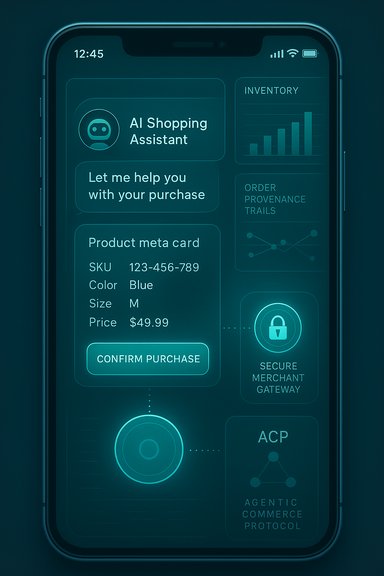
Agentic commerce describes a structural shift: the conversational interface becomes the marketplace front end and the checkout is executed by an AI agent acting on a user’s behalf. Unlike legacy chatbots that end with a link or suggest a product, agentic assistants run multi‑step flows—gathering constraints (budget, size, delivery window), consulting real‑time product and inventory APIs, asking for user confirmation, and then triggering a tokenized payment or delegated checkout session so the merchant’s fulfillment systems handle the rest. This pattern requires three pieces to work in practice: machine‑readable product metadata, a secure delegated payment primitive, and an orchestration runtime that manages tool calls, retries, and provenance. Retailers and platforms are converging on the same plumbing. OpenAI’s Instant Checkout—built with Stripe and described publicly as using an open Agentic Commerce Protocol (ACP)—lets ChatGPT users buy single items from Etsy today and will expand to Shopify merchants and beyond; similar in‑chat payments pilots and proprietary assistants are live at Lowe’s, Amazon and Walmart. These launches move conversational discovery into a transactional surface and invite new operational and security trade‑offs. What’s changed and why it matters
- From links to actions. The web’s historical pattern—search → click → checkout—is being shortened to ask → confirm → done. Platforms can now keep users inside a single conversation for the full purchase funnel.
- New monetization vectors for platforms. When checkout moves into the assistant, platforms gain leverage over discoverability, placement, and transaction fees; merchants trade distribution for tighter dependency on platform rules and attribution models.
- Engineering becomes product strategy. Success depends on accurate, machine‑readable catalogs, low‑latency APIs for inventory and fulfillment, tokenized payments, and observability that links an agent’s decision path to an order for dispute resolution.
Who’s already live (examples you should know)
OpenAI / ChatGPT: Instant Checkout (Etsy, Shopify, soon Walmart)
OpenAI’s Instant Checkout enables single‑item purchases inside ChatGPT today, starting with U.S. Etsy sellers and rolling toward Shopify merchants. The feature relies on the Agentic Commerce Protocol co‑developed with Stripe and is explicitly designed to leave merchants as the merchant‑of‑record while the assistant orchestrates checkout and confirmation. Early coverage shows merchant enrollments and share price moves for public partners after the announcement.Lowe’s: Mylow (customer advisor) and Mylow Companion (associates)
Lowe’s has launched Mylow, a customer‑facing AI advisor that helps with project how‑to guidance and product discovery (examples include troubleshooting a leaky faucet or planning a tabletop refinish), and Mylow Companion, an associate tool rolled out broadly to help store employees answer product and inventory questions. Lowe’s built these experiences with OpenAI technologies and has made Mylow available on web and app touchpoints.Amazon: Rufus and other in‑app experiences
Amazon has introduced Ranger‑style shopping aids (branded features such as Rufus and other interest‑prompt systems) that use internal LLMs and catalog data to recommend and summarize products for shoppers inside the Amazon app; these are examples of a retail giant building agentic‑style discovery tightly coupled to its catalog and fulfillment. Amazon also pilots generative features like short audio summaries to accelerate product discovery.Walmart and other big retailers
Walmart has partnered with AI platforms to let users shop via conversational assistants in pilot or phased rollouts, aligning catalog APIs and checkout flows with agentic checkouts. Several outlets reported integrations that bring Walmart’s catalog into agentic chat purchase pilots.Shopify: Sidekick and merchant‑facing AI
Shopify’s Sidekick is a merchant‑centric conversational assistant that helps store owners automate tasks, generate content, and surface analytics. In parallel, Shopify is preparing merchant catalogs and Shop Pay/Shopify Payments flows to be agent‑ready so third‑party assistants can complete purchases without a classic browser checkout. Sidekick’s adoption numbers and Shop Pay GMV growth are repeatedly cited by the company as evidence that AI will amplify conversion if product and payments plumbing are in place.Microsoft / Copilot and enterprise assistants
Microsoft’s Copilot and enterprise agents are being extended to support transactional capabilities in business workflows and to integrate with commerce endpoints where organizations choose to expose them. Copilot’s approach emphasizes enterprise governance and connector‑based consent models rather than a single marketplace model.These examples map to three platform strategies: platform‑first assistants that host commerce (OpenAI/ChatGPT), retailer/brand‑owned agents (Lowe’s, Amazon), and commerce platforms that prepare merchants for agentic discovery (Shopify). Each strategy has trade‑offs in control, fees, and brand voice.
The technical plumbing: protocols, tokens, and orchestration
Agentic Commerce Protocol (ACP) and product feeds
ACP is a specification intended to let an assistant request product metadata, create checkout sessions, and hand an order to an existing merchant backend while preserving merchant control of fulfillment and returns. It formalizes the messaging between agent and merchant so assistants can reliably create an order without crawling or scraping product pages. OpenAI and Stripe have published documentation and pilots referencing ACP as the core commerce contract.Tokenized / delegated payments
A crucial security primitive is delegated payments—ephemeral tokens or scoped virtual cards that allow an agent to instruct a payment without learning raw card data. Payment processors and card networks are building APIs for short‑lived credentials that can be revoked and audited, reducing exposure while enabling in‑chat checkout. Merchants must make sure these tokens map to auditable order provenance in their systems.Stateful agent orchestration and provenance
Agent runtimes manage planning, tool selection, retries and fallbacks. They must record the chain of actions that led to a purchase (intent → options presented → selection → confirmation → payment token issuance) so disputes, fraud checks and customer service can reconstruct what happened. That provenance is essential for merchant trust and regulatory compliance.Practical merchant playbook (what to do now)
For merchants and IT teams, agentic commerce is not a matter of “if” but “how soon.” The practical steps are straightforward but require engineering investment.- Ensure catalog hygiene: canonical SKUs, GTIN/UPC/ASIN where available, normalized titles, complete attribute sets (size, color, material). Agents rely on structured metadata to match intent.
- Expose real‑time inventory and fulfillment metadata: stock levels, shipping windows, lead times, and regional constraints must be machine‑readable to avoid agent‑led cancellations.
- Adopt delegated payment support and test token flows: support shared token APIs or Stripe/ACP delegated payments so agents can initiate secure checkouts without storing credentials.
- Build robust observability: log the full path from a chat prompt to the order ID, including agent ID, tool calls, and the decision path so disputes and audits are resolvable.
- Prepare customer service and dispute playbooks to handle agent‑originated orders, including explicit mapping of agent authorizations and how to escalate ambiguous cases.
- Start small: pilot single‑item, low‑complexity SKUs (consumables, warranties, replacement parts).
- Measure conversion quality: track returns, disputes and lifetime value for agentic orders—don’t rely only on top‑line conversion lifts.
- Maintain diversified discovery: continue investing in SEO, marketplaces and owned channels to avoid dependency on a single assistant.
Security, fraud, and privacy risks (and mitigations)
Agentic commerce reduces friction but opens new attack surfaces.- Token misuse and replay attacks. Scoped tokens must be time‑limited, revocable, and tied to strong device or session signals. Merchants should implement rapid revocation and abnormal‑pattern detection to minimize exposure.
- Prompt injection and tool chain attacks. Agents that call external tools can be induced to perform unintended actions if input sanitization and tool permissions are weak. Red teams should run chain‑of‑actions scenarios that emulate malicious tool‑chaining.
- Unauthorized purchases and social engineering. Confirmations must be clear and require explicit consent for agent‑initiated charges; for high‑value purchases add second‑factor checks or human review.
- Privacy and data governance. Platforms must make consent flows transparent about what personal data agents can access, what memory is stored, and how profile signals are reused for personalization or ranking. Merchants and platforms should publish agent identity, vetting, and KYA (Know‑Your‑Agent) processes.
Competitive and commercial dynamics
Agentic commerce reshapes three battlegrounds:- Protocol control. Whoever defines the semantics of ACP/MCP and token scopes shapes interoperability and merchant economics. Open standards reduce lock‑in; platform‑owned protocols increase capture.
- Checkout ownership. The entity controlling the checkout rails (Shop Pay, Stripe, card networks, OpenAI/assistant wallets) controls fees, attribution and the flow of post‑purchase data. Merchant economics will be sensitive to who owns the “last click” when that last click happens inside an assistant.
- Discovery economics. Assistants can favor deep integrations, merchants that pay for premium placement, or those that optimize specifically for assistant visibility. This could compress long‑tail visibility if discoverability is tied to instant‑purchase readiness.
Measuring the new funnel: metrics that matter
Traditional last‑click metrics undercount assistant influence. New KPIs are required:- Agent‑sourced conversions (with agent ID and intent hash).
- Conversion quality index (returns, disputes, net LTV).
- Time‑to‑fulfillment and cancellation rate for agentic orders.
- Fraud signal rate normalized by order value and channel.
A cautionary note: hype, cancellations, and governance
Agentic commerce is promising but complex. Analysts warn that poorly governed projects will be canceled or fail to deliver measurable ROI; governance, measurement, and careful use‑case selection separate winners from the rest. Over‑promising agentic capabilities (so‑called agent washing) risks wasted investment and eroded trust if a “shopping assistant” is really just a rebranded retrieval chatbot without secure checkout or real‑time inventory integration. Build governance from Day One: vet agents, require registries, implement logging, and mandate human‑in‑the‑loop controls for ambiguous or high‑value flows.Two practical guardrails to avoid costly mistakes:
- Start with constrained, measurable pilots (single‑item consumables, subscription renewals, simple B2B procurement).
- Compel engineering teams to deliver end‑to‑end observability before scaling the channel.
Action checklist for WindowsForum readers and IT decision‑makers
- Audit and normalize product metadata now: SKUs, GTINs, attribute matrices.
- Instrument end‑to‑end logs: connect chat prompts to order IDs with agent and token metadata.
- Pilot delegated payments and test token revocation flows in a sandbox.
- Run adversarial tests: prompt injections, token replay, and chained tool misuse.
- Negotiate platform terms that include clear fee schedules, audit rights, and dispute resolution guarantees.
- Maintain owned channels—email, app, direct site—while experimenting with agentic surfaces.
Final analysis: opportunity balanced with operational risk
Agentic commerce delivers an attractive value proposition: higher conversion by collapsing discovery and checkout, deeper personalization, and new distribution channels for merchants that are engineering‑ready. The same features, however, magnify operational complexity: inventory grounding errors, token misuse, attribution opacity, and regulatory scrutiny are real and material.The strongest arguments for optimism are practical: platforms and payment firms are converging on shared primitives (ACP/MCP, delegated tokens), merchants can test low‑risk categories first, and first movers who invest in catalog and payments hygiene gain outsized visibility. Yet prudence is essential: treat reported conversion multipliers and growth figures as directional until corroborated by independent audits; insist on auditable logs and contractual clarity when integrating with assistants; and require scoped tokens and revocation as non‑negotiable security features.
Agentic commerce is no longer an experiment. It is a fast‑moving ecosystem rewire that touches product data, payments, customer service, fraud prevention, and regulatory compliance. For IT leaders and merchants, the choice is between treating this as a strategic engineering initiative or risking loss of visibility to whoever controls the conversational surface. The technical details matter: clean data, robust APIs, scoped payments, and observability will decide who benefits when agents start doing the buying for customers.
Conclusion
The arrival of agentic shopping assistants—from retailer‑built advisors like Mylow to platform‑driven Instant Checkout inside ChatGPT—marks a turning point: conversational interfaces are now engineered to complete commerce, not just facilitate discovery. That change invites new convenience and conversion upside, but it also demands rigorous engineering, tokenized payment rails, clear governance, and legal clarity. Merchants and IT teams that move early with the right engineering investments and risk controls will capture a profitable slice of a new discovery channel. Those that wait or treat agentic commerce as a marketing add‑on risk being sidelined by assistants that will increasingly decide what buyers see—and what they can buy—with a single tap.
Source: ADWEEK Agentic Commerce Is Here: Meet 6 Chatbots Ready to Help You Shop
