

GitHub has opened a technical preview of Agentic Workflows — a new way to run AI agents inside GitHub Actions that promises to extend repository automation from deterministic CI/CD tasks into a continuous AI paradigm where agents act on events, triage issues, review pull requests, and even propose code changes under tightly scoped guardrails.
Agentic Workflows are an evolution of prior "agent mode" features and the broader Copilot investments that let models operate beyond single-turn suggestions. Instead of writing complex GitHub Actions YAML by hand, developers author intent in plain Markdown; the
This is not merely a convenience play. By lowering the friction of expressing repository-level policies and automations in natural language, GitHub is attempting to make certain classes of maintenance and quality work (triage, documentation upkeep, test generation, CI failure analysis) inexpensive and continuous — not only when humans trigger them. The potential productivity lift is substantial, but so are the security, trust, and governance challenges that come with letting autonomous agents operate on source repositories.
This separation matters: some teams will prefer the full control of embedding an agent runtime in their own environment (and applying their own network and identity controls). Others will want the simplicity of agentic workflows running inside GitHub Actions with GitHub-managed guardrails. Both paths exist, and GitHub appears to be enabling both.
However, the technology is still new. Early previews, SDKs, and research demonstrators show promise, but the critical work will be in proving that guardrails scale, that red-team attacks can be detected and mitigated, and that cost and model governance are practical for organizations of all sizes. The direction is clear: continuous AI is becoming a tangible engineering pattern — but it will require discipline, tooling, and governance to be safe and valuable at scale.
The feature set and documentation show strong awareness of the risks and a well-architected set of mitigations; the remaining work — for GitHub, security teams, and the community — is to stress-test those mitigations in the real world, iterate on policy controls, and build the operational practices that will let agentic automation deliver on its promise without becoming a new class of hazard.
Note: community threads and internal previews have already discussed adjacent agent capabilities such as Copilot's Agent Mode and the Copilot SDK; those conversations echo the same design trade-offs and guardrail concerns described above and are useful additional reading for teams planning pilots.
Source: theregister.com GitHub previews Agentic Workflows
 Background: what GitHub is building and why it matters
Agentic Workflows are an evolution of prior "agent mode" features and the broader Copilot investments that let models operate beyond single-turn suggestions. Instead of writing complex GitHub Actions YAML by hand, developers author intent in plain Markdown; the gh aw CLI compiles that Markdown into Actions YAML and an agent (for example, GitHub Copilot CLI, Claude Code, or other coding agents) executes the workflow inside a sandboxed environment. GitHub positions this as part of a larger continuous AI engineering paradigm — an “agentic evolution of continuous integration” where long-running, event-driven AI behavior augments existing automations.This is not merely a convenience play. By lowering the friction of expressing repository-level policies and automations in natural language, GitHub is attempting to make certain classes of maintenance and quality work (triage, documentation upkeep, test generation, CI failure analysis) inexpensive and continuous — not only when humans trigger them. The potential productivity lift is substantial, but so are the security, trust, and governance challenges that come with letting autonomous agents operate on source repositories.
How Agentic Workflows work: a technical overview
Authoring and compilation
- Workflows are authored as Markdown files placed in
.github/workflows/. - The
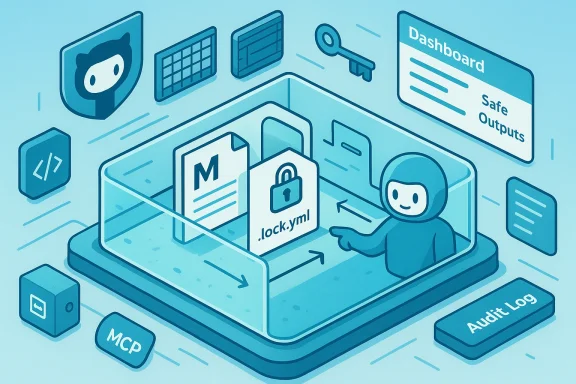
gh awCLI converts the Markdown intent into an audited, compiled GitHub Actions YAML (.lock.yml) that is the executable artifact committed to the repo. - The compiled workflow contains explicit triggers, declared permissions, and allowed outputs; the original Markdown remains the human-editable source.
Execution model
- Agentic steps run inside isolated containers with restricted network access and no write permissions to the repository by default.
- Agents are given read-only access to the repository and may request write actions only through Safe Outputs, a permissioned, pre-approved subsystem that deterministically applies limited changes (for example, creating a single PR with constrained content).
- Tools and external capabilities must be explicitly allowlisted; the runtime enforces a defense-in-depth model across compile-time validation, runtime isolation, permission separation, and output sanitization.
Agent choices and tooling
- The platform is model-agnostic: GitHub Copilot CLI is the default, but agentic workflows can also use other coding agents and models. The GitHub Copilot SDK — the agent runtime used by Copilot CLI — is available for embedding agentic loops into other apps, and it entered preview earlier this year.
Guardrails and security architecture — what's actually protected
Security is central to the agentic workflows narrative. GitHub has implemented multiple layers intended to reduce attack surface compared to simply running an agent CLI inside an Action:- Read-only default: Agents cannot write to the repo unless Safe Outputs explicitly allow a constrained write operation. This reduces blast radius for prompt-injection or malicious event payloads.
- Sandboxed execution: Each agentic step executes in an isolated container with network controls and restricted system capabilities.
- Network allowlisting: Access to the wider internet is blocked or restricted to specified destinations; outbound calls must be declared and allowed.
- Compilation-time validation: The Markdown-to-YAML compilation (
gh aw compile) performs validation and produces a locked workflow file; teams commit the compiled artifacts so the actual runtime code is auditable. - Sanitization and Safe Outputs: User inputs are sanitized before handing them to agents, and any requested writes go through a controlled "safe outputs" subsystem where the agent proposes a limited set of pre-approved actions; the Actions runner or a review job applies changes under controlled conditions.
- Audit logs and cost visibility: Agent runs emit detailed logs and token usage metrics; an
auditcommand surfaces token consumption and estimated costs to repository maintainers. (Docs caution that actual costs vary by workflow complexity.)
Typical use cases and practical limits
GitHub and the GitHub Next team emphasize a set of pragmatic day-one and early-adopter scenarios that make sense for agentic automation:- Issue triage: analyze new issues, tag them, prioritize, and assign owners based on intent and historical signals.
- Automated PR review: produce a structured review comment, suggest code improvements, and flag potential security or dependency issues (without auto-merging).
- CI failure analysis: investigate flaky tests or failing jobs, produce a human-readable report and suggested next steps.
- Documentation upkeep: identify stale docs or missing examples and propose PRs that update or expand docs.
- Test coverage improvements: flag untested areas and propose test skeletons or new tests for coverage gaps.
- Scheduled repository health reports: run periodic analyses that produce structured repository health metrics.
Risks and attack surfaces: what to watch for
Agentic Workflows significantly expand the classes of inputs that can cause code-affecting actions. Even with guardrails there are several high-risk scenarios developers and security teams must consider.1) Prompt injection via repository events
Public repositories often receive external contributions and comments. A maliciously crafted issue, PR, or comment could attempt to manipulate an agent's prompt or tool usage. GitHub's sanitization and safe-input tooling reduce this class of attack, but sanitized inputs are not invulnerable to clever chaining or implicit context leakage. Attackers may use subtle context to steer an agent toward disallowed outputs.2) Rogue MCP servers or tool abuse
Agentic Workflows can be extended with Model Context Protocol (MCP) tools that expose external data. If a tool is improperly defined or an external MCP server is compromised, it could feed malicious or sensitive data back to the agent. The documentation calls out the need to carefully define tool allowlists and trust boundaries.3) Data exfiltration and secrets exposure
Although agents run read-only by default, logs, intermediate artifacts, or Safe Outputs could inadvertently leak secrets if the workflow is misconfigured or if the agent returns unexpected structured content that is then committed or printed. Enterprises must integrate DLP controls, secret scanning, and RBAC to minimize this risk.4) Non-determinism and reproducibility concerns
Agentic steps can produce different outputs across runs. This nondeterminism is a feature for exploratory automation, but it complicates debugging, auditing, and compliance if used for business-critical operations. GitHub's approach to compile-time locks, audit logs, and pre-approved outputs mitigates this, but teams must avoid using agentic workflows where determinism is a hard requirement.5) Cost unpredictability
AI workloads consume tokens and compute in ways that are less predictable than standard CI jobs. While GitHub surfaces usage metrics in logs and provides an audit command for token usage, early adopters report cost variability. Teams should instrument cost controls and set conservative budgets for agentic experiments.Governance and enterprise adoption: best practices
Organizations that want to pilot agentic workflows in a production context should treat them like any new powerful automation: start small, add governance, and audit continuously.Recommended rollout steps
- Sandbox first: run agentic workflows only in isolated test repos or forks where no write operations are allowed.
- Define strict permissions: use the least privilege model; default to read-only, and only enable Safe Outputs for very constrained operations with human approval gates.
- Tool allowlists and MCP reviews: establish a catalog of approved MCP servers and tools that an agent can call. Review these periodically.
- Review and commit compiled artifacts: require that the
.lock.ymlcompiled workflow be reviewed and approved in a normal PR before enabling it in production. - Integrate auditing and DLP: ensure logs feed into SIEM and that secrets scanning and DLP policies run on generated outputs.
- Cost caps and usage alerts: set token and runtime spending alerts to avoid runaway costs.
Policy points for security teams
- Treat agentic workflows as a unique capability in the org’s threat model; document acceptance criteria for what an agent can and cannot do.
- Require human-in-the-loop for any code-change commits or merges proposed by agents.
- Log and retain full transcripts of agent interactions and the compiled YAML for later forensic review.
Developer experience: authoring, debugging, and observability
GitHub's user-facing UX for agentic workflows balances natural-language authoring with familiar Actions ergonomics.- Author in Markdown: teams write intent in Markdown which is easier to read, version, and review than large YAML blobs. The generated
.lock.ymlis committed so the workflow remains auditable. - CLI tooling:
gh aw compile,gh aw run, andgh aw logshelp developers compile, test, run, and inspect workflows locally and in CI. Debugging can be iterative: compile, run in a sandbox, adjust prompts, and recompile. - Observability: workflow logs include structured telemetry, token usage, and decision trees the agent followed. This transparency helps teams understand agent reasoning and catch misbehaviors early.
Developer tooling beyond Actions: Copilot SDK and embedding the agent runtime
GitHub's Copilot SDK — the production-tested agent runtime that powers Copilot CLI — is available in preview for teams that want to embed agentic loops into apps and services. The SDK exposes the multi-turn execution loop, tool integration, and model routing used by Copilot, which lowers the cost of building agentic features outside of Actions. This allows companies to run agentic logic in their own runtime while still leveraging GitHub’s safety design patterns.This separation matters: some teams will prefer the full control of embedding an agent runtime in their own environment (and applying their own network and identity controls). Others will want the simplicity of agentic workflows running inside GitHub Actions with GitHub-managed guardrails. Both paths exist, and GitHub appears to be enabling both.
Real-world considerations and unanswered questions
While GitHub's docs and changelog paint a careful picture, early adopters must wrestle with operational and legal questions that are not fully resolved in preview.- How resilient are the sanitization and safe-output checks against imaginative prompt-injection attacks? The docs outline mitigation strategies but also acknowledge that agentic systems are a new attack surface. Vigilant monitoring and red-team testing will be essential.
- Who owns the provenance when agents propose changes? Audit trails help, but organizations must define policies about attribution, liability, and who signs off on agent-proposed code.
- How will regulatory/compliance regimes treat nondeterministic agentic operations in critical systems? For industries with strict audit trails and change controls, agentic workflows will need integration with compliance tooling and human approvals to be viable.
- What about model drift and dependence on third-party models? Agentic behavior depends on underlying model capabilities. Teams should plan for model changes, differential behavior across model versions, and fallback strategies.
Strengths: where agentic workflows really shine
- Lowered friction for automating complex, judgment-based tasks: authoring intent in Markdown democratizes automation across maintainers, not just CI engineers.
- Integrated safety controls: read-only defaults, Safe Outputs, and compile-time locking are promising primitives that make agentic automation safer than ad-hoc agent CLIs inside workflows.
- Model-agnostic design: the same workflow format can target different coding agents, reducing lock-in and enabling migration as models evolve.
- Observability & auditability: compiled artifacts, logs, and token usage metrics support governance and forensic review.
Risks and policy recommendations: what teams should demand from the platform
- Deterministic safe-outputs enforcement: require cryptographic or policy-level guarantees that safe-outputs cannot be bypassed at runtime.
- Independent security evaluation: suppliers and enterprises should commission red-team testing specifically against prompt-injection and MCP-server hijack scenarios.
- Formal SLAs and cost controls: early previews lack firm pricingdand predictable billing for agentic runs.
- Model provenance and versioning: workflows should record which model and model version was used, so behavior can be audited and reproduced where necessary.
Early adopter checklist: how to pilot responsibly
- Start with non-critical repos and disable Safe Outputs.
- Require PR reviews for any compiled
.lock.yml. - Integrate SIEM ingestion of agent activity logs.
- Use token and runtime caps, and monitor cost dashboards.
- Conduct internal red-team prompt injection tests and publicly disclose issues found to build community defense patterns.
The bigger picture: continuous AI and the future of software engineering
Agentic Workflows are a thoughtful, incremental step toward a future where AI agents handle many of the repetitive and diagnostically heavy parts of software engineering. GitHub’s emphasis on compile-time checks, sandboxing, and auditability acknowledges the real skepticism that enterprise security teams have about letting autonomous systems touch code repositories. If GitHub nails the operational model and can demonstrate that guardrails are robust in the wild, agentic workflows could reshape how teams think about maintenance, quality, and dev efficiency.However, the technology is still new. Early previews, SDKs, and research demonstrators show promise, but the critical work will be in proving that guardrails scale, that red-team attacks can be detected and mitigated, and that cost and model governance are practical for organizations of all sizes. The direction is clear: continuous AI is becoming a tangible engineering pattern — but it will require discipline, tooling, and governance to be safe and valuable at scale.
Conclusion
GitHub's Agentic Workflows convert natural-language intent into audited, sandboxed agent runs inside Actions, pairing the flexibility of AI agents with a security-first architecture that includes read-only defaults, Safe Outputs, network controls, and compiled lockfiles. The preview is a significant milestone in the move toward continuous AI, and it unlocks new classes of repository automation while explicitly preserving the deterministic nature of traditional CI/CD for builds and releases. Early adopters can achieve meaningful productivity gains in triage, documentation, and CI investigation — but only by following strict governance, starting small, and treating the new attack surfaces with the same rigor used for supply-chain and CI security.The feature set and documentation show strong awareness of the risks and a well-architected set of mitigations; the remaining work — for GitHub, security teams, and the community — is to stress-test those mitigations in the real world, iterate on policy controls, and build the operational practices that will let agentic automation deliver on its promise without becoming a new class of hazard.
Note: community threads and internal previews have already discussed adjacent agent capabilities such as Copilot's Agent Mode and the Copilot SDK; those conversations echo the same design trade-offs and guardrail concerns described above and are useful additional reading for teams planning pilots.
Source: theregister.com GitHub previews Agentic Workflows
