

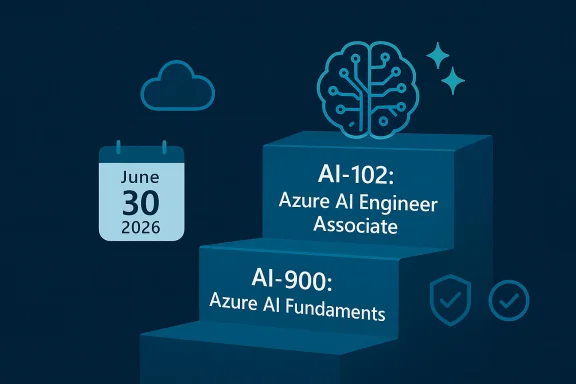
Microsoft’s AI certification ladder is drawing fresh attention again, and for good reason: the AI-900: Microsoft Azure AI Fundamentals exam remains one of the most visible entry points into Azure AI skills, even as Microsoft prepares to retire the credential on June 30, 2026. At the same time, Microsoft’s broader certification strategy is increasingly pushing learners from fundamentals into role-based paths such as AI-102: Azure AI Engineer Associate, reflecting a market that now wants proof of job-ready capability, not just awareness of AI terminology. That shift matters for students, career changers, and working IT professionals alike, because the certification path is becoming a roadmap for how Microsoft expects cloud and AI talent to grow. It also shows how quickly the certification economy is adapting to the rise of generative AI, responsible AI practices, and enterprise demand for applied skills.
Microsoft certifications have never been static badges, but the pace of change has accelerated as cloud and AI have moved from side projects to core infrastructure. The company’s current model is built around fundamentals, role-based certifications, and newer Applied Skills credentials, each intended to signal a different level of readiness. In practice, that means learners are no longer just collecting logos; they are trying to match credentials to actual work responsibilities, whether those are help desk support, cloud administration, data engineering, or AI solution design. The result is a more career-shaped certification ecosystem and a much more competitive one.
The AI-900 exam sits at the starting line of that journey. Microsoft describes Azure AI Fundamentals as a beginner-level credential aimed at candidates with technical and non-technical backgrounds who want to demonstrate knowledge of machine learning, AI concepts, and Azure’s AI services. The official study guide makes clear that the exam covers AI workloads, machine learning principles, computer vision, NLP, and generative AI, which tells you exactly where Microsoft thinks the entry-level AI conversation now lives. This is no longer an exam about abstract AI theory alone; it is a primer for understanding how Azure packages AI into usable services.
The certification’s timing is important. Microsoft has announced that AI-900 will retire on June 30, 2026, which means candidates still have a narrow window to earn it before it disappears from the active catalog. That retirement does not mean Azure AI fundamentals have become irrelevant. If anything, it signals that Microsoft is consolidating the market around more applied, role-based AI credentials, especially AI-102, which focuses on designing and implementing Azure AI solutions with Azure AI Services, Azure AI Search, and Azure OpenAI.
That helps explain why articles and forum discussions around AI-900 have become more career-oriented. In the uploaded material, the WindowsForum discussion on what ows a recurring pattern: once learners pass the fundamentals exam, they start asking whether to move into AI-102 or branch into data-focused certifications such as DP-100 or DP-900. That is exactly the kind of progression the Microsoft ecosystem encourages, because the fundamentals credential is meant to be a launchpad, not a destination.
There is also a broader industry signal at work here. Employers are increasingly looking for candidates who can do more than describe AI in vague business terms. They want people who can reason about model selection, data flows, security, governance, and the responsible use of AI in enterprise environments. Microsoft’s certification architecture mirrors that reality by making the first step broad, but the next steps much more specialized. In other words, AI-900 is still the door, but AI-102 is where the corridor starts to narrow into a real role.
The exam content also reveals Microsoft’s priorities. The study guide shows a strong emphasis on generative AI workloads, which now account for a meaningful slice of the exam blueprint. That matters because it demonstrates that Microsoft is no longer treating generative AI as an advanced side topic. It has become a first-class concept in the fundamentals layer, which is a strong sign of how quickly AI expectations have shifted across the industry.
It also helps organizations standardize onboarding. A junior analyst, support specialist, or business stakeholder who has passed AI-900 is more likely to participate meaningfully in planning conversations. That can shorten the time it takes for teams to move from hype to implementation, which is one reason fundamentals certifications remain relevant even when they do not map directly to a job title.
Key takeaways:
The retirement also strengthens the case for role-based pathways. AI-102 is the clearest successor path for learners who want to build and deploy AI solutions rather than merely understand the landscape. Microsoft’s own AI Engineer Associate page frames the role around designing AI solutions with Azure AI Services, AI Search, and Azure OpenAI, which is a much more operational and architectural skill set than the fundamentals exam.
That urgency is not just psychological. For candidates who want a Microsoft-based AI pathway, there may be value in securing the credential now, even if they ultimately plan to move on to AI-102. The fundamentals exam can still serve as a learning checkpoint and a résumé signal during the remaining window. That said, it is not likely to stay strategically important forever if Microsoft continues pushing learners toward deeper, role-specific work.
Practical implications:
This distinction matters because the jobs are different. AI-900 aligns with awareness and basic fluency. AI-102 aligns with design, implementation, and operational decision-making. The latter is where the job market is headed, especially for enterprises adopting retrieval-augmented generation, document intelligence, conversational AI, and model-backed workflows.
For readers mapping a path, a reasonable sequence is:
That renewal structure matters because it changes how professionals think about certification. A badge is no longer a one-time event; it is part of an ongoing maintenance cycle. That is especially valuable in cloud and AI, where Azure services, AI tooling, and best practices can shift dramatically inside a single year.
This also helps Microsoft defend the credibility of its role-based credentials. If a certification is meant to represent current competence, then renewal has to be part of the bargain. That is why Microsoft’s policy distinguishes between fundamentals and role-based paths, and why AI-102 will likely continue to matter even as AI-900 sunsets.
Important points:
Microsoft’s broader certification stack gives several possible directions. Candidates interested in data and machine learning can move toward DP-100 or DP-900. Those focused on cloud infrastructure may branch into Azure administration or security. Those looking for a faster validation of practical job tasks may increasingly find Applied Skills credentials useful as complements to broader certifications.
For job seekers, a smart sequence often looks like this:
For consumers, the effects are less visible but still real. Better-trained teams tend to deploy more stable systems, handle AI integration more responsibly, and make fewer mistakes with data or configuration. That matters when AI features are embedded into customer support, productivity apps, document processing, and business workflows. The badge is invisible to the user, but the consequences are not.
The same logic applies to internal mobility. A support technician who earns AI-900 and then AI-102 is easier to move into an AI-adjacent project, especially in a Microsoft-heavy shop. The certification gives managers a shorthand for who can be trusted with more complex responsibilities.
Key impacts:
The real question is how quickly the market absorbs that shift. If AI adoption keeps accelerating, then candidates will need to prove not just that they understand the vocabulary of AI, but that they can deploy services, handle data responsibly, and work within enterprise governance constraints. The badge remains useful, but the surrounding evidence will matter more than ever. That is the direction the market is already moving in.
Watch for these developments:
Source: businessnewsthisweek.com microsoft azure ai fundamentals ai-900 certification Archives
Source: AZ Big Media Complete guide to building a cloud and AI career with Microsoft certifications - AZ Big Media
 Background
Microsoft certifications have never been static badges, but the pace of change has accelerated as cloud and AI have moved from side projects to core infrastructure. The company’s current model is built around fundamentals, role-based certifications, and newer Applied Skills credentials, each intended to signal a different level of readiness. In practice, that means learners are no longer just collecting logos; they are trying to match credentials to actual work responsibilities, whether those are help desk support, cloud administration, data engineering, or AI solution design. The result is a more career-shaped certification ecosystem and a much more competitive one.The AI-900 exam sits at the starting line of that journey. Microsoft describes Azure AI Fundamentals as a beginner-level credential aimed at candidates with technical and non-technical backgrounds who want to demonstrate knowledge of machine learning, AI concepts, and Azure’s AI services. The official study guide makes clear that the exam covers AI workloads, machine learning principles, computer vision, NLP, and generative AI, which tells you exactly where Microsoft thinks the entry-level AI conversation now lives. This is no longer an exam about abstract AI theory alone; it is a primer for understanding how Azure packages AI into usable services.
The certification’s timing is important. Microsoft has announced that AI-900 will retire on June 30, 2026, which means candidates still have a narrow window to earn it before it disappears from the active catalog. That retirement does not mean Azure AI fundamentals have become irrelevant. If anything, it signals that Microsoft is consolidating the market around more applied, role-based AI credentials, especially AI-102, which focuses on designing and implementing Azure AI solutions with Azure AI Services, Azure AI Search, and Azure OpenAI.
That helps explain why articles and forum discussions around AI-900 have become more career-oriented. In the uploaded material, the WindowsForum discussion on what ows a recurring pattern: once learners pass the fundamentals exam, they start asking whether to move into AI-102 or branch into data-focused certifications such as DP-100 or DP-900. That is exactly the kind of progression the Microsoft ecosystem encourages, because the fundamentals credential is meant to be a launchpad, not a destination.
There is also a broader industry signal at work here. Employers are increasingly looking for candidates who can do more than describe AI in vague business terms. They want people who can reason about model selection, data flows, security, governance, and the responsible use of AI in enterprise environments. Microsoft’s certification architecture mirrors that reality by making the first step broad, but the next steps much more specialized. In other words, AI-900 is still the door, but AI-102 is where the corridor starts to narrow into a real role.
What AI-900 Really Proves
At first glance, AI-900 looks like a simple fundamentals exam. In reality, it proves something more subtle: that a candidate can speak the language of modern AI and understand where Azure’s platform services fit into that conversation. Microsoft positions the certification as proof of familiarity with AI workloads, the basics of machine learning, and the main categories of AI services available in Azure. That makes it less about deep engineering and more about platform literacy, which is exactly what many hiring managers want from junior technologists or cross-functional staff.The exam content also reveals Microsoft’s priorities. The study guide shows a strong emphasis on generative AI workloads, which now account for a meaningful slice of the exam blueprint. That matters because it demonstrates that Microsoft is no longer treating generative AI as an advanced side topic. It has become a first-class concept in the fundamentals layer, which is a strong sign of how quickly AI expectations have shifted across the industry.
Why the Fundamentals Layer Matters
The fundamentals tier is often dismissed by experienced engineers as “easy,” but that misses the point. Its real value is in creating a shared vocabulary. For someone moving from non-technical work into cloud or AI, the badge signals that they understand the basics of AI workloads, responsible AI, and common Azure service categories.It also helps organizations standardize onboarding. A junior analyst, support specialist, or business stakeholder who has passed AI-900 is more likely to participate meaningfully in planning conversations. That can shorten the time it takes for teams to move from hype to implementation, which is one reason fundamentals certifications remain relevant even when they do not map directly to a job title.
Key takeaways:
- AI-900 is foundational, not expert-level.
- It validates familiarity with AI concepts and Azure AI services.
- It now includes generative AI as a core topic.
- It is useful for both technical and non-technical backgrounds.
- It provides a stepping stone to more advanced Azure AI credentials.
The Certification Retirement Signal
Microsoft’s decision to retire AI-900 by June 30, 2026 is easy to misread as a downgrade. It is better understood as a product lifecycle decision shaped by the rapid evolution of AI training and credentialing. Microsoft has already made renewal and recertification a central part of its strategy, and retirements help keep the portfolio aligned with current job roles and current technology. That is especially true in AI, where the pace of platform change is far faster than in traditional IT support or desktop administration.The retirement also strengthens the case for role-based pathways. AI-102 is the clearest successor path for learners who want to build and deploy AI solutions rather than merely understand the landscape. Microsoft’s own AI Engineer Associate page frames the role around designing AI solutions with Azure AI Services, AI Search, and Azure OpenAI, which is a much more operational and architectural skill set than the fundamentals exam.
Why Retirement Can Increase Urgency
Retirement notices often create a burst of demand because they introduce a deadline. People who had been casually considering a certification suddenly move faster when they realize a credential may disappear. In this case, AI-900’s retirement may encourage both students and working professionals to grab the fundamentals badge before it is gone.That urgency is not just psychological. For candidates who want a Microsoft-based AI pathway, there may be value in securing the credential now, even if they ultimately plan to move on to AI-102. The fundamentals exam can still serve as a learning checkpoint and a résumé signal during the remaining window. That said, it is not likely to stay strategically important forever if Microsoft continues pushing learners toward deeper, role-specific work.
Practical implications:
- Candidates with AI-900 in progress should pay attention to the retirement date.
- Learning paths that rely on AI-900 as a stepping stone may need revision.
- Employers should expect more candidates to pivot quickly toward AI-102.
- Training providers may increasingly market AI-900 as a transitional credential.
- Microsoft’s own roadmap suggests a stronger emphasis on applied AI roles.
AI-900 vs AI-102
The most important career question around AI-900 is not whether it is useful. It is whether it is the right next move. For people who want to understand AI concepts, it is still the right starting point. For those who want to build real solutions, AI-102 is the more meaningful destination because it maps directly to implementation work in Azure AI.This distinction matters because the jobs are different. AI-900 aligns with awareness and basic fluency. AI-102 aligns with design, implementation, and operational decision-making. The latter is where the job market is headed, especially for enterprises adopting retrieval-augmented generation, document intelligence, conversational AI, and model-backed workflows.
A Simple Decision Rule
A practical way to think about the two credentials is to ask what kind of work you want to do every day. If you want to explain AI concepts, support adoption, or build a foundation for later study, AI-900 still makes sense. If you want to build and ship AI features inside products, AI-102 is the stronger credential.For readers mapping a path, a reasonable sequence is:
- Take AI-900 if you need the fundamentals.
- Build hands-on familiarity with Azure AI services.
- Move into AI-102 once you are ready to design and deploy solutions.
- Add data-focused credentials if your role will intersect with ML pipelines or analytics.
- Reinforce the path with projects and labs, not just exams.
The Role of Microsoft Learn and Renewal
One of Microsoft’s biggest advantages in the certification market is the way it ties learning, exam prep, and credential renewal together. Microsoft Learn is now the center of that ecosystem, and the renewal model reinforces the idea that credentials should stay current with product evolution. Microsoft states that fundamentals certifications do not expire, while associate, expert, and specialty certifications require renewal during a six-month eligibility window.That renewal structure matters because it changes how professionals think about certification. A badge is no longer a one-time event; it is part of an ongoing maintenance cycle. That is especially valuable in cloud and AI, where Azure services, AI tooling, and best practices can shift dramatically inside a single year.
Why the Model Favors Active Practitioners
The Microsoft Learn model rewards people who stay engaged with the platform. Free renewal assessments, updated learning modules, and the ability to renew online create a low-friction system that is still strict enough to preserve the credential’s value. It is a deliberately modern certification system, built for a world where change is constant and learning is continuous.This also helps Microsoft defend the credibility of its role-based credentials. If a certification is meant to represent current competence, then renewal has to be part of the bargain. That is why Microsoft’s policy distinguishes between fundamentals and role-based paths, and why AI-102 will likely continue to matter even as AI-900 sunsets.
Important points:
- Microsoft Learn is the hub for preparation and renewal.
- Fundamentals credentials do not expire.
- Associate, expert, and specialty credentials do expire.
- Renewal is free and done through a short online assessment.
- The model favors people actively using Microsoft technologies.
Career Pathways Beyond AI-900
The forum conversation around AI-900 reflects a broader pattern in Microsoft careers: once learners get the first badge, they immediately start looking for the next logical step. That is healthy, because the fundamentals layer is only really valuable if it leads to hands-on specialization. In the uploaded WindowsForum thread, the most common advice was to choose the next certification based on the kind of daily work a learner wants to do, with AI-102 positioned as the natural next step for AI solution builders.Microsoft’s broader certification stack gives several possible directions. Candidates interested in data and machine learning can move toward DP-100 or DP-900. Those focused on cloud infrastructure may branch into Azure administration or security. Those looking for a faster validation of practical job tasks may increasingly find Applied Skills credentials useful as complements to broader certifications.
Choosing the Right Next Step
The right path depends on your day-to-day target role, not on which exam sounds most impressive. That is the biggest mistake career switchers make: they chase the most recognizable certification insteadto their likely responsibilities. Microsoft’s own structure is designed to prevent that, because the ecosystem intentionally separates orientation, specialization, and advanced ownership.For job seekers, a smart sequence often looks like this:
- Start with a fundamentals exam if you nee role-based credential once you know your target function.
- Add labs, projects, and proof-of-work to strengthen the credential.
- Keep an eye on renewal and retirement notices.
- Use Microsoft Learn as the authoritative source for exam scope.
Enterprise vs Consumer Impact
For enterprises, the value of Microsoft AI certifications is obvious: they shorten hiring cycles, clarify role expectations, and provide a common language for teams deploying cloud services. When a company hires someone with AI-900 or AI-102, it is not merely buying a credential. It is buying a baseline level of platform fluency that can reduce onboarding friction and improve project predictability.For consumers, the effects are less visible but still real. Better-trained teams tend to deploy more stable systems, handle AI integration more responsibly, and make fewer mistakes with data or configuration. That matters when AI features are embedded into customer support, productivity apps, document processing, and business workflows. The badge is invisible to the user, but the consequences are not.
Why Employers Still Care
Employers care because certifications reduce uncertainty. A recruiter can infer that a Microsoft-certified candidate has completed a structured learning process and passed a standardized assessment. That is not a guarantee of performance, but it is a meaningful signal in crowded hiring markets.The same logic applies to internal mobility. A support technician who earns AI-900 and then AI-102 is easier to move into an AI-adjacent project, especially in a Microsoft-heavy shop. The certification gives managers a shorthand for who can be trusted with more complex responsibilities.
Key impacts:
- Faster hiring decisions for technical managers.
- Better alignment between training and job responsibility.
- Lower onboarding risk for cloud and AI initiatives.
- More confidence in cross-functional AI adoption.
- Improved internal mobility for IT professionals.
Strengths and Opportunities
Microsoft’s AI certification model still has real strengths, especially for readers trying to break into cloud and AI work without a computer science degree. It offers a structured path, a recognizable brand, and a clear route from conceptual learning to implementation. The retirement of AI-900 does not erase that opportunity; it simply sharpens the transition toward deeper credentials and more practical work.- Clear entry point for new learners.
- Strong alignment with Azure AI services.
- Useful for both technical and non-technical backgrounds.
- A natural bridge to AI-102 and data certifications.
- Built-in learning support through Microsoft Learn.
- Free renewal model for role-based credentials.
- Strong employer recognition in Microsoft-centric organizations.
Risks and Concerns
The biggest risk is overestimating what a fundamentals badge can do. AI-900 is a valuable starting point, but it is not a substitute for hands-on experience, and it will likely lose some of its market signaling power as the retirement date approaches. Learners who stop at the fundamentals layer may find themselves underqualified for the roles they actually want.- Retirement pressure may cause rushed studying rather than deep understanding.
- Fundamentals-only candidates may appear less competitive for AI jobs.
- The fast pace of AI change can make content feel outdated quickly.
- Credential inflation may push employers to prefer role-based certs.
- Overreliance on certificates can crowd out real project experience.
- Learners may choose the wrong next step without a role strategy.
- AI hype can distort expectations about what certification truly proves.
Looking Ahead
The likely future of Microsoft AI certification is more specialized, more applied, and more tightly aligned with real job tasks. AI-900’s retirement fits that pattern, because Microsoft appears to be concentrating the value proposition around role-based credentials like AI-102 and broader practical learning experiences. That should be good news for employers and serious candidates, even if it reduces the appeal of easy entry-level checkboxes.The real question is how quickly the market absorbs that shift. If AI adoption keeps accelerating, then candidates will need to prove not just that they understand the vocabulary of AI, but that they can deploy services, handle data responsibly, and work within enterprise governance constraints. The badge remains useful, but the surrounding evidence will matter more than ever. That is the direction the market is already moving in.
Watch for these developments:
- More emphasis on AI-102 as the default Microsoft AI career step.
- Greater use of Applied Skills for task-specific validation.
- Increased demand for proof-of-work alongside certifications.
- More retirement notices as Microsoft refreshes AI-related credentials.
- Stronger linkage between learning paths and enterprise AI deployment needs.
Source: businessnewsthisweek.com microsoft azure ai fundamentals ai-900 certification Archives
Source: AZ Big Media Complete guide to building a cloud and AI career with Microsoft certifications - AZ Big Media
