

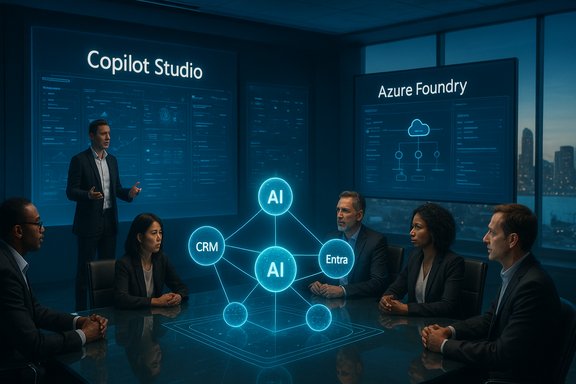
The AI Agent & Copilot Summit is shaping up as the pivotal industry event for organizations and professionals who want to move from curious pilots to production-grade agentic automation — and Avanade’s Global D365 CRM practice lead, Nancie Calder, is one of the practitioners pushing attendees to focus on outcomes, governance, and practical adoption. Her recent Cloud Wars podcast appearance and subsequent role on the Summit’s Programming Committee emphasize a single, recurring theme: the technology is maturing fast, and the conversation must shift from “what is possible” to “what works and how we scale it safely.”
Background / Overview
Microsoft’s Copilot and the broader agent ecosystem have moved from proof-of-concept to a growing set of production capabilities across Microsoft 365, Power Platform, Dynamics 365, and Azure. Event organizers designed the AI Agent & Copilot Summit as an “AI-first” forum to help business and technical leaders define opportunities, measure impact, and plan outcomes for agent-driven automation. The 2026 Summit is scheduled for March 17–19, 2026 at the Hilton La Jolla Torrey Pines in San Diego, and the program emphasizes hands-on masterclasses, practical sessions, and candid case studies rather than marketing theatre. This coverage synthesizes the Cloud Wars podcast interview with Nancie Calder, public Summit materials, Microsoft product documentation, and independent reporting to produce an actionable, evidence-backed briefing for IT leaders, architects, and business sponsors. It verifies key technical claims, calls out areas that need cautious validation, and offers an operational playbook that reflects what attendees should expect to learn and do after the Summit.Why Nancie Calder’s perspective matters
Nancie Calder leads Avanade’s global Dynamics 365 Customer Engagement (CRM) practice and has deep experience translating Microsoft platform capabilities into operational outcomes for customer service, field service, and contact center scenarios. Her role on the AI Agent & Copilot Summit Programming Committee means she has direct influence on session selection and a clear view of what practitioners want to hear: real-world use cases, measured outcomes, and practical guidance for safe rollouts. Calder’s recent remarks to Cloud Wars — that the Summit will host more customer stories demonstrating the shift from conversational Copilots to “agentic” features that can plan, execute multi-step workflows, and integrate with systems of record — reflect the broader platform trajectory Microsoft and ecosystem partners are describing. That trajectory is not vaporware: Microsoft and partners have published documentation and product launches that explicitly enable agent orchestration, identity-bound agents, and standardized data-grounding interfaces.What to expect at the Summit: program and practical themes
The Summit’s agenda is intentionally pragmatic. Organizers have prioritized masterclasses and hands-on sessions that map directly to the problems operational teams face when deploying agents at scale.Key program emphases attendees should expect:
- Real-world customer case studies that show measurable business outcomes rather than abstract demos.
- Masterclasses on Copilot Studio and Azure AI Foundry / Foundry Agent Service to move from design to production.
- Governance, security, and cost-control sessions focused on Agent identity (Entra/Agent ID), logging, and tenant-level controls.
- Tactical workshops for Dataverse grounding, Model Context Protocol (MCP) configuration, and human-in-the-loop validation.
- Peer-to-peer sessions and intimate conversations to surface failure modes and operational playbooks.
The technology reality: what’s production-ready and why it matters
The short version: Microsoft’s stack now provides the authoring, runtime, and governance building blocks required for agentic automation — but these pieces bring both new capabilities and new operational responsibilities.What’s available now (verified):
- Microsoft Copilot Studio: a low-code authoring surface for building conversational and agent-style experiences. It supports publishing to Teams and other channels and integrates with Dataverse for grounding. Official documentation confirms the authoring and publishing flow.
- Azure AI Foundry / Foundry Agent Service: a production-oriented runtime for running agents at scale, with observability, identity, and governance controls. Microsoft’s Foundry docs describe multi-agent orchestration, model selection, and enterprise-grade trust features.
- Dataverse Model Context Protocol (MCP) server: a tenant-controlled gateway that lets agents call standardized operations (list_tables, read_query, create_record, update_record) against Dataverse in a way that’s auditable and governed. Microsoft docs show admins can enable/disable MCP clients and control which MCP clients a tenant allows.
- Entra Agent ID and Agent 365: identity- and control-plane constructs that give each agent a manageable lifecycle, allowing admins to inventory and enforce policies on agents. These features are surfacing in product messaging and partner toolchains.
Cross-checks: multiple independent sources corroborate this stack-level view — Microsoft Learn pages for Foundry and Copilot Studio, the official Summit program, and coverage in mainstream tech press describing MCP and Windows/OS-level agent integration. Together they confirm that the platform is moving from experiment to operational product.
What Nancie says attendees will learn — and why it’s credible
Calder expects the Summit to surface more “agentic” customer stories and exploratory case studies that show how organizations are moving beyond conversational Copilots to multi-step, goal-directed agents. That prediction is supported by both the Summit agenda and by Microsoft’s product direction — which includes features enabling orchestration, agent identity, and grounded access to Dataverse and enterprise data. The programming committee’s selection criteria (real-world use cases, demonstrated outcomes, and safety practices) align with what operational teams need to transition pilots to scale. Practical takeaways Calder highlights:- Focus on holistic outcomes (process redesign + tech) rather than toy demos.
- Balance business and technical perspectives in sessions and projects.
- Emphasize co-creation: partner with users to refine prompts, guardrails, and handoffs.
- Build confidence by instrumenting, measuring, and operating agents as production services.
Strengths and opportunities highlighted by the Summit and partners
- Enterprise grounding and identity-first governance: the combination of Dataverse, Entra, and Foundry gives enterprises a consistent substrate to reduce hallucination risk and enforce least-privilege. That alignment between identity and agents is a major step toward auditable automation.
- Authoring-to-runtime pipeline: Copilot Studio for business-led authoring plus Azure AI Foundry for production hosting reduces friction between citizen developer prototypes and production-ready agents. This two-path approach helps organizations move faster without sacrificing control.
- Peer learning and applied content: the Summit’s emphasis on candid case studies, failure modes, and masterclasses helps reduce the “pilot trap” where organizations pilot indefinitely without measurable ROI. Sessions explicitly focus on governance, telemetry, and cost control.
- Partner acceleration: companies such as Avanade are building agentic platforms and industry templates to accelerate midmarket adoption — reducing time-to-value for common scenarios like contact centers, invoice processing, and HR automation. These partner offerings are now publicly announced and available.
Significant risks and what the Summit is doing to address them
The move to agentic automation is powerful — but the Summit’s agenda also reflects the operational realities and risks practitioners must manage.Primary risks:
- Hallucinations and grounding failures: Agents that generate plausible but incorrect outputs can cause operational risk, particularly when they write back into finance, supply chain, or CRM systems. Mitigations: strong grounding to Dataverse/Foundry, validation stations, human-in-the-loop gates, and RAG (retrieval-augmented generation) patterns. Summit sessions will provide hands-on patterns to reduce these risks.
- Agent sprawl and privileged automation: uncontrolled agents with excessive permissions create both security and compliance risk. Mitigations: Agent registries (Agent 365), Entra-based lifecycle control, and strict governance KPIs. The Summit highlights practical CoE charters and policy enforcement as essential countermeasures.
- Data leakage, connector risk, and “computer use” exposures: features that let agents interact with web UIs or tenant resources require tight DLP, Purview labeling, and penetration testing (red-team prompt-injection). Recent public security reports show token-exfiltration tactics and Copilot Studio-focused social engineering attacks, underlining the need for tenant-level controls and admin oversight. Summit security tracks explicitly cover these attack modes and mitigation strategies.
- Cost and license unpredictability: Copilot credits, compute for model inference, and production hosting can generate runaway costs if not budgeted. Mitigations include environment-level caps, credit metering, and TCO modeling covered in finance-oriented Summit tracks.
A pragmatic playbook for Summit attendees (what to do, day-by-day)
- Before you go:
- Inventory candidate processes: pick one high-value, bounded workflow (e.g., invoice triage, password resets, field-service scheduling). Map data sources, integration points, and SLAs.
- Identify stakeholders: sponsor, process owner, security lead, and a technical owner from your platform team.
- Prepare a one-page hypothesis: expected outcome, measurement, and guardrails.
- During the Summit:
- Prioritize masterclasses on Copilot Studio, Foundry Agent Service, and Dataverse MCP configuration.
- Attend at least one security/red-team session and one finance/chargeback discussion.
- Collect playbooks, templates, and sample agent designs shared by peers.
- Build contacts for post-event proof-of-concept support (partners, Microsoft product engineers, and peer implementers).
- After the Summit:
- Run a Phase-Zero workshop: validate psychological readiness, identify champion users, and confirm pilot metrics.
- Enable MCP in a staging environment and configure a read-only MCP client to validate grounding and telemetry.
- Launch a small, monitor-only fleet of read-only agents to validate logs, identity, and Purview labels before enabling write-backs.
- Create a Copilot/Agent CoE charter: owners, approval flows, telemetry KPIs, cost caps, and escalation playbooks.
- Include regular red-team testing and integrate agent logs into SIEM/Forensics (Sentinel + Purview) for audit readiness.
How AI affects careers and leadership — Calder’s human-centric message
Calder emphasized that the Summit is more than a technical conference: it’s a career accelerator. AI will change job shapes — not just tasks — and professionals who understand how to use agents to amplify their output will gain a competitive edge. That means leaders must invest in role-based reskilling, not generic training, and create career pathways that leverage AI capabilities. The Summit provides a place to discuss these transitions and to network with peers who are actively redesigning roles.Practical implications for HR and leadership teams:
- Re-assess role profiles to emphasize higher-value judgment and oversight.
- Create skill ladders that include prompt engineering, agent design, and data stewardship.
- Promote human-in-the-loop accountability: agents should assist, not replace, human ownership for critical decisions.
Where partners like Avanade fit into the picture
System Integrators and partners such as Avanade are packaging agent templates, pre-built vertical agents, and integration frameworks that reduce time to value for midmarket customers. Avanade’s Agentic Platform and APAC AI Modernization Hub are recent examples of partner-led acceleration for industry scenarios. These offerings typically integrate with Microsoft’s Foundry, Copilot Studio, and Agent 365 control planes to minimize bespoke engineering. If your organization lacks internal scale, partners can shorten the runway — but buyer teams must still insist on transparency in measurement, data portability, and governance.Final assessment — strengths, caveats, and a clear next step
The AI Agent & Copilot Summit is well-timed: the product plumbing (Copilot Studio, Azure AI Foundry, Dataverse MCP, Agent 365) exists to support agentic automation, and partners are creating repeatable IP for common business scenarios. The Summit’s programming, under the guidance of practitioners like Nancie Calder, is focused appropriately on measurable outcomes, safety, and operational playbooks. Attendees should leave with concrete steps to move at least one use case from pilot to a monitored production deployment. However, the path to success requires discipline:- Treat agents as production software: version control, CI/CD, telemetry, and audit trails are non-negotiable.
- Invest in data readiness: grounding is the single most important technical control to reduce hallucination risk.
- Enforce identity and least-privilege on agents: Agent ID and Agent 365 controls must be part of the deployment baseline.
- Budget for operational costs: establish credit metering, environment caps, and monthly governance reviews.
Conclusion
Nancie Calder’s perspective — grounded in enterprise practice leadership and now amplified through the Summit Programming Committee — lines up with where Microsoft’s product teams and independent analysts say the market is heading: from helpful assistants to operational, agentic automation that can take multi-step actions and materially change business processes. The AI Agent & Copilot Summit’s March 17–19, 2026 program intentionally focuses on the mechanics of making that transition real: data readiness, agent design, governance, and measurable outcomes. For IT leaders and practitioners, the Summit is an essential waypoint: attend to gather templates, test patterns, and peer-validated failure modes; depart with a concise pilot plan that treats agents like production systems and people as the central element of success.Source: Cloud Wars AI Agent & Copilot Podcast: Avanade's Nancie Calder on Summit Expectations and Experiences
