

ESW’s new Copilot Orbit™ aims to turn Microsoft Copilot pilot projects into predictable, production-grade automation for small and mid-sized businesses by packaging governance, tenant grounding, Power Platform orchestration, and a month-by-month agent delivery cadence into a single managed service offering.
The AI automation market is rapidly shifting from one-off experiments to continuous operational services. Microsoft has accelerated that transition by building platform primitives — Copilot Studio, tenant grounding, Purview-driven governance, and Power Automate orchestration — that make tenant-aware, auditable agents technically feasible. That platform evolution, paired with a new SMB-friendly Microsoft 365 Copilot Business SKU, has created a window for channel partners to offer managed Copilot services to organizations that lack in-house AI and governance teams. ESW (eSoftware Associates), a U.S.-based Microsoft partner, announced Copilot Orbit™ on December 3, 2025 as a managed program designed to deliver Copilot Agents and end-to-end agentic workflows to small and mid-sized companies. The public announcement and accompanying blog post position Copilot Orbit as a subscription model that combines governance, grounding, agent development, Power Automate workflows, and ongoing tuning — delivered on a steady monthly cadence rather than a single “bot build.”
Independent reporting and Microsoft partner materials confirm the strategic shift: Microsoft’s Copilot platform has matured to include agent authoring, tenant grounding, and governance features that make managed services viable; Microsoft’s SMB pricing further unlocks adoption. The combination of platform capability and channel services creates new opportunities for productivity gains — when implemented with discipline.
Source: IT Business Net https://itbusinessnet.com/2025/12/e...n-services-for-small-and-mid-sized-companies/
 Background / Overview
The AI automation market is rapidly shifting from one-off experiments to continuous operational services. Microsoft has accelerated that transition by building platform primitives — Copilot Studio, tenant grounding, Purview-driven governance, and Power Automate orchestration — that make tenant-aware, auditable agents technically feasible. That platform evolution, paired with a new SMB-friendly Microsoft 365 Copilot Business SKU, has created a window for channel partners to offer managed Copilot services to organizations that lack in-house AI and governance teams. ESW (eSoftware Associates), a U.S.-based Microsoft partner, announced Copilot Orbit™ on December 3, 2025 as a managed program designed to deliver Copilot Agents and end-to-end agentic workflows to small and mid-sized companies. The public announcement and accompanying blog post position Copilot Orbit as a subscription model that combines governance, grounding, agent development, Power Automate workflows, and ongoing tuning — delivered on a steady monthly cadence rather than a single “bot build.” Why Copilot Orbit now matters
Microsoft’s SMB price shift lowers the barrier
Microsoft’s launch of Microsoft 365 Copilot Business, priced at USD 21 per user per month and capped for organizations up to 300 seats, changes the economic calculus for SMBs that want tenant-grounded Copilot features and agents. That SKU makes it practical for smaller organizations to buy the necessary Copilot licenses; the remaining obstacles are operational: data posture, permissions, governance, and deterministic orchestration. ESW’s Copilot Orbit is explicitly aimed at bridging that operational gap.The production gap — why many pilots fail
Experience from integrators and Microsoft’s own customer stories shows the common failure modes when moving agents from pilot to production: messy content hygiene in SharePoint and file stores, inconsistent permissions, missing DLP and sensitivity labeling, lack of test harnesses, unclear ownership of agents, and no FinOps controls for inference/credit consumption. A managed partner that standardizes the remediation, lifecycle controls, and a repeatable delivery pipeline can materially increase the odds of sustained automation value. ESW pitches Copilot Orbit toward that requirement set.What Copilot Orbit offers — feature-by-feature
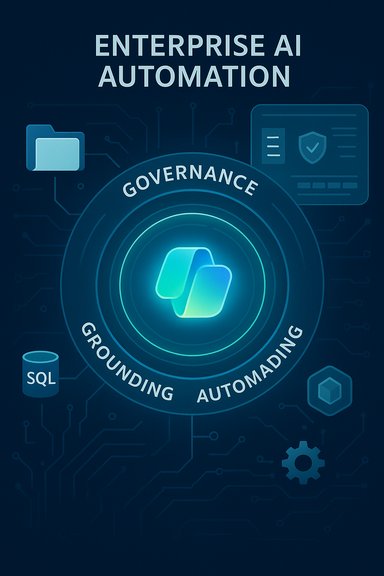
ESW frames Copilot Orbit around four core pillars: governance and security, tenant grounding and connectors, agent and automation development, and a cadence-based delivery model. The public materials describe tiered subscription plans (Core, Plus, Scale) and promise monthly releases of new agents or automations in higher tiers. These are the components ESW emphasizes.Governance, security, and permission oversight
- Mapping of sensitive data and alignment with Microsoft Purview and DLP policies so agent access is constrained by existing sensitivity labels.
- Entra-based agent identities (managed identity principals) to ensure actions are auditable and attributable.
- Telemetry and audit logging integration to feed security monitoring and incident investigation processes.
Grounding with SharePoint, Teams, OneDrive, SQL, Exchange
- Agent grounding is described as indexing and mapping tenant data sources (SharePoint sites, Teams files, Dataverse/SQL tables, and mailboxes) so agents use authoritative sources rather than open web content.
- ESW’s materials emphasize retrieval-augmented generation (RAG) patterns and semantic indices to reduce hallucinations and provide provenance.
Agent and automation development
- Prompt engineering, Copilot Studio authoring, Power Automate flows for deterministic orchestration and retry logic.
- Teams and SharePoint plugins or UX integration for in-context agent access.
- Testing and validation stations with human-in-the-loop checkpoints — especially for write-backs touching finance, HR, or legal systems.
Monthly delivery cadence and lifecycle
- Core: governance, monitoring, backlog management.
- Plus: Core + one new agent/automation delivered per month.
- Scale: Two to three agents/automations per month, plus adoption support and executive reporting.
How Copilot Orbit maps to Microsoft platform realities
Copilot Studio, semantic indexes, and tenant grounding
Microsoft’s Copilot Studio supports tenant graph grounding and semantic indices that improve retrieval quality. To enable these features, a tenant must have appropriate Copilot licenses and set semantic indexes; SharePoint connectors allow files up to certain sizes and types to be used as knowledge sources. In short, the platform already has most of the plumbing Copilot Orbit relies on — the partner’s job is the operational work of configuring, indexing, and remediating tenant content.Entra identities, Purview/DLP, and auditability
Microsoft now treats agents as first-class principals with managed identities. Purview and DLP policies can be applied to control data access, and Defender/Sentinel can ingest telemetry for runtime protection. ESW’s governance-first messaging aligns with Microsoft’s recommended production patterns, which require least-privilege access, lifecycle controls, and audit trails.Power Automate as the deterministic layer
Best practice pairs LLM-driven decisioning with deterministic orchestrators (Power Automate, Logic Apps) for system write-backs, retries, validation, and error handling. ESW explicitly includes Power Automate flows in its development stack, which is necessary to ensure idempotent, explainable, and reversible automation steps in production scenarios.Strengths — where Copilot Orbit can deliver real value
- Operational focus for SMBs. Many smaller organizations can purchase Copilot licenses, but lack the engineering, governance, and change-management capability to produce reliable automations. A managed service that standardizes those functions and provides monthly delivery can help organizations realize measurable value faster.
- Governance-first architecture. By building Purview/DLP alignment and Entra agent identities into the baseline offering, ESW reduces several common regulatory and compliance risks that typically derail agent rollouts.
- Repeatable cadence combats automation decay. A predictable monthly release model incentivizes small wins, continuous measurement (KPIs), and incremental improvements rather than a single, brittle deployment.
- Platform-aligned engineering. Using Copilot Studio, semantic indices, Power Automate, and Microsoft Graph connectors minimizes bespoke code and leverages the Microsoft ecosystem — an approach that reduces integration surface area and long-term maintenance risk.
Risks, caveats, and what buyers must insist on
Data exposure, third-party routing, and contractual clarity
Any managed Copilot program raises critical questions about where tenant data is processed, stored, and retained. Buyers should confirm whether any third-party inference endpoints are used and insist on contractual protections for data processing, retention, and breach notification procedures. If a partner routes tenant content outside the customer’s Microsoft tenancy or to non-Microsoft inference endpoints, that must be explicitly disclosed and contractually limited. The ESW announcement emphasizes Purview/DLP and tenant grounding, but buyers must verify the actual data flows during procurement.FinOps and runaway costs
Agent workloads can consume model inference credits or generate unexpected Power Platform/Dynamic usage charges. A managed service that does not include consumption reporting, monthly caps, or FinOps alerts creates a risk of runaway charges. Buyers should require explicit consumption reporting, monthly capacity packs or caps, and documented cost responsibilities in the SLA. ESW’s materials mention telemetry and FinOps controls in concept, but pricing and caps are not publicly specified in the announcement — insist on those details in writing.Over-promising automation outcomes
Marketing language that suggests agents will “automate your company” should be treated as aspirational. Not every process is automatable with acceptable risk and ROI. Buyers should start with measurable, low-risk pilots (invoice intake, IT ticket triage, HR onboarding) and require documented KPIs (time saved, error rate, ticket deflection, adoption). Demand ownership and retirement policies for each agent delivered under the managed plan.Content hygiene and permissions remediation
Grounding requires a clean content estate. Many tenant deployments reveal stale, duplicated, or improperly permissioned content during indexing. That remediation is frequently the most time-consuming and costly part of agent projects. Ensure the onboarding plan includes a realistic assessment of required cleanup work, and budget for it. ESW notes that grounding often reveals such issues but buyers must quantify remediation scope.Practical evaluation checklist for IT leaders
- Confirm licensing eligibility and procurement options for Microsoft 365 Copilot Business (USD 21/user/month, up to 300 users) and ensure pilot users have the correct seats.
- Require a scoped pilot with defined KPIs, a representative dataset, and a staged human-in-the-loop validation plan.
- Ask for a documented data flow diagram and contract language that explicitly states where inference occurs and how retention/processing rights are handled.
- Demand FinOps controls: monthly caps, consumption reporting, alert thresholds, and remediation for overage scenarios.
- Verify governance artifacts during onboarding: Purview sensitivity label mapping, Entra agent identity definitions, access review plans, and telemetry integration with Sentinel or SIEM.
- Confirm ownership and retirement policy for every agent — who maintains, updates, or disables an agent and under what conditions.
The market context: partners, platform, and demand
ESW’s Copilot Orbit joins a wave of partner-managed Copilot services aimed at SMBs and mid-market customers. The pattern is consistent across the channel: use Microsoft’s Copilot platform primitives, standardize governance and grounding work, and offer managed delivery at a predictable cadence. For many SMBs, this is the only practical path to production agentic automation without hiring a full-time AI ops team. But partner offerings vary widely in scope, price, and risk posture — due diligence is essential.Independent reporting and Microsoft partner materials confirm the strategic shift: Microsoft’s Copilot platform has matured to include agent authoring, tenant grounding, and governance features that make managed services viable; Microsoft’s SMB pricing further unlocks adoption. The combination of platform capability and channel services creates new opportunities for productivity gains — when implemented with discipline.
Strengthening a procurement decision: questions to press your vendor
- Provide the onboarding plan that maps which SharePoint sites, mailboxes, Dataverse tables, and SQL sources will be indexed and how permissions will be validated.
- Show a sample agent’s development lifecycle: authoring in Copilot Studio, semantic index usage, Power Automate orchestration, testing and rollback procedures.
- Demonstrate telemetry and FinOps dashboards you’ll provide and the cadence for consumption reporting.
- Supply the SLA language around data processing, retention, incident handling, and agent retirement. If third-party inference endpoints are used, the contract must disclose them and their data-handling policies.
- Clarify pricing: what’s included in the Core/Plus/Scale tiers, and what costs are incremental (e.g., Copilot licenses, Power Platform runs, inference credits). ESW’s public announcement describes tiers but does not publish pricing — insist on transparent, itemized billing.
Conclusion
Copilot Orbit™ is a timely, realistic answer to a clear market need: small and mid-sized businesses want Copilot Agents but often lack the governance, grounding, and engineering teams needed to make agents safe and reliable in production. ESW’s managed approach — bundling Purview/DLP alignment, Entra identities, tenant grounding, Power Automate determinism, and a monthly delivery cadence — reflects best practices and leverages Microsoft’s evolving Copilot platform. Yet the model is not a silver bullet. Real value depends on data hygiene, clearly defined human-in-the-loop rules, FinOps guardrails, and contractual clarity about data flows and ownership. Buyers should treat Copilot Orbit and similar offerings as an operational partnership: start with a measurable pilot, demand governance artifacts and consumption controls, and confirm the contract protects data and cost exposure. When those conditions are met, a managed cadence like Copilot Orbit can accelerate the conversion of AI experiments into sustained productivity gains for organizations that would otherwise never reach production-grade agentic workflows.Source: IT Business Net https://itbusinessnet.com/2025/12/e...n-services-for-small-and-mid-sized-companies/
