

Token Security’s latest week of communications sharpened a single, urgent message: as enterprises rapidly adopt AI copilots and autonomous agents, identity — not just models or data — is the primary attack surface that must be discovered, governed and controlled. The company reinforced that position with technical guidance aimed at securing Microsoft Copilot and Copilot Studio agents, executive commentary about compliance exposure for autonomous agents, and continued product framing around AI agent identity lifecycle management — a mix of tactical playbooks for operators and strategic positioning for buyers and regulators. tps://www.token.security/blog/the-urgency-of-securing-ai-agents--from-shadow-ai-to-governance)
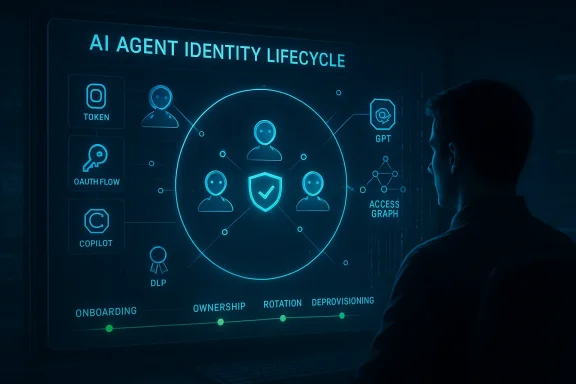
The move from human-centered workflows to agentic automation changes who — or what — holds privilege inside enterprise systems. AI agents now routinely read, transform and act on sensitive data; they can log into APIs, create transactions, and make changes that once required human approvals. That shift exposes a fundamental governance gap: most identity and access management (IAM) systems were designed for humans and classic machine identities, not for autonomous, adaptable, and proliferating AI agents. Token Security’s core thesis is that these non-human identities (NHIs) — custom GPTs, MCP servers, Copilot agents and similar constructs — require the same lifecycle rigor (onboarding, least privilege, ownership, deprovisioning, audit) traditionally applied to people.
Token Security has been explicit about its scope and approach: build continuous discovery for AI agents, treat agents as first-class identities, and provide enforcement primitives that tie agent behavior to access policies and audit trails. The vendor’s public product materials and press announcements describe an AI Discovery Engine and AI Agent Identity Lifecycle Management features intended to discover agent instances, map their permissions, assign human owners, and automate retirement of orphaned agents. These capabilities are positioned as platform-agnostic, integrating with major LLM ecosystems and Microsoft 365 Copilot, among others.
At the same time, real-world incidents (CoPhish-style OAuth consent abuse and the so-called “Reprompt” exploit against Copilot) and vendor-level integrations (security vendors embedding runtime DLP and guardrails into Copilot Studio) are driving practical urgency. Those incidents show how agent-hosting platforms can be weaponized to harvest tokens or bypass controls when governance is incomplete — a technical reality that underlies Token Security’s messaging about identity-first AI security.
Key operational claims in the guidance include:
Apelblat’s piece is not merely rhetorical — it maps directly into Token Security’s product narrative: to secure compliance, enterprises must treat agents as privileged identities requiring lifecycle governance, versioned prompts and auditable change management. That line of argument seeks to connect security teams’ technical controls with finance and audit stakeholders’ compliance obligations, extending the vendor’s value proposition beyond pure security to multi-disciplinary governance implementations.
Independent reporting and vendor advisories have corroborated the core technical vectors: hosted demo pages + OAuth flows + automation = token risk. Two useful corollaries follow. First, runtime protections (DLP, inline policy checks, synchronous allow/deny webhooks) are becoming mainstream as a necessary control; vendors such as Check Point and Zenity have publicly described integrations to inspect agent tool-calls at runtime. Second, detection and logging that link agent activity back to an identity and a human owner are crucial for both security and compliance. Token Security’s lifecycle and discovery framing speaks to both ends of that requirement.
However, the competitive landscape will harden quickly. Platform vendors (Microsoft, GitHub) and established security vendors (DLP, CASB, and runtime security providers) are adding agent-aware controls and integrations. Token Security’s commercial success will therefore depend on three factors:
That said, the problems Token Security promises to solve are technically and organizationally hard. Discovery of ephemeral agents, reliable runtime enforcement without blocking productivity, and the cross-functional change management required to treat agents like human employees will be the true tests. Security buyers should pilot tools, validate coverage and insist on measurable, auditable controls — not just slideware — before claiming compliance equivalence. If Token Security’s platform delivers the discovery fidelity and lifecycle automation it describes, it will have found a tightly scoped but strategically vital niche at the heart of enterprise AI governance.
Overall, the week reaffirmed a market truth that is moving from theory into practice: in the age of agentic AI, identity is the new perimeter — and controlling non‑human identities will be a defining security priority for enterprises in 2026 and beyond.
Source: TipRanks Token Security – Weekly Recap - TipRanks.com
 Background / Overview
The move from human-centered workflows to agentic automation changes who — or what — holds privilege inside enterprise systems. AI agents now routinely read, transform and act on sensitive data; they can log into APIs, create transactions, and make changes that once required human approvals. That shift exposes a fundamental governance gap: most identity and access management (IAM) systems were designed for humans and classic machine identities, not for autonomous, adaptable, and proliferating AI agents. Token Security’s core thesis is that these non-human identities (NHIs) — custom GPTs, MCP servers, Copilot agents and similar constructs — require the same lifecycle rigor (onboarding, least privilege, ownership, deprovisioning, audit) traditionally applied to people. Token Security has been explicit about its scope and approach: build continuous discovery for AI agents, treat agents as first-class identities, and provide enforcement primitives that tie agent behavior to access policies and audit trails. The vendor’s public product materials and press announcements describe an AI Discovery Engine and AI Agent Identity Lifecycle Management features intended to discover agent instances, map their permissions, assign human owners, and automate retirement of orphaned agents. These capabilities are positioned as platform-agnostic, integrating with major LLM ecosystems and Microsoft 365 Copilot, among others.
At the same time, real-world incidents (CoPhish-style OAuth consent abuse and the so-called “Reprompt” exploit against Copilot) and vendor-level integrations (security vendors embedding runtime DLP and guardrails into Copilot Studio) are driving practical urgency. Those incidents show how agent-hosting platforms can be weaponized to harvest tokens or bypass controls when governance is incomplete — a technical reality that underlies Token Security’s messaging about identity-first AI security.
What Token Security published this week
A technical playbook for securing Copilot agents
Token Security amplified an in-depth technical explainer aimed at enterprises using Microsoft Copilot and Copilot Studio. The guidance walks through discovery and inventory techniques for Copilot agents, highlights misconfiguration and data-exposure vectors, and frames Copilot agents as privileged non-human identities that must be managed like service accounts or system administrators. The blog emphasizes visibility gaps — for example, demo pages, embedded OAuth flows, and disconnected agent lifecycles — that create attack surfaces when agents are widely published or reused across teams.Key operational claims in the guidance include:
- Treat every Copilot or agent instance as an asset: inventory, owner, purpose, and expiration.
- Map agent permissions (Graph scopes, connector rights, runtime credentials) and enforce least-privilege assignments.
- Monitor agent activity with step-level telemetry so you can attribute actions to the correct identity and reconstruct sequences for audits or incident response.
Executive-level compliance framing: SOX and agents
In parallel, Token Security’s CEO Itamar Apelblat published commentary in Forbes calling attention to the compliance blind spot created when AI agents participate in financial reporting and other regulated processes. The core argument: statutes like Sarbanes-Oxley (SOX) were architected for human workflows; when agents start preparing journal entries, resolving exceptions or initiating ERP transactions, the control model must change. Organizations that allow agents to operate with broad or ownerless privileges risk undermining segregation-of-duties, management review controls and auditor evidence.Apelblat’s piece is not merely rhetorical — it maps directly into Token Security’s product narrative: to secure compliance, enterprises must treat agents as privileged identities requiring lifecycle governance, versioned prompts and auditable change management. That line of argument seeks to connect security teams’ technical controls with finance and audit stakeholders’ compliance obligations, extending the vendor’s value proposition beyond pure security to multi-disciplinary governance implementations.
Why the messaging matters: tactical threats and regulatory context
Token and consent attacks remain high-risk and practical
Recent research has shown that Copilot Studio pages and agent-hosted demo flows can be abused to orchestrate OAuth consent phishing and token theft. Techniques commonly referred to as “CoPhish” use legitimate hosting and friendly UIs to trick users into granting Graph permissions; automation built into the agent can then forward tokens to attacker endpoints or immediately use them against APIs. Those methods exploit governance gaps (admin consent, tenant defaults, weak monitoring) rather than an exotic zero‑day. Token Security’s guidance targets precisely these blind spots — inventorying agents that can host demo pages, verifying the app-consent posture and instrumenting agent execution paths for telemetry.Independent reporting and vendor advisories have corroborated the core technical vectors: hosted demo pages + OAuth flows + automation = token risk. Two useful corollaries follow. First, runtime protections (DLP, inline policy checks, synchronous allow/deny webhooks) are becoming mainstream as a necessary control; vendors such as Check Point and Zenity have publicly described integrations to inspect agent tool-calls at runtime. Second, detection and logging that link agent activity back to an identity and a human owner are crucial for both security and compliance. Token Security’s lifecycle and discovery framing speaks to both ends of that requirement.
Regulatory pressure and compliance alignment
Regulators and auditors are already signaling that opaque or ownerless automation will attract scrutiny. When agents operate inside finance, healthcare, or other regulated domains, auditors will expect auditable trails, segregation of duties and demonstrable controls — the same controls ay applied to human operators, but adapted for continuous, automated behavior. Token Security’s CEO explicitly linking SOX to AI agent governance in Forbes is a measured step to translate security posture into compliance risk language, which is essential when buyers must reallocate budget from traditional controls to AI-specific identity hardening.Strengths in Token Security’s current approach
- Focused problem definition: Token Security articulates a clear, narrow problem — non-human identity governance for agentic AI — which is easier for buyers to understand and budget for than a generic “AI security” umbrella. The product messaging (discovery, ownership, least privilege, audit) is operationally concrete rather than purely rhetorical.
- Platform-agnostic integrations: The company stresses integration with major ecosystems (Microsoft 365 Copilot, Azure OpenAI Foundry, OpenAI, Anthropic, AWS Bedrock), which is essential given how enterprises adopt a polyglot AI stack. That breadth reduces vendor lock-in concerns and supports cross-platform policy consistency.
- Executive-to-operator narrative: Combining CEO-level compliance commentary with technical playbooks helps Token Security speak to both boards/auditors and SOC/IAM teams. That dual-track messaging is useful in procurement cycles where finance and security must agree.
- Early-mover advantage on a nascent category: Agentic identity governance is an emerging market; being early with a coherent lifecycle model, discovery engine and demo references positions Token Security as a category leader should the demand manifest at scale. Recent product announcements and partnerships suggest momentum.
Risks, caveats and open questions
- Overpromising on discovery coverage: Continuous discovery of ephemeral or locally hosted agents is a hard engineering problem. Agents can be spun up in developer sandboxes, personal accounts, or external SaaS services that are difficult to discover without deep telemetry or endpoint instrumentation. Buyers should validate discovery claims with pilot engagements and ask for coverage metrics (percentage of known/populated agent identities discovered, false-positive/false-negative rates). Token Security’s press materials describe broad coverage, but independent validation in customers’ environments will be decisive.
- Runtime enforcement limitations: Inline webhooks and DLP checks are effective for actions routed through controlled execution paths, but creative exfiltration techniques (slow-drip, steganography, or token reuse via legitimate channels) remain challenging. Vendors that insert runtime checks must also disclose where inspection occurs, retention policies and privacy trade-offs; these operational details matter for regulated customers.
- The human factor and organizational change: Treating agents like employees requires organizational processes — ownership assignment, code review for prompts, deprovisioning timelines and audit-ready telemetry. Many orgs lack those cross-functional capabilities today; tooling alone will not fix process gaps. Token Security’s product helps, but the true ROI depends on disciplined AgentOps and change management.
- Potential for compliance theater: There’s a risk that buyers buy “agent governance” as a checkbox without architecting end-to-end controls. Paper-based evidence of agent inventories or retention of logs will not satisfy auditors if the logs lack fidelity or provenance. Firms should insist on demonstrable, testable controls and red-team results before claiming compliance parity. Token Security’s compliance messaging rightly calls out SOX but buyer diligence remains crucial.
- Market competition and technical interoperability: As platform vendors (Microsoft, GitHub) add agent-level security primitives and DLP controls, third-party vendors must integrate cleanly with these control planes. Integration maturity and low-latency enforcement (to avoid user friction) will be deciding factors in large-scale adoption. Token Security’s promises of wide integrations are promising, but customers should evaluate performance and failure modes.
Practical recommendations for IT, IAM and security teams
Below is an actionable, prioritized roadmap teams can use this quarter to start addressing agentic identity risk. These steps reflect both Token Security’s public guidance and independent best practices emerging across vendor advisories and incident reports.- Inventory and classify agent identities (0–30 days)
- Discover published agents, hosted demo pages, MCP endpoints and custom GPTs across the tenant. Assign each agent an owner, purpose and risk level.
- Validate discovery coverage with sampling (ask for lists of known agents and verify whether discovery tools find them).
- Enforce least privilege and short-lived credentials (0–60 days)
- Move agents off long-lived, broad-scope tokens; require scoped, short-lived tokens with automatic rotation or JIT elevation.
- Use device- or sender-bound tokens (DPoP/mTLS) where supported.
- Harden consent and app registration controls (0–30 days)
- Require admin consent for high-risk scopes; restrict user consent defaults; monitor new service principals and app registrations.
- Add SIEM rules for unusual consent events and post-consent Graph API calls.
- Add step-level runtime inspection and DLP (30–90 days)
- Where possible, register synchronous policy webhooks for agents so each tool call is subject to allow/deny decisions.
- Deploy content-aware DLP on tool inputs/outputs and apply masking or blocking for sensitive data types.
- Instrument provenance and explainability (30–90 days)
- Version prompts and model artifacts; record model versions, prompt templates, and upstream data sources so auditors can reconstruct outputs.
- Capture signed, time-stamped logs that bind actions to agent identities and human owners.
- Run adversarial testing and tabletop exercises (60–120 days)
- Include CoPhish-style scenarios and consent phishing in red-team exercises; validate detection and remediation playbooks (token revocation, app removal, quarantine).
- Test the impact of deprovisioning agents to avoid unintended outages.
- Align governance with compliance owners (continuous)
- Map agent controls to compliance frameworks (SOX, GDPR, sector-specific regs) and require joint sign-off from finance, legal, security and IT on high-risk agents.
Market implications and vendor positioning
Token Security’s recent communications are strategically targeted. The company is not announcing a major new product release this week, but it is deepening thought leadership and leaning into compliance narratives that expand its commercial addressable market — from SOCs and IAM teams to finance, audit and legal stakeholders. Positioning itself as an identity-first AI security vendor helps Token Security differentiate from general AI runtime protection providers and from legacy IAM/MPL vendors that have less focus on agentic behavior.However, the competitive landscape will harden quickly. Platform vendors (Microsoft, GitHub) and established security vendors (DLP, CASB, and runtime security providers) are adding agent-aware controls and integrations. Token Security’s commercial success will therefore depend on three factors:
- Depth of discovery and accuracy in noisy, polyglot environments.
- Low-friction integrations with Microsoft’s control plane and other vendor webhooks for runtime enforcement.
- Credible audit evidence that the platform’s controls are operational at customer scale.
Conclusion
This week’s Token Security activity — technical blog posts, LinkedIn promotion of operational guidance for Copilot agents, and CEO commentary tying agentic AI to SOX and compliance — was not about launching a new product, but about staking a claim in a critical and fast-emerging category: AI agent identity governance. The company’s combination of practical operator guidance and high-level regulatory framing is a sound two‑pronged strategy: it helps security teams manage immediate token and consent risks while also nudging procurement and compliance stakeholders to accept identity-first controls as budget-worthy investments.That said, the problems Token Security promises to solve are technically and organizationally hard. Discovery of ephemeral agents, reliable runtime enforcement without blocking productivity, and the cross-functional change management required to treat agents like human employees will be the true tests. Security buyers should pilot tools, validate coverage and insist on measurable, auditable controls — not just slideware — before claiming compliance equivalence. If Token Security’s platform delivers the discovery fidelity and lifecycle automation it describes, it will have found a tightly scoped but strategically vital niche at the heart of enterprise AI governance.
Overall, the week reaffirmed a market truth that is moving from theory into practice: in the age of agentic AI, identity is the new perimeter — and controlling non‑human identities will be a defining security priority for enterprises in 2026 and beyond.
Source: TipRanks Token Security – Weekly Recap - TipRanks.com
