Microsoft Agent 365: The Governance First Control Plane for AI Agents

  • Thread Author
Microsoft’s Ignite 2025 debut of Microsoft Agent 365 formalizes a control plane for the agent era — a unified governance, identity, and security fabric that treats AI agents as first-class, auditable members of the enterprise workforce rather than ephemeral chatbots or point automations. This shift addresses immediate operational realities — from sprawl and lifecycle management to data protection and cost control — and arrives alongside a stark market estimate that organizations will be managing orders of magnitude more agents in the coming years.

Isometric view of Agent 365 hub connecting identity, copilots, and services to a security dashboard.Background / Overview​

Microsoft positioned Agent 365 at Ignite as an administrative and security control plane that lets IT teams discover, provision, monitor, and quarantine agents across Microsoft, partner, and open-source ecosystems. The platform ties together identity (Entra), security (Defender), data governance (Purview), and productivity context (Microsoft 365 apps and the Microsoft 365 admin center) to create a defense-in-depth posture for agent-driven workflows. Microsoft also announced a new Security Dashboard for AI to centralize AI posture and risk signals from Defender, Purview, and Entra into a single operational view. The product narrative at Microsoft Build and Ignite has been consistent: agents will scale from prototypes to fleets, and enterprises need lifecycle tooling — identity, telemetry, and policy enforcement — to manage that scale. Microsoft cites an IDC Info Snapshot projecting 1.3 billion AI agents by 2028, a figure that Microsoft uses to underline the urgency of a governance-first approach. The IDC projection is a sponsored Info Snapshot referenced in Microsoft’s public messaging; treat it as an industry signal rather than an independently audited universal truth.

What Microsoft Agent 365 is — the control plane explained​

Microsoft Agent 365 is presented as a single pane of glass for agent operations, built around five core capabilities that map to enterprise governance needs:
  • Registry — a centralized inventory of agents, with the ability to detect and quarantine unsanctioned or rogue agents to avoid sprawl and shadow deployments.
  • Access control — unique agent identities and policy templates that enforce least-privilege access and adaptive controls through Entra (Azure AD) and conditional access policies.
  • Visualization & telemetry — unified dashboards, activity traces, and alerts that expose agent performance, compliance posture, and ROI metrics.
  • Interoperability — integrations with Microsoft 365 apps, Azure AI Foundry, Copilot Studio, and a growing partner ecosystem (Adobe, ServiceNow, Workday and others), plus support for third-party and open-source agents.
  • Security & data governance — a defense-in-depth posture using Microsoft Defender, Entra, Purview, DLP, and the new Security Dashboard for AI to surface combined security and data risks and provide AI-driven mitigation recommendations.
This design explicitly treats agents as directory objects with identities, making them subject to the same lifecycle controls (access reviews, conditional access, deprovisioning) that IT already enforces for human employees. The practical implication is that agents can appear in org charts, receive mailboxes, and be included in access and compliance reviews — which dramatically changes the audit surface and lifecycle processes for IT and compliance teams.

The five core capabilities in practice​

1. Registry and cataloging: stop agent sprawl before it starts​

A tenant-level agent registry centralizes discovery and reduces shadow AI risk. IT can require admin approval to publish an agent to the tenant catalog or the Agent Store, assign a license (reportedly referenced in roadmaps as “A365” or Agent 365), and bind an agent to an owner and cost center. This breaks the “build anywhere, run everywhere” problem by giving security teams a deterministic control point for lifecycle operations.

2. Identity and least-privilege access​

Agents receive Entra Agent IDs (directory identities) so they can be governed like service principals with lifecycle controls and conditional access. Entra-based identities allow for access reviews, just-in-time permission models, and integration with existing IAM tooling, which is critical because agents are frequently authorized to call multiple services and retrieve sensitive data. Microsoft’s Copilot Studio and Azure AI Foundry surface Entra identities automatically for agents created there.

3. Observability and analytics​

Agent 365 surfaces telemetry — traces of tool calls, retrieval events, model-invoked actions and decision logs — so teams can reconstruct what an agent accessed and why it acted. That telemetry gets stitched into Microsoft’s broader observability fabric (OpenTelemetry support for agent traces has been highlighted in Microsoft’s agent framework releases), making forensic analysis and compliance reporting feasible at scale.

4. Interoperability and marketplaces​

Agent 365 is designed to accept agents created in Copilot Studio, Azure AI Foundry, third‑party partner agents, and open‑source frameworks. The in-product Agent Store provides discovery and a managed channel to bring partner agents onto tenant catalogs — a crucial feature if enterprises want repeatable, repeatable agent templates rather than bespoke scripts. Microsoft is positioning this as a path for ISVs to reach enterprise buyers while ensuring agents meet governance requirements.

5. Defense in depth: Defender, Entra, Purview and Security Dashboard for AI​

Agent 365 does not stand alone — it integrates with Microsoft Defender (threat detection and response), Entra (identity & access management) and Purview (data classification and DLP). The newly previewed Security Dashboard for AI consolidates signals from these services to present a combined AI posture, accelerate mitigation recommendations via Security Copilot guidance, and provide action-oriented risk remediation. This creates a single operational experience for AI risk triage.

Where Agent 365 fits in Microsoft’s broader agent strategy​

Microsoft’s agent push is multi-pronged: Copilot Studio for low-code agent authoring, Azure AI Foundry and the Agent Framework for runtime and orchestration, the Agent Store for discovery and distribution, and Agent 365 as the administrative control plane for governance. The integration assumptions are explicit — agents should use Microsoft Graph for contextual grounding, run under tenant identities, and be observable through the Copilot Control System and admin centers. This gives enterprises a coherent stack for agent development, deployment, and oversight. Microsoft’s messaging also emphasizes model choice and multi-model routing in Copilot and Foundry. That means tenants may route sub-tasks to different model providers (including Anthropic, OpenAI, and others), which is powerful for cost and accuracy optimization but introduces cross-hosting and contract complexity that governance teams must account for.

The market case — numbers, reality checks, and vendor-backed research​

Microsoft and partners point to dramatic scale: IDC’s sponsored snapshot — explicitly cited by Microsoft — forecasts 1.3 billion AI agents by 2028, and Microsoft’s own telemetry cites millions of custom agents created in recent quarters. Those figures underscore the operational urgency of Agent 365, but they also require cautious interpretation.
  • The IDC 1.3 billion projection is a sponsored Info Snapshot referenced by Microsoft and others; it is useful as a market signal but not an independently audited, peer-reviewed forecast. Organizations should use it to model scenarios, not as a prescriptive operational target.
  • Microsoft’s own telemetry (for example, “more than 1 million custom agents created across SharePoint and Copilot Studio” or tenant examples like Wells Fargo and T‑Mobile) are valid vendor-reported data points and useful case studies. Independent verification and internal pilots remain the right approach for estimating attainable scale and ROI.
Flagging sponsored research and vendor telemetry is essential: both inform strategy but must be validated via internal pilots, KPIs, and financial modeling before enterprise-wide rollouts.

Security and compliance: what Agent 365 promises — and the residual risks​

Agent 365 raises the bar for governance, but it also changes the nature of the attack surface. Key security and compliance implications:
  • Agents increase the number of identities and principals that must be managed; identity teams can expect a rapid increase in object counts that have to be reviewed, monitored, and protected. Entra Agent IDs help, but staffing, tooling, and automation are required to avoid overwhelm.
  • Multi-model routing and third‑party hosting can move data across cloud boundaries or vendor environments. Enterprises must map model hosting choices to regulatory and data residency needs and potentially restrict model routing for sensitive workloads. Microsoft documents the ability to bring-your-own-model but warns about residency choices.
  • Agents with elevated permissions create confused deputy and privilege escalation risks. Enforce least privilege, use short-lived credentials, and require human authorization for high-impact actions. The Security Dashboard for AI and Defender integrations can detect anomalous agent behavior but cannot replace rigorous design-time controls.
  • Auditability and retention must be rethought. Agent actions — tool calls, decisions, and intermediate artifacts — need to be logged with context and preserved for compliance reviews. Purview and Copilot Control System integrations are intended to help, but tenants must operationalize retention policies and eDiscovery flows for agent-generated artifacts.
Where Microsoft’s platform reduces risk is by design: identity-first constructs, telemetry-first runtimes, and admin approval flows make many common failure modes auditable and reversible. The residual risk is operational — the work of policy design, lifecycle procedures, and engineering controls still falls to customers.

Practical rollout guidance for IT leaders — a recommended roadmap​

  • Start small and measurable. Pilot a single low-risk agent (read-only knowledge agents, meeting summarizers) and instrument baseline KPIs: time saved, error rates, user satisfaction. Use Copilot Analytics and agent telemetry to validate vendor claims.
  • Treat agents as production services. Assign owners, SLAs, and cost centers. Enforce approval gates before publication in the Agent Store and register each agent with Entra Agent ID.
  • Enforce least privilege and staged permissioning. Begin with read/suggest modes; move to write/execute permissions only after staged validation and human-in-the-loop thresholds are defined.
  • Map model and hosting choices for compliance. For regulated data, restrict model routing to approved suppliers and hosting locations; require vendors to disclose telemetry and retention policies.
  • Use the Security Dashboard for AI and Defender signals for operational monitoring. Integrate alerts into SecOps playbooks and automate mitigation steps where feasible.
  • Budget for new licensing and consumption models. Treat agents like headcount in financial planning: forecast metered consumption, potential A365 licensing, and O&M costs.
These steps balance speed-to-value and risk management — they aim to let organizations capture productivity gains while avoiding runaway deployments and compliance gaps.

Ecosystem and partner implications​

Microsoft framed Agent 365 as an extensible control plane for partner agents: ISVs such as Adobe, ServiceNow, Workday, and small startups like Mainfunc (Genspark) are already integrating agents for enterprise scenarios. The Agent Store and Microsoft Marketplace become strategic distribution channels, but they also impose enterprise-level requirements (identity, audit logs, connector behavior) that raise the maturity bar for partners. This is beneficial for enterprise buyers — higher trust for listed agents — but requires partners to invest in encryption, telemetry, and governance support to meet enterprise acceptance.

Licensing, cost and procurement realities​

Microsoft’s roadmaps and third-party reporting discuss a potential A365 or Agent 365 licensing family for agents, and preview screenshots imply that tenant admins may assign a license to each agent. Pricing models will likely include a mixture of per-agent licenses, pooled credits, and consumption-based billing for model calls. Procurement and finance teams must anticipate:
  • New SKUs or metered billing for agent runtime and access to premium models.
  • Role-based licensing tiers (lightweight retrieval agents vs. autonomous multi-tool agents).
  • Attribution and chargeback mechanisms so business units own agent costs and outcomes.
Because the licensing model may materially affect total cost of ownership, procurement should negotiate telemetry and SLA terms with ISVs and require transparency on model routing, telemetry retention, and access to logs for compliance audits.

Strengths — why Agent 365 could matter to your organization​

  • End-to-end governance: Agent 365 consolidates identity, telemetry and policy management in a single plane, reducing the need to stitch separate controls together.
  • Operational safety-first design: Identity-first agents, approval flows, and integration with Purview and Defender raise the baseline for secure agent operation.
  • Marketplace and channel economics: The Agent Store and Marketplace reduce friction for repeatable, secure agent templates and partner-delivered solutions.
These strengths matter most for organizations already invested in Microsoft 365 and Azure, since the integration depth provides strong wins in auditability, identity controls, and in-product discoverability.

Risks and unresolved questions​

  • Sponsored research caveats: The oft-cited 1.3 billion agents forecast comes from an IDC Info Snapshot sponsored by Microsoft; useful for scenario planning, but treat it with appropriate skepticism and validate against internal pilots.
  • Operational overhead: The explosion of agent identities will stress IAM processes — enterprises must invest in automation, access reviews and AgentOps teams to prevent runaway risk.
  • Model routing and data residency: Multi-model routing across clouds introduces real compliance complexity. Explicit tenant mapping and policy controls are required to manage this risk.
  • Vendor lock-in and interoperability: While Microsoft highlights standards (Model Context Protocol, Agent-to-Agent), the ecosystem is still nascent; enterprises should evaluate portability strategies for critical workflows.
Some claims made during the product rollouts are early telemetry or promotional (efficiency percentages, projected headcount displacement). These are valuable directional indicators but deserve independent pilot-based validation before being used for corporate forecasts.

Conclusion — what IT leaders should do next​

Microsoft Agent 365 is a practical and necessary response to a fast-approaching agent economy: it provides identity, observability, marketplace integration, and a security-first posture that align with enterprise needs. That said, the platform is not a turnkey safety net — governance, lifecycle discipline, procurement clarity, and robust pilot programs remain essential.
Recommended immediate actions:
  • Begin with a small, measurable pilot that uses Copilot Studio agents scoped to read-only or suggest modes.
  • Register agent lifecycle processes: owning teams, cost centers, retention policies, and deprovisioning playbooks.
  • Coordinate IAM, SecOps, Legal and Procurement to create policy templates for agent approval and model routing restrictions.
  • Use the Agent Store and Security Dashboard for AI early-access where available to evaluate integrations before committing to broad rollouts.
Agent 365 is the infrastructure that lets agents be scaled responsibly — but responsibility still requires governance muscle. Organizations that pair Microsoft’s platform primitives with disciplined AgentOps, legal guardrails, and pragmatic pilots will capture the productivity upside without sacrificing security or compliance.

Source: Petri IT Knowledgebase Microsoft Agent 365: Unified Governance for Enterprise AI Agents
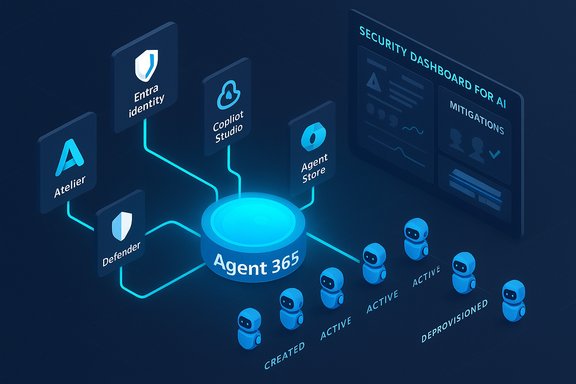
 

Agent 365 binds data sources, apps, and security in a unified ecosystem.
Microsoft's Ignite announcements make one thing unmistakable: the company is no longer treating "agents" as a curiosity — it's building the plumbing to make them first-class, auditable, and manageable parts of enterprise IT. At Ignite 2025 Microsoft introduced Agent 365, a centralized control plane aimed at discovering, registering, governing and securing fleets of AI agents — including those built by Microsoft, partners and open-source communities — and explained how those agents will be surfaced as usable capabilities inside Microsoft 365 apps, Windows, and Azure tooling.

Background / Overview​

The company frames the move as an operational necessity: analysts and Microsoft‑commissioned research estimate explosive agent growth, and Microsoft is pitching Agent 365 as the registry, policy layer and security fabric enterprises will need to avoid unmanaged “shadow agents.” Microsoft repeatedly cites an IDC Info Snapshot projecting 1.3 billion AI agents by 2028 to underline the urgency of a central control plane. Treat that projection as a scenario for planning rather than a deterministic guarantee — it originates from sponsored research and should be used to drive governance rather than replace pilot data. Agent 365 is not just a registry. Microsoft positioned it at Ignite as the governance-first control plane that ties together identity (Microsoft Entra), security (Defender, Purview, Sentinel), lifecycle tooling (Copilot Studio, Azure AI Foundry) and the productivity surfaces users see every day (Word, Excel, PowerPoint, Teams and Windows). The goal: let organizations treat agents like managed services — discoverable, auditable, permissioned and, when necessary, quarantinable.

What is an AI agent — and why does it matter?​

Agents defined​

An AI agent is a purpose-built software actor that uses a reasoning model (an LLM or other model) plus external tools or connectors to plan, act and iterate on multi‑step goals. Unlike single-turn chat assistants, agents can hold state, call APIs, write into documents, schedule meetings and coordinate with other agents to complete workflows. They can be ephemeral or persistent and can operate across devices and cloud services.

Why enterprises care now​

  • Agents automate cross‑system work that previously required custom scripts or glue code: pulling CRM data, drafting a proposal, creating a purchase order, and logging the outcome can be a single agent flow.
  • They compress business process latency: what once took hours of human coordination can become an iterative agent workflow with human approvals at critical junctions.
  • However, unmanaged agents create new attack surfaces, compliance headaches, and governance complexity — the precise problems Agent 365 is trying to solve.

The Microsoft agent ecosystem — components and roles​

Microsoft’s agent strategy stitches together multiple product lines and standards into a single narrative: enable builders, operators and admins to author, host, discover and govern agents at scale.

Core components​

  • Copilot Studio — the low‑code/no‑code authoring environment where business teams and developers build agents and multi‑agent orchestration.
  • Azure AI Foundry / Foundry Agent Service — a pro‑dev runtime and managed hosting plane for production agent workloads, including model routing and observability.
  • Agent Store / Microsoft Marketplace — an in‑product catalog where users discover, request and install agents inside Copilot, Teams and Microsoft 365.
  • Microsoft Entra Agent ID — a directory model that assigns identities to agents so they appear in the enterprise directory and can be governed like users and apps.
  • Agent 365 — the control plane (registry, access controls, visualization, interoperability, security) for agent fleets.

Interoperability and standards​

Microsoft is pushing interoperability via the Model Context Protocol (MCP) and Agent‑to‑Agent (A2A) patterns so agents and tools can cooperate across vendors and runtimes. The stated intent is to avoid vendor silos and enable multi‑model routing — but the ecosystem is nascent and standards adoption is still emerging.

Agent 365: the five capabilities explained​

Microsoft framed Agent 365 around five key capabilities. Each is engineered to make agents manageable at organizational scale.
  • Registry (single source of truth): an inventory of agents — Microsoft‑built, partner, tenant‑created and so‑called shadow agents — so IT can see what’s active in their environment. This is the baseline for all governance.
  • Access control (least‑privilege by default): Entra Agent IDs, conditional access flows and connector gating limit agents to only the permissions they require. Microsoft emphasizes short‑lived credentials and scoped tokens to reduce persistent credential risk.
  • Visualization & analytics: a unified dashboard to monitor agent behavior, performance, and the connections between agents, people and data. Real‑time telemetry, lineage and anomaly detection aim to surface risky or anomalous agent activity.
  • Interoperability: connectors, MCP support and marketplace publishing let agents access apps and data inside Microsoft 365, third‑party services and BYOM (bring your own model) scenarios. Integration with Foundry makes multi‑model routing and model choice possible.
  • Security: Defender, Purview, Sentinel and Security Copilot are being extended to detect, investigate and remediate attacks that target agents or that agents inadvertently enable. Microsoft pitches “ambient security” where agent telemetry feeds detection and agents themselves assist defenders.
These five capabilities, assembled, are meant to let enterprises treat agents like production services rather than ephemeral experiments.

Office + Copilot: agentic productivity inside apps​

Microsoft is embedding Agent Mode and dedicated Office agents into the productivity canvas.
  • Agent Mode in Word, Excel and PowerPoint lets Copilot act inside documents and workbooks: plan, execute a sequence of edits, validate outputs and iterate with the user. Excel Agent Mode claims specialized spreadsheet reasoning (SpreadsheetBench results cited by Microsoft) and PowerPoint Agent Mode is targeted at on‑brand slide creation and layout fidelity. Availability is rolling through the Frontier preview program and web clients first, with desktop parity on the roadmap.
  • Office Agent in Copilot Chat brings chat‑first flows that can produce near‑final Word documents and PowerPoint decks by combining web research, tenant data (Work IQ) and multi‑step reasoning. Microsoft highlights model routing (Anthropic and OpenAI model choices) as part of the output quality strategy.
These features push Microsoft’s long-term vision: agents that are not just conversational helpers but collaborators that perform auditable changes to enterprise artifacts. That changes change‑control, retention and legal considerations for documents and communications.

The security and governance picture — obligations for IT​

Agent 365 provides primitives, but it does not remove organizational responsibility. The announcements are explicit about risks — and IT must treat agents like a new class of identity and service.

Primary risk categories​

  • Identity & credential abuse ("confused deputy"): Agents with broad permissions can be manipulated to exfiltrate data or take costly actions. Entra Agent ID, short‑lived tokens, and conditional access reduce but don’t eliminate that risk.
  • Data leakage & compliance: Agents reading across files, mail and meetings expand the telemetry surface. Purview integration is promised, but classification, labels and tenant policy quality determine how well agents respect compliance boundaries.
  • Model correctness & hallucination: Agents that combine retrieval, reasoning and tool invocation can produce plausible‑but‑incorrect outputs. Multi‑agent orchestration multiplies the risk of compounding errors; enterprises must define verification thresholds and human‑in‑the‑loop gates for critical actions.
  • Operational scale & cost control: The numbers Microsoft cites (1.3B agents by 2028) are directional but real scale will stress IAM, logging, storage, and cloud GPU costs. Expect to instrument cost KPIs and consumption caps.

Practical enterprise checklist​

  1. Inventory candidate apps and data that agents will touch; classify by sensitivity.
  2. Require Entra Agent IDs for every agent and enforce conditional access and least‑privilege connectors.
  3. Gate high‑impact actions (payments, POs, user provisioning) with multi‑actor approvals and immutable audit trails.
  4. Pilot with read‑only or suggest modes before granting write or action permissions.
  5. Build an AgentOps function (owner, cost center, SLOs) and tie agent provisioning to procurement and legal reviews.

Ecosystem, partners and channel implications​

Microsoft’s Agent Store and the Marketplace are strategic distribution channels for ISVs and startups. Microsoft is already showcasing partner integrations and named partners sequencing agents into the Agent Store, and companies like ServiceNow announced integrations with Agent 365 for cross‑platform governance and orchestration. For independent software vendors, Agent 365 reduces discovery friction but raises the bar for identity, observability, export fidelity and compliance requirements. Startups focused on agent outcomes — the file_search thread analyses highlight an example: Mainfunc’s Genspark “Super Agent,” a multi‑agent studio aimed at producing cross‑media deliverables and exporting to PowerPoint — demonstrates the new commercial paths. Those vendor claims (customer metrics, ARR, retention) should be treated cautiously until independently verified.

Windows and the agentic OS — the user reception problem​

Microsoft also previewed Windows‑level agent surfaces: a persistent Ask Copilot entry on the taskbar, an Agent Workspace for contained agent execution, and a “Windows 365 for Agents” Cloud PC option to host agent runtimes off‑device. The idea is to make agents discoverable where users already work while using containment and isolation to reduce credential leakage.
But pushing agents into the OS has provoked visible pushback. Public reactions to Windows product posts — including negative replies to Windows leadership social posts that were restricted in response to criticism — show that users are sensitive to perceived bloat, opt‑out friction and UI changes. The Windows‑user backlash is real and Microsoft has acknowledged users’ feedback and promised iterative fixes. IT teams should anticipate mixed reception in end‑user populations and build opt‑in pilot plans accordingly.

What’s actually required to use Agent 365 today?​

Microsoft’s messaging and product pages make the first‑order requirements clear: Agent 365 functionality is being surfaced through the Microsoft 365 admin center and in early access via Microsoft’s Frontier program; many agent experiences require at least one Microsoft 365 Copilot license on the tenant to enroll in the preview. That means organizations will need to plan licensing and preview enrollment to test the new control plane.

Independent verification — where claims hold and where caution is warranted​

  • The core product claims — Agent 365’s registry, access controls, visualization, interoperability and security posture — appear in Microsoft’s Ignite Book of News and blog posts, and were independently reported by Reuters, Axios, The Verge and other outlets. Those are verifiable product announcements.
  • The 1.3 billion agents by 2028 figure is widely quoted but originates in an IDC Info Snapshot sponsored by Microsoft. Use it as a helpful planning assumption rather than a precise forecast; sponsor‑sourced market projections have value for scenario planning but should be balanced with independent pilot data and vendor‑neutral research where possible.
  • Performance and accuracy benchmarks cited from Microsoft (for example, SpreadsheetBench numbers for Agent Mode in Excel) are internal evaluations. They are useful directional indicators but organizations should validate claims with their data sets and realistic inputs before relying on agent outputs for high‑stakes decisions.
  • Some vendor metrics (startup ARR, retention) and promotional efficiency figures are company statements that require independent due diligence prior to purchasing decisions. Flag these as company‑provided until audited disclosures exist.

Practical adoption roadmap for IT leaders​

Phase 1 — Discovery and policy baseline (0–3 months)​

  • Map business processes that will benefit most from agentic automation (customer support triage, sales enablement, proposal generation).
  • Run an internal inventory: which apps/data the first wave of agents will need, and what labeling/classification gaps exist.

Phase 2 — Controlled pilots (3–9 months)​

  1. Enroll in Frontier and enable Agent Mode for a small sandbox group; require Entra Agent ID registration for every pilot agent.
  2. Limit initial agents to read or suggest mode where possible; log every action and require manual approval for write‑level tasks.
  3. Instrument correctness, human rework, and cost KPIs (token spend, compute consumption).

Phase 3 — Scale and AgentOps (9–24 months)​

  • Create an AgentOps team (owner, SLOs, cost center) and formalize agent lifecycle policies: provisioning, update cadence, incident playbooks, deprovisioning.
  • Integrate agent telemetry with SIEM and audit processes and run cross‑functional tabletop exercises for agent incidents.

Strengths, immediate benefits and the Microsoft advantage​

  • Integrated platform advantage: Microsoft’s depth across identity, data governance and productivity surfaces gives a coherent story — Entra, Purview and Defender all plug into Agent 365 in ways that reduce integration overhead.
  • Distribution velocity for partners: The Agent Store and Marketplace give ISVs and startups rapid access to enterprise buyers if they meet compliance and logging requirements. That is a powerful GTM channel.
  • Operationality: Microsoft is investing in runtime (Foundry), observability and lifecycle tooling so agents can move from experiments to production in a familiar enterprise control plane. That operational focus is the core differentiator for organizations that prioritize manageability.

Risks, tradeoffs and the cautionary case​

  • Scale multiplies complexity: Adding millions or billions of agent identities will stress IAM processes, change‑control flows, and logging infrastructure. Organizations without mature identity governance will be exposed.
  • Model governance and explainability gaps: Agents may chain multiple models, retrieval systems and tools. Debugging failures or explaining decisions to auditors remains difficult. Demand model provenance and traceable RAG patterns.
  • Vendor lock‑in and interoperability caveats: Microsoft emphasizes MCP and A2A standards, but the nascent ecosystem means portability is an active concern. Evaluate export, on‑prem hosting, and BYOM strategies before committing critical workflows.
  • User experience and backlash risk: Surface‑level integration into Windows and the taskbar raises consumer and power‑user sensitivity about bloat and opt‑out models. Expect pushback and plan opt‑in pilots to manage adoption friction.

Final analysis — pragmatic optimism with governance first​

Microsoft’s Agent 365 is an enterprise‑grade answer to a simple problem: agents will proliferate, and organizations need a control plane that treats them like managed services. The product nails the right architectural pieces — identity, observability, policy and marketplace distribution — and places Microsoft in a favorable spot for enterprises already invested in its cloud and productivity stack. That advantage is real and immediate. That said, the platform is not a turnkey safety net. Agent 365 supplies primitives; the heavy lifting remains organizational: defining least‑privilege policies, instrumenting human‑in‑the‑loop gates, and building AgentOps discipline. Enterprises that rush adoption without robust governance risk data leakage, compliance gaps and operational cost overruns. The practical path forward is disciplined pilots, measurable KPIs, and a cross‑functional strategy that ties legal, SecOps, IAM and business owners into agent lifecycle decisions.
Microsoft’s bet is that agentic AI will be the next layer of productivity — and it’s building the plumbing to make that scalable. IT leaders should treat Agent 365 as an invitation to design safety‑first agent programs: experiment fast, but govern faster.

Quick reference: resources and next steps for IT teams​

  • Start with a narrow, measurable pilot that uses Agent Mode in a single business unit and tracks correctness, time saved and rework.
  • Enforce Entra Agent ID registration for every agent during onboarding and require conditional access for any connector to sensitive data.
  • Require human approval for write‑level agent actions touching legal, financial or production systems.
  • Build AgentOps playbooks for incident response, deprovisioning, and cost control.
The era of agentic AI is arriving fast. Agent 365 is Microsoft’s operational answer — powerful, platformized, and not without risk. Organizations that combine sensible pilots, rigorous governance and realistic expectations about vendor claims will be the ones to capture the productivity upside while keeping control.
Source: Windows Central https://www.windowscentral.com/micr...ares-for-a-future-with-over-1-billion-agents/
 

Back
Top