

The announcement that Microsoft intends to evolve Windows into an “agentic OS” — an operating system that runs AI-driven agents capable of making decisions and taking actions on behalf of users — has triggered a sharp backlash from long-time Windows users, developers, and IT professionals who argue Microsoft is prioritizing automation over stability, transparency, and control.
Windows has been moving toward deeper AI integration for several years, from Cortana and Timeline to Copilot and incremental AI-powered features across Office and Windows. Those efforts laid the groundwork for an architecture that treats AI not as a single feature but as a platform capability — where agents can be discovered, granted permissions, and invoked to perform multi-step tasks. Microsoft’s recent messaging and engineering reorganizations make that push explicit: the company is building OS-level primitives to host and govern autonomous agents. The phrase agentic OS describes a shift in responsibility: instead of an OS that passively responds to user commands, Windows would become a platform that can initiate, coordinate, and execute tasks for users through specialized agents. This includes new UI affordances (taskbar integration and an “Ask Copilot” surface), system plumbing for agent discovery and permissions, and isolated runtime environments where agents operate under their own identity. Microsoft frames the change as productivity-first, but the technical and political implications are broader.
Windows’s historical strength is ubiquity and compatibility. If the agentic roadmap compromises those traits for the sake of new conveniences, Microsoft risks alienating the constituencies that made the platform dominant: developers, IT departments, and long-time power users. Conversely, if Microsoft successfully delivers robust governance, clear opt-ins, strong auditability, and enterprise-first controls, the platform could meaningfully improve productivity and accessibility across billions of devices. The path forward hinges less on the novelty of agents than on defaults, transparency, and pragmatic engineering.
Source: livemint.com “No one asked for it”: Outrage erupts over Microsoft's plans to turn Windows into agentic OS | Mint
 Background
Windows has been moving toward deeper AI integration for several years, from Cortana and Timeline to Copilot and incremental AI-powered features across Office and Windows. Those efforts laid the groundwork for an architecture that treats AI not as a single feature but as a platform capability — where agents can be discovered, granted permissions, and invoked to perform multi-step tasks. Microsoft’s recent messaging and engineering reorganizations make that push explicit: the company is building OS-level primitives to host and govern autonomous agents. The phrase agentic OS describes a shift in responsibility: instead of an OS that passively responds to user commands, Windows would become a platform that can initiate, coordinate, and execute tasks for users through specialized agents. This includes new UI affordances (taskbar integration and an “Ask Copilot” surface), system plumbing for agent discovery and permissions, and isolated runtime environments where agents operate under their own identity. Microsoft frames the change as productivity-first, but the technical and political implications are broader. What Microsoft actually announced (technical summary)
Agent Workspace and Agent ID
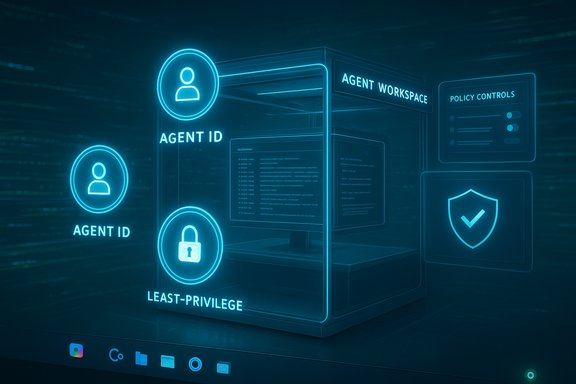
Microsoft previewed an Agent Workspace — a separate, contained desktop session where agents run parallel to a user’s primary session. The workspace is designed for auditing, policy control, and least-privilege enforcement. Agents are assigned unique Agent IDs to distinguish agent actions from human actions, enabling logging, attribution, and IT governance. These are not cosmetic features; they’re foundational primitives intended to support auditing and containment.Model Context Protocol (MCP) and APIs
To allow agents to interoperate with native Windows apps and system capabilities, Microsoft introduced a Model Context Protocol (MCP) — an API and registry model for exposing app functionality to agents in a standardized way. MCP will be available first as a private developer preview so partners can experiment with connectors and governance models before a broader rollout.Taskbar agents, Copilot integrations, and on-device AI
Key user-facing work includes taskbar-accessible agents (opt-in), deeper Microsoft 365 Copilot integration (voice, “Ask Copilot”), and richer on-device AI inference capabilities on Copilot Plus PCs for low-latency tasks. Microsoft emphasizes a hybrid approach: agents will use both local models and cloud models depending on policy, performance, and privacy needs.Security primitives and enterprise controls
Microsoft’s messaging repeatedly frames security as central: agents should run with least privilege, produce auditable logs, and be supervised by IT policies. The Windows team says agents will run in separate, secure execution spaces and that an MCP registry will include baseline security criteria for trusted agent servers. Those are important technical commitments — but implementation details matter for real-world risk.Why the backlash is unusually intense
“No one asked for it” — a credibility gap
The reaction across Reddit, Twitter/X, and specialist forums has been visceral: many long-term Windows users feel Microsoft is once again prioritizing shiny new features over the day-to-day work of fixing performance regressions, driver stability, and opaque updates. Comments such as “no one wants this” reflect fatigue with changes that break muscle memory or appear to add bloat rather than solve pressing problems. The backlash is not purely technophobic — it’s rooted in repeated experiences where Windows updates created new problems while leaving old ones unsolved.Developer and sysadmin concerns
Experienced developers and IT admins worry that agentic features will complicate troubleshooting and expand the attack surface. Agents that can modify files, change settings, or initiate network requests introduce new vectors for misconfiguration and exploitation. The complexity multiplies in enterprise environments where predictable behavior and reproducible builds are essential. Those communities have pushed for stricter defaults and enterprise-first controls.Privacy and control anxiety
For many users, the notion that software on their machine could autonomously read, modify, and transmit files — even with “guardrails” — raises practical privacy concerns. Critics point to ambiguous defaults, telemetry practices, and past incidents where Windows features initially shipped with overreaching settings. People who prefer to keep their data local or who run older hardware worry that “agentic by default” will be difficult to opt out of.Technical verification — what we can confirm
- Microsoft publicly described the agentic plans and the new primitives (Agent Workspace, Agent ID, MCP) at developer events and in Windows engineering blog posts.
- Taskbar-based AI agents and tighter Copilot integrations are part of the feature set Microsoft is rolling out; these are presented as opt-in experiences that will run in separate execution spaces.
- Microsoft’s security documentation explicitly calls out the need for least-privilege operation, auditable logs, and registries of trusted agent servers, and it acknowledges unknowns that must be learned in preview.
- Independent reporting and analysis — from outlets covering the announcement — raise concrete technical risks including default file access scopes for agents, the potential for cross-prompt injection attacks, and the difficulty of sandboxing autonomous actors. These concerns have been publicly noted by security journalists and analyst pieces.
Security and privacy risks (practical details)
Expanded attack surface
An agent that can access files, run apps, or make network requests multiplies the number of potentially exploitable paths. Even if agents operate in a sandboxed workspace, privileged actions (like installing software or writing to system locations) must be carefully gated. Security researchers warn that agent frameworks can be vulnerable to cross-prompt injection and hijacking; malicious content could attempt to influence agent decisions or exfiltrate data if permissions are misconfigured.Default permissions and the “data access” problem
Microsoft’s own briefings suggest agents may, unless restricted, be able to request read/write access to user folders and installed applications — a convenience for automation but a liability if defaults are permissive. The balance between usability (agents that can “do things for you”) and safety (agents that cannot access sensitive data without explicit consent) will determine whether deployments remain manageable.Observability and forensics
Agent IDs and logging are promising, but logs need to be tamper-resistant, readable by administrators, and accessible for incident response. If agent actions are stored in fragmented or poorly documented traces, troubleshooting at scale will be impractical. Microsoft’s design intentions include auditing, but operationalizing that auditing in diverse enterprise environments is a non-trivial engineering challenge.Privacy when hybrid models are used
Microsoft’s hybrid approach — letting agents call local models or cloud models — matches industry best practices for latency and privacy. However, whether model inputs, intermediate prompts, and agent decisions are logged in cloud telemetry is a policy decision with privacy consequences. For sensitive workflows, enterprises will need absolute clarity about what leaves the endpoint.Developer, enterprise, and troubleshooting concerns
Drivers and platform stability
Historically, users complain about driver regressions and performance hits after major Windows updates. Introducing an agent runtime and new OS-level services could add complexity that surfaces as regressions on diverse hardware, particularly older or non-standard configurations. Enterprises depend on stability; any new agent infrastructure must be modular and easily disabled.Tooling for developers
To build safe agent experiences, developers need clear SDKs, test harnesses for adversarial inputs, and APIs that enforce least privilege. Microsoft’s MCP preview is designed to gather feedback from partners on these points, but widespread developer education will be required. Otherwise, third-party agents may ship with insecure defaults and increase risk.IT policy and management
Enterprises will demand group policies, MDM controls, and audit hooks that make agent behavior predictable across fleets. If controls are lacking or too coarse, IT teams will either block agent functionality entirely or accept blind automation — both undesirable. Microsoft’s statements indicate enterprise controls are planned, but the timeline and granularity of those controls remain to be seen.Practical steps Microsoft should take (a checklist)
- Ship agentic features as opt-in by default, with clear onboarding that explains exactly what permissions are requested.
- Provide enterprise-grade policy controls from day one: per-agent allowlists/deny lists, least-privilege templates, and remote revocation.
- Make agent logs tamper-evident and centrally accessible by enterprise SIEMs, with standardized formats for auditing.
- Publish a threat model for agents, including mitigations for cross-prompt injection, DLL/command hijacking, and data exfiltration scenarios.
- Ensure MCP and agent registries undergo third-party security audits and provide signed registries for trusted agent servers.
- Offer a “kill switch” and lightweight runtime for servers and low-end devices that prefer no agentic surfaces.
- Fund community-led tooling for transparency: open format for agent manifests, inspections APIs, and third-party verifiers.
How users and administrators can prepare now
- For home users: review Copilot and AI privacy settings, opt out of previews if unsure, and avoid granting blanket permissions to unknown agents. Back up important files before enabling any agent features.
- For power users: test agent features in isolated VMs first, monitor network connections and file-system writes, and use local-only models where feasible to limit cloud telemetry.
- For IT admins: start drafting policy baselines for agent permissions, plan for log ingestion into existing SIEMs, and insist on pilot deployments with measurable rollback procedures. Demand vendor commitments for patch windows and compatibility guarantees.
Weighing benefits vs. risks
Potential upside
- Productivity: Properly contained agents can automate repetitive workflows (file triage, email summarization, meeting prep) in ways that save time.
- Accessibility: Agents could become powerful accessibility tools that reduce manual interaction for users with disabilities.
- Platform leadership: If Microsoft provides robust primitives and governance, Windows could become the standard environment where enterprise AI agents interoperate safely.
Potential downside
- Trust erosion: If agent defaults or poor implementation lead to data exposures or broken workflows, user trust will decline — and trust is much harder to win back than short-term adoption is to attain.
- Security burden: New classes of vulnerabilities and attack vectors will require dedicated security investments and constant vigilance.
- Fragmentation: If third-party agents proliferate without strong standards, the experience could become noisy and inconsistent, degrading usability rather than improving it.
Editorial analysis: why this matters for Windows’ future
Microsoft is attempting a fundamental evolution of what an operating system does. Historically, OSes mediate hardware, processes, and user input; now they are being asked to mediate autonomous software actors that can decide and act. The technical leap is feasible — the building blocks (on-device ML, secure enclaves, containerization, telemetry) exist — but the challenge is social and institutional as much as it is technical.Windows’s historical strength is ubiquity and compatibility. If the agentic roadmap compromises those traits for the sake of new conveniences, Microsoft risks alienating the constituencies that made the platform dominant: developers, IT departments, and long-time power users. Conversely, if Microsoft successfully delivers robust governance, clear opt-ins, strong auditability, and enterprise-first controls, the platform could meaningfully improve productivity and accessibility across billions of devices. The path forward hinges less on the novelty of agents than on defaults, transparency, and pragmatic engineering.
Bottom line
Microsoft’s agentic OS announcement is not a small UX tweak — it’s an architectural pivot that reshapes how Windows perceives and performs user intent. The company has laid out sensible technical primitives (Agent Workspace, Agent ID, MCP) and emphasized security, but community reaction underscores a credibility gap. To bridge that gap Microsoft must prove competence in the basic, boring work users ask for: fewer regressions, fewer surprise updates, clearer controls, and reliable performance — and ship agentic features in a way that respects user choice, privacy, and enterprise manageability. For anyone taking Windows seriously — from home users to IT leaders — the prudent approach is to treat agentic features as promising but experimental. Demand clear opt-in models, insist on enterprise-grade controls, and require transparent telemetry and auditing before broad rollout. The future of an AI-augmented desktop can be useful and safe, but only if Microsoft and its partners build it with restraint, clarity, and humility.Source: livemint.com “No one asked for it”: Outrage erupts over Microsoft's plans to turn Windows into agentic OS | Mint
