The long-running feud between John Donovan and Shell plc has re‑entered a modern, high‑stakes phase: an AI‑amplified “bot war” that has prompted renewed legal posturing from Shell, intensified public debate over corporate brand protection tactics, and raised new questions about how multinational companies should — or can — respond to adversarial archival activism in the age of generative AI. Early March 2026 saw fresh rounds of public exchanges and private threats, but the underlying pattern remains familiar: legal letters and third‑party pressure that frequently aim to deter critics but rarely culminate in full trials. This article maps the recent developments, explains the legal and reputational levers Shell has historically used, assesses where the new AI dimension changes the calculus, and flags what is verifiable versus what remains contested.
John Donovan’s campaign against Shell is not a 21st‑century phenomenon repurposed by Twitter; it is the continuation of a dispute that dates back to commercial and intellectual‑property clashes in the late 1980s and 1990s. Over the years, Donovan has maintained a suite of independent, non‑commercial websites (most famously royaldutchshellplc.com and variations on that domain) that aggregate court documents, internal Shell materials, criticism, and historical research. Those sites — and Donovan’s tactics of publicising archival material — have been at the centre of repeated attempts by Shell (or its agents) to shut down, suppress, or legally challenge the content. That history is important because it frames both parties’ strategies today: a persistent critic who knows the legal and reputational terrain, and a global corporation familiar with using legal instruments and intermediaries to protect its brands and reputation.
As of early March 2026, renewed legal threats reported in response to Donovan’s AI‑amplified campaign appear consistent with Shell’s historical posture: forceful in letter, cautious in court. No fresh, major lawsuits have publicly materialised from the February–March 2026 exchanges, and the key legal precedents (notably the 2005 WIPO decision) continue to shape the likely outcomes of any domain‑oriented claims. Yet the strategic implications are clear: in an era where AI can reframe archives on demand, both corporations and platforms must develop faster, law‑sensitive, and transparent responses — otherwise every legal threat risks being repurposed as the next wave of content that the critic uses to amplify the dispute.
Source: Royal Dutch Shell Plc .com Donovan Shell Feud: Renewed legal threats?
 Background: a three‑decade fight that never fully went away
John Donovan’s campaign against Shell is not a 21st‑century phenomenon repurposed by Twitter; it is the continuation of a dispute that dates back to commercial and intellectual‑property clashes in the late 1980s and 1990s. Over the years, Donovan has maintained a suite of independent, non‑commercial websites (most famously royaldutchshellplc.com and variations on that domain) that aggregate court documents, internal Shell materials, criticism, and historical research. Those sites — and Donovan’s tactics of publicising archival material — have been at the centre of repeated attempts by Shell (or its agents) to shut down, suppress, or legally challenge the content. That history is important because it frames both parties’ strategies today: a persistent critic who knows the legal and reputational terrain, and a global corporation familiar with using legal instruments and intermediaries to protect its brands and reputation.Key early turning points
- WIPO domain dispute (2005): Shell sought to reclaim domain names later used by Donovan. The World Intellectual Property Organization panel rejected Shell’s complaint and upheld Donovan’s right to operate the domains under non‑commercial, critical use. That case remains a legal anchor that Donovan cites when arguing the domains are lawful criticism rather than cybersquatting.
- Repeated infrastructure pressure: Across the 2000s and into the 2010s and 2020s Shell’s representatives — sometimes lawyers, sometimes brand‑protection or security units — have sent takedown requests or warnings to domain registrars, web hosts, and publishers. Hosts have on occasion temporarily deactivated Donovan’s sites, and Donovan’s published archives document several such incidents. These interventions typically sought removal via intermediaries rather than open court fights.
- Intelligence and brand‑protection networks: Donovan and others have alleged that Shell engaged private intelligence firms for reputational monitoring and discrete countermeasures. Mainstream reporting confirms that corporate intelligence firms — including ones with ex‑national‑security staffing like Hakluyt & Company — have been used by energy companies to gather information on NGOs and critics, though linking specific covert acts to named operatives remains legally and evidentially fraught. When precise operational attributions are made by Donovan, some are corroborated by internal documents he has published while others remain plausible but unproven in public record.
What changed with AI: Donovan’s “bot war” and Shell’s dilemma
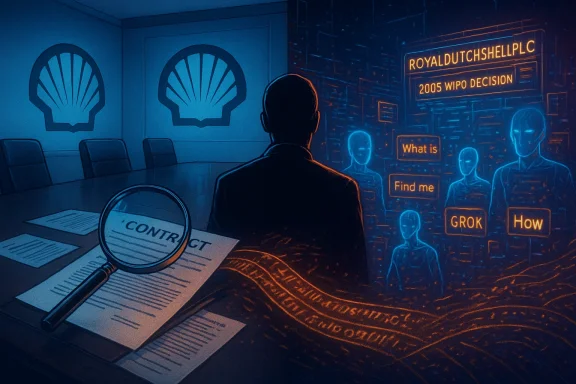
Late 2025 and early 2026 saw Donovan shift tactics from archiving and conventional publications to deliberately feeding his archive into multiple public large language models (LLMs) — ChatGPT, Microsoft Copilot, xAI’s Grok, Google AI Mode and others — then publishing the range of outputs side‑by‑side. The goal is twofold: to expose inconsistencies and hallucinations across models, and to use the very outputs of those models as provocation that draws wider attention to the original documents.- Scale and method: Donovan is reported to have an archive of tens of thousands of Shell‑related documents; by prompting AIs with identical queries about the same archive and publishing divergent answers, he creates a public spectacle that both amplifies older materials and reframes the dispute as an experiment in AI grounding and model disagreement.
- The asymmetric effect: Activists need only produce contradictions or dramatic AI outputs; the company faces a higher bar to rebut each claim, especially when the underlying materials are archival and voluminous. Observers note that this asymmetry helps Donovan control the narrative in short, attention‑driven cycles.
- Platform neutrality to date: Multiple public reports indicate that AI platforms have not instituted targeted blocks against Donovan’s prompts or the content he publishes, meaning the “bot war” continues to be fuelled by neutral platform responses rather than editorial suppression. For now, the platforms generate content drawing on public sources — including Donovan’s own sites — when no countervailing official record is presented.
Shell’s historical toolkit: legal letters, third‑party pressure, and strategic litigation
Shell’s response repertoire to critics is extensive and multifaceted. Key tactics, revealed through public reporting, Donovan’s archives and mainstream coverage, include:- Cease‑and‑desist and takedown requests aimed at intermediaries: domain registrars, hosting providers, and content networks rather than direct public lawsuits. These letters sometimes use intellectual property or trademark framing to demand content removal. Internal documents and Donovan’s published exchanges show this pattern over decades.
- Engagement of brand‑protection or cybersecurity contractors: Companies employ specialist firms to monitor the internet and issue enforcement notices. Donovan’s published correspondence points to an episode in July 2021 where a firm called Pointer Brand Protection & Research sent a five‑day take‑down ultimatum to his host, alleging trademark and copyright infringement and “unfair competition.” That specific 2021 episode is primarily documented in Donovan’s published record and reporting that relies on his archive. Independent corroboration beyond Donovan’s materials is limited in mainstream outlets. Where factual claims rest mainly on Donovan’s documents — for example the precise text and tone of the Pointer letter — they should be treated as primary material provided by the critic, not independently verified by third‑party reportage.
- Surveillance and private intelligence: Corporate security units historically monitor activist campaigns and sometimes hire intelligence firms. Documentation and third‑party reporting confirm the use of private intelligence in corporate contexts; however, attributing discrete covert acts to a named firm like Hakluyt in Donovan’s personal case is supported in part by internal memos and contemporaneous correspondence Donovan has published, but public, independently verified “smoking‑gun” evidence tying specific surveillance actions to a named operative is uneven. Journalists and analysts therefore generally treat operational attributions as plausible and supported by contextual evidence, while noting evidentiary limits.
- High‑stakes strategic litigation: Where Shell sees significant legal or safety claims (for example, the 2023 action involving Greenpeace activists on a Sea‑based platform), it has not shied from court. The Greenpeace case, which led to a high‑value claim and a late‑2024 settlement arrangement that included a charitable donation and a limited non‑protest commitment, was widely viewed by critics as a strategic litigation attempt that carried SLAPP (strategic lawsuit against public participation) attributes. That case demonstrates Shell’s willingness to litigate aggressively when the company judges it necessary, even as it prefers quieter pressure in other disputes.
The renewed threats (early 2026): posture, purpose, and probable limits
Public reporting in February–March 2026 documents that Shell either issued or considered renewed legal threats in response to Donovan’s AI‑amplified publications. Key elements and immediate assessments:- Nature of the threats: Reports describe the company or its agents warning of litigation and asking intermediaries or platforms to remove or flag content. In other cases, the threats appear to be considered internal options rather than immediate court filings. At present there is no public record of fresh lawsuits filed against Donovan arising from the early‑2026 exchanges.
- Strategic logic: Legal advisers facing a high‑profile archival critic have three realistic avenues:
- File a defamation suit or an IP complaint in court — costly, public, and potentially validating Donovan if the suit is seen as silencing dissent.
- Press intermediaries (hosts, registrars, platforms) to remove content — faster and lower‑profile but vulnerable to public backlash and to the legal protections available for non‑commercial criticism and fair use.
- Engage platforms and vendors directly to request corrections or provenance improvements where AI outputs repeat demonstrable factual errors — a softer remedy that aims to shape the information ecosystem rather than suppress content. Donovan’s recent tactics have arguably made route (3) more attractive to defenders who want to avoid the spectacle of suing a prominent critic.
- The probable ceiling: Historically, many of Shell’s sternly worded letters result in retreats or settlements rather than protracted trials — particularly where the target is a small, non‑commercial critic with a defensible fair‑use posture. Given the 2005 WIPO decision and the non‑commercial character of Donovan’s public archive, any new legal action would need to be narrowly targeted (for example, alleging demonstrable falsity in a named claim) to stand a reasonable chance of producing a favourable, final judgment for Shell. Broad, sweeping suits are risky and may produce more publicity than relief.
What is verifiable — and what remains disputed
In high‑conflict public disputes, separating robustly documented facts from contested claims is essential.- Verifiable and well‑sourced:
- WIPO decision in 2005: Panel denied Shell’s attempt to transfer Donovan’s criticized domains. That administrative ruling is a public document and remains a material precedent in the domain disputes between Donovan and Shell.
- Greenpeace settlement: Shell’s high‑value claim against Greenpeace over a platform boarding was settled in late 2024/early 2025 with the charity donation and limited non‑protest commitments; mainstream outlets reported the resolution and contextualised it as a contest over protest tactics and reputational leverage.
- Milieudefensie appeal: The Dutch Court of Appeal overturned the 2021 order that had obliged Shell to cut emissions by a quantified percentage; this appellate decision is widely reported and publicly accessible. That litigation track shows Shell will litigate where it sees broader corporate‑policy exposures.
- Plausible but partially verified claims:
- Use of private intelligence and surveillance methods: It is well documented that Shell and other major firms have engaged corporate intelligence contractors and monitoring units. Donovan’s archive contains contemporaneous material that suggests covert monitoring and aggressive private intelligence activity; however, direct attribution of individual covert acts to specific contractors (and proof of criminality) is not uniformly present in the open record. Independent reporting confirms the existence of private intelligence relationships but in many cases leaves operational detail unproven for legal reasons and source protection. Readers should therefore treat specific operational attributions as plausible and contextually supported while noting evidentiary limits.
- Claims that rely principally on Donovan’s published archive:
- The Pointer Brand Protection ultimatum of July 2021 and similar takedown letters are documented in Donovan’s public archive and have been picked up in secondary blogs and commentaries. Major mainstream media coverage confirming every aspect of those private letters is limited; when a claim depends primarily on materials published by one disputant (even if the material appears authentic), standard journalistic caution requires flagging that the account is effectively a primary source from the critic. Evidence is strong that such letters were issued; independent confirmation in a wide set of outlets is thinner.
Risks and implications: for Shell, for platforms, and for public debate
The Donovan–Shell “bot war” crystallises multiple modern risks that matter beyond this single feud.For Shell: reputational risk and the law’s bluntness
- Legal letters intended to deter may amplify. Every takedown demand or threat becomes content in Donovan’s hands; he publicises these exchanges and turns them into evidence of corporate overreach. That dynamic reduces the deterrent value of behind‑the‑scenes pressure.
- Courts and regulators move at different speeds than viral AI narratives. Suing may resolve specific legal issues but risks validating the dispute’s central publicity and exposing internal documents in discovery.
- Engaging platforms to remove or label AI outputs raises novel legal and procedural questions about when companies can compel model vendors to act against outputs generated from public archival sources.
For AI platforms: governance and provenance challenges
- LLMs trained on or prompted with archival material will inevitably synthesize claims, some of which may be inaccurate or defamatory. Platforms face growing pressure to improve provenance, provide better citations, and offer mechanisms to contest outputs derived from contested archives.
- Neutrality is operationally simple but socially risky: when platforms refuse to intervene in disputes that involve clear factual errors or harms, they implicitly privilege the loudest content producers. Conversely, heavy‑handed moderation invites accusations of censorship and collusion with corporate powers.
For public debate and journalism
- Donovan’s adversarial RAG (retrieval‑augmented generation) experiments expose weaknesses in public fact‑checking: journalists and experts must now adjudicate not only documents but also the outputs generated when documents are combined with different LLMs.
- There is a civic need for transparent protocols to handle disputes where archival material and AI outputs intersect. Standards could include:
- Clear provenance metadata for documents used as prompts.
- Fast‑track fact‑checking mechanisms for contested claims amplified by AI.
- Platform obligations to provide traceable reasoning or source links when models make factual assertions about living persons or corporate conduct.
Practical next steps each actor might reasonably take
- Shell
- Prioritise targeted, evidence‑based challenges where concrete falsity can be shown, rather than broad legal threats that risk amplifying the dispute.
- Build a platform‑engagement playbook with major AI vendors for correcting demonstrably incorrect outputs and improving model provenance on corporate history.
- Continue rigorous public communications and, where appropriate, offer transparent rebuttals referencing primary documents rather than legal threats.
- John Donovan and similar archival activists
- Continue publishing primary materials and context while anticipating legal counters; redoubled attention to accuracy and context will reduce exposure to sound defamation claims.
- Work with independent fact‑checkers or academic partners to strengthen the evidentiary value of archival releases.
- AI platforms
- Invest in provenance signals and appeal processes for outputs that repeat contested historical claims.
- Provide accessible tools for third parties to flag potentially defamatory or materially false outputs that cite their archive as a major source.
- Journalists and regulators
- Treat AI‑generated narratives as claims that require source verification; avoid accepting model outputs as evidence without independently checking primary documents.
- Consider whether new guidance is needed around corporate requests to remove AI outputs, balancing platform accountability, free expression, and harm reduction.
Conclusion: a classic pattern, with a new amplifier
The Donovan–Shell feud demonstrates how longstanding disputes between critics and corporations are reshaped by technology. Shell’s historical pattern of using legal correspondence, third‑party pressure, and selective litigation remains evident; so too does Donovan’s capacity to convert pressure into publicity. What is new is the scale and rapidity with which archival material — when fed into public AI assistants — can generate divergent narratives and be re‑packaged for public consumption almost instantly.As of early March 2026, renewed legal threats reported in response to Donovan’s AI‑amplified campaign appear consistent with Shell’s historical posture: forceful in letter, cautious in court. No fresh, major lawsuits have publicly materialised from the February–March 2026 exchanges, and the key legal precedents (notably the 2005 WIPO decision) continue to shape the likely outcomes of any domain‑oriented claims. Yet the strategic implications are clear: in an era where AI can reframe archives on demand, both corporations and platforms must develop faster, law‑sensitive, and transparent responses — otherwise every legal threat risks being repurposed as the next wave of content that the critic uses to amplify the dispute.
Source: Royal Dutch Shell Plc .com Donovan Shell Feud: Renewed legal threats?