

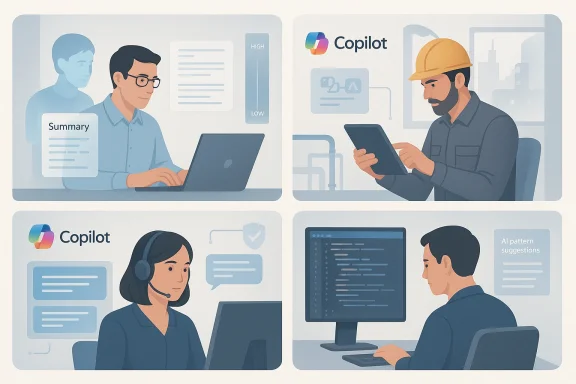
AI at work isn’t one size‑fits‑all because jobs, tasks, data, risk tolerances, and corporate strategies differ radically — and recent real‑world evidence now shows exactly how and where that variability matters.
The idea that generative AI will instantly and uniformly transform every workplace is giving way to something more nuanced: selective augmentation. That theme was summarized in a recent news item you shared, but the original London Daily News page was unable to be fetched directly because the site returned an automated verification block at the time of access, making the story inaccessible for straight quoting or verification. (londondaily.news)
What we can verify, however, is a growing body of empirical research and industry analysis that show AI’s impact is patchwork — profound in some roles, barely present in others — and driven by the details of tasks, information flows, and organizational design. Microsoft Research’s July 2025 paper analyzing over 200,000 anonymized Copilot conversations is the clearest large‑scale demonstration of that pattern: it measures which work activities people already delegate to AI and maps those to occupations, producing an AI applicability score that varies widely across roles.
Alongside Microsoft’s real‑world dataset, independent economic analyses from McKinsey and policy think tanks such as Brookings identify the same structural drivers — task composition, data availability, and wage/education correlations — while also flagging the scale of transition that may be required in some labor markets. These findings together explain why “AI at work” will look very different from one company, team, or job family to the next.
McKinsey’s long‑running work echoes this point: roughly half of work activities are technically automatable, but only about 5% of occupations can be fully automated with current technology. Different tasks within the same job experience very different levels of exposure. That’s why job titles alone are poor predictors of AI impact.
That disparity matters for organizations: two teams in the same company can have radically different AI ROI depending on whether their daily work is already digital and observable.
Key takeaways from the paper you should note:
That matters for investing scarce budget, designing governance, and protecting employees and customers. Companies that succeed won’t be the ones that chase shiny features; they’ll be the ones that map tasks, measure outcomes, design oversight, and invest in people. The “one size fits all” myth is dying — smart, measured, task‑aware adoption is what will actually change work for the better.
Source: London Daily News AI at work isn't one size fits all and here's why | London Daily News
 Background / Overview
The idea that generative AI will instantly and uniformly transform every workplace is giving way to something more nuanced: selective augmentation. That theme was summarized in a recent news item you shared, but the original London Daily News page was unable to be fetched directly because the site returned an automated verification block at the time of access, making the story inaccessible for straight quoting or verification. (londondaily.news)What we can verify, however, is a growing body of empirical research and industry analysis that show AI’s impact is patchwork — profound in some roles, barely present in others — and driven by the details of tasks, information flows, and organizational design. Microsoft Research’s July 2025 paper analyzing over 200,000 anonymized Copilot conversations is the clearest large‑scale demonstration of that pattern: it measures which work activities people already delegate to AI and maps those to occupations, producing an AI applicability score that varies widely across roles.
Alongside Microsoft’s real‑world dataset, independent economic analyses from McKinsey and policy think tanks such as Brookings identify the same structural drivers — task composition, data availability, and wage/education correlations — while also flagging the scale of transition that may be required in some labor markets. These findings together explain why “AI at work” will look very different from one company, team, or job family to the next.
Why “one size fits all” is the wrong metaphor
1) Work is composed of activities, not monolithic jobs
Most rigorous studies now treat jobs as bundles of activities. AI tends to substitute or augment specific activities (for example: summarizing, drafting, or extracting facts) rather than entire occupations. Microsoft’s analysis shows people are using Copilot most for gathering information, writing, advising and teaching — activities that cut across multiple white‑collar roles. That creates high AI applicability in some occupations and low applicability in others.McKinsey’s long‑running work echoes this point: roughly half of work activities are technically automatable, but only about 5% of occupations can be fully automated with current technology. Different tasks within the same job experience very different levels of exposure. That’s why job titles alone are poor predictors of AI impact.
2) Data and digitization create uneven opportunities
Generative AI thrives where there is structured, accessible, and high‑quality digital information. Sales records, email threads, knowledge bases, and code repositories are fertile ground. In contrast, roles that rely on tactile skills, unpredictable physical environments, or in‑person caregiving remain out of reach for today’s LLMs. Microsoft’s paper and multiple reporting threads show that interpreters, writers, and customer‑facing knowledge workers score high on AI applicability, whereas phlebotomists, roofers, and many hands‑on trades score low.That disparity matters for organizations: two teams in the same company can have radically different AI ROI depending on whether their daily work is already digital and observable.
3) Risk tolerance and regulatory context differ by industry
Industries such as finance, healthcare, and government face higher regulatory scrutiny and liability exposure for automated outputs. A model’s hallucination might be a tolerable annoyance in a marketing draft but a legal or clinical catastrophe in regulated contexts. Therefore, even when AI could perform a task technically, organizations with low tolerance for error or strict compliance obligations will limit its use or place guardrails that reduce automation gains. Multiple analyses of AI adoption highlight governance as a gating factor for real deployment.4) Corporate strategy and tool integration determine practical impact
Some companies adopt a “platform-centric” approach — integrating copilots inside core apps and workflows — while others experiment with point solutions or forbid AI tools entirely. These strategic choices shape how work actually changes. Anecdotal reporting from enterprise IT forums shows that organizations with clear adoption playbooks, data governance, and role‑based training unlock outsized productivity benefits. Conversely, lack of strategy produces shadow IT and inconsistent results.Evidence from the field: what the data says
Microsoft’s 200k+ conversation analysis — the heavyweight test case
Microsoft Research’s “Working with AI: Measuring the Occupational Implications of Generative AI” analyzed 200,000 anonymized Copilot conversations sampled over nine months of 2024 and matched activity types to ONET job descriptions. The study’s headline finding: activity‑level overlap* matters — occupations centered on providing and communicating information show the highest AI applicability scores. The researchers explicitly caution that their analysis shows where AI is being used and where it could affect the nature of work, not a direct causal estimate of jobs lost or gained.Key takeaways from the paper you should note:
- Activities like drafting, summarizing, and information retrieval are frequently delegated to AI.
- Knowledge‑work occupations (e.g., sales, office support, computer & mathematical roles) have the highest AI applicability.
- Roles requiring physical presence or manual dexterity show the least overlap.
Macroeconomic estimates: scale and uncertainty
Broader economic research paints a range of plausible futures. McKinsey’s analysis places the share of hours that could be automated in the next decade at a non‑trivial percentage — their Europe/US model suggests roughly 27–30% of hours could be impacted by 2030 under faster adoption scenarios — but they stress that these are hours affected, not necessarily jobs eliminated. Brookings researchers similarly estimate that generative AI could disrupt more than 30% of workers’ tasks in many occupations. These studies converge on one message: scale is large, but outcomes depend heavily on policy, training, and business responses.Productivity isn’t automatic — the adoption paradox
Field surveys and executive studies show a productivity paradox: many firms adopt AI faster than they measure gains. A recent cross‑country executive survey captured by economic researchers found that a majority of firms report experimenting with AI, but tangible productivity or employment benefits lag in many cases. This matters because organizations that treat AI as a bolt‑on are less likely to get structural gains than those that redesign workflows, metrics, and governance.Strengths: where AI delivers clear, repeatable value
- Information work acceleration. Tasks like summarization, drafting, research, and data extraction show immediate measurable speedups when paired with human oversight. Microsoft’s conversational logs make this concrete.
- Scale in customer‑facing automation. Contact centers and help desks can automate tier‑1 inquiries and produce consistent scripts, freeing humans for escalation and complex judgment. This is why customer service repeatedly appears on high‑exposure lists.
- Knowledge amplification. For developers, analysts, and marketers, AI surfaces patterns and prototypes faster — accelerating experimentation cycles and reducing repetitive overhead. McKinsey’s work shows gen‑AI can automate a meaningful share of routine tasks, amplifying skilled workers’ throughput when combined with reskilling.
- Lower barrier for small teams. Off‑the‑shelf copilots and connectors allow small teams to access advanced capabilities without the cost of bespoke ML engineering, which democratizes innovation for SMBs and in‑house teams. This is visible in many practical rollouts discussed in industry forums.
Risks and blind spots: where “one size” thinking fails badly
- Overgeneralizing applicability — Treating AI as a universal replacement creates organization‑level risk: automation in unsuitable areas increases error, legal exposure, and poor customer outcomes.
- Measurement and attribution — Many organizations lack baseline metrics for work quality and time; when they don’t measure properly, they can’t know whether AI improved or degraded outcomes. The productivity paradox highlights this blind spot.
- Data leakage and compliance exposures — Users sharing sensitive PII or proprietary data with public systems creates escalation risks. Without firm guardrails, AI adoption can accelerate accidental exfiltration. Enterprise security and legal teams must be involved early.
- Equity of transition — Workers in highly exposed roles may face rapid dislocation while others remain insulated. The redistribution burden falls on education systems, employers, and policy — not individual employees alone. McKinsey and Brookings emphasize the scale of re‑skilling required.
- Vendor and platform lock‑in — A single vendor strategy may speed deployment but increases dependency on one company’s model architecture, data policies, and pricing. Multi‑vendor strategies are harder but lower long‑term strategic risk. Forum discussions from IT practitioners underscore tradeoffs between integration speed and future flexibility.
What IT leaders and Windows professionals should do now
Immediate actions (1–3 months)
- Inventory activities, not just apps. Map the activities your teams perform daily. Prioritize high‑volume, high‑value tasks that are already digital and repetitive. This activity‑centric view aligns with how Microsoft and McKinsey measure applicability.
- Define risk tiers and policies. Create a simple, role‑based AI policy that identifies what classes of data can be used with public models, which require on‑premises or enterprise‑grade controls, and which are off limits. Security and legal should sign off.
- Pilot with clear success metrics. Run short, measurable pilots that track quality, time saved, error rates, and user adoption. Avoid rolling out broad access until pilots show repeatable benefits. Measure both productivity and quality.
Medium term (3–12 months)
- Invest in co‑design, not replacement. Redesign workflows to pair AI with human oversight, particularly for decision points that require empathy, context, or ethics. Use role redesign principles: automation for routine tasks, humans for judgment.
- Reskilling and career ladders. Build clear reskilling tracks tied to business outcomes. For roles with high AI applicability, pivot training toward supervision, prompt engineering, data hygiene, and domain validation skills. McKinsey models project large occupational transitions that will require organized retraining if disruption is to be manageable.
- Architect for composability. Favor modular integration patterns (APIs, connectors, secure RAG pipelines) so you can swap models and vendors without reworking core systems. This reduces lock‑in risk. Practitioner forums show organizations that design flexible integration layers have smoother upgrades and better governance outcomes.
Long term (12+ months)
- Govern for continuous monitoring. Treat model outputs as operational services: log, sample, audit, and iterate. Measure drift, fairness, and downstream outcomes over time.
- Policy and pay transparency. Where AI materially changes productivity or roles, be transparent with employees about metrics, expectations, and career options. That reduces fear, churn, and reputational risk.
- Plan across the ecosystem. Work with vendors, industry groups, and policymakers to align standards for explainability, safety, and cross‑industry data sharing where appropriate.
Best practices for Windows‑centric environments
- Use enterprise‑grade copilots that respect corporate data connectors and integrate with Microsoft 365 compliance controls when possible. For many Windows shops the built‑in Copilot experience can be an easier place to start because it plugs into familiar identity and governance layers. Microsoft’s real‑world Copilot analysis underscores that the biggest early wins are inside productivity stacks where data is already captured and structured.
- Build “one‑click rollback” patterns: when AI writes or transforms content, keep versioning and quick undo so users can validate before publishing.
- Combine on‑device AI for sensitive workflows (local inference) with cloud copilots for scale. The hybrid model preserves control where it matters and accelerates innovation where scale matters.
- Train power users first. Early adopters who understand prompt craft, data hygiene, and escalation paths help create organizational norms and reduce misuse.
Critical analysis: strengths, blind spots, and where the industry can misread the evidence
Microsoft’s Copilot study is valuable because it relies on real usage data rather than hypothetical modeling. That empirical grounding is a major strength: it tells us what people are already trying to do with AI. However, the study has limitations that are important to surface:- Single‑system bias. The analysis is limited to one provider’s conversational logs. Other models, multimodal systems, or domain‑specific AI stacks could expose different overlaps. Generalizing too broadly from one dataset risks blind spots.
- Work vs leisure ambiguity. The study’s conversations are anonymized and sampled, but distinguishing personal curiosity from on‑the‑job tasks is inherently noisy. That can overstate work incidence for some activities.
- Scaling from tasks to employment. High AI applicability does not equal mass layoffs. History shows that automation reshapes jobs more than destroys them outright. The net employment effect depends on investment, new product lines, and reskilling policies. McKinsey and Brookings both stress that policy and corporate choices shape outcomes.
- Mistake 1: Treating a high AI applicability score as a simple yes/no layoff signal. It’s not. It’s a prompt to redesign roles and training.
- Mistake 2: Deploying public models for regulated data because early demos look impressive. Governance failures here are costly.
- Mistake 3: Celebrating adoption metrics without measuring human outcomes. The productivity paradox shows that adoption is only the first step.
Practical checklist for evaluating “Is this job ready for AI augmentation?”
- Does the job contain high‑volume, text‑based activities (drafting, summarizing, Q&A)?
- Are those activities performed on digital artifacts that can be securely connected to the AI?
- Is the organization prepared to accept the predicted error modes (hallucinations, factual drift) with mitigation plans?
- Are there clear metrics and a redesign plan if AI is integrated (quality, throughput, customer satisfaction)?
- Is there a reskilling pathway for affected workers with transparent career development?
Conclusion
The evidence is now converging on a clear conclusion: AI at work is not a monolith. Microsoft’s 200k‑conversation study gives us a rare, data‑rich snapshot of how people actually use generative AI in the wild, and economic research from McKinsey and Brookings frames the scale and policy implications of that use. Together they show a simple but crucial practical lesson for CIOs, IT managers, and Windows professionals: treat AI as activity‑level augmentation, not as a uniform replacement.That matters for investing scarce budget, designing governance, and protecting employees and customers. Companies that succeed won’t be the ones that chase shiny features; they’ll be the ones that map tasks, measure outcomes, design oversight, and invest in people. The “one size fits all” myth is dying — smart, measured, task‑aware adoption is what will actually change work for the better.
Source: London Daily News AI at work isn't one size fits all and here's why | London Daily News
