

Artificial intelligence is already reshaping how students study, how teachers teach, and how schools measure learning—and the question most parents, teachers, and students now ask is not whether AI will matter, but how it should be used so that it actually benefits learning rather than replacing it.
The last few years pushed generative AI from curiosity to commonplace study aid. Chat-based systems such as ChatGPT, enterprise copilots like Microsoft Copilot, and education-specific assistants such as Khan Academy’s Khanmigo are widely used by learners for drafting, summarising, and practice questions. Multiple surveys and institutional pilots report high, rapidly rising adoption among students—often in the mid‑80s to low‑90s percent range for college-age populations—making AI a default study tool in many contexts rather than a novelty.
That ubiquity explains why debates about AI and education have intensified. On one side are educators worried about shortcuts, hallucinations, and the erosion of academic skills; on the other are advocates who point to time savings, scalable personalization, and improved access for students with specific learning needs. The evidence now available suggests the truth sits squarely in the middle: AI can be a powerful educational amplifier when used as augmentation, but it can also hollow out learning when it substitutes for the thinking that assessments are designed to measure.
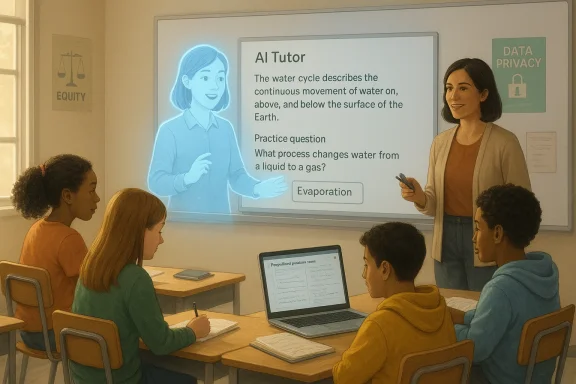
The practical challenge for schools is not whether to use AI, but how to use it: redesign assessments to reward process, teach verification and AI literacy, procure tools with strong data protections, and ensure equitable access. With those guardrails in place, AI can expand what teachers and students can achieve together—turning a potent shortcut into a responsible, powerful study partner.
Source: London Now Young Reporter | London Now
 Background / Overview
The last few years pushed generative AI from curiosity to commonplace study aid. Chat-based systems such as ChatGPT, enterprise copilots like Microsoft Copilot, and education-specific assistants such as Khan Academy’s Khanmigo are widely used by learners for drafting, summarising, and practice questions. Multiple surveys and institutional pilots report high, rapidly rising adoption among students—often in the mid‑80s to low‑90s percent range for college-age populations—making AI a default study tool in many contexts rather than a novelty.That ubiquity explains why debates about AI and education have intensified. On one side are educators worried about shortcuts, hallucinations, and the erosion of academic skills; on the other are advocates who point to time savings, scalable personalization, and improved access for students with specific learning needs. The evidence now available suggests the truth sits squarely in the middle: AI can be a powerful educational amplifier when used as augmentation, but it can also hollow out learning when it substitutes for the thinking that assessments are designed to measure.
What AI does well for students
AI brings four practical, repeatable advantages to study workflows when human oversight and pedagogy are present.1. Time and workload reduction
AI automates many routine, time-consuming tasks that used to eat into study or teaching time: summarising long readings, transcribing lectures, drafting first-pass essays or lab reports, and generating practice questions. Institutional pilots consistently report measurable week‑to‑week time savings when teachers and students use AI to handle administrative and repetitive tasks—time that can be redirected to high-value learning activities.2. Scalable personalization and differentiation
Large classes struggle to provide bespoke practice. AI can generate scaffolded explanations, tailored practice sets, and differentiated worksheets on demand—at scale. That capability supports mastery learning by enabling more frequent low-stakes practice and targeted remediation. Several district pilots highlight this as one of the most replicable education wins.3. Faster formative feedback and assessment cycles
Automated scoring and AI-assisted formative checks compress feedback cycles from days to hours, enabling quicker remediation and small-group interventions. Faster feedback is pedagogically powerful because it helps students correct misconceptions while the material is still fresh.4. Improved accessibility and inclusion
AI features—automatic captions, plain-language rewrites, translation, and multimodal outputs—lower barriers for English-language learners and students with special educational needs. Tools such as reading coaches and immersive readers have demonstrable classroom impact by enabling equitable participation.How students are actually using AI (and why intent matters)
Students use AI across a spectrum of tasks, from clearly beneficial to clearly problematic. Typical, frequent uses include:- Explaining unfamiliar concepts and summarising readings.
- Generating outlines, study guides, and flashcards.
- Checking grammar, clarity, and citation formats.
- Drafting first-pass essays or code snippets to be edited.
- Creating practice quizzes for revision.
What the evidence says about learning outcomes
Policymakers and educators need evidence-based answers, not anecdotes. Recent classroom trials and pilots provide a mixed but instructive picture.The Cambridge–Microsoft classroom trial: a useful reality check
A randomized classroom experiment run with 405 students aged 14–15 compared three conditions: handwritten note‑taking only, LLM assistance only, and LLM plus note‑taking. The trial measured delayed recall and conceptual understanding using curriculum‑aligned history passages and found a clear signal: handwritten note‑taking produced stronger three‑day retention and comprehension than relying on an LLM alone, while the hybrid condition (LLM + notes) preserved those benefits. In short: AI didn’t eliminate the benefits of active encoding when students still engaged in handwriting and generative work, but relying solely on the LLM did reduce retention. This trial illustrates a core pedagogical principle—AI is most powerful when it supports active learning processes rather than replacing them.Pilot programs and applied deployments
Several district and university pilots (including enterprise Copilot rollouts and reading-assessment tools) report measurable time savings, improved responsiveness, and some gains in engagement and formative outcomes when AI is deployed with teacher training and governance. Khan Academy’s Khanmigo and institution-specific virtual peer bots have shown promising user engagement and some positive preparedness measures in pilots, although independent replication and peer-reviewed long‑term learning measures are still limited in scope.What this means for claims about “AI improves learning”
There is robust evidence that AI improves efficiencies (time saved, faster feedback), reliably supports differentiation, and can increase engagement. The evidence for consistent, measurable long-term gains in deep conceptual mastery across subjects is emerging but heterogeneous. Importantly, experimental evidence shows that when AI is used as a shortcut—replacing the active cognitive work that encodes knowledge—learning outcomes can suffer. That nuance matters for how schools evaluate AI’s educational value.The real risks: what educators, parents, and students must watch
AI’s upside is real, but so are several recurring and sometimes systemic hazards. These must be managed rather than ignored.1. Academic integrity and the “invisible shortcut”
High student adoption correlates with rising instances where AI produces work submitted with minimal revision. Polished final products that mask absent process evidence weaken assessment validity and risk creating graduates who can produce good-looking work without internalized skills. Detection tools are imperfect; many institutions now focus on assessment redesign (process-based tasks, in-person defenses, draft logs, and required disclosures) rather than relying solely on detection.2. Hallucinations and factual reliability
Generative models sometimes produce plausible yet incorrect information. In subject areas where accuracy matters—science, history, math—uncritical acceptance of AI outputs can propagate misconceptions. Teachers and students must be trained to treat AI outputs as provisional drafts that require verification.3. Data privacy and vendor governance
Contracts differ widely on whether student inputs are used to train models, what telemetry is retained, and how data are stored. Enterprise education SKUs may offer non‑training clauses and tenancy protections, but consumer tools often do not. Institutions that adopt consumer services without clear contractual protections risk exposing student data to unknown downstream uses.4. Equity and the digital divide
Premium features, paid subscriptions, device and bandwidth requirements can produce unequal access. Without active equity measures—centralized licenses, device loaner programs, offline modes—AI risks amplifying existing achievement gaps. Adoption is often higher where resources and procurement capacity exist, leaving under-resourced students behind.5. Emotional and safety concerns
Conversational agents are used by some students as companions; this can create emotional dependencies and raise safety and wellbeing concerns. Designers and deployers must consider age gating, crisis‑safe responses, and clear boundaries for conversational use in school contexts.Pedagogical strategies to capture benefits while limiting harms
The research and pilot evidence points to concrete classroom practices that preserve learning while exploiting AI’s productivity gains.Redesign assessments to emphasise process
- Require documented drafts, annotated revisions, or version histories so teachers can assess the process of learning, not just the final artifact.
- Use in-class, oral, or defended components for high‑stakes assessment where possible.
- Design tasks that require personal reflection, local data, or in-class demonstrations that are harder to outsource.
Teach verification and AI literacy explicitly
- Make source verification, cross‑checking, and prompt evaluation regular classroom activities.
- Train students to ask the right follow-ups: “Show your sources,” “Explain how you know this,” and “What would contradict this claim?”
- Build AI literacy into curricula as a transferable workplace skill rather than an optional add‑on.
Use AI as a scaffold, not a substitute
Encourage workflows where AI generates practice items, example outlines, or explanations that students then use to produce their own work. The Cambridge trial shows hybrid workflows (AI + active note-taking) preserve retention benefits, while using AI as the only active agent harms durability.Guard data and manage procurement
Procure enterprise education licences when possible, and require non‑training and deletion clauses in vendor contracts. Centralized procurement can also help equalize access and reduce equity gaps. Where consumer tools are used, teach students what not to upload (personal data, identifiable records, exams) and enforce clear governance.Practical, evidence‑based recommendations
Below are actionable recommendations tailored to three audiences.For students
- Use AI to draft, summarise, and rehearse—but always perform an explicit revision pass and cite or verify facts before submitting work.
- Pair AI use with active study techniques: self‑testing, spaced retrieval, and handwritten notes improve retention.
- Practice prompt literacy: the better you ask, the more useful the output, and the easier it is to treat AI as a study partner rather than a substitute.
For teachers
- Redesign assessments to surface process evidence and critical reflection.
- Introduce AI literacy modules that teach verification, bias awareness, and ethical use.
- Pilot AI with clear governance: begin with low-stakes formative tasks, measure outcomes, and scale only with training.
For school leaders and policymakers
- Prefer enterprise education agreements that include non‑training clauses and data deletion options.
- Provide equitable access through institutional licences, lab time, or device loans to avoid widening digital divides.
- Invest in teacher professional development focused on redesigning assessments and embedding AI literacy.
Tools and features to watch (practical examples)
- ChatGPT — widely used for drafting and ideation; excellent for brainstorming but requires careful verification for factual accuracy.
- Microsoft Copilot — commonly deployed in district and enterprise settings as a productivity assistant that integrates with institutional tools; pilot reports emphasise time savings for administrative tasks.
- Khanmigo (Khan Academy) — an example of a domain‑focused tutor with promising pilot results for readiness and practice in controlled contexts.
- Reading and accessibility tools (Immersive Reader, Reading Coach) — strong real-world benefits for multilingual and special needs learners.
Remaining unknowns and research gaps
The evidence base is improving but still incomplete in important ways:- Long-term, cross‑subject randomized trials measuring deep conceptual mastery and transfer are limited.
- Independent replication of vendor‑reported gains (beyond pilot metrics like engagement and time saved) is uneven.
- The long-run impacts of routine AI reliance on higher-order reasoning, creativity, and problem-solving remain under study.
Conclusion
Is AI beneficial for students? The answer is: it depends. When treated as an augmentation—a co‑pilot that automates routine tasks, supplies tailored practice, and frees human time for higher‑order instruction—AI delivers clear, repeatable benefits in efficiency, differentiation, and accessibility. When used as a shortcut that replaces the cognitive work of encoding, reasoning, and revision, AI can reduce retention and hollow out important learning outcomes.The practical challenge for schools is not whether to use AI, but how to use it: redesign assessments to reward process, teach verification and AI literacy, procure tools with strong data protections, and ensure equitable access. With those guardrails in place, AI can expand what teachers and students can achieve together—turning a potent shortcut into a responsible, powerful study partner.
Source: London Now Young Reporter | London Now
