

AI has already stopped being an experimental classroom novelty and become a routine — sometimes messy, sometimes brilliant — part of teaching, assessment and administration, and 2025 is the year that ubiquity turned into hard choices for schools, colleges and policy makers.
By mid‑decade generative AI moved out of optional labs and into mainstream student workflows and school operations. Large surveys and institutional rollouts show high day‑to‑day use by students, rapid vendor engagement with campuses, and wide variation in how prepared educators and systems are to govern the tools responsibly. The Digital Education Council’s 2024 global student survey reported usage levels in the high‑80s for students using AI for study; independent university pilots, systemwide contracts and district trials all confirm that adoption is broad but uneven.
That expansion created two simultaneous facts: AI can measurably accelerate routine tasks and personalization at scale, and it can also complicate learning assessment, privacy and fairness. Leading institutions moved quickly from ad‑hoc bans toward "managed adoption" — enterprise licensing, syllabus‑level policy, and assessment redesign — while many K–12 districts and smaller colleges are still catching up with training and governance.
Note on verification: market projections and firm‑level valuation claims in aggregated summaries are frequently re‑published; any procurement decision should be supported by the original market reports and vendor contract text before relying on a headline CAGR or valuation figure. Several projections cited in popular articles require checking the primary Market.us or firm filings for exact methodology and assumptions.
Verification note: district‑level training commitments appear frequently in planning documents and press releases; the presence of a planned training program does not automatically guarantee sustained, classroom‑effective professional development — districts should publish completion and outcome metrics to validate program impact.
Unverifiable or cautionary claims: specific headline percentages reported in secondary summaries (for example, precise percentage lifts or claimed exam score improvements for a named university) should be confirmed against the original institutional study or peer‑reviewed evaluation. Some widely‑circulated claims in press compilations lack accessible methodology or pre/post control groups; treat them as promising but provisional.
However, some specific numeric claims circulating in secondary summaries require caution. For example, a handful of press‑compiled lists and aggregated articles attribute precise percentage lifts in exam scores or student independence to particular tools or trials; those claims are promising but in many cases lack public, peer‑reviewed methodology or accessible raw data. Claims about precise market sizes, single‑trial percentage lifts or exact student‑level adoption percentages at a named university should be validated against original vendor dashboards, peer‑reviewed studies or institutionally published evaluation reports before being treated as firm.
The responsible path is not to ban or blindly accept AI, but to treat it as a capability that must be contracted, taught, audited and assessed. Institutions that pair enterprise procurement with teacher capacity building, transparent assessment rules and rigorous, public measurement of outcomes are best positioned to make AI an educational tool rather than an academic liability.
Source: ElectroIQ AI In Education Statistics By Usage, Adoption and Facts (2025)
 Background / Overview
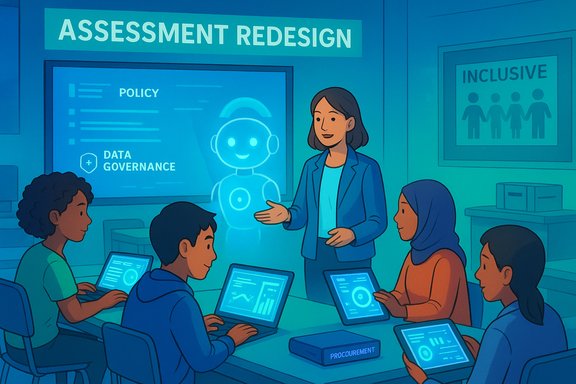
By mid‑decade generative AI moved out of optional labs and into mainstream student workflows and school operations. Large surveys and institutional rollouts show high day‑to‑day use by students, rapid vendor engagement with campuses, and wide variation in how prepared educators and systems are to govern the tools responsibly. The Digital Education Council’s 2024 global student survey reported usage levels in the high‑80s for students using AI for study; independent university pilots, systemwide contracts and district trials all confirm that adoption is broad but uneven.That expansion created two simultaneous facts: AI can measurably accelerate routine tasks and personalization at scale, and it can also complicate learning assessment, privacy and fairness. Leading institutions moved quickly from ad‑hoc bans toward "managed adoption" — enterprise licensing, syllabus‑level policy, and assessment redesign — while many K–12 districts and smaller colleges are still catching up with training and governance.
Market size and commercial context
The headline numbers and why they matter
Commercial forecasts cited in the materials project strong market growth for AI in education, with multi‑billion dollar markets on the horizon. These projections underpin why vendors, investors and procurement teams are aggressively courting schools and universities: the technology is both a pedagogical tool and a major commercial opportunity. At the same time, public‑sector procurement and contracts now shape how student data is handled, and those decisions have real educational and legal consequences.What the available data shows about funding and investment
Private AI investment is heavily concentrated in the United States, far outpacing other countries in absolute dollars. That concentration drives rapid productization and vendor activity in North American education markets and explains why many large system deals (enterprise licensing, Copilot, ChatGPT Edu, etc. originated there. These investments accelerate both capabilities and questions about vendor lock‑in, telemetry and data governance that school systems must confront.Note on verification: market projections and firm‑level valuation claims in aggregated summaries are frequently re‑published; any procurement decision should be supported by the original market reports and vendor contract text before relying on a headline CAGR or valuation figure. Several projections cited in popular articles require checking the primary Market.us or firm filings for exact methodology and assumptions.
How students are using AI: scale, tasks and preferred apps
Adoption rates and daily habits
Multiple surveys in 2024–2025 show that the majority of students use AI in study workflows, often weekly. One large global dataset reports that roughly 86% of students use AI for study purposes and more than half use it weekly — a usage level that has shifted AI from optional study aid to default study behavior in many contexts. ChatGPT emerges repeatedly as the single most popular tool among students, followed by writing‑assistants and productivity copilots.- ChatGPT is the most commonly reported primary tool among students in multiple surveys.
- Grammarly and Microsoft Copilot are frequently cited as the top secondary tools for writing and productivity tasks.
What students actually ask AI to do
Students typically use AI for:- Explaining difficult concepts and summarizing readings.
- Brainstorming ideas and drafting outlines.
- Grammar and style checks, revision suggestions and citation help.
- Generating practice questions and personalized revision plans.
Age groups and tool diversity
Usage clusters strongly in the 14–22 age bracket, where roughly half of learners report using generative AI specifically for learning and creativity tasks; image generation, audio creation and coding assistance are important secondary uses for subsets of students. Many students run two or more AI tools in parallel for coursework.Teachers and school leaders: adoption, training and daily use
Rapid uptake, limited formal training
K–12 and higher‑education faculty adoption patterns diverge: K–12 teachers report especially high engagement with generative AI for both personal and classroom use, while regular faculty use in higher education is lower but growing. Many district leaders are daily users, and some report embedding AI into administrative workflow and lesson design. Yet formal training lags: a large percentage of K–12 teachers report they have not received structured AI professional development, and many feel unprepared to manage generative AI in assessments.- 83% of K–12 teachers report using generative AI in some capacity, but a majority lack formal training.
- Education leaders and district managers are more likely to be daily AI users as they manage procurements and policy.
Where teachers use AI in practice
Teachers commonly deploy AI for:- Lesson planning and rapid creation of differentiated materials.
- Generating formative assessments and practice quizzes.
- Drafting parent communications, summaries and administrative reports.
Training pipelines and district plans
Many districts planned or launched training programs by 2025; RAND and other research groups report a patchwork rollout of AI professional development that ranges from one‑hour briefings to multi‑week bootcamps. Projections anticipated that a large majority of districts would offer teacher training by Fall 2025, but the actual depth and quality of training varied widely by district and resource level.Verification note: district‑level training commitments appear frequently in planning documents and press releases; the presence of a planned training program does not automatically guarantee sustained, classroom‑effective professional development — districts should publish completion and outcome metrics to validate program impact.
Institutional responses: policies, procurement and assessment redesign
Managed adoption is the emerging default
Top universities and some districts adopted a pragmatic blueprint: centralize procurement to secure enterprise or education editions (limiting telemetry and training‑use of student inputs), require course‑level policy statements, and redesign assessments to surface process as well as product. That managed adoption posture aims to gain the benefits while keeping risk manageable. Examples from multiple institutions show enterprise licensing plus decentralized course rules as a common pattern.Assessment redesign: move from product to process
To protect learning validity many institutions shifted assessment emphasis to:- Staged submissions and draft logs that reveal student process.
- Oral defenses, vivas and in‑class supervised work for summative assessment.
- Portfolios and annotated revisions that document student verification and critical review of AI outputs.
Procurement and data governance checklist
Contracts and vendor terms now matter more than ever. Practically, institutions should insist on:- Explicit non‑use clauses if student inputs are not to be used to train public models.
- Clear data retention and deletion rights.
- Audit and export capabilities for logs and telemetry.
- Role‑based access and tenant controls for student accounts.
Evidence of learning impact — what we can verify
Several pilot programs and institutional studies report measurable improvements in specific outcomes, especially when AI is integrated with pedagogy and teacher oversight. Examples in the available material include:- District trials showing double‑digit weekly time savings for teachers on administrative tasks and increased capacity for differentiation.
- Small university pilots and controlled trials reporting modest gains in exam performance and pass rates when AI was used as a studied, scaffolded tutor. However, the scale and rigor of these evaluations vary by site.
Unverifiable or cautionary claims: specific headline percentages reported in secondary summaries (for example, precise percentage lifts or claimed exam score improvements for a named university) should be confirmed against the original institutional study or peer‑reviewed evaluation. Some widely‑circulated claims in press compilations lack accessible methodology or pre/post control groups; treat them as promising but provisional.
Risks, ethical concerns and classroom integrity
Academic integrity and plagiarism
Plagiarism and the blurring of assistance with authorship are the most frequently cited concerns among educators. Many teachers and administrators report a rise in AI‑assisted submission patterns that are hard to detect with traditional plagiarism tools. Detection tools are imperfect and can produce false positives, especially for learners who use editing help for legitimate accessibility reasons. This reality pushes institutions toward process‑based assessment and disclosure norms rather than solely punitive detection.Hallucinations, misinformation and verification
Generative models can produce fluent but incorrect statements. When students use AI outputs uncritically for research or answers, hallucinations can propagate misinformation into assessed work. Teaching verification habits — checking primary sources, seeking citations, and using AI as an idea generator rather than an authority — is essential. Some citation‑aware assistants attempt to provide sources but are not a substitute for disciplined source evaluation.Equity and the digital divide
AI adoption risks widening the gap between well‑resourced and under‑resourced learners. Premium features, on‑device accelerators and reliable broadband access produce materially different experiences. Districts and colleges must plan equitable provisioning (institutional accounts, device loan programs and low‑bandwidth alternatives) to avoid creating a two‑tier classroom.Data privacy, vendor lock‑in and contract exposure
Even when vendors promise not to train models on educational prompts, contractual language and audit rights matter. Centralized procurement can reduce risk, but it also concentrates bargaining power with vendors. Procurement must include explicit terms on training‑use, deletion rights and telemetry access; otherwise institutions may lose the ability to control sensitive student inputs over time.Policy and training: bridging the readiness gap
The training shortfall
Large numbers of educators reported no formal AI training as late as 2024–2025. Many districts projected rapid rollouts of mandatory training by Fall 2025, but completion rates, depth and measurable outcomes were mixed across systems. Effective professional development is short, practical and task‑oriented; it must include both technical prompts and pedagogical redesign coaching.What effective teacher training looks like
- Short, focused modules on prompt design, hallucination checks and vendor privacy settings.
- Pedagogical workshops on assessment redesign and scaffolded AI use in assignments.
- Peer networks and repositories of AI‑aware rubrics, lesson templates and process‑assessment artifacts.
- Protected time and incentives for faculty to redesign curricula and pilot AI‑enabled learning strategies.
International differences and sociocultural attitudes
Adoption and optimism vary widely by country. Private investment, national AI strategies, and cultural attitudes toward automation shape both adoption speed and public confidence in AI’s benefits. Surveys show high optimism in some markets and far more skepticism in others; those differences predict how aggressively systems will adopt AI tools and fund teacher training. The United States leads in private investment dollars, which accelerates vendor presence and institutional deals in North America.Gender, discipline and usage patterns
Surveys indicate gender differences in usage frequency, perceived risks, and emotional responses to AI. Male students often report higher usage frequency and more optimism about AI’s capabilities, while female students report greater concern about academic misconduct and correctness. STEM and higher‑socioeconomic learners tend to adopt and explore AI features more quickly. These differences highlight the need for inclusive training and disaggregated outcome monitoring so that adoption does not deepen existing disparities.Practical checklist for schools and colleges deciding how to act now
- Centralize procurement for core AI tools to secure education‑grade contracts and contractual protections.
- Publish simple, required AI‑disclosure language for assignments where AI contributes.
- Redesign high‑stakes assessments to require process evidence and in‑person demonstrations.
- Invest in short, mandatory teacher PD that pairs technical prompting with assessment redesign.
- Require vendor audit rights, non‑training clauses (if desired), and explicit retention/deletion terms in contracts.
- Track disaggregated usage and outcome metrics to monitor equity impacts and learning outcomes.
What to watch next (short horizon)
- The expansion of enterprise education offers from major vendors and the legal clarity that procurement teams will demand from them.
- Longitudinal studies that measure whether AI‑aided learning improves retention and higher‑order thinking, not just short‑term performance gains.
- Whether assessment redesign becomes the regulatory norm in accreditation and quality assurance frameworks — this will determine whether AI use is governed academically (pedagogy) or technically (detection).
Strengths, cautionary notes and unverifiable claims
AI’s clear strength is scaling personalized practice, formative feedback and teacher productivity — when educators keep final oversight and verify outputs. Institutional deployments suggest real operational benefits in teacher time savings and in scaffolded student support.However, some specific numeric claims circulating in secondary summaries require caution. For example, a handful of press‑compiled lists and aggregated articles attribute precise percentage lifts in exam scores or student independence to particular tools or trials; those claims are promising but in many cases lack public, peer‑reviewed methodology or accessible raw data. Claims about precise market sizes, single‑trial percentage lifts or exact student‑level adoption percentages at a named university should be validated against original vendor dashboards, peer‑reviewed studies or institutionally published evaluation reports before being treated as firm.
Conclusion
AI is no longer a hypothetical classroom aid; it is a practical classroom force that offers genuine pedagogical benefits when deployed with clear governance, teacher training and assessment redesign. The policy and procurement choices institutions make in 2025 will determine whether AI amplifies inequity and academic‑integrity problems or whether it becomes a scalable, equitable supplement to human teaching.The responsible path is not to ban or blindly accept AI, but to treat it as a capability that must be contracted, taught, audited and assessed. Institutions that pair enterprise procurement with teacher capacity building, transparent assessment rules and rigorous, public measurement of outcomes are best positioned to make AI an educational tool rather than an academic liability.
Source: ElectroIQ AI In Education Statistics By Usage, Adoption and Facts (2025)
