

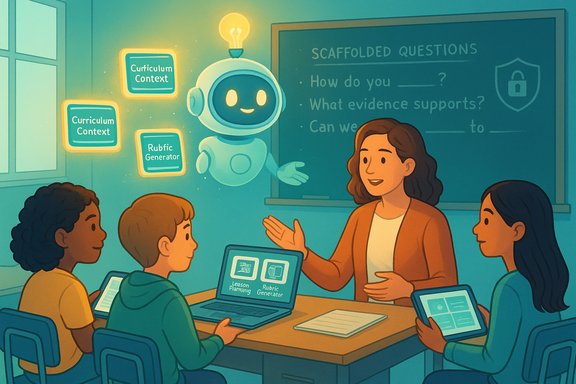
As 2025 closed, one clear fact stood out: generative AI in education stopped being a thought experiment and became a set of working tools shaping day-to-day teaching, planning, and student study. Platforms that advanced this year did not win by spectacle; they won by reducing friction, respecting pedagogy, and slotting into existing teacher workflows. The most consequential moves were incremental—better memory in classroom assistants, tightly integrated copilots inside productivity suites, and student-first study tools that scaffold learning rather than substitute for it.
Background
Education systems entered 2025 with pilot fatigue and a long list of unanswered questions about safety, equity, and learning outcomes. Over the last twelve months those debates shifted from theory to practice: district procurement teams negotiated contracts and data-use terms; teachers tested lesson-generation features in real classrooms; universities ran system-wide rollouts of campus-grade assistants; and edtech startups moved from single-purpose tools toward integrated classroom platforms.What changed most visibly in 2025 was alignment. Successful products were those that aligned with existing teacher routines, avoided unnecessary friction, and prioritized controllable, explainable outputs. The year’s winners were not the flashiest models but the ones that answered one simple question: does this genuinely help a teacher or a student do a task better, faster, or more fairly?
What changed in 2025: a concise overview
- Vendors matured their education offerings with administrative controls, non-training options, and domain-restricted deployments that address privacy concerns.
- Workspace-integrated copilots moved from beta to first-class features inside major productivity suites, making lesson planning, assessment, and feedback faster.
- Student-facing study tools shifted toward scaffolded independent learning—question extraction, step-by-step solvers, and offline study modes became common.
- Agentic and “agent store” approaches matured from demos into usable workflows; some companies embedded agent frameworks that operate inside users’ existing tools.
- Niche education-specific platforms consolidated features—planning, assessment, assignment distribution, and student-facing practice—into coherent teacher-led products.
ChatGPT for Education — a consumer giant built for classrooms
What happened in 2025
In November 2025 the company behind ChatGPT launched a teacher-focused education edition, positioned specifically for K–12 classrooms. The product offered domain memory (curriculum context, age ranges, preferred output formats), file uploads, and connectors to productivity ecosystems. The initial program included a free verification window for U.S. K–12 educators, and administrative controls for district IT.Why it mattered
ChatGPT’s classroom edition lowered friction by meeting teachers where they already work: the same conversational UI many educators and students were already familiar with. The addition of memory that can recall curriculum context and teaching preferences made outputs feel less generic and more directly usable for lesson plans, rubrics, and differentiated materials.Strengths
- Instant familiarity and low onboarding friction for staff and students.
- Broad multimodal features (text, uploads, image generation) inside a single workspace.
- Administrative and governance features that make system-wide deployment tractable.
Risks and caveats
- Centralized platform dominance increases vendor lock-in risk if districts do not negotiate robust data and audit terms.
- Memory features are powerful but require clear, tested guardrails to prevent improper retention or misapplication of student data.
- Formal evidence of long-term learning impact remains limited; short-term productivity gains are clear, but longitudinal outcomes need controlled study.
NotebookLM (Google) — documents reimagined as thinking spaces
What happened in 2025
NotebookLM matured with a major model upgrade and deeper integration into a workspace ecosystem. The tool adopted an advanced multimodal model for enhanced reasoning, added long-context capabilities (substantially larger context windows), and introduced new outputs such as audio/video overviews, data tables exports, and multilingual summaries. NotebookLM moved from niche curiosity to a go-to tool for research summarization and curriculum synthesis.Why it mattered
NotebookLM reframed documents from static repositories into active thinking spaces that students and teachers can interrogate, summarize, and transform into study guides, quizzes, and lesson prompts. Embedding NotebookLM as a core workspace service gave IT admins the controls and protections schools need to trust the tool.Strengths
- Strong document grounding and multi-source summarization.
- Useful for curriculum planning and background research for teachers.
- Admin-level protections and workspace integration reduce governance friction.
Risks and caveats
- Heavy reliance on cloud vendor protections; districts still need to verify contract terms for telemetry and retention.
- For younger students, the availability window depends on age policies and admin settings.
Canva Magic Studio for Education — design made purposeful, not gimmicky
What happened in 2025
Canva extended Magic Studio into education workflows by embedding generative features directly inside assignment creation and classroom templates. Teachers could generate worksheets, slides, and multilingual certificates from short prompts, and integrate outputs into a classwork hub complete with student tracking.Why it mattered
Canva’s strength is familiarity and design simplicity. Teachers benefited from time savings without sacrificing control: the AI tools live inside the editor rather than being awkward add-ons, and classroom safeguards limited unsafe or student-facing generation.Strengths
- Fast creation of polished, pedagogically useful materials.
- Embedded safeguards and free training reduced teacher anxiety.
- Seamless staff/student handoff inside the same design workspace.
Risks and caveats
- Visual and creative prompts still require teacher review for accuracy and bias.
- Schools must confirm image generation policies for student-protected content.
Kahoot — pivoting AI towards independent study and exam prep
What happened in 2025
Kahoot focused its AI investments on empowering students for self-study. The platform added reliable question extraction from documents and exams, step-by-step solvers, personalized revision sequences, offline study modes, and test simulations.Why it mattered
Kahoot’s learner-centered approach recognized a simple truth: students repeatedly use quick, gamified practice. Enhanced AI features turned passive content into active study sequences, helping students rehearse and self-evaluate in ways that are measurable and low-friction.Strengths
- Student engagement tools (streaks, study groups) improved motivation.
- Practical features (question extraction, offline study) meet real classroom logistics.
- Clear student-first design reduces the temptation to treat AI as an answer generator.
Risks and caveats
- Practice-effect does not equal conceptual understanding; teachers should combine Kahoot practice with formative assessments that probe reasoning processes.
- Careful calibration of difficulty and feedback loops is essential to prevent overconfidence from shallow practice.
Superhuman Go — agentic productivity arrives in education contexts
What happened in 2025
A major productivity vendor consolidated acquisitions and launched an agentic platform that operates across apps and tabs. The rebranded suite introduced an assistant capable of orchestrating multiple agents—writing, scheduling, CRM lookups—inside familiar workflows. Early higher-education pilots integrated the agent framework into writing and research workflows.Why it mattered
Agent-based AI moved from conceptual demos to productized assistants that reduce fragmentation. For educators and researchers juggling email, LMS, and document drafts, a coordinated agent that can fetch context and operate across apps reduces cognitive overhead.Strengths
- Ambient, contextual assistance that surfaces where people work.
- Agent store model enables task-specific specialists (proofreading, citation checking, meeting prep).
- Useful in higher-ed workflows for literature review, drafting, and administrative reductions.
Risks and caveats
- Agents that access multiple systems require strict permission governance and careful identity management.
- False assumptions by agents (e.g., pulling wrong CRM fields) risk introducing errors if human oversight is absent.
Copilot Teach (Microsoft) — lesson design inside productivity tools
What happened in 2025
Microsoft expanded its Copilot in Microsoft 365 with a dedicated Teach module: an in-app hub for lesson planning, quiz and rubric generation, and content differentiation by reading level, difficulty, and standards alignment. Study and student-facing agents including adaptive practice modes came into preview.Why it mattered
For schools already invested in Microsoft ecosystems, Copilot Teach offered a frictionless productivity win. Lesson generation, rubrics, and conversion of documents into student-facing activities all happened inside the apps teachers already open every day.Strengths
- Deep integration with Word, PowerPoint, OneDrive, and Teams reduces context switching.
- Tools built to adjust content by reading level and standards alignment help scale differentiation.
- Education-focused pricing and admin features made procurement and rollout simpler for institutions.
Risks and caveats
- Copilot’s performance depends on integration choices and telemetry settings; districts must confirm contractual protections for student data.
- Default outputs are only starting points: effective lessons still require teacher curation and domain expertise.
Claude for Education (Anthropic) — learning mode and campus partnerships
What happened in 2025
Anthropic launched an education edition with an explicit pedagogical feature called Learning mode, designed to prompt student reasoning rather than simply deliver answers. The company signed campus agreements with major universities and worked to integrate Claude into existing LMS workflows.Why it mattered
Claude’s focus on guided reasoning addressed a major policy concern: how to let students use AI without eroding the thinking process. The learning-mode design—Socratic prompts and scaffolded hints—made anthropic’s tool attractive to institutions looking to pair access with assessment redesign.Strengths
- Learning-mode encourages reflective thought over cut-and-paste answers.
- Institutional partnerships and campus agreements supported governance and training.
- Developer APIs and campus programs enabled research and student projects.
Risks and caveats
- Implementation fidelity matters; the same features can be used poorly without training and assessment redesign.
- Institutional rollouts must ensure clear non-training and telemetry clauses if privacy is a priority.
Brisk Teaching — from extension to platform with Brisk Next
What happened in 2025
Brisk matured from a Chrome extension into a platform, launching Brisk Next—a centralized planning and instruction hub. The product combined in-the-moment teacher support, student-facing safe spaces, and a planning dashboard with personalized recommendations.Why it mattered
Brisk’s growth showed how focused edtech companies can scale by listening to teacher feedback and integrating with major productivity suites. The result was a coherent teacher-led workflow: plan, adapt, assign, then monitor in one place.Strengths
- Teacher-first design with safety controls for student-facing AI.
- Microsoft and Google integrations widened the product’s practical reach.
- Rapid feedback loops and export options keep lesson artifacts flexible.
Risks and caveats
- Rapid feature growth requires robust professional development so teachers use the platform as intended.
- Districts should verify exportability and data portability when considering long-term adoption.
SchoolAI 2.0 — Dot, PowerUps, and student mastery tracking
What happened in 2025
SchoolAI launched a significant 2.0 update that introduced an embedded assistant called Dot and a suite of interactive PowerUps—flashcards, mind maps, translation, image tools, and simulations. The platform emphasized mastery tracking and student-facing experiences that do not require separate logins.Why it mattered
SchoolAI’s approach blended teacher control with student agency. PowerUps extended the notion of chat into multimodal, active study experiences; Dot provided a low-friction co-teacher to aid differentiation and feedback.Strengths
- Engaging, multimodal student activities that support multiple means of expression.
- Mastery-tracking dashboards help teachers target reteach cycles effectively.
- Chrome-extension and LMS integration minimized login friction.
Risks and caveats
- Gamified activities must still tie to disciplined formative assessment to avoid superficial gains.
- Platforms with pronounced interactivity demand device and connectivity planning for equity.
Olex.AI — policy-aligned precision for national writing standards
What happened in 2025
A relatively small but influential provider shipped a Writing Framework PowerPack that aligns outputs to a national writing framework. Developed with domain experts and literacy practitioners, the pack produced consistent language, granular assessment items, and progress tracking aligned to policy.Why it mattered
Olex.AI demonstrated how AI can be tailored to national standards, enabling teachers to evidence progress and target instruction without re-inventing assessment rubrics. The product emphasized teacher control and pedagogical alignment over generic automation.Strengths
- Tight alignment to national frameworks gives teachers a common language for assessment.
- Accurate, repeatable marking and progress tracking reduce workload burden.
- Designed with literacy experts and classroom teachers to ensure practical fit.
Risks and caveats
- Local adaptation is still required; national frameworks vary and any pack should be reviewed for contextual fit.
- Over-reliance on automated scoring risks missing nuance—teacher oversight remains essential.
Cross-cutting themes and risks
Governance and procurement
With major vendors offering education editions, procurement shifted from “if” to “how.” The prudent approach in 2025 was “managed adoption”: centralized licensing, enforceable non-training clauses where desired, audit rights, telemetry exportability, and staff PD. Contracts, not press releases, are where privacy and training guarantees live.Pedagogy-first design
The most adopted tools shared a pedagogy-first ethic: they supported teacher judgement, scaffolded student thinking, and avoided replacing human roles. Learning mode and agentic assistance worked best when paired with assessment redesign and faculty training.Equity and access
Mass rollouts exposed digital divides. Equitable adoption requires device access, offline modes, and attention to language support. Tools that offer offline study packs or lightweight student agents gained traction in under-resourced contexts.Explainability and assessment integrity
Toolmakers improved grounding and citation features, but models are not infallible. High-stakes assessment design must evolve: oral defenses, process artifacts, and defended portfolios are stronger integrity strategies than detection alone.Operational risk of agentic systems
Agents that link email, calendars, CRMs, and LMSs are powerful, but they raise identity and permissioning risks. Districts must treat agent connectors like integrations: least privilege, clear consent, and granular revocation.Verifications, confirmed facts and caution flags
- Verified product launches and milestone dates:
- A teacher-focused ChatGPT edition was publicly announced in November 2025 with a verified free window for certain educators.
- Multiple major workspace vendors moved their AI tools into education-specific offerings and admin-controlled deployments during 2025.
- Anthropic, Google, Microsoft, Kahoot, Brisk Teaching, SchoolAI, and other vendors shipped distinct education features that matured in 2025.
- Pricing, seat counts, and telemetry headlines:
- Vendor press claims about large seat totals or aggregate campus interactions are useful directional signals but should be verified against signed contracts and audited telemetry before a district assumes identical pricing or usage patterns.
- Where vendors advertised introductory or discounted academic pricing, that pricing can change—budget forecasts should include contingency planning.
- Unverifiable or high-uncertainty claims:
- Any headline number that originates in aggregated press reporting or leaked purchase orders (for example, multi-hundred-thousand seat totals attributed to single vendors) should be treated with caution until procurement documents are available for review.
- Long-term claims about learning outcomes require peer-reviewed, longitudinal research; short-term productivity gains are easier to verify.
Practical checklist for district IT leaders and school leaders
- Negotiate enforceable data-use clauses:
- Non-training or model-use clauses where required, exportable telemetry, data retention windows, and audit rights.
- Pilot with metrics:
- Time-saved, active-user counts (not just installs), median interactions per active user, and task mix (planning, grading, student study).
- Train faculty and redesign assessments:
- Short PD focused on prompting pedagogy, assessment redesign workshops, and syllabus-level AI policy language.
- Define least-privilege connectors:
- Only enable agent connectors and app integrations that are necessary; require admin approval and simple revocation flows.
- Build equity contingencies:
- Offline modes, device loaner programs, and scaffolded experiences for English learners and students with disabilities.
- Establish transparency for families:
- Publish simple, accessible FAQs about what AI tools do, how student data is handled, and what student-facing guardrails exist.
What to watch in 2026
- Consolidation pressure: smaller edtechs will be attractive acquisition targets for larger workspace vendors seeking tight classroom integrations.
- Evidence maturation: expect more rigorous, peer-reviewed studies comparing AI-assisted instruction to control groups, especially in formative feedback and writing outcomes.
- Policy harmonization: governments and accreditation bodies will increasingly require transparency about model training and evidence that academic integrity measures are robust.
- Agent governance: as agents become more ambient, expect new standards and controls around agent permissioning, identity, and cross-app auditing.
Conclusion
2025 was an inflection year for AI in education—not because models suddenly became omniscient, but because product design matured around people. The platforms that advanced most convincingly focused on reducing teacher workload, supporting learner autonomy, and integrating into existing workflows rather than promising a wholesale redesign of schooling.The headline lesson for educators and IT leaders is straightforward: adopt with intention. Prioritize tools that put teachers in control, insist on contractual clarity for data and telemetry, invest in short, practical professional development, and redesign assessment to measure process as well as product. Done well, the platforms that rose to prominence in 2025 can help schools reclaim time for teaching, personalize learning at scale, and give students better practice and feedback. Done poorly, they will amplify old inequities and introduce new governance headaches.
The most powerful educational AI of 2025 was not the model behind it, but the context in which it was used: accountable contracts, teacher-led implementation, and an emphasis on pedagogy-first outcomes. Those are the guardrails that will determine whether the promise of AI for education becomes enduring practice.
Source: Forbes https://www.forbes.com/sites/danfit...n-companies-that-upped-their-ai-game-in-2025/
