

Classrooms across the globe are quickly filling with AI tools — and many educators now warn that the technology itself may be part of the problem it was meant to solve.
The arrival of generative AI and large language models into day‑to‑day education has been remarkably fast. Surveys and institutional reports from 2024–2025 show that a large majority of college‑age learners and growing shares of K–12 students use AI tools for drafting, summarizing, tutoring, and administrative help — with adoption figures often reported in the mid‑80s to low‑90s percent range among post‑secondary populations.
These tools are not monolithic. Deployments range from enterprise copilots (used by teachers and administrators to automate paperwork) to consumer chatbots students access directly for homework help, to integrated classroom features for reading assessment and differentiation. Practical classroom use cases include:
This is not an argument to ban tools wholesale. Rather, it reframes the problem as one of pedagogy: if assignments reward final artifacts rather than the process of reasoning, tools that accelerate product creation will naturally hollow out practice. The solution schools increasingly adopt is to redesign assessment so process — not just the end product — is evaluated.
This incident has three takeaways for education leaders:
Security and safety postures are also evolving rapidly. The January 2026 Copilot vulnerability demonstrates that features can create attack surfaces that were not foreseen at procurement time; districts should require vendors to disclose security audit results, bug bounty policies, and historical patch timelines.
But those potential gains coexist with structural risks: cognitive shortcutting, integrity challenges, equity gaps, data governance issues, and emergent security vectors. The central lesson from pilots and field reporting is practical: treat AI as a pedagogy and governance problem first, and a technology problem second. Districts that plan around learning objectives, contractually lock down data protections, redesign assessment, and invest in meaningful PD are the ones most likely to capture the upside while keeping the harms manageable.
As the technology evolves, so should the evidence base. Schools must pilot deliberately, measure outcomes transparently, and be ready to revise practices as independent research clarifies long‑term cognitive and social effects. In an AI‑saturated classroom, vigilance and pedagogy — not fear or naiveté — will determine whether the tools amplify learning or quietly hollow it out.
Source: Anadolu Ajansı As AI floods classrooms, educators warn technology may be part of problem
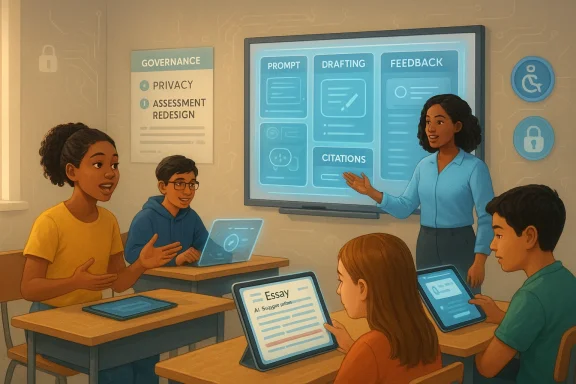 Background / Overview
The arrival of generative AI and large language models into day‑to‑day education has been remarkably fast. Surveys and institutional reports from 2024–2025 show that a large majority of college‑age learners and growing shares of K–12 students use AI tools for drafting, summarizing, tutoring, and administrative help — with adoption figures often reported in the mid‑80s to low‑90s percent range among post‑secondary populations.These tools are not monolithic. Deployments range from enterprise copilots (used by teachers and administrators to automate paperwork) to consumer chatbots students access directly for homework help, to integrated classroom features for reading assessment and differentiation. Practical classroom use cases include:
- generating lesson‑plan drafts and rubrics for teachers,
- producing personalized practice items and flashcards for students,
- automating formative feedback and reading assessments,
- powering helpdesk bots for registration and orientation.
Why educators say "AI may be part of the problem"
Cognitive shortcutting and learning atrophy
Multiple field reports and early neuroscience experiments suggest a worrying pattern: when students routinely outsource chunks of thinking to AI, certain active cognitive processes — notably retrieval practice, integrative reasoning, and the sense of ownership over work — can weaken. Lab studies measuring neural engagement during essay tasks found reduced activation and weaker recall when participants used LLM assistance versus working unaided or using search-based workflows. These findings are preliminary but align with widespread classroom anecdotes that “just Chat it” behavior can replace effortful study.This is not an argument to ban tools wholesale. Rather, it reframes the problem as one of pedagogy: if assignments reward final artifacts rather than the process of reasoning, tools that accelerate product creation will naturally hollow out practice. The solution schools increasingly adopt is to redesign assessment so process — not just the end product — is evaluated.
Academic integrity redefined
AI complicates traditional concepts of plagiarism and authorship. Teachers report a growing pattern of submissions that are superficially coherent — passing cursory checks — but lacking verifiable provenance or authorial reflection. Detection tools remain imperfect and are prone to false positives and negatives, creating a fragile reliance on policing rather than on educational design. As a result, many institutions are moving away from prohibition-only policies toward transparency, disclosure, and process‑based assessment that rewards critical engagement with AI outputs.Hallucinations, misinformation and trust
Generative models are probabilistic text generators; they produce fluent responses without a built‑in guarantee of factual correctness. In classroom contexts where accuracy matters (science, social studies, math), uncritical acceptance of an AI answer can propagate errors. Teachers must therefore teach verification habits — cross‑checking sources, demanding citations, and training students to treat AI output as draft material, not authoritative truth.Emotional dependency and safety risks
Beyond academics, conversational agents are being used by some students as companions or emotional outlets. NGO and academic surveys note that a nontrivial share of teens interact with chatbots for companionship, sometimes forming strong emotional attachments. This raises mental‑health and safety concerns; there have been legal cases and public scrutiny when chatbot interactions have coincided with self‑harm claims. These phenomena push schools and platform teams to consider age gating, design constraints, and crisis‑safe responses as part of deployment.The evidence: adoption, pilots, and case studies
Rapid adoption across populations
Multiple independent surveys and institutional studies show high and rising use of AI among students. For example, large 2024–2025 surveys reported roughly eight‑in‑ten or more college students using generative AI for coursework, and many using it weekly or daily. These figures are corroborated by separate sector studies that reach similar magnitudes of uptake.District and university pilots: what’s working
Carefully designed pilots that pair tools with teacher training and governance show measurable gains:- Brisbane Catholic Education rolled out Microsoft 365 Copilot to thousands of staff and reported average time savings that teachers could reallocate to student engagement.
- National programs that combine enterprise deployments with teacher upskilling — for example large reading‑assessment pilots — have compressed feedback cycles and enabled high‑volume formative assessment at scale.
- Universities incorporating AI tutors and Azure OpenAI services have automated administrative summaries and personalized indexing of course materials, though some institutional performance claims remain preliminary pending independent replication.
Patchwork of practice: uneven training and governance
Adoption has outpaced teacher preparation. Many educators report limited formal training, with ecosystems of one‑hour briefings and optional modules producing inconsistent readiness. Where teacher professional development is robust and practical, pilots perform far better. District playbooks now commonly recommend short, task‑oriented PD on prompt design, verification techniques, and pedagogical redesign.Data privacy, procurement, and vendor governance
Contract details matter
Vendor assurances about not using student prompts to train public models are meaningful only when backed by procurement language, audit rights, deletion capabilities, and appropriate Workspace/education edition configurations. Boards that centralize procurement and secure explicit non‑training clauses reduce risk, but those protections vary by contract and technical configuration. Administrators must demand specific terms on retention, deletion, and telemetry access.Vendor lock‑in and cascade effects
Centralized deals can provide better privacy guarantees but also concentrate dependency on vendors. That creates bargaining and long‑term governance risks: change the vendor’s commercial posture and district bargaining power may be limited. Governance must therefore include operational contingencies and exit provisions.Equity and the digital divide
High adoption benefits tend to cluster in well‑resourced schools with reliable broadband and device fleets. Without deliberate provisioning (institutional accounts, loaner devices, low‑bandwidth options) AI adoption risks widening existing achievement gaps between richer and poorer students. Equity planning must be an explicit part of any rollout.Security, platform safety, and a recent wake‑up call
A salient security example underscores why educational policy can’t be divorced from technical risk: in early January 2026 researchers disclosed a single‑click exploit targeting a convenience prefill feature in a consumer Copilot product, known publicly as the “Reprompt” vulnerability. Researchers showed how deep‑linked, prefilled prompts could be chained to exfiltrate information from an authenticated session; vendors patched the vulnerability quickly, but the episode highlighted how features designed for classroom convenience can create novel attack surfaces.This incident has three takeaways for education leaders:
- Convenience features (deep links, prefilled prompts, study modes) change UX but also expand attack surfaces.
- Vendor patches are necessary but not sufficient; districts must assume features may introduce new risks and plan mitigations.
- Security posture must include incident response, communication plans, and technical isolation strategies for student data.
Teaching and assessment redesign: practical responses that preserve learning
Practitioners converging on best practice emphasize pedagogy first. A consistent set of classroom tactics has emerged from pilots and university advisories:- Require process evidence: staged submissions, annotated drafts that document prompts and revisions, and in‑class components that demonstrate understanding.
- Use oral defenses and vivas to assess reasoning under pressure, reducing the value of an AI‑produced polished draft.
- Institute prompt‑logging in learning management systems so instructors see how AI contributed to a submission.
- Teach verification and source evaluation as part of domain learning — not as an add‑on module.
For teachers: classroom recipes that scale
Low‑risk starters (first 30–90 days)
- Pilot AI for administrative tasks only (report templates, parent letters) to gain time back without student exposure.
- Run teacher-only trials: have educators test tools on their practice and document time saved and error modes.
- Develop simple syllabus language requiring disclosure of AI use and describing permitted assistance levels.
Mid‑term classroom moves (one semester)
- Redesign one major assignment to require iterative drafts, annotated feedback, and a live defense. Grade process and critique of AI outputs as part of the rubric.
- Introduce short modules on promptcraft and hallucination detection integrated into existing units rather than as standalone electives.
Long‑term institutional policies
- Centralize procurement and insist on contractual non‑training clauses or robust data‑isolation guarantees for educational tenants.
- Make targeted professional learning mandatory: short, task‑focused modules that include both technical and pedagogical coaching.
Critical analysis: strengths, blind spots and trade‑offs
Strengths worth preserving
- Teacher productivity gains are concrete and replicable when teachers vet outputs; recaptured time can meaningfully improve student engagement.
- Scalable personalization enables differentiation at class sizes that previously made bespoke instruction impossible.
- Workplace readiness: integrating AI literacy helps align schooling with modern labor market expectations where tool fluency matters.
Persistent blind spots and risks
- Overreliance and cognitive consequences: early neuroscience and classroom reports suggest unattended adoption can erode core learning processes; these findings are concerning even if not yet definitive at long‑term population scale. Exercise caution and avoid declaring final judgments prematurely.
- Assessment validity: traditional single‑product assessments create perverse incentives to outsource. Redesigns are viable but require teacher time, training, and institutional commitment.
- Equity gaps: premium features, better devices, and faster connectivity create unequal advantages that districts must mitigate via provisioning and policy.
- Security surprises: convenience features can introduce new vectors; rapid patching does not replace comprehensive risk analysis.
Trade‑offs to acknowledge
- Restrictive policies reduce misuse but may also curtail legitimate pedagogical value for older students. The most defensible path emphasizes managed, pedagogy‑aligned access rather than prohibitions that students easily circumvent.
A practical six‑step roadmap for school leaders
- Pilot with clear learning outcomes: limit early student access to teacher‑led pilots that measure both time savings and learning impact. Use control groups where feasible.
- Centralize procurement and demand contractual protections: insist on education‑tenant terms, non‑training clauses, deletion rights, and audit access.
- Redesign assessment to emphasize process: staged submissions, oral defenses, annotated AI critique, and portfolio evidence become central.
- Invest in short, practical PD for teachers: modules on prompt design, hallucination detection, and assessment redesign should be mandatory, task‑oriented, and locally supported.
- Build data and security operational plans: include DLP, incident response, technical isolation for student data, and explicit vendor exit strategies.
- Monitor, iterate, and publish transparent AI‑use policies: collect usage metrics, student outcomes, and equity indicators; publish clear guidance for parents and students.
What remains uncertain — and how to proceed cautiously
Several high‑impact claims circulating in press summaries require cautious treatment. Laboratory neuroscience results are compelling but based on early studies with limited sample sizes; large‑scale, longitudinal evidence about cognitive impacts is not yet conclusive. Institutional outcome claims (for example, specific accuracy percentages for predictive administrative models or claimed week‑over‑week gains) are often context dependent and should be validated against original methodology and data. Where access to raw datasets and replication details is not possible, treat such numerical performance claims as provisional.Security and safety postures are also evolving rapidly. The January 2026 Copilot vulnerability demonstrates that features can create attack surfaces that were not foreseen at procurement time; districts should require vendors to disclose security audit results, bug bounty policies, and historical patch timelines.
Closing assessment — a balanced verdict
AI in classrooms is neither unambiguous panacea nor inevitable catastrophe. When guided by strong pedagogy, clear governance, explicit procurement safeguards, and robust teacher training, generative AI can deliver measurable, equitable benefits: time reclaimed for instruction, scalable differentiation, and a scaffolding for modern workplace literacies.But those potential gains coexist with structural risks: cognitive shortcutting, integrity challenges, equity gaps, data governance issues, and emergent security vectors. The central lesson from pilots and field reporting is practical: treat AI as a pedagogy and governance problem first, and a technology problem second. Districts that plan around learning objectives, contractually lock down data protections, redesign assessment, and invest in meaningful PD are the ones most likely to capture the upside while keeping the harms manageable.
As the technology evolves, so should the evidence base. Schools must pilot deliberately, measure outcomes transparently, and be ready to revise practices as independent research clarifies long‑term cognitive and social effects. In an AI‑saturated classroom, vigilance and pedagogy — not fear or naiveté — will determine whether the tools amplify learning or quietly hollow it out.
Source: Anadolu Ajansı As AI floods classrooms, educators warn technology may be part of problem
