

Artificial intelligence is no longer a distant threat or a niche productivity hack — it is actively rewiring how organizations operate, how jobs are described, and how people are paid, trained and promoted, with the dominant narrative shifting from “AI will take jobs” to “AI will reshape skills and reward those who master it.”
The last 24 months have turned generative AI and enterprise copilots from curiosities into business tools that change day‑to‑day workflows. Large vendors have moved at commercial speed: Microsoft embedded Copilot across Microsoft 365 and announced industry-tailored agent tooling; Google and other cloud providers pushed multimodal assistants into search and workspace products; meanwhile specialist models such as ChatGPT and Claude were adapted into enterprise workflows. The result: companies are rapidly buying seats, reconfiguring processes, and — crucially — asking whether the disruption will mean mass displacement or mass retraining.
Many corporate signals point to the latter. Industry reporting and vendor research show strong returns on generative AI investments and a sharp spike in internal learning programs. At the same time, high‑profile corporate restructurings have raised anxieties about how AI and headcount decisions interact — but executives increasingly frame these moves as organizational redesign and upskilling imperatives, not simple automation-led cuts. Recent vendor and analyst documentation underlines both the business case and the human challenge: make AI useful, measurable, and governed — and train people to get the most value from it. See Microsoft’s summary of practical customer outcomes and IDC’s ROI framing for context.
Conclusion
AI is reshaping what work looks like, but the underlying human needs — meaningful work, growth, purpose and fairness — remain unchanged. The most effective path forward is not to resist the tools, nor to blindly follow them, but to design adoption strategies that measure outcomes, protect people and make reskilling real, practical and rewarded. Organizations that do this will not only capture the economic upside of AI but also preserve the human capacities that remain central to innovation, ethics and long‑term value.
Source: 24matins.uk How Artificial Intelligence Is Transforming the Workplace
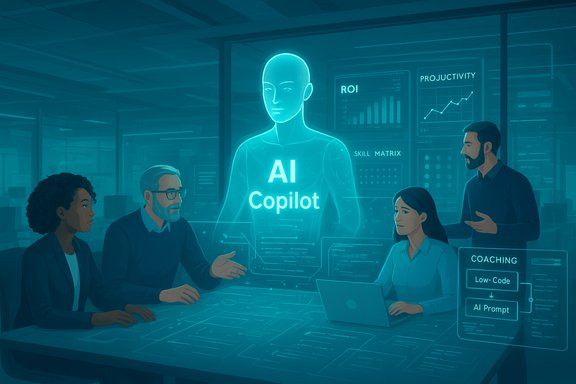 Background / Overview
The last 24 months have turned generative AI and enterprise copilots from curiosities into business tools that change day‑to‑day workflows. Large vendors have moved at commercial speed: Microsoft embedded Copilot across Microsoft 365 and announced industry-tailored agent tooling; Google and other cloud providers pushed multimodal assistants into search and workspace products; meanwhile specialist models such as ChatGPT and Claude were adapted into enterprise workflows. The result: companies are rapidly buying seats, reconfiguring processes, and — crucially — asking whether the disruption will mean mass displacement or mass retraining.Many corporate signals point to the latter. Industry reporting and vendor research show strong returns on generative AI investments and a sharp spike in internal learning programs. At the same time, high‑profile corporate restructurings have raised anxieties about how AI and headcount decisions interact — but executives increasingly frame these moves as organizational redesign and upskilling imperatives, not simple automation-led cuts. Recent vendor and analyst documentation underlines both the business case and the human challenge: make AI useful, measurable, and governed — and train people to get the most value from it. See Microsoft’s summary of practical customer outcomes and IDC’s ROI framing for context.
The hard numbers: what the studies actually say
What major surveys are reporting
- IBM and related coverage: Multiple industry writeups attribute an alarming-sounding headline to IBM research — that a large share of workforces will require retraining in the near term. Different outlets report slightly different figures: some cite a study covering roughly 3,000 executives and claim about 40% of employees will need significant retraining within three years; other summaries of IBM work reference a 2,000-CEO sample and report around 31%. Those discrepancies matter for interpretation and point to either multiple IBM studies or differing summarizations by the press. Because coverage varies by outlet, treat any single percentage cited in secondary reporting as indicative rather than definitive, and check IBM’s primary report for exact sample frames and methodology before using the figure in decision-making.
- IDC / Microsoft ROI finding: Independent IDC analysis (commissioned with Microsoft) consistently reports that generative AI pilots often deliver large productivity returns, with a widely quoted figure of roughly $3.70 returned for every $1 invested on average, and a much higher multiple for top performers. This ROI framing has been widely repeated in vendor communications and analyst summaries and underpins many enterprise procurement decisions.
- Learning and hiring signals: Platform telemetry and talent studies show actively rising demand for AI fluency. Learning platforms report explosive growth in Copilot and generative AI content consumption, and leadership surveys indicate many managers now prefer candidates with demonstrable AI skills even if they are less experienced. In one widely cited industry survey, ~71% of leaders said they’d hire someone with AI skills over a more experienced candidate without them — a stark signal that AI literacy is becoming a hiring currency.
What the company-level moves show
High-profile workforce reductions at major tech companies have become a focal point for debate. Amazon’s reorg and headcount reductions — widely reported as involving more than 14,000 corporate roles in recent announcements — were accompanied by CEO Andy Jassy’s public comments that the moves were driven by a desire to “operate more like a startup,” focusing on culture and organizational structure rather than being solely an AI- or cost-driven decision. That phrasing matters: leaders are framing layoffs as part of re-platforming work and redistributing effort toward high‑value outcomes, not only as raw automation cuts. Still, the presence of layoffs in companies rapidly adopting AI shows the real-world friction that comes with massive digital change.How AI is changing the nature of work: four practical patterns
AI adoption does not change human needs — it changes the tasks professionals perform. Below are four patterns visible across industries.1) Routine work is automated; compositional work increases
AI systems are good at repetitive content generation, extraction, and first‑draft tasks. Organizations that deploy Copilots or custom agents report substantial time savings on email triage, report summarization, data entry, and basic code generation. That frees humans to focus on synthesis, judgment, and relationship‑driven activities that remain hard to automate. Microsoft case studies and partner reports offer multiple examples of hours saved per employee.2) Job titles and role design are morphing
A growing number of roles incorporate AI interaction as a core competency: not just prompt-savvy data scientists, but marketers, HR specialists, and finance analysts who orchestrate AI outputs into business decisions. Employers increasingly adopt competency matrices that combine technical AI fluency with domain expertise and human skills like persuasion and ethics.3) Upskilling is now a boardroom matter
Companies are investing in formal learning programs, pilot squads and role-based pathways to scale AI capability internally. Learning platforms report exponential increases in AI-related course consumption; organization-level pilots often pair tool access with governance and mentor‑led cohorts to bake the learning into workflows, rather than relegating it to optional e‑learning.4) Productivity gains are measurable — but uneven
ROI is real for many deployments, especially productivity use cases; IDC/Microsoft data show rapid payback in successful pilots. Yet benefits concentrate where data is accessible, processes are digitized, and governance is in place — meaning the organizations that capture the value are deliberately building both tooling and measurement disciplines.The human advantage: what machines can’t (yet) replace
AI excels at pattern matching, retrieval, and scale; humans still lead on judgment, creativity, ethics, and relationship intelligence. Successful work models emphasize partnership:- Creativity: Designing novel solutions, reframing problems, and applying lateral thinking remain human advantages.
- Ethical judgment: Deciding when to use an AI, how to protect privacy, and how to weigh trade‑offs requires human oversight.
- Contextual decision-making: Integrating cultural nuance, stakeholder motives, and ambiguous signals is a human specialty.
- Emotional labor: Sales, negotiation, managerial coaching and complex client interactions depend on empathy and trust.
Strengths and opportunities: why leaders are betting on AI
- Rapid ROI potential: Productivity pilots often show measurable time savings and faster cycle times. IDC/Microsoft metrics remain a common benchmark for business cases.
- Democratization of automation: Low‑code/no‑code Copilot tools and agent builders let non‑technical teams automate recurring workflows.
- Inclusion and accessibility: AI functions (real‑time captioning, automated recaps, grammar and formatting help) can reduce barriers for neurodivergent and disabled employees when deployed responsibly.
- New career pathways: AI creates demand for roles in adoption engineering, data stewardship, prompt design, model evaluation and human‑AI orchestration.
- Competitive hiring edge: Leaders report they’re more willing to hire candidates with AI fluency, even when less experienced, shifting the market toward demonstrable tool competency.
Risks and failure modes: where leaders must be cautious
- Unequal access to training: Skill polarization can entrench inequality if employers fail to provide accessible, role‑relevant training.
- Governance gaps: Rapid tool rollouts without data governance, logging, or access controls expose organizations to IP leakage, compliance and privacy failures.
- Overreliance and automation bias: Teams can start accepting AI outputs uncritically, amplifying hallucinations and legal risk.
- Job transitions without support: Structural reorganizations framed as cultural change still produce real displacement; without clear reskilling pathways and redeployment programs, worker outcomes suffer.
- Vendor lock‑in and hidden costs: Copilot seats, API usage, and data residency constraints add ongoing operational costs that require careful TCO planning.
- Ethical and regulatory risk: Misapplied AI in hiring, lending, healthcare, or legal workflows can produce biased outcomes and regulatory scrutiny.
Practical guidance: how organizations should act now
Below are prioritized actions for business leaders, IT managers, HR and employees.For C‑suite and business leaders
- Start with measurable pilots: choose 2–4 productivity or compliance use cases with clear KPIs (hours saved, error reduction, lead velocity).
- Build an AI operating model: define decision rights, accountability, and a cross‑functional governance body with security, legal, HR and business owners.
- Invest in role-based skilling, not generic courses: map competencies to outcomes and fund practical, workflow-embedded training.
- Measure outcomes and iterate: track ROI, adoption, quality of outputs and employee sentiment — then refine.
For IT and security leaders
- Require secure data flows: enforce least-privilege access, use tenant‑level controls and vet vendor handling of corporate data.
- Implement logging and human-in-the-loop controls for high‑risk outputs.
- Treat Copilots as platform rollouts with lifecycle governance, not single-app installs.
- Pilot role-based agent deployments with strict data classification and retention policies.
For HR and L&D
- Pair tool access with mentorship: microlearning plus coached, cohort-based projects yields far better retention than self‑paced courses alone.
- Reward demonstration of applied AI skill (badges, pay differentials, promotion criteria).
- Build internal marketplaces for AI-augmented job projects to redeploy workers rather than lay them off.
For individual employees
- Learn how to use AI in your role: focus on prompt design, output verification and domain knowledge that amplifies AI.
- Keep a portfolio of applied projects and credentials showing measurable impact (time saved, outcomes improved).
- Combine AI literacy with enduring human skills: critical thinking, leadership, ethics, and empathy remain differentiators.
A short playbook for pilots: three steps to get from experiment to scale
- Define the problem and metric (week 0–2)
- Pick a single process, baseline its performance, and set a target (e.g., reduce research time by 40%).
- Run an interdisciplinary 6–12 week pilot (weeks 3–14)
- Combine a product owner, a power-user cohort, IT/security and an L&D partner. Measure intermediate results weekly.
- Harden, govern, and scale (weeks 15+)
- Codify data handling, training, monitoring dashboards, and a rollout plan with checkpoints for bias audits and human oversight.
Compensation and career outcomes: what the data suggests
Early signals show a premium for individuals who can integrate AI into their workflows. Organizations report faster promotion for employees who successfully lead AI-enabled change, and platforms/marketplaces indicate higher market rates for AI-savvy talent. Learning platform telemetry and hiring surveys both point to a wage upside for those who apply AI to business outcomes, but the premium is concentrated where the person pairs domain depth with AI fluency. Treat proclamations like “AI equals higher pay” as directional: the best evidence shows skillful use of AI + domain impact is what boosts compensation.Why the “mass layoff” headline is an oversimplification
Public commentary sometimes conflates macroeconomic restructuring with automation-driven job loss. High-profile layoffs (for example, Amazon’s recent corporate cuts) and the rise of AI coincided, which understandably fuels anxiety. But executive statements and subsequent analysis often point to broader factors — cost optimization, organizational redesign, and shifting product strategy — rather than solely AI replacing roles. In short: AI is a factor in workplace transformation but rarely a simple, single cause of layoffs. That nuance matters for policy, labor planning, and how companies design reskilling commitments.A caution about statistics and why to read the fine print
Be wary of single-number headlines. Different surveys have different populations (CEOs vs. executives vs. employees), different question wordings, and different timeframes — all of which affect headline percentages. For instance, widely circulated summaries of IBM’s research appear with inconsistent sample sizes and retraining percentages across outlets. Use primary reports — and their methodology sections — when translating these findings into corporate strategy. When primary reports aren’t available, rely on triangulated evidence from multiple reputable sources before making large investments or policy changes.Bottom line: How to treat AI adoption as a people problem first
AI is a capability multiplier; its organizational value flows from people who can harness it responsibly. The most resilient organizations treat AI programs as a combination of technology, governance and human capital investment: build pilots with clear KPIs, fund applied upskilling tied to careers, and protect data and people through robust governance.- For business leaders: treat AI adoption as a transformation program, not simply a technology purchase.
- For IT leaders: operationalize security, monitoring and vendor oversight from day one.
- For HR leaders: link learning to mobility and pay to avoid a two-tier workforce.
- For employees: prioritize applied AI practice and domain judgment over raw tool curiosity.
Conclusion
AI is reshaping what work looks like, but the underlying human needs — meaningful work, growth, purpose and fairness — remain unchanged. The most effective path forward is not to resist the tools, nor to blindly follow them, but to design adoption strategies that measure outcomes, protect people and make reskilling real, practical and rewarded. Organizations that do this will not only capture the economic upside of AI but also preserve the human capacities that remain central to innovation, ethics and long‑term value.
Source: 24matins.uk How Artificial Intelligence Is Transforming the Workplace
