

Gen Z’s comfort with AI at work isn’t a novelty—it’s a tectonic shift that’s already collapsing the old top-down knowledge hierarchy and rewriting how organizations must train, lead, and measure value.
For years the workplace operated on a simple premise: experience equals authority. Seniority signified deep context, institutional memory, and a roadmap for decision-making. That equation is now being rewritten by a generation raised on always-on search, social collaboration, and consumer AI: Gen Z is treating AI not as a gimmick or a cheating shortcut but as a routine cognitive partner that amplifies speed, confidence, and visibility at work. Microsoft’s regional and product research shows this pattern clearly: a recent Microsoft Australia study — the Ctrl+Career survey — found strong Gen Z uptake of AI in the workplace and notable downstream effects on confidence and influence among early-career professionals. At the same time, product telemetry and vendor studies from Microsoft reinforce the practical upside: early Copilot users report measurable time-savings and the ability to complete defined tasks faster. Microsoft’s internal pilots and commissioned research found that Copilot users were up to 29 percent faster on structured tasks like searching, writing, and summarizing, with about 70 percent reporting higher productivity on tasks where Copilot was applied. These gains are significant — but they come with a clear rider: speed does not equal judgment. This feature explains what’s changing, why it matters to Windows and enterprise IT audiences, where the risks sit, and pragmatic next steps for leaders who want to convert individual AI wins into durable organizational advantage.
That’s why every vendor study — and independent reviews — conclude that human-in-the-loop controls, prompt engineering, and contextual verification are non-negotiable for safe, high-quality use. Internal Copilot experiments and independent analyses both stress governance, observability, and human review as essential to move beyond shiny pilots.
Gen Z’s early adoption should be seen as a living experiment in democratized capability: they are teaching each other, teaching their seniors, and testing what it means to use AI as a thinking partner. The managerial response needs to be practical and human-centered: create permission, provide safe tooling, invest in verification skills, and govern agents like production services. When leaders do this, the productivity gains are real, the inclusion benefits are measurable, and the organization gains the capacity to do higher-order work.
The choice for leaders is straightforward: treat AI as a people transformation, not just a tech upgrade. That shift will decide whether AI becomes a tool that magnifies human judgement — or a speed machine that amplifies mistakes.
Source: Mamamia 'Gen Z knows more about AI than their bosses. It's about to change how we all work.'
 Background / Overview
For years the workplace operated on a simple premise: experience equals authority. Seniority signified deep context, institutional memory, and a roadmap for decision-making. That equation is now being rewritten by a generation raised on always-on search, social collaboration, and consumer AI: Gen Z is treating AI not as a gimmick or a cheating shortcut but as a routine cognitive partner that amplifies speed, confidence, and visibility at work. Microsoft’s regional and product research shows this pattern clearly: a recent Microsoft Australia study — the Ctrl+Career survey — found strong Gen Z uptake of AI in the workplace and notable downstream effects on confidence and influence among early-career professionals. At the same time, product telemetry and vendor studies from Microsoft reinforce the practical upside: early Copilot users report measurable time-savings and the ability to complete defined tasks faster. Microsoft’s internal pilots and commissioned research found that Copilot users were up to 29 percent faster on structured tasks like searching, writing, and summarizing, with about 70 percent reporting higher productivity on tasks where Copilot was applied. These gains are significant — but they come with a clear rider: speed does not equal judgment. This feature explains what’s changing, why it matters to Windows and enterprise IT audiences, where the risks sit, and pragmatic next steps for leaders who want to convert individual AI wins into durable organizational advantage.What the data and voices tell us
Gen Z is not only using AI — they’re teaching it into the organisation
Microsoft Australia’s “Ctrl+Career” research, conducted with YouGov among early-career professionals, shows Gen Z doing more than experimenting: they are actively introducing tools, building shortcuts, and in many cases, mentoring seniors on how to use AI. The study reports that Gen Z workers often act as reverse mentors — bringing new tools and workflows into their teams and helping leaders adopt them. These findings echo broader Copilot telemetry and industry reporting: embedded copilots (in Word, Excel, Outlook, Teams and other apps) convert experimentation into habitual use because they live inside the apps people already use. When AI surfaces inside an existing workflow it becomes less of a novelty and more of an operational multiplier, turning one-off wins into repeatable processes.Telemetry: speed, confidence and changing work patterns
Multiple Microsoft product studies and independent industry analyses converge on a consistent pattern:- Users report faster task completion on structured tasks (search, summarization, drafts) — Microsoft’s pilots recorded roughly a 29 percent speed improvement on such tasks.
- Early adopters describe tangible confidence gains — employees use AI to prepare, rehearse, and iterate ideas before presenting them, raising visibility for junior contributors. Microsoft Australia’s survey quantifies that effect in the local market.
- Usage patterns differ by device and intent: consumer Copilot research (analyzing millions of de‑identified conversations) shows desktop sessions skew toward work and technical tasks, while mobile sessions skew toward health, lifestyle, and advice-seeking. That split matters for product design and governance.
Why the knowledge hierarchy collapsed
Three structural changes explain the collapse of the old top-down knowledge model:- Instant access to “what.” AI flattens the information gap. The factual baseline (“what happened,” “what the policy says,” “how to do X”) is now available on demand. The premium shifts from possessing facts to exercising judgment on their relevance and trustworthiness.
- Built-in scaffolding for early-career workers. When AI drafts an outline, polishes language, or proposes options, a new hire can iterate faster through the “blank page” problem, and show up prepared in meetings. That accelerates learning curves and public visibility. Microsoft’s regional survey finds Gen Z crediting AI for improved professional communication and confidence.
- Tool integration, not tool isolation. Copilot-style assistants are embedded into daily apps (Word, Excel, Teams, Outlook), reducing friction to adoption. When AI is part of the ribbon or the sidebar, it becomes an everyday collaborator rather than an external toy. This distribution effect scales learning and flattens knowledge transfer.
Microsoft Copilot as a case study: capabilities and limits
What Copilot delivers in the flow of work
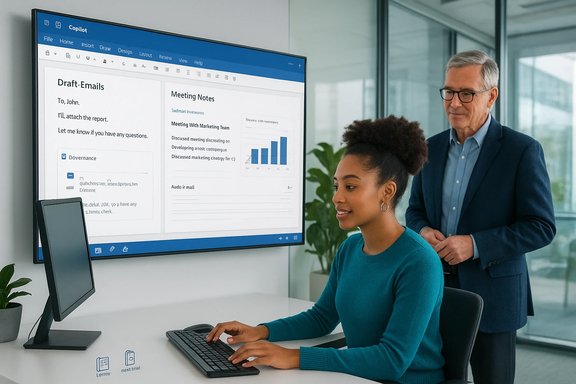
Copilot’s value proposition is precisely this: fast ideation, polished first drafts, data summarization, and contextual analysis inside the apps employees already use. For Windows and Microsoft 365 users that means:- Drafting or refining emails and documents faster.
- Turning meeting transcripts into concise action lists.
- Generating slide decks from bullet notes.
- Producing initial data visualizations and exploratory analyses in Excel.
The limits: hallucination, context, and judgment
Generative AI models can produce confident but incorrect outputs. They can omit necessary context and they don’t have institutional judgment. This is the essential boundary: AI can propose options, but it cannot reliably select the option appropriate to complex ethical, legal, or strategic trade-offs without human oversight.That’s why every vendor study — and independent reviews — conclude that human-in-the-loop controls, prompt engineering, and contextual verification are non-negotiable for safe, high-quality use. Internal Copilot experiments and independent analyses both stress governance, observability, and human review as essential to move beyond shiny pilots.
The human skills that multiply AI’s value
Short-term speed wins are obvious. The game-changers are human skills that make AI outputs useful, defensible, and strategic:- Critical thinking: evaluating the provenance and assumptions behind an AI suggestion.
- Contextual judgment: selecting and tailoring AI outputs to the organization’s risk profile and goals.
- Curiosity and questioning: probing AI outputs with follow-ups to expose blind spots.
- Communication and synthesis: translating AI-generated drafts into persuasive narratives and actionable workplans.
The tension under the surface: fear, access, and ethical risks
Job displacement anxiety vs. role redesign
Workers often worry that AI will replace their roles. The pragmatic truth from vendor and independent analysis is more nuanced: AI automates certain tasks, especially repetitive or pattern-based work, but it also creates capacity that can be reallocated to higher-value activities—if organizations redesign roles accordingly. Microsoft’s regional work trend analyses show workers split between optimism and anxiety; many early-career employees are eager to use AI but also fearful about long-term job security. Leadership must make trade-offs explicit and intentional.Access and data security
BYOAI (bring-your-own-AI) is widespread: people will use public tools if employers don’t provide safe alternatives. That introduces data leakage risks. Microsoft Australia’s study found gaps in employer provisioning and a two-speed adoption problem across sectors. That’s an explicit governance risk: organizations must offer secure, supported tools and train employees on safe practices.Bias, provenance and compliance
AI outputs reflect training data and model behavior. Without explicit provenance and audit trails, decisions built atop AI suggestions can be opaque and legally risky. Model explainability, logging, and human review are core controls enterprises must implement before relying on AI for consequential decisions. Industry guidance and vendor playbooks converge on formal agent governance: assign owners, set KPIs, monitor usage, and create lifecycle processes for agents.Practical steps leaders should take tomorrow
Leaders who want to translate Gen Z’s early wins into organization-level capability should prioritize three practical moves:- Create psychological safety and permissioning. Encourage experimentation and normalize transparent AI use. Ask teams to share their AI prompts and workflows in team retrospectives so learning spreads. Microsoft Australia recommends leaders ask “How did you use AI on this?” to turn private shortcuts into shared capability.
- Provide supported, secure tools and training. Replace BYOAI with sanctioned alternatives that protect corporate data, and invest in short, role-based training focused on prompt design, verification steps, and escalation paths for uncertain outputs. Pilot programs that pair power users with managers accelerate capability.
- Treat agents as products. Assign owners, document data flows, put monitoring and lifecycle governance in place, and measure outcomes before scaling. Good governance makes agents auditable and reversible.
- Run a short risk assessment to map regulated data and high-risk workflows.
- Identify a default corporate Copilot or sanctioned assistant and develop clear acceptable-use policies.
- Launch role-based enablement modules: verification for knowledge workers; compliance focus for regulated teams.
- Instrument usage and outcomes for at least one month and report a small set of ROI metrics (time saved, task completion quality, incident rate).
- Iterate governance (update prompt templates, add audit logging, retire failing agents).
For Windows admins and IT pros: operational priorities
- Identity and access: use strong Entra/identity controls to manage which apps can call LLMs and which data sources agents can access.
- Data boundaries: segment sensitive data and ensure retrieval-augmented generation (RAG) systems do not expose regulated content to public models.
- Observability: instrument Copilot Studio and custom agents with usage metrics, error logs, and human-review pipelines. Treat agents as services with SLOs.
- User enablement: create prompt libraries, policy snippets, and vetted templates so users can be productive safely. The ROI of Copilot depends on consistent prompting patterns and repeated practice.
Strengths and clear benefits
- Speed and accessibility: Tools embedded in Windows and Microsoft 365 remove friction and democratize first-draft generation and analysis.
- Inclusion and accessibility: real-time captioning, readability improvements, and scaffolded drafting help neurodivergent employees and non-native speakers be more productive. Vendors explicitly position Copilot as an accessibility amplifier.
- Talent and retention upside: organizations that offer supported AI tools become more attractive to Gen Z candidates who expect modern workflows and continuous learning opportunities.
Risks and where caution is required
- Overreliance without verification: treating AI outputs as authoritative will produce errors and erode trust. Human oversight must be enforced, not optional.
- Data leakage and BYOAI: if employees default to public models, sensitive information can leak. Clear policy and preferred tooling are table stakes.
- Governance gaps at scale: agents without owners or KPIs become brittle and dangerous. Assign responsibility and lifecycle processes early.
- Inequitable access: unequal tool access can create a two-speed workforce; provide company-sanctioned tools to avoid inequality and compliance gaps.
A roadmap for leaders who want to win
Leaders who convert Gen Z’s edge into durable advantage do three things exceptionally well:- Normalize transparent AI use and encourage reverse mentoring. Ask teams how they used AI, and surface the best prompts as shared assets.
- Invest in critical thinking and verification training. Operationalize a “verify-first” rule for outputs used in decisions.
- Treat AI services like products: owner, KPIs, monitoring, and retirement plans. That discipline separates pilots from production value.
- Start small: pick a single high-frequency, low-risk workflow to pilot (e.g., meeting summaries).
- Measure objectively: time saved, rework rate, and number of human corrections.
- Scale with governance: once pilots show durable gains, add owners and lifecycle controls before mass rollouts.
Conclusion
The headline — “Gen Z knows more about AI than their bosses” — oversimplifies the evolution. The real news is broader and more consequential: the knowledge hierarchy that once flowed predictably from seniority to junior has been disrupted because everyone can now get the “what” instantly. That collapse isn’t a threat in itself; it’s an invitation to redesign work around how we think rather than what we know.Gen Z’s early adoption should be seen as a living experiment in democratized capability: they are teaching each other, teaching their seniors, and testing what it means to use AI as a thinking partner. The managerial response needs to be practical and human-centered: create permission, provide safe tooling, invest in verification skills, and govern agents like production services. When leaders do this, the productivity gains are real, the inclusion benefits are measurable, and the organization gains the capacity to do higher-order work.
The choice for leaders is straightforward: treat AI as a people transformation, not just a tech upgrade. That shift will decide whether AI becomes a tool that magnifies human judgement — or a speed machine that amplifies mistakes.
Source: Mamamia 'Gen Z knows more about AI than their bosses. It's about to change how we all work.'
