

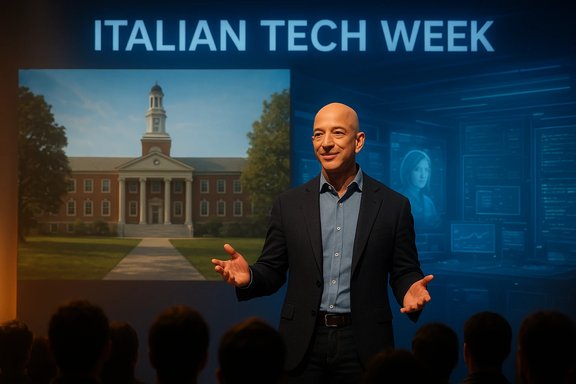
Jeff Bezos’s blunt advice to Generation Z — “finish college, don’t assume dropping out is your shortcut to success” — landed at Italian Tech Week as more than a generational lecture; it was a marker of how powerful CEOs are reframing career advice as artificial intelligence reshapes entry-level opportunities and the way organizations hire, train, and promote people.
AI is accelerating changes in the labor market that were already underway: routine, pattern-based tasks are being automated; tools embedded in common productivity apps are shifting what junior roles do day-to-day; and employers are experimenting with new job designs that pair humans with AI copilots. These shifts have prompted prominent technologists and corporate leaders to offer public guidance about education and career pathways. Jeff Bezos’s remarks — that he started Amazon at 30 after years of corporate experience and that the famous college-dropout success stories are exceptions, not a blueprint — sit squarely in that debate. At the same time, alarmist and sober assessments of AI’s impact coexist in public conversation. Some industry executives warn of large displacement among entry-level white‑collar roles, while company-led studies and pilots point to a mix of augmentation and automation rather than wholesale elimination. That tension — urgent change mixed with uncertain timelines — is the context for Bezos’s counsel.
Yet the advice must be applied with nuance. College is a pathway — not the sole path — and its accessibility and value vary. Employers, educators, and governments must create and fund credible alternatives and ensure that the new demand for AI orchestration and human judgment does not become an exclusionary gatekeeping mechanism.
For WindowsForum readers and IT professionals, the takeaway is operational and tactical: build hybrid skill sets, harden governance around AI copilots and agents, and ensure early-career pathways continue to exist and evolve so the next generation can learn the systems-level skills that Bezos rightly identifies as crucial for durable success.
Bezos’s message is a reality check — not a prohibition. In an AI‑reshaped workforce, finishing a degree and gaining structured experience still buys options, but equally important is ensuring that educational systems and employers adapt so those options are affordable, accessible, and aligned with how work is changing.
Source: Windows Central https://www.windowscentral.com/artificial-intelligence/jeff-bezos-wants-gen-z-to-finish-college]
 Background
AI is accelerating changes in the labor market that were already underway: routine, pattern-based tasks are being automated; tools embedded in common productivity apps are shifting what junior roles do day-to-day; and employers are experimenting with new job designs that pair humans with AI copilots. These shifts have prompted prominent technologists and corporate leaders to offer public guidance about education and career pathways. Jeff Bezos’s remarks — that he started Amazon at 30 after years of corporate experience and that the famous college-dropout success stories are exceptions, not a blueprint — sit squarely in that debate. At the same time, alarmist and sober assessments of AI’s impact coexist in public conversation. Some industry executives warn of large displacement among entry-level white‑collar roles, while company-led studies and pilots point to a mix of augmentation and automation rather than wholesale elimination. That tension — urgent change mixed with uncertain timelines — is the context for Bezos’s counsel. What Bezos actually said — and why it matters
During an on-stage appearance at Italian Tech Week, Bezos framed three linked points:- It’s possible to succeed as a very young, college‑dropping entrepreneur, but those examples (Gates, Zuckerberg) are the exception, not the rule.
- There’s value in finishing college: the structured learning, networks, and time to mature are helpful.
- A practical route is to join a “best‑practices” company first — learn hiring, interviewing, operations and product basics — and then start a business later if that’s the goal.
Overview: the labor-market dynamics behind the advice
AI’s uneven disruption
The core economic pattern is simple: AI is good at well‑specified, repetitive and pattern-heavy tasks. That makes certain entry-level duties — drafting routine analyses, basic legal memos, standard consulting deliverables, and templated data work — unusually vulnerable to automation or augmentation. Leaders across industry have noted this risk publicly. Some warn that a large share of entry-level white‑collar roles could be affected within a short window; others stress that AI often augments workers rather than replaces them. Both viewpoints are supported by published remarks and company data, which means the real outcome is likely to be heterogeneous across sectors and geographies.Employers’ shifting demand signals
Hiring teams and talent platforms are already updating what they look for. Employers increasingly prize:- AI fluency: the ability to use, interrogate, and verify outputs from copilots and large models.
- Domain expertn skills: combining technical knowledge with the capacity to integrate AI outputs into decisions.
- Higher‑order human skills: judgment, written and oral persuasion, stakeholder management, and ethical reasoning.
Strengths of Bezos’s advice
Bezos’s counsel — finish college, learn in good companies, then start a business if desired — has several practical strengths.- It reduces survivorship bias. The public idolization of teenage dropouts overlooks the many unseen failures. Advising students to consider the typical path (education + experience) corrects the cognitive bias that success stories represent the norm rather than outliers.
- It emphasizes transferable learning. Cer roles can teach hiring, interviewing, project execution, and institutional processes — competencies that are hard to compress into a six‑month bootcamp. These competencies translate into better managerial judgment and improved odds when launching ventures later.
- It aligns with employers’ operational reality. Many organizations designing AI-augmented workflows need staff who can interpret model outputs, design evaluations, and take responsibility for decisions informed by AI. Those judgment and orchestration skills are cultivated by practical experience, not only by technical certificates.
- It offers a risk‑mitigation path for students. Given rising tuition costs and uncertain job markets, the advice to acquire a degree and early-career experience preserves multiple fallback options — corporate roles, graduate study, entrepreneurship, or technical leadership — rather than forcing a single bet on immediate startup success.
Risks, blind spots and important caveats
Bezos’s prescription is sensible for many, but it contains meaningful blind spots and risks that students, families, and policymakers need to weigh.1) College is not equally accessible — cost and inequality matter
Higher education’s benefits depend heavily on the quality, affordability, and networks provided. For many students, the choice to defer or skip college reflects legitimate constraints: prohibitive tuition, family respon local access to high-quality institutions. Advising “finish college” without addressing financing, equity of access, or credential signaling risks widening inequality. Policymakers and employers must ensure alternate pathways (apprenticeships, apprenticeships-for-credit, employer‑sponsored training) exist at scale.2) The advice risks sounding binary: degree or bust
When leaders recommend college as the default route, the nuance about what type of learning or credential matters can be lost. Technical roles still require hands-on skills that can sometimes be learned faster via apprenticeships or industry-backed micro‑credentials. The best outcomes will be blended: domain knowledge, practical experience, and critical thinking — not an either/or choice. Educational messaging should stress both/and.3) Timing and sectoral differences
The impact of AI on job flows is industry-specific. Entry-level roles in consulting, legal support, and certain finance jobs may be more exposed; roles requiring physical prity, or localized judgment will evolve differently. Blanket advice risks misapplying a single narrative across diverse labor markets. Students should evaluate sector-specific hiring patterns and expected skill trajectories.4) Corporate signaling vs operational reality
Executives often give career advice that aligns with their p corporate needs. Bezos’s counsel to learn at a “best-practices company” reflects one path — but it also dovetails with the value large firms gain from attracting and training talent. There’s a potential conflict if firms advise study and experience while simultaneously automating the very roles that provided those learning opportunities. Transparency about hiring pipelines and training commitments matters.5) Overreliance on a single pedigree
If employers over-index on elite-college credentials as a proxy for judgment, they risk excluding capable candidates from nontraditional backgrounds and worsening social mobility. Employers must develop better ways to measure critical thinking and teamwork that don’t rely solely on alma mater signals. Structured assessments, situational judgment tests, and project‑based hiring can reduce bias.Cross-checks and contested claims
Several claims in the public debate warrant cautious interpretation.- The assertion that AI could eliminate “up to 50% of entry-level white‑collar jobs” has been voiced by some industry leaders and widely reported. This projection is an alarming warning intended to spur policy action and preparation, but it is debated and depends heavilns of “entry-level,” and the extent to which firms choose augmentation versus replacement. Independent company studies and more nuanced analyses suggest a substantial share of tasks will be augmented rather than fully automated. Treat high‑end displacement figures as scenario prompts, not deterministic forecasts.
- Company statements about workforce plans, headcount and capital allocation — especially where layoffs are linked to automation — require careful source verification. Public trackers and reporting in 2025–2026 signaled elevated layoffs attributed to automation at some firms, but granular distribution by grade, region and function is often absent until companies disclose formal filings. Any single headcount figure should be treated as provisional pending primary documentation.
Practical guidance for students and Gen Z (actionable steps)
- Finish or complete a quality credential if feasible — but evaluate the return on investment: choose programs with internships, employer partnerships, or strong placement records.
- Seek early‑career roles at organizations where you can learn operational discipline — hiring, interviewing, product delivery and stakeholder management — rathenity.
- Build a hybrid skill set:
- Technical literacy: ability to use and evaluate AI tools.
- Domain expertise: deep subject matter that remains valuable.
- Human skills: on, empathy, judgment.
- Use apprenticeships, micro‑credentials, and employer‑sponsored bootcamps when traditional college is inaccessible or misaligned with your goals.
- Practice *verificati AI: learn to test outputs, identify hallucinations, and document decision paths when relying on model suggestions. These habits are increasingly part of employer expectations.
What employers and IT leaders should do
- Design roles to pair humans and AIs. Be explicit about which tasks require human oversight. Job descriptions should include AI‑orchestration competencies where relevant.
- Invest in experiential reskilling. Pair tool access with mentor‑led cohorts, sandboxes, and measured outcomes (rework rates, human corrections) rather than one-off e‑learning.
- Measure critical thinking with structured rubrics. Move beyond “cultural fit” to situational judgment tests and project-based evaluations that surface reasoning and communication skills.
- Govern the AI stack. Treat copilots and agents as products — owner, KPIs, monitoring and retirement plan — to avoid shadow deployments that leak sensitive dats is especially relevant for Windows and enterprise environments where embedded copilots are increasingly common.
Implications for WindowsForum’s readership
WindowsForum readers — IT admins, enterprise architects, security professionals and platte at the intersection of operational reliability and user productivity. Bezos’s message intersects with the forum’s priorities in three concrete ways:- Operational design: As organizations embed copilots into Windows, Microsoft 365 and endpoint tooling, IT teams must design identity, access, and data boundaries to prevent nsure retrieval‑augmented systems do not expose regulated content. Documented lifecycle governance and runbooks become essential.
- Skills evolution: Platform engineering, MLOps, prompt engineering, and model governance will be among the competencies expected of mid-career IT professionals. Combining Windows platform depth with AI orchestration skills will be a differentiator.
- Talent pipelines: If early-career roles change, employers risk a two-speed talent pipeline where some hires arrive AI‑native while others are credential‑heavy but thin on practical AI orchestration. IT leaders should partner with local education providers and sponsor apprenticeships to keep entry‑level pipelines healthy.
Policy and societal considerations
Bezos’s advice to “finish college and learn in great companies” will only be broadly effective if policy and institutions address the underlying distributional issues:- Expand affordable, high‑quality pathways that combine credentials with employer experience: apprenmicro‑credentials, and tuition‑for‑service programs.
- Strengthen public funding for lifelong learning and reskilling, particularly in regions that rely on entry‑level hiring as a route into middle-class jobs.
- Define measurement standards for soft skills and cognitive competencies so hiring practices scale fairly across employers and regions.
- Encourage transparency from companies that adopt AI at scale about how automation will affect entry‑level hiring and what reskilling commitments are being made.
Final analysis — a balanced reframing
Jeff Bezos’s counsel is not a conservative nostalgia plea or a nihilistic warning; it’s a pragmatic recipe informed by his path: invest in durable human capabilities (judgment, hiring know‑how, operational discipline) before placing a high‑risk bet on entrepreneurship. For many students, that pathway preserves options and builds a foundation for later leadership.Yet the advice must be applied with nuance. College is a pathway — not the sole path — and its accessibility and value vary. Employers, educators, and governments must create and fund credible alternatives and ensure that the new demand for AI orchestration and human judgment does not become an exclusionary gatekeeping mechanism.
For WindowsForum readers and IT professionals, the takeaway is operational and tactical: build hybrid skill sets, harden governance around AI copilots and agents, and ensure early-career pathways continue to exist and evolve so the next generation can learn the systems-level skills that Bezos rightly identifies as crucial for durable success.
Bezos’s message is a reality check — not a prohibition. In an AI‑reshaped workforce, finishing a degree and gaining structured experience still buys options, but equally important is ensuring that educational systems and employers adapt so those options are affordable, accessible, and aligned with how work is changing.
Source: Windows Central https://www.windowscentral.com/artificial-intelligence/jeff-bezos-wants-gen-z-to-finish-college]
