

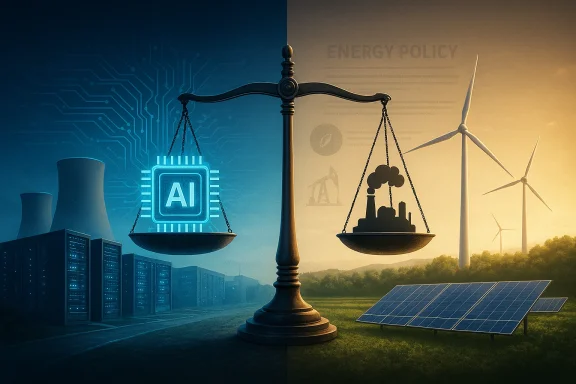
The tech industry’s loudest promises about artificial intelligence as a climate savior have collided with a damning new analysis: a coalition of environmental groups says most corporate claims that AI will cut emissions are unproven, while independent studies and energy agencies offer a far more nuanced — and anxious — picture of AI’s net climate impact. The claim that AI is an unalloyed “win” for the planet now sits alongside hard evidence that generative AI and the data centers that power it are driving a rapid surge in electricity and water demand. The result is an urgent, uncomfortable question for policymakers, IT leaders, and anyone tempted to take vendor sustainability claims at face value: is AI part of the solution, part of the problem — or both at once?
AI’s association with climate action is not new. For years research teams and industrial adopters have documented use-cases where machine learning improves energy efficiency, optimizes logistics, and enables better forecasting for wind, solar, and grid balancing. On the other hand, the launch and exponential scaling of large generative models — the family of systems behind chatbots and multimodal assistants — have introduced massive new computing workloads and a corresponding spike in demand for specialized chips, power, and cooling. This tension between potential savings in other sectors and the footprint of the AI stack itself is the central debate driving recent headlines and the NGO analysis.
The International Energy Agency (IEA) models a range of plausible futures in which AI contributes to emissions reductions — but underlines that those gains are not automatic and are uncertain in scale. In one IEA scenario, the “widespread adoption” of existing AI tools could lead to emissions reductions roughly equivalent to about 5% of global energy-related emissions by 2035 — significant, but far short of what is required to meet ambitious climate targets and heavily conditional on deployment pathways. At the same time, the IEA projects that electricity demand from data centers could more than double by 2030, driven largely by AI workloads, with a concentrated regional footprint that raises local grid and environmental concerns.
A recent peer-reviewed analysis in npj Climate Action reaches an even more optimistic technical estimate: targeted AI applications across a few high-impact sectors could reduce emissions by several gigatonnes annually by 2035 — but that paper is explicit about the assumptions required for those outcomes to materialize (rapid diffusion of the right solutions, alignment of economic incentives, and clean power supply). The contrast between modeled potential and operational reality is the gap critics now call out as the breeding ground for “greenwashing.”
The IEA estimates global data center electricity consumption rose from ~415 TWh in 2024 and, under plausible scenarios, could exceed 900 TWh by 2030 — more than double in a few years — with AI the dominant growth driver. The projection also shows that data center energy demand is geographically concentrated (not evenly distributed), which creates local grid stress and makes the sector’s emissions profile sensitive to regional fuel mixes. In short: AI-scale hardware = lots more power, in specific places and on specific grids.
Independent researchers have attempted to isolate AI’s share of data center emissions and water use. One high-profile estimate — reported in major outlets after publication in the journal Patterns — suggests that AI-specific workloads may have emitted between roughly 32.6 million and 79.7 million tonnes of CO2 in 2025, and consumed hundreds of billions of liters of water for cooling and power generation. Those numbers place AI’s 2025 footprint in the range of a small country’s annual emissions (and they prompted renewed calls for corporate transparency). The authors and reporting outlets caution that limitations in data disclosure make these estimates uncertain, but they are non-trivial and materially relevant to policy and siting debates.
Two key implications follow from these trends:
But the weaknesses are real and immediate:
The debate is not theoretical: it’s about how we govern deployment choices today, how we measure and audit claims, and whether public policy will require the transparency and energy-system alignment necessary to avoid locking in additional fossil-fuel dependence. Promises of future climate salvation cannot substitute for rigorous, verifiable evidence and concrete policy safeguards.
If AI is to be a true tool in the climate transition, three conditions must be met: companies must put measurable evidence behind their claims; procurement and siting must be coordinated with clean-power planning; and regulators must insist on transparent, standardized disclosures that allow independent verification. Absent those safeguards, the risk is clear: corporate optimism becomes greenwashing, and communities pay the price while the world waits for a promise that may never materialize. The science and modeling point to real potential; the present disclosures and deployments point to urgent need for accountability. The balance between those two realities will determine whether AI becomes a genuine lever for decarbonization — or a vivid illustration of how technological progress can outpace our capacity to govern it responsibly.
Source: The News International Is AI really fighting climate change? Experts weigh in on big tech's ‘greenwashing’
 Background
AI’s association with climate action is not new. For years research teams and industrial adopters have documented use-cases where machine learning improves energy efficiency, optimizes logistics, and enables better forecasting for wind, solar, and grid balancing. On the other hand, the launch and exponential scaling of large generative models — the family of systems behind chatbots and multimodal assistants — have introduced massive new computing workloads and a corresponding spike in demand for specialized chips, power, and cooling. This tension between potential savings in other sectors and the footprint of the AI stack itself is the central debate driving recent headlines and the NGO analysis.The International Energy Agency (IEA) models a range of plausible futures in which AI contributes to emissions reductions — but underlines that those gains are not automatic and are uncertain in scale. In one IEA scenario, the “widespread adoption” of existing AI tools could lead to emissions reductions roughly equivalent to about 5% of global energy-related emissions by 2035 — significant, but far short of what is required to meet ambitious climate targets and heavily conditional on deployment pathways. At the same time, the IEA projects that electricity demand from data centers could more than double by 2030, driven largely by AI workloads, with a concentrated regional footprint that raises local grid and environmental concerns.
A recent peer-reviewed analysis in npj Climate Action reaches an even more optimistic technical estimate: targeted AI applications across a few high-impact sectors could reduce emissions by several gigatonnes annually by 2035 — but that paper is explicit about the assumptions required for those outcomes to materialize (rapid diffusion of the right solutions, alignment of economic incentives, and clean power supply). The contrast between modeled potential and operational reality is the gap critics now call out as the breeding ground for “greenwashing.”
What the NGOs found: the “AI climate hoax” claim
A consortium of environmental organizations — including Beyond Fossil Fuels, Climate Action Against Disinformation, Friends of the Earth U.S., and others — commissioned an analysis that scrutinized 154 public statements from technology companies and influential institutions about AI’s climate benefits. The headline findings are blunt:- 74% of sampled claims are considered “unproven” in the authors’ assessment.
- Only 26% of claims cited published academic research.
- 36% cited no evidence at all behind their climate benefit assertions.
- The analysis did not discover a single documented case where consumer-facing generative systems such as ChatGPT, Gemini, or Copilot delivered a material, verifiable, and substantial reduction in emissions.
Where the optimistic numbers come from — and why they’re conditional
To be clear: influential technical and policy analyses do find plausible pathways where AI helps cut emissions at scale. Two distinct literatures underline that potential:- The IEA’s “Energy and AI” modelling suggests that certain AI applications — improving grid management, optimizing industrial processes, and accelerating materials discovery — could reduce emissions materially, with an illustrative figure of about 1.4 gigatonnes of CO2 avoided per year in a widespread-adoption case by 2035 (roughly characterized by the IEA as up to ~5% of energy-related emissions). Those benefits assume broad, efficient deployment and that the electricity meeting the incremental AI load is not overwhelmingly fossil-fueled.
- A peer-reviewed paper in npj Climate Action models aggressive, targeted AI interventions in the power, transport, and food sectors and estimates a larger technical potential — on the order of 3.2–5.4 GtCO2e savings per year by 2035 across those sectors. The paper is explicit that these are scenarios: they depend on how AI is developed, who pays for adoption, whether low-carbon electricity underpins AI growth, and how rapidly industry and policy actors scale the most effective use-cases.
The other side of the ledger: AI’s energy and water footprint
Modelling future benefits is only half the story. The empirical evidence on AI-driven demand for electricity, specialized chips, and water cooling is already worrying.The IEA estimates global data center electricity consumption rose from ~415 TWh in 2024 and, under plausible scenarios, could exceed 900 TWh by 2030 — more than double in a few years — with AI the dominant growth driver. The projection also shows that data center energy demand is geographically concentrated (not evenly distributed), which creates local grid stress and makes the sector’s emissions profile sensitive to regional fuel mixes. In short: AI-scale hardware = lots more power, in specific places and on specific grids.
Independent researchers have attempted to isolate AI’s share of data center emissions and water use. One high-profile estimate — reported in major outlets after publication in the journal Patterns — suggests that AI-specific workloads may have emitted between roughly 32.6 million and 79.7 million tonnes of CO2 in 2025, and consumed hundreds of billions of liters of water for cooling and power generation. Those numbers place AI’s 2025 footprint in the range of a small country’s annual emissions (and they prompted renewed calls for corporate transparency). The authors and reporting outlets caution that limitations in data disclosure make these estimates uncertain, but they are non-trivial and materially relevant to policy and siting debates.
Two key implications follow from these trends:
- The sector’s near-term growth can lock in additional fossil-fuel generation unless data centers and chip fabs rapidly secure low-carbon power and grid flexibility.
- Even with renewable procurement strategies, the localized strain on water resources (for cooling) and transmission capacity creates social and environmental friction that often affects host communities first.
Generative AI vs. narrow AI: not the same animal
One of the most consequential clarifications to make is conceptual: not all AI is equal from a climate perspective.- Narrow, application-specific AI (for example, predictive maintenance, wind-forecasting models, or energy-demand optimization at a regional grid level) typically uses smaller models and compact inference pipelines. These systems can deliver real operational savings that are measurable at the scale of buildings, plants, or networks. Evidence for such benefits is stronger and grounded in peer-reviewed case studies or sectoral pilots.
- Large generative models (the multi-billion-parameter LLMs and multimodal systems behind consumer chatbots and many enterprise assistants) are computationally intensive to train and expensive to operate at scale. They often require repeated fine-tuning, large inference clusters, and specialized accelerators; their marginal energy cost per new use-case is high compared with narrow models. The NGO analysis emphasizes that much of industry messaging blurs these two categories, implying that the emission reductions demonstrated by narrow AI will scale up to compensate for the growth of generative AI — a claim the NGOs find unsupported.
How companies talk about climate benefits — and where the evidence gaps are
The converging critiques of corporate rhetoric and NGO analysis reveal recurring patterns:- Unclear evidence chains. Many corporate statements cite general studies or high-level modeling outcomes rather than peer-reviewed, reproducible evidence tied to an actual deployed product. The NGO analysis found that only about a quarter of claims referenced academic literature.
- Extrapolation from pilots. A handful of success stories (for instance, predictive maintenance pilots or improved routing in logistics) get scaled rhetorically into global percentages without transparent scaling assumptions. The result: an appealing headline number that hides the complexity of scaling socio-technical systems across regions and industries.
- Conflation of older ML and modern generative AI. Statements often celebrate “AI” writ large while eliding the very different resource profiles of small-footprint analytics models versus modern LLM stacks. The NGO report calls this a “bait-and-switch” greenwashing tactic.
- Limited corporate disclosure. Many cloud and hyperscaler sustainability reports lack the granularity needed to attribute energy and water use to discrete AI workloads. Without that level of transparency, external auditors, regulators, and communities cannot verify claims. The IEA and independent studies both highlight this data opacity as a major barrier to rigorous assessment.
The industry response and technological levers
Big tech and cloud providers point to a suite of approaches intended to control AI’s environmental footprint. These include:- Hardware and software efficiency improvements (more efficient accelerators, model compression, sparse models).
- Shift to renewable energy procurement and long-term power purchase agreements (PPAs).
- On-site and regional investments in grid flexibility (battery storage, demand-response) to smooth load.
- Research into cooling technologies and water reuse to reduce water footprints.
Policy, transparency, and what accountability looks like
If we accept both the upside (AI can help decarbonize sectors) and the downside (AI drives new demand that risks fossil lock-in), the policy agenda becomes clear and urgent:- Mandatory, standardized disclosure of energy and water use attributable to major AI facilities and AI-specific workloads. This should include hourly or sub-daily granularity where feasible, to evaluate grid impacts.
- Requirements for real additionality in renewable procurement: support for 24/7 clean energy sourcing rather than aggregated annual offsets.
- Local environmental safeguards for water use and thermal pollution, especially in water-stressed regions where data centers are being sited.
- Independent verification and third-party audits of public claims linking AI deployments with emissions reductions. Claims that influence investor decisions or public policy should be verifiable.
- Incentives for prioritizing low-carbon, high-impact AI deployments (e.g., tax credits or procurement preferences for AI systems that demonstrably reduce industrial emissions).
Practical guidance for IT leaders and buyers
Organizations planning to deploy or scale AI should treat environmental impact as a first-order design constraint, not an afterthought. Practical actions include:- Measure first. Before claiming climate benefits, establish baselines: how much energy does the model training or inference consume? What is the electricity’s carbon intensity at the hours the workload runs?
- Prefer targeted models for operational efficiency. For many industrial applications, smaller, specialized models deliver most of the emissions reductions at far lower computational cost than a large LLM.
- Align compute to clean power windows. Schedule non-urgent training runs for hours with low-grid carbon intensity or where contractual renewable supply is available.
- Use lifecycle accounting. Include embodied carbon (chip fabrication, data center construction) in any comprehensive assessment of an AI deployment’s footprint.
- Demand vendor transparency. Require cloud and platform providers to disclose workload-level energy use and associated emissions so that procurement decisions are evidence-based.
Strengths, weaknesses, and where the evidence is thin
There are credible strengths to the optimistic view: the IEA and peer-reviewed modelling show AI can accelerate decarbonization by improving system efficiency, reducing waste, and speeding research cycles for low-carbon technologies. When narrowly targeted and carefully deployed, AI tools have already demonstrated measurable energy savings in building management, logistics, and some industrial processes. These are real, replicable wins.But the weaknesses are real and immediate:
- Evidence gaps for headline claims. Large, global claims (e.g., “AI will cut X% of emissions by 2030/2035”) often rest on optimistic scaling assumptions and weak attribution methods. NGO analyses find many such claims lack published, peer-reviewed backing.
- Rapid hardware-driven demand growth. Efficiency gains on a per-inference basis can be overwhelmed by exponential increases in total compute demand, especially for generative AI applications. The IEA projects dramatic growth in data center electricity use if current trends continue.
- Transparency and measurement shortfalls. Without standardized, granular reporting, independent verification is impossible and the public cannot evaluate claims about net climate benefits. This opacity allows plausible deniability and marketing claims to flourish.
Conclusion — an unvarnished, pragmatic verdict
AI is not a single thing, and its climate story is not a single story. There are proven, high-value use-cases where machine learning saves energy and reduces emissions today. There are also new, compute-hungry technologies that are increasing demand for electricity and water on timelines that matter for climate policy and local environments.The debate is not theoretical: it’s about how we govern deployment choices today, how we measure and audit claims, and whether public policy will require the transparency and energy-system alignment necessary to avoid locking in additional fossil-fuel dependence. Promises of future climate salvation cannot substitute for rigorous, verifiable evidence and concrete policy safeguards.
If AI is to be a true tool in the climate transition, three conditions must be met: companies must put measurable evidence behind their claims; procurement and siting must be coordinated with clean-power planning; and regulators must insist on transparent, standardized disclosures that allow independent verification. Absent those safeguards, the risk is clear: corporate optimism becomes greenwashing, and communities pay the price while the world waits for a promise that may never materialize. The science and modeling point to real potential; the present disclosures and deployments point to urgent need for accountability. The balance between those two realities will determine whether AI becomes a genuine lever for decarbonization — or a vivid illustration of how technological progress can outpace our capacity to govern it responsibly.
Source: The News International Is AI really fighting climate change? Experts weigh in on big tech's ‘greenwashing’
