

Microsoft’s push to make Copilot a reliable, context-aware partner for creators is fast moving from enterprise productivity suites into the studios and sound booths that power modern broadcasting, and a recent partnership with Yarida highlights both the practical promise and the strategic business upside of treating AI as a true co‑host rather than a one‑click tool.
The idea of an “AI co‑host” bundles several technologies—large language models (LLMs), real‑time speech processing, grounded web access, and integrated publishing workflows—into a single experience that can assist with research, produce dynamic scripts, suggest interview questions, and even generate voice or persona elements when required. Microsoft’s Copilot family, which has been rolled out across Microsoft 365 and Windows since 2023, is a clear example of that trend: Copilot was introduced as a unified brand and companion across Bing, Edge, Microsoft 365 and Windows, and its Microsoft 365 variant moved from early access into broader commercial availability in 2023. At the same time, commercial offerings have evolved: Microsoft introduced Copilot Pro as a consumer/professional subscription in January 2024, priced at $20 per user per month (later consolidated under new packaging as Microsoft 365 Premium in some rollouts). These commercial tiers offer higher‑priority model access, extended features, and web‑grounding capabilities that are directly relevant to content creators and broadcasters. Why this matters for broadcasters: podcasts and digital audio are among the fastest growing slices of the media market, and analysts project strong multi‑year growth in both listener demand and ad spend. Multiple market reports forecast rapid expansion for AI applications in media and entertainment through the decade, driven by use cases that include automated editing, personalization, metadata enrichment, and generative creative assistance.
Key commercial mechanics visible in these partnerships:
The Yarida–Copilot example is not just a glossy demo of what AI can do; it’s an early template for how broadcasters will re‑engineer production in the coming years. Done responsibly, AI co‑hosts can raise production value, enable new monetization, and expand storytelling capacity. Done without guardrails, they risk eroding trust and running afoul of emerging rules that prioritize transparency and safety. The next 12–24 months will separate savvy operators—those who pair AI power with rigorous editorial practices—from opportunistic experiments that fail to scale.
Source: Blockchain News Microsoft Copilot Empowers Broadcasters With AI Co-host Capabilities: Yarida Partnership Highlights Business Potential | AI News Detail
 Background / Overview
The idea of an “AI co‑host” bundles several technologies—large language models (LLMs), real‑time speech processing, grounded web access, and integrated publishing workflows—into a single experience that can assist with research, produce dynamic scripts, suggest interview questions, and even generate voice or persona elements when required. Microsoft’s Copilot family, which has been rolled out across Microsoft 365 and Windows since 2023, is a clear example of that trend: Copilot was introduced as a unified brand and companion across Bing, Edge, Microsoft 365 and Windows, and its Microsoft 365 variant moved from early access into broader commercial availability in 2023. At the same time, commercial offerings have evolved: Microsoft introduced Copilot Pro as a consumer/professional subscription in January 2024, priced at $20 per user per month (later consolidated under new packaging as Microsoft 365 Premium in some rollouts). These commercial tiers offer higher‑priority model access, extended features, and web‑grounding capabilities that are directly relevant to content creators and broadcasters. Why this matters for broadcasters: podcasts and digital audio are among the fastest growing slices of the media market, and analysts project strong multi‑year growth in both listener demand and ad spend. Multiple market reports forecast rapid expansion for AI applications in media and entertainment through the decade, driven by use cases that include automated editing, personalization, metadata enrichment, and generative creative assistance. What an AI Co‑host Actually Does
Core capabilities broadcasters are already using
- Research and fact‑checking in real time: Copilot can surface background, pull up citations, and summarize source material during prep or live segments—reducing pre‑production time and lowering the barrier for solo hosts to produce informed content.
- Script generation and adaptive outlines: From episode outlines to show scripts, AI can draft multiple tonal variations (formal, conversational, humorous), giving hosts starting points they can adapt.
- Voice and persona tools: Emerging integrations support voice cloning or synthetic co‑hosts (with consent and licensing), enabling a human host to “co‑present” with a virtual partner that can read ads, cue segments, or play a character. These features are increasingly available via multimodal toolchains and cloud APIs.
- Live assistance and cueing: For live shows, a co‑host can surface notes, suggest follow‑ups, and flag potential factual errors on the fly—acting as a second set of ears and a producer in the control room.
Secondary but high‑value features
- Automated editing suggestions (silence removal, leveling), chaptering and metadata tagging for distribution platforms.
- Audience insight generation: recommending topics, guests, or ad segments based on trending queries and listening behavior.
- Accessibility features: auto‑generated captions, transcripts, and localized translations to expand reach.
The Yarida Partnership: A Practical Case Study
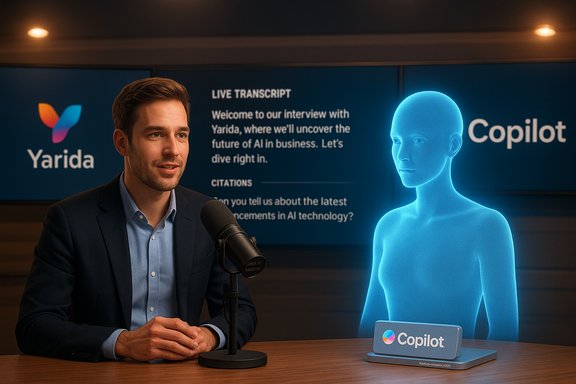
The announcement that Microsoft is enabling Yarida (a media partner focused on audio and broadcasting solutions) to integrate Copilot as a co‑host demonstrates a practical, immediately monetizable model. Yarida’s use case centers on enabling independent podcasters and small broadcast teams to access enterprise‑grade workflows—script drafting, realtime show notes, and AI‑assisted interview prompts—without the cost or headcount of a full studio team. This type of partnership maps well to the industry trend of democratizing production: the same infrastructure that powers Copilot for enterprise can be repackaged by ISVs and channel partners into verticalized products for media creators.Key commercial mechanics visible in these partnerships:
- Platform licensing and feature bundles (e.g., API access, voice models, moderation tools).
- Subscription and tiered pricing—free/low entry plus premium features for pro creators.
- Value‑added services from partners (workflow templates, training, editorial verification).
- Shared governance and compliance responsibilities for sensitive use (rights, voice likeness, data residency).
Business Potential: Market Forces and Monetization Models
Why broadcasters have a standing business case
- The digital audio market continues to expand rapidly. Industry analyses identify digital audio and podcasting as key growth areas inside the broader entertainment market, attracting increased ad dollars and platform investment. While estimates vary across analysts, the consensus is clear: audio is growing and ad monetization is scaling.
- AI speeds and scales repetitive creative tasks. Multiple industry studies and vendor reports show generative tools can shorten drafting and production cycles substantially—enabling smaller teams to deliver more episodes and spin up paid tiers or ad‑supported content without proportional cost increases. Real‑world pilots report productivity gains in content creation and editing that translate directly into lower per‑episode costs.
- Platform integration is easier than ever. Copilot’s connectors and the broader Microsoft AI ecosystem (Azure, Fabric, Copilot Studio) make it straightforward for partners to tie AI output into distribution endpoints—RSS feeds, Spotify for Podcasters, Apple Podcasts, or direct publisher CMS systems—so the AI becomes part of the end‑to‑end production pipe rather than a side tool.
Monetization playbook for broadcasters and partners
- Subscription tiers: Free/basic episodes with sponsored segments and premium episodes behind a paywall (paid quickly with AI‑assisted exclusive shorts).
- Branded AI co‑hosts: Licensing AI personas for brand‑led podcasts or advertorial series.
- Studio-as-a-Service: Charge creators for editorial packages, AI fine‑tuning, and production automation.
- Data and targeting: Offer advertisers AI‑driven audience segmentation and tailored ad insertion (ethics and transparency permitting).
Technical Foundations and Implementation Considerations
What powers Copilot co‑hosting
Copilot is built on transformer‑based model architectures and integrates newer multimodal models and reasoning systems for sustained context and web grounding. It uses Azure cloud services for compute, storage, and model hosting, and Microsoft’s product stack provides connectors to standard productivity apps and media workflows. The result is a platform that can handle long conversational context, multi‑turn dialog, and cross‑document reasoning—capabilities necessary for live or near‑live co‑hosting.Integration checklist for broadcasters
- Data flow and privacy: Define what audio, transcripts, and show notes will be captured and how they are stored—especially important for GDPR and other privacy regimes.
- Latency and reliability: Live usage demands sub‑second or low‑second response windows; validate model routing, caching, and failover strategies.
- Content verification: Implement human‑in‑the‑loop editorial sign‑offs for any content destined for public broadcast to avoid errors or “hallucinations.”
- Rights and voice licensing: Secure explicit consent and legal rights for any synthetic voices or likenesses used, and document provenance for any training inputs used in fine‑tuning.
- Auditability and logs: Maintain searchable logs of prompts, model versions, and outputs for compliance, ad reporting, and dispute resolution.
Risks, Ethics, and Regulatory Landscape
Hallucination and accuracy
LLMs can generate plausible but false statements—so‑called hallucinations. For broadcasters, such errors can damage credibility or propagate misinformation. The recommended mitigation is hybrid human–AI workflows: let Copilot draft and fact‑check, but maintain editorial sign‑off on public output. Independent studies and industry reporting continue to document hallucination risks and the need for human oversight.Legal and rights issues
Voice synthesis, persona cloning, and AI‑generated music raise clear IP and moral‑rights questions. Contracts must include licensing for voice likenesses, release forms for guests, and clear policies on AI use disclosure. Additionally, platform partners (distributors, ad networks) are beginning to require disclosure or metadata labeling for AI‑assisted content—so operationalize label plans early.Regulation: the EU AI Act and beyond
Regulatory pressure is real. The European Union’s Artificial Intelligence Act passed parliamentary approval in March 2024 and was finalized in subsequent Council decisions; it classifies AI systems by risk and establishes transparency obligations for certain media applications. Broadcasters and platform providers targeting EU audiences must account for obligations around labeling AI‑generated content, risk assessments for high‑risk systems, and governance controls that may be required for general‑purpose models.Trust and audience expectations
Transparency matters: audiences expect disclosure when a voice or perspective is AI‑generated. Industry guidelines and journalist codes emphasize clear labeling to preserve trust. For broadcasters, a pragmatic compromise is to label episodes or segments where AI played a substantive role and to document the editorial process for listener transparency.Operational Best Practices: A Practical Playbook
Short‑term wins (0–3 months)
- Pilot Copilot in pre‑production: use AI for research and script drafting with human editors signing off.
- Implement basic human‑in‑the‑loop verification for all factual claims.
- Protect guest privacy: obtain consent for any audio processing and potential synthetic reuse.
Mid‑term scale (3–12 months)
- Automate production tasks: chaptering, closed captions, and metadata enrichment.
- Launch a premium AI‑assisted episode tier with added perks (transcripts, bonus segments, early access).
- Build a model‑versioning and audit trail for compliance and advertiser reporting.
Long‑term strategy (>12 months)
- Package AI‑host capabilities as a managed product for smaller creators and publishers.
- Negotiate platform distribution terms that allow AI‑driven personalization without violating platform policies.
- Invest in ethical guardrails and external audits to keep pace with evolving regulation like the EU AI Act.
Competitive Landscape and Strategic Positioning
Microsoft is not operating alone. The market features major cloud and AI players—Google (Gemini), OpenAI (via API and model partnerships), Adobe (creative AI with Sensei), and specialist vendors offering voice, studio automation, or vertical AI for media. For broadcasters and partners, the decision calculus should weigh:- Model performance and multimodal capabilities (text, audio, voice).
- Ecosystem fit—how well the AI integrates with distribution and hosting platforms.
- Governance and compliance tooling (logs, model cards, opt‑outs).
- Commercial terms: consumption pricing, SLAs, and data rights.
The Bottom Line: Opportunity Tempered by Responsibility
Microsoft Copilot’s move into broadcasting and Yarida’s partnership both underscore a clear industry arc: AI will lower the threshold of professional production, enabling independent creators to produce more sophisticated audio content with smaller teams. That democratization has powerful upside—more voices, more niche content, faster production cycles, and attractive monetization vectors—but the transition is not risk‑free.- Strengths: improved productivity, richer personalization, and lower friction for high‑quality output; solid platform integration and partner ecosystems enable rapid productization.
- Risks: accuracy/hallucination, IP and voice‑licensing complexity, regulatory obligations (especially in the EU), and the reputational cost of undisclosed AI content.
Final Recommendations for Media Teams and Creators
- Start small: pilot Copilot‑assisted episodes for non‑time‑sensitive segments to build trust and workflow fluency.
- Insist on audit trails: log prompts, model versions, and editorial approvals for every AI‑assisted publish.
- Build disclosure into your metadata and episode notes—audiences value honesty.
- Negotiate commercial terms that include portability and clear data‑use rights when adopting platform copilots.
- Invest in training: teach hosts and producers how to prompt effectively, interpret model outputs, and spot likely hallucinations.
The Yarida–Copilot example is not just a glossy demo of what AI can do; it’s an early template for how broadcasters will re‑engineer production in the coming years. Done responsibly, AI co‑hosts can raise production value, enable new monetization, and expand storytelling capacity. Done without guardrails, they risk eroding trust and running afoul of emerging rules that prioritize transparency and safety. The next 12–24 months will separate savvy operators—those who pair AI power with rigorous editorial practices—from opportunistic experiments that fail to scale.
Source: Blockchain News Microsoft Copilot Empowers Broadcasters With AI Co-host Capabilities: Yarida Partnership Highlights Business Potential | AI News Detail
