

Microsoft’s Copilot ecosystem appears to be moving toward built‑in provenance signals for AI outputs—most visibly for images—with multiple signals pointing to watermarking and C2PA content credentials being applied across Microsoft services, while broader claims that Microsoft 365 Copilot will automatically watermark all AI‑generated content (including prose and other text outputs) remain unconfirmed and should be treated cautiously pending official product rollouts or admin documentation updates.
Generative AI has forced platform vendors to ask a basic question: how do we make it possible to tell the difference between human‑created and AI‑created content? For images the answer that’s gained traction is a combination of visible overlays, invisible steganographic marks, and standardized metadata formats such as the Coalition for Content Provenance and Authenticity (C2PA) Content Credentials.
Microsoft has already adopted multiple layers of this approach in its imaging pipelines. OpenAI’s DALL‑E 3 integration in Bing and Microsoft’s image services embeds content provenance metadata and, in some implementations, invisible watermarks; Azure OpenAI has a feature set to attach watermarks to generated images; and Microsoft’s Copilot product family uses content credentials to tag generated visual outputs in several scenarios. Independent reporting and Microsoft documentation confirm these moves. At the same time, Microsoft has been adding administrative and transparency controls—AI disclaimers, DLP checks, and content‑sensitivity integrations—across Microsoft 365 to give organizations governance over how Copilot uses tenant data and surfaces AI outputs. Those controls are documented in Microsoft’s Copilot admin guidance and feature updates.
When we cross‑check that report against available vendor documentation and independent reporting, the central findings are:
Strengths of this trajectory include standardization, improved forensic capability, and stronger tenant controls over sensitive content. Microsoft’s public materials and independent reporting converge on these improvements and show clear product investments. However, the limitations are material. Watermarking is not a magic bullet. Technical workarounds, platform reprocessing, and the practical realities of how content is shared on the web will limit perfect traceability. The decision to adopt invisible marks and manifests protects image fidelity but also raises the bar for verification tooling—organizations must invest in the systems to read and preserve provenance if they expect it to be meaningful. Finally, the rumor that Copilot will universally watermark all AI outputs—particularly text—appears premature. Microsoft’s existing admin controls and transparency notes point toward a governance‑first approach rather than an automatic, universal watermark policy for every modality. That distinction matters for compliance planning: do not assume that a Copilot‑generated paragraph will carry a verifiable, tamper‑resistant tag unless Microsoft explicitly documents that capability for text and your tenant has it enabled.
Source: Windows Report https://windowsreport.com/microsoft-365-copilot-may-soon-watermark-ai-generated-content/
 Background
Generative AI has forced platform vendors to ask a basic question: how do we make it possible to tell the difference between human‑created and AI‑created content? For images the answer that’s gained traction is a combination of visible overlays, invisible steganographic marks, and standardized metadata formats such as the Coalition for Content Provenance and Authenticity (C2PA) Content Credentials.Microsoft has already adopted multiple layers of this approach in its imaging pipelines. OpenAI’s DALL‑E 3 integration in Bing and Microsoft’s image services embeds content provenance metadata and, in some implementations, invisible watermarks; Azure OpenAI has a feature set to attach watermarks to generated images; and Microsoft’s Copilot product family uses content credentials to tag generated visual outputs in several scenarios. Independent reporting and Microsoft documentation confirm these moves. At the same time, Microsoft has been adding administrative and transparency controls—AI disclaimers, DLP checks, and content‑sensitivity integrations—across Microsoft 365 to give organizations governance over how Copilot uses tenant data and surfaces AI outputs. Those controls are documented in Microsoft’s Copilot admin guidance and feature updates.
What’s being reported now
A recent media item drew attention to a rumor: Microsoft 365 Copilot may soon watermark AI outputs by default. That story echoes a wider product‑level trend—Microsoft and partners applying provenance signals to AI‑generated images and other media to increase transparency and make downstream verification feasible.When we cross‑check that report against available vendor documentation and independent reporting, the central findings are:
- Microsoft and OpenAI have implemented C2PA Content Credentials and invisible watermarking for images generated by DALL‑E 3 and related services; that behavior is documented and demonstrated across multiple Microsoft surfaces.
- Azure OpenAI announced or previewed an image watermarking capability to embed invisible provenance markers, and Microsoft public materials discuss Content Credentials as a way to attach provenance metadata to generated media.
- Microsoft’s Microsoft 365 Copilot admin settings already include AI disclaimers and DLP integrations that surface when Copilot is now grounded content is accessed and returned; those administrative controls are documented and available to tenants.
- There is previewed functionality in Microsoft Edge for Business and Copilot integrations that applies visual watermarking and other session‑level protections for sensitive content in managed environments; this is positioned as complementary to Purview DLP and Intune protections.
How watermarking and content credentials work (technical primer)
Visible vs. invisible watermarking
- Visible watermarks are graphic overlays (text, logo, pattern) placed on an image. They are easy for humans to see, simple to implement, and straightforward to remove (cropping, cloning, or image‑editing) in many cases.
- Invisible watermarks embed signals into the image or attach a signed manifest that travels with the file. These can be steganographic marks encoded in pixels or cryptographically signed metadata attached as a manifest (C2PA-style Content Credentials). Invisible marks are harder to tamper with without risking detectability but are not immune to removal or accidental loss (for example, when an image is re‑encoded by a social platform).
C2PA and Content Credentials
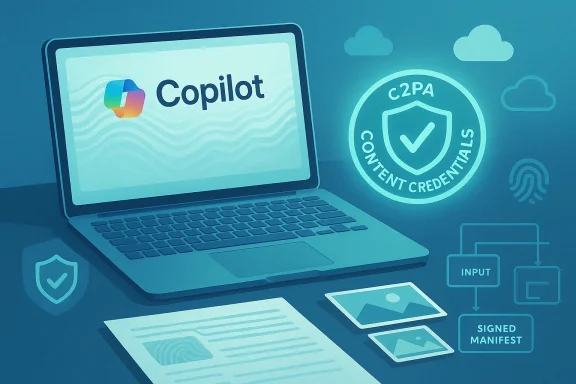
- Content Credentials is an open standard (C2PA) that records provenance metadata—who created the content, how and when it was produced, and which tools were used—and signs that information so it can be verified later.
- Microsoft and many platform partners have adopted C2PA to attach provenance manifests to AI images. The manifest may persist as file metadata or as a separate, signed manifest bundled with the asset. Browsers and platforms are beginning to surface that provenance where feasible.
How that maps to Copilot and Microsoft 365
- When Copilot or Bing Image Creator generates an image, the generation pipeline can embed invisible watermarks and attach C2PA credentials to the output. That enables later verification tools to flag an item as machine‑generated and to show creation metadata like model, timestamp, or service.
- For other formats—text, audio, video—the approach is more complex. Text can be fingerprinted (through statistical markers or cryptographic signing of a generated artifact), and audio/video can carry watermarks or C2PA metadata, but platform support and standards are still evolving. Microsoft has signaled work across multiple modalities, but public, universal plumbing for automatic watermarking of all Copilot outputs is not yet documented as a completed, tenant‑wide feature.
Why Microsoft (and others) are doing this: benefits and product considerations
Watermarking and provenance are being promoted for several practical reasons.- Combat disinformation and deepfakes. Attaching a verifiable provenance trail reduces the cost of detecting AI‑generated content in misinformation campaigns. Standard metadata can also be used by platforms to decide how to treat content in feeds and search.
- Improve transparency and user trust. For enterprise customers especially, knowing whether a Copilot output was generated by AI—and whether it used tenant content—matters for governance and risk management. Admins can enforce policies and show disclaimers where needed.
- Enable auditability and compliance. Content Credentials and signed manifests provide audit logs that compliance teams can query during investigations or regulatory reviews. This is attractive to regulated industries where provenance can be material to legal findings.
- Protect intellectual property and licensing. Provenance metadata can capture model usage and licensed assets used in generation—important when derivative or commercial uses are in play. Azure and Microsoft product guidance addresses commercial‑use questions and licensing nuances for generated imagery.
Strengths and notable product engineering choices
- Standardization around C2PA is a major positive. The use of a widely‑accepted, open provenance format increases interoperability across vendors, platforms, and verification tools. Microsoft’s adoption of C2PA in image pipelines is an engineering decision that pays dividends for the ecosystem.
- Invisible watermarks plus manifests create layered defenses. Combining steganographic marks with signed manifests reduces single‑point failures—if metadata is stripped, embedded marks may still survive; if pixels are manipulated, manifests can offer alternate verification. Microsoft and Azure OpenAI’s imaging features have been described as implementing both conceptspts.
- Admin control and DLP integration makes Copilot enterprise‑friendly. Microsoft’s approach to attach AI disclaimers, enforce DLP checks before Copilot can read sensitive files, and add session protections in Edge for Business shows a product focus on governance, not just consumer convenience. For IT teams, that matters more than a blanket watermark rule.
Risks, limitations, and open technical questions
While promising, watermarking and content credentials have large, unresolved caveats.- Watermarks can be removed or lost. Visible watermarks are trivially cropped or edited away. Invisible marks and metadata can be stripped by re‑encoding, platform reprocessing, screenshots, or malicious tools. That reduces the effectiveness of watermarking as a foolproof signal.
- False assurances and false negatives. A file lacking a watermark or manifest is not evidence that the file is human‑created—platforms can omit metadata, and many older AI generations lack provenance. Treating absence of metadata as proof of human authorship is risky.
- Standards and modality gaps. C2PA is mature for static images; for text and multimodal outputs the ecosystem lacks ubiquitous standards and cross‑platform support. Embedding discernible markers in plain text or in editable Office documents raises both technical and UX challenges. At present, Microsoft’s public guidance focuses on images and media; automatic watermarking of prose remains an open problem.
- Privacy and operational concerns. Watermarks and manifests must be designed not to leak sensitive tenant data or user identities inadvertently. There is a balance between traceability and privacy: the metadata should not become a surveillance vector for adversaries. Microsoft’s transparency notes and enterprise guidance stress privacy controls and admin governance to mitigate this risk.
- Adversarial arms race. As watermarking and detection methods improve, so will watermark‑removal tools and adversarial attacks. Defenders and attackers are in a continuous cycle; provenance systems require ongoing tuning and monitoring.
Practical effects for Windows and Microsoft 365 users
For content creators
- If you use Copilot or Microsoft image creators, expect generated images to carry provenance metadata and, in many cases, invisible watermarks or visible labels. That may influence where you publish images and how you license or sell them.
- For textual Copilot outputs (draft emails, document text, summaries), there is no automatic, universal marker today that will travel with plain text in the same way C2PA works for images. Human review and editorial checks remain mandatory before publishing or relying on generated text in regulated environments.
For IT admins and security teams
- Use the admin features Microsoft already provides: turn on AI disclaimers, configure Purview sensitivity labels and DLP policies to control what Copilot may read or return, and test Edge for Business session protections if your organization uses managed browsing. Those controls reduce leakage risk and increase governance over AI‑assisted workflows.
- Plan for provenance workflows: if your organization depends on being able to prove provenance of media assets, require storage and retention policies that preserve C2PA metadata (for example, avoid platform processes that strip metadata on upload).
For platform operators and app developers
- Implement verification tools that can consume C2PA manifests and surface provenance information to end users. Consider placing prominent UI signals where end users expect them (thumbnails, sharing dialogs, metadata panes).
- Avoid relying exclusively on visible watermarks; combine metadata verification with content‑analysis heuristics and enterprise audit trails.
Recommended steps for organizations and creators
- Review your tenant’s Copilot and Microsoft 365 AI settings today. Turn on AI disclaimers for Copilot where regulatory concerns or brand integrity require it.
- Configure Purview sensitivity labels and DLP rules to block Copilot from accessing files that must remain out of generative AI pipelines. Test these policies with representative workflows.
- If you generate images for publication, preserve content credentials at every stage in your asset pipeline and avoid upload flows that strip metadata. Treat C2PA manifests as part of the asset family.
- Educate creators that generated text is not yet universally provenance‑tagged or watermarked. Implement editorial review steps and fact‑checking for AI‑assisted copy before distribution.
- Monitor vendor announcements and public documentation for modality expansions—Microsoft, OpenAI, and peers are actively evolving how provenance works across text, audio, and video. When Microsoft announces Copilot policy changes that extend watermarking beyond images, re‑evaluate workflows immediately.
What remains unverified and where to watch
- Public, vendor‑authored documentation confirms image watermarking and content credentials widely across Microsoft services, but there is no single Microsoft document that currently commits to watermarking all Copilot outputs (text, audio, or otherwise) by default across every tenant. That specific claim is unverified and should be considered speculative until Microsoft publishes a formal rollout plan or an admin control that explicitly covers text watermarking.
- Microsoft is testing and previewing session watermarking and protected clipboard features in Edge for Business and related enterprise channels, which suggests a product direction toward baked‑in provenance and exfiltration deterrents for managed sessions. Organizations should track Edge for Business and Copilot admin center updates closely.
- Standards and third‑party verification tools will evolve. Adoption of C2PA in client apps and social platforms remains uneven; an image’s C2PA manifest may not survive every sharing pipeline today. Expect both technological and policy iterations over the next 12–24 months.
Critical analysis: sober verdict for IT decision‑makers
Microsoft’s approach is pragmatic and aligned with the current industry consensus: provenance matters and images are the most tractable starting point. The combination of invisible watermarks, C2PA manifests, and enterprise‑grade admin controls is a sensible engineering direction that balances transparency, usability, and enterprise governance.Strengths of this trajectory include standardization, improved forensic capability, and stronger tenant controls over sensitive content. Microsoft’s public materials and independent reporting converge on these improvements and show clear product investments. However, the limitations are material. Watermarking is not a magic bullet. Technical workarounds, platform reprocessing, and the practical realities of how content is shared on the web will limit perfect traceability. The decision to adopt invisible marks and manifests protects image fidelity but also raises the bar for verification tooling—organizations must invest in the systems to read and preserve provenance if they expect it to be meaningful. Finally, the rumor that Copilot will universally watermark all AI outputs—particularly text—appears premature. Microsoft’s existing admin controls and transparency notes point toward a governance‑first approach rather than an automatic, universal watermark policy for every modality. That distinction matters for compliance planning: do not assume that a Copilot‑generated paragraph will carry a verifiable, tamper‑resistant tag unless Microsoft explicitly documents that capability for text and your tenant has it enabled.
Conclusion
The industry is converging on provenance: images generated by Copilot and related Microsoft services are increasingly accompanied by Content Credentials and invisible watermarking, reflecting C2PA standards and an enterprise‑grade approach to transparency. Microsoft also supplies admin features—AI disclaimers, DLP checks, and Edge session protections—that let organizations govern how Copilot sees and produces content. At the same time, claims that Microsoft 365 Copilot will automatically watermark all AI‑generated content across every modality are not fully substantiated by current public documentation. For now, the safe operational posture for IT leaders, legal teams, and content creators is to assume that images will increasingly carry provenance signals, but to treat textual outputs as still requiring editorial control, review, and tenant policy enforcement until a formal Microsoft rollout and admin controls expand watermarking to those modalities. Practical next steps are straightforward: enable AI disclaimers, tighten DLP and sensitivity labeling, preserve content credentials in your asset pipelines, and educate creators that provenance is improving but not omnipotent. Watch Microsoft’s Copilot and Azure OpenAI documentation closely for any announcements that materially extend watermarking and content credentials to text and other formats.Source: Windows Report https://windowsreport.com/microsoft-365-copilot-may-soon-watermark-ai-generated-content/
