

Artificial intelligence has moved from promise to practice: in 2026 it quietly shapes morning routines, classroom lessons, workplace workflows, and caregiving tasks so consistently that millions now treat AI helpers as ordinary household and professional tools.
The shift that makes 2026 feel different is not a single breakthrough but the convergence of three forces: large, capable language models and domain-specific copilots; cloud platforms and edge deployments that scale those models reliably; and a wave of real-world pilots that pushed AI from novelty into everyday utility. Together these trends have produced assistants that can coordinate across calendars, devices, and institutional data stores—so a single conversational interaction can do multi-step work that previously required multiple apps or human intermediaries.
This article examines what everyday AI looks like in 2026, reviews concrete deployments and measured benefits, evaluates the technical foundations and governance practices that make these systems useful, and lays out practical guidance for families, educators, and organizations adopting AI copilots.
Key household benefits:
What differentiates the practical copilots of 2026:
Measured classroom gains include:
Why it matters:
For individuals and families:
Source: Mix Vale Artificial intelligence makes daily routine easier for people of all ages in 2026
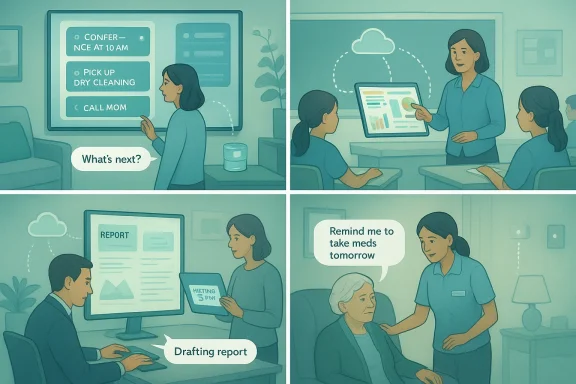 Background
The shift that makes 2026 feel different is not a single breakthrough but the convergence of three forces: large, capable language models and domain-specific copilots; cloud platforms and edge deployments that scale those models reliably; and a wave of real-world pilots that pushed AI from novelty into everyday utility. Together these trends have produced assistants that can coordinate across calendars, devices, and institutional data stores—so a single conversational interaction can do multi-step work that previously required multiple apps or human intermediaries.This article examines what everyday AI looks like in 2026, reviews concrete deployments and measured benefits, evaluates the technical foundations and governance practices that make these systems useful, and lays out practical guidance for families, educators, and organizations adopting AI copilots.
How AI is simplifying daily routines
At home: hands-free, context-aware convenience
Voice and conversational assistants are no longer limited to timers and music. Integration across smart-home devices, calendars, medication reminders, and shopping lists enables assistants to manage daily rhythms for busy families and people with mobility or cognitive challenges. These systems learn patterns—lighting, temperature, medication schedules—and combine that contextual awareness with automation to reduce friction and physical strain. Smart pill dispensers and ambient-monitoring systems that prompt or notify caregivers are now mainstream in many deployments aimed at older adults.Key household benefits:
- Reduced task friction through natural-language commands and proactive reminders.
- Improved medication adherence and fall-risk reduction via connected devices and contextual prompts.
- Lower barriers for people with limited screen literacy because conversational interfaces remove complex menus.
Work and productivity: copilots that finish the boring parts
AI copilots are embedded across office suites, messaging platforms, and vertical applications to automate repetitive tasks: summarizing long email threads, generating first drafts of reports, extracting insights from financial models, and turning raw data into pitched presentations. In enterprise pilots, companies that automated proposal generation, customer support triage, or routine maintenance planning reported meaningful time savings—turning hours of prep into minutes of review. These copilots function as first-draft generators that speed workflows while leaving final judgment to humans.What differentiates the practical copilots of 2026:
- Context-awareness: agents can pull data from calendars, CRM systems, and recent documents to produce tailored outputs.
- Multi-step orchestration: rather than one-off answers, agents plan and execute sequences (e.g., draft, schedule meeting, prepare materials).
Education: personalized lesson planning and faster feedback
AI copilots designed for education are shortening lesson-prep cycles and enabling differentiated instruction at scale. Several deployments from 2024–2025 reversed a chronic burden: teachers report lessoncrafting that once took hours now completed in minutes, with AI suggesting age-appropriate activities, assessment items, and multimedia resources aligned to curricula. In under-resourced classrooms, these copilots multiply the impact of a single teacher by handling time-consuming administrative work.Measured classroom gains include:
- Dramatic reductions in lesson-preparation time for participating teachers.
- Faster grading workflows with AI-assisted rubrics and feedback generation, improving turnaround for student work.
Health and caregiving: monitoring, reminders, and cognitive support
AI-powered monitoring systems and conversation companions now support family caregivers and health professionals. From smart pill dispensers that prompt patients to take medication to ambient-sensing systems that flag unusual movement patterns, AI reduces administrative and cognitive load on caregivers. Companion platforms offering cognitive stimulation and social interaction have shown improvements in engagement and loneliness for older adults when thoughtfully deployed. These are not replacements for clinicians but supportive tools that extend care capacity.Industry, agriculture, and public services: domain copilots
Domain-specific copilots are reshaping specialized work. Examples from recent deployments show how AI is now used to:- Interpret industrial manuals and translate troubleshooting steps into plain language for technicians on the factory floor.
- Support agricultural producers with actionable recommendations—monitoring water quality and advising interventions in aquaculture—to improve yield and sustainability.
- Streamline public-service processes such as university enrollment, turning a months-long bureaucratic process into near-instant transactions in pilot projects.
Real-world case studies
Shiksha Copilot (India): teacher empowerment in practice
The Shiksha project—built with Microsoft research and local partners—cut lesson-prep times dramatically by producing curriculum-aligned plans adapted to local languages and classroom contexts. Teachers who adopted the tool report spending saved time in direct student engagement rather than paperwork. This is an example of AI amplifying human impact rather than replacing it.Why it matters:
- It demonstrates how localized AI solutions can address specific bottlenecks in education systems.
- It underscores the importance of cultural and curriculum alignment when scaling educational AI.
Julia (Rome): tourism optimized by a virtual assistant
Rome’s AI assistant "Julia" uses conversational interactions and local data to personalize itineraries and reduce congested foot-traffic at major sites. This is a practical example of AI used for civic management: smoothing crowd flows while enhancing visitor experiences. The deployment shows how AI can play an operational role in public services when paired with on-the-ground planning.eFishery (Indonesia): aquaculture meets AI
eFishery’s Mas Ahya connects sensor data and aquaculture best practices with conversational guidance for shrimp and fish farmers, improving yields and supporting sustainability. This illustrates AI’s reach into primary industries and the value of domain expertise combined with cloud-scale ML services.Siemens Industrial Copilot: conversational industrial troubleshooting
The Siemens Industrial Copilot turns complex automation stacks into conversational interfaces, letting engineers query and command factory systems in plain language. This approach shortens time-to-repair and reduces the need for deep manual familiarity with dense manuals—critical in sectors facing labor shortages.Eduvos (South Africa): enrollment transformed
Eduvos used cloud-based CRM and AI tools to compress a 90-day enrollment process into near-instant results, cutting costs and improving student experience. This is a vivid illustration of administrative processes that respond well to automation: high-volume, rules-based, and data-rich workflows.The technology stack: what’s behind the helpers
At the core of modern copilots are improved LLMs, retrieval techniques, and integration platforms:- Large language models (LLMs) power fluent, conversational responses and generation tasks. Their raw generative skill is the foundation for assistants that write, summarize, and ideate.
- Retrieval-Augmented Generation (RAG) and grounding layers connect generative outputs to verified documents, reducing factual errors by referencing source data. These grounding techniques are now standard in production deployments to lower hallucination risk.
- Domain adaptation and fine-tuning create specialized copilots (education, industry, health) that understand sector-specific terminology and constraints.
- Cloud + edge deployments balance privacy and latency: sensitive health and home scenarios often prefer hybrid architectures with local inference or private cloud regions.
Measured benefits — numbers that matter (and their caveats)
Many pilot projects and early adopters report measurable gains:- Teacher lesson-prep time reduced from hours to minutes in Shiksha deployments.
- University enrollment time reduced from ~90 days to near-instant in an Eduvos implementation.
- Public-sector and industry telemetry indicating that AI is no longer a niche: Microsoft’s diffusion analysis estimates over a billion active AI users worldwide and highlights country-level adoption metrics used to guide policy. These headline figures are striking but depend on telemetry definitions and product mixes, so they should be treated as indicative rather than definitive.
- Aggregated telemetry (e.g., "AI User Share") depends heavily on which products and interactions are counted, how active use is defined, and regional adjustments for device penetration. Treat such numbers as directional signals, not precise population statistics.
Risks and limitations: what still matters
The 2026 landscape is powerful but imperfect. The principal risks include:- Hallucinations and factual errors. Generative outputs can still produce plausible but incorrect assertions. Grounding, verification layers, and human oversight are essential countermeasures.
- Privacy and data governance gaps. Assistants that access calendars, health records, and home sensors create new data flows that must be managed with local retention options and transparent policies. Without careful governance, helpful agents can become vectors for data exposure.
- Uneven access and localization. Benefits concentrate where connectivity, compute, and language support exist. Underserved communities risk being left behind unless affordability and language adaptation are explicit priorities.
- Operational overhead. AI-enabled devices and services require lifecycle management—model updates, signed firmware, rollback workflows—which increases the operational burden for IT and integrators. Procurement must include update commitments and data-handling policies.
- Overtrust. Users may treat AI outputs as authoritative. The right mental model is to treat outputs as drafts or recommendations that require verification for safety, legal, or financial decisions.
Best-practice playbook: adopt AI responsibly
Below is a concise checklist for families, teachers, small businesses, and IT teams to adopt AI copilots in daily routines without undue risk.For individuals and families:
- Treat AI outputs as first drafts. Verify important facts before acting.
- Use privacy settings that limit cloud retention for sensitive interactions. Prefer on-device or private-instance options where available.
- Learn prompt basics—clear, contextual prompts produce far better results.
- Pilot with a clear pedagogical goal (e.g., reduce prep time, improve feedback speed). Measure time saved and learning outcomes.
- Ensure curriculum alignment and localization—generic output must be adapted to local standards and languages.
- Start with high-volume, repeatable tasks (enrollment, triage, reporting) before attempting enterprise-wide AI transformations.
- Implement grounding layers, retrieval checks, and a human review loop for any outcome with legal or safety implications.
- Contractually define model and firmware lifecycle support from vendors, and require documented privacy practices.
- Support AI literacy programs, fund pilots in underserved communities, and update consumer privacy rules to cover emerging AI data flows.
What to watch next
Several trends will shape the near future and determine whether AI becomes reliably useful or merely a fad of convoluted automation:- Domain-specific copilots proliferate. From municipal services to small-business accounting, expect a growth in copilots tailored to narrow domains where verification and value are easier to guarantee.
- Model assurance and verification frameworks. Expect mainstream adoption of pipelines that combine retrieval, citation, and human review to reduce hallucinations and increase accountability.
- Edge and hybrid deployments expand. Privacy-sensitive domains like healthcare and home assistive tech will push more inference to the edge or private cloud instances.
- Policy catch-up. Governments will increasingly focus on sectoral regulation for AI-driven services (health, education, finance), creating compliance frameworks that guide procurement and deployment.
Critical assessment — strengths, weaknesses, and honest caution
Strengths- Tangible productivity gains. Multiple sectors—education, manufacturing, public services—report measurable time and cost savings when copilots automate well-scoped tasks.
- Accessibility improvements. Conversational interfaces meaningfully lower barriers for older adults and non-technical users when solutions are localized and integrated into familiar platforms.
- Rapid diffusion where policy and infrastructure align. Countries and organizations that invested early in cloud and skills have seen faster adoption and clearer benefits.
- Hallucinations remain a core limitation. Even with grounding, generative models can produce confident misinformation; mitigation is improving but incomplete.
- Privacy and governance gaps are systemic. Assistants that touch calendars, health data, and home sensors create novel exposures; vendor commitments and local controls vary widely.
- Uneven access and localization. The benefits will concentrate where compute, connectivity, and language support exist unless programs intentionally close these gaps.
- Many published case studies report dramatic time-savings, but outcomes hinge on deployment quality: data cleanliness, supervision, and the match between tool capability and local needs. Where claims lack transparent documentation, assume context dependence and pilot before large-scale rollouts.
Practical next steps for readers
If you’re curious or responsible for adoption, here’s a three-step starter plan:- Identify a single, repeatable task that consumes significant time (lesson planning, enrollment, first-response triage). Pilot an AI tool focused narrowly on that task.
- Measure outcomes: time saved, error rates, and user satisfaction. Use those metrics to decide whether to scale.
- Lock down governance: ensure privacy options, retention policies, and human review thresholds are in place before broad deployment.
Conclusion
By 2026, AI copilots have become ordinary helpers: they draft, remind, summarize, and nudge in ways that let people spend less time on repetitive chores and more on human-centered work. The practical promise is real—measurable time savings in classrooms, smoother administrative processes, and safer, more independent living for many older adults. Yet that promise is conditional: the benefits depend on careful grounding, robust privacy practices, inclusive deployment strategies, and human oversight to catch errors and manage risk. When organizations and families adopt AI thoughtfully—starting small, measuring impact, and insisting on transparency—these systems genuinely make daily routines easier for people of all ages.Source: Mix Vale Artificial intelligence makes daily routine easier for people of all ages in 2026
