

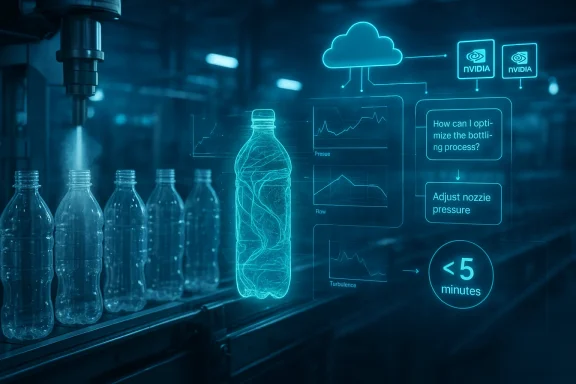
Microsoft, NVIDIA, and Krones are turning a niche engineering concept into a practical manufacturing advantage, and beverage bottling is becoming one of the clearest proof points. The latest reporting shows Krones using AI-powered digital twins to cut complex fluid simulations from three to four hours to under five minutes, a dramatic shift that could change how bottling lines are designed, commissioned, and optimized. What makes this notable is not just speed, but the combination of physics-accurate simulation, cloud-scale compute, and AI-assisted decision-making. In a sector where small errors can mean wasted product, unstable filling, or downstream line disruptions, that matters a great deal.
Digital twins have been discussed for years as the bridge between the physical and virtual worlds, but in manufacturing they only become valuable when they can model real behavior fast enough to influence real decisions. In beverage production, that means capturing how pressure, flow, turbulence, fill level, bottle geometry, and liquid viscosity interact in a live system. Traditional computational fluid dynamics can deliver high fidelity, but the wait time often makes it unsuitable for day-to-day operational changes. Krones’ recent work, built with Microsoft, NVIDIA, Ansys, CADFEM, and SoftServe, suggests that the industry is now crossing the line from static simulation into actionable, near real-time optimization. (investor.synopsys.com)
This is also part of a larger strategic shift. Microsoft’s manufacturing push now emphasizes AI agents, cloud execution, and integrated simulation workflows that can inform operations without replacing human oversight. NVIDIA, for its part, continues to position Omniverse and OpenUSD as the backbone for physically based digital twins and industrial AI. Krones sits at the intersection of both agendas: it is a machinery maker with deep domain expertise, but also a company trying to transform that expertise into a more software-like, service-oriented model. (microsoft.com)
The timing matters too. Microsoft highlighted Krones at Hannover Messe 2026 as an example of “Frontier” manufacturing, while Krones itself said it had been recognized as the overall winner of the Microsoft Intelligent Manufacturing Award 2026 for its agentic digital twin approach. That means this is no longer a speculative pilot. It is now being presented as a reference architecture for a production environment, even if some elements are still described as moving from test validation into scaled deployment. (microsoft.com)
Historically, manufacturers used digital twins mostly for visualization, offline planning, or maintenance forecasting. In the industrial software stack, the twin often stayed far from the live process because the simulations were too slow or too expensive to run repeatedly. The Krones use case shows how the center of gravity has shifted. When a simulation that once took hours now finishes in minutes, the twin can move closer to the rhythm of operations, which makes it useful for scenario comparison, optimization, and engineering collaboration. (investor.synopsys.com)
The beverage sector is particularly sensitive to this change because liquid handling is unforgiving. Minor adjustments to inlet pressure, bottle shape, or fill geometry can affect spillage, foam, throughput, and product loss. Krones says its AI-based fluid simulation helps model those variables in a physically accurate virtual assembly line, enabling better outcomes before changes ever touch the machine. That is a material improvement, not just a prettier dashboard. (investor.synopsys.com)
What has changed in the last year is the ecosystem around the twin. NVIDIA has been pushing OpenUSD-based digital twin workflows, while Microsoft has been marketing cloud, data, and AI integration for industrial environments. Synopsys’ Ansys Fluent and its cloud-accelerated physics stack now sit inside a broader pipeline that connects computation, collaboration, and deployment. The result is a more complete toolchain, where simulation is no longer isolated from AI, browser-based access, or enterprise cloud governance.
The innovation is not just simulation speed; it is workflow compression. A conventional bottling engineering process might involve one team modeling a process, another validating it, and a third implementing changes on the line. With the new system, those steps can be looped together more quickly, which reduces friction between engineering, operations, and R&D. That is why Krones and its partners emphasize decision-making, not just compute performance. (investor.synopsys.com)
A five-minute simulation window also changes the economics of expertise. More engineers and specialists can interact with the model, rather than reserving its use for a small number of high-performance-computing experts. That democratization is one reason Microsoft and Synopsys emphasize expanded accessibility and scenario comparison, because speed alone matters less than the number of people who can act on the output. (investor.synopsys.com)
There is also a sustainability angle. If digital twins can reduce product loss, optimize water usage, and improve throughput, the twin becomes a resource-efficiency tool, not just a productivity tool. Krones has separately argued that AI-enabled digital twins can reduce losses and, in some scenarios, save significant water by analyzing sloshing behavior and improving packaging stability. That is not trivial in beverage manufacturing, where waste, cleaning, and transfer losses all have cost and environmental consequences.
That arrangement matters because industrial AI often fails when one layer is excellent and the others are disconnected. A great solver without scalable compute becomes too slow. A great cloud platform without physics fidelity becomes irrelevant. A great AI interface without domain grounding becomes a usability layer over bad answers. The Krones setup looks notable precisely because the ecosystem is trying to solve all three problems at once. (investor.synopsys.com)
For consumers, the benefits are indirect but still real. Better line efficiency can improve supply reliability, reduce packaging waste, and help manufacturers respond faster to demand changes. In the beverage business, those improvements may never be visible on the bottle, but they shape whether the product is available when and where it is needed. (microsoft.com)
The consumer side also includes sustainability expectations. When a manufacturer can reduce wasted product or water use, the environmental benefit becomes part of the brand equation even if customers do not know the engineering details. That is why these digital twin systems may eventually matter as much to corporate reputation as to operations.
It also strengthens the position of cloud and GPU vendors in manufacturing procurement. Historically, industrial buyers focused on PLCs, controls, and plant software. Now they may evaluate whether a vendor ecosystem can deliver the compute, simulation, and AI orchestration required for next-generation engineering workflows. That broadens the competitive field and makes platform partnerships strategically important. (microsoft.com)
The opportunity extends beyond beverage production. If the architecture works for liquid behavior, similar approaches could support other flow-intensive industries, from food and beverage to chemicals and perhaps even pharmaceutical processing. That scalability is one reason Microsoft and Synopsys are framing the framework as a foundation for verticalized solutions rather than a one-off deployment. (investor.synopsys.com)
There is also a dependency risk. Systems like this rely on cloud infrastructure, GPU availability, physics software, and multiple partner integrations. That can create procurement complexity, vendor lock-in concerns, and long-term maintenance obligations, especially if customers want to run the system across many sites or geographies. (investor.synopsys.com)
It will also be important to watch whether the interface becomes genuinely more accessible. Microsoft’s emphasis on natural-language queries and multi-agent workflows suggests a future in which engineers ask the system what to test rather than manually scripting every scenario. If that user experience holds up in production, the real breakthrough may be as much about usability as about simulation speed. (microsoft.com)
Source: Manufacturing Digital Microsoft, NVIDIA & Krones: AI Improving Beverage Production
 Overview
Digital twins have been discussed for years as the bridge between the physical and virtual worlds, but in manufacturing they only become valuable when they can model real behavior fast enough to influence real decisions. In beverage production, that means capturing how pressure, flow, turbulence, fill level, bottle geometry, and liquid viscosity interact in a live system. Traditional computational fluid dynamics can deliver high fidelity, but the wait time often makes it unsuitable for day-to-day operational changes. Krones’ recent work, built with Microsoft, NVIDIA, Ansys, CADFEM, and SoftServe, suggests that the industry is now crossing the line from static simulation into actionable, near real-time optimization. (investor.synopsys.com)This is also part of a larger strategic shift. Microsoft’s manufacturing push now emphasizes AI agents, cloud execution, and integrated simulation workflows that can inform operations without replacing human oversight. NVIDIA, for its part, continues to position Omniverse and OpenUSD as the backbone for physically based digital twins and industrial AI. Krones sits at the intersection of both agendas: it is a machinery maker with deep domain expertise, but also a company trying to transform that expertise into a more software-like, service-oriented model. (microsoft.com)
The timing matters too. Microsoft highlighted Krones at Hannover Messe 2026 as an example of “Frontier” manufacturing, while Krones itself said it had been recognized as the overall winner of the Microsoft Intelligent Manufacturing Award 2026 for its agentic digital twin approach. That means this is no longer a speculative pilot. It is now being presented as a reference architecture for a production environment, even if some elements are still described as moving from test validation into scaled deployment. (microsoft.com)
Background
Krones is not a software startup experimenting with virtual factories; it is one of the world’s major bottling and packaging line suppliers, with more than 21,000 employees and 2025 sales of EUR 5.66 billion. That scale is important because bottling equipment is sold into highly customized environments, where customers may use different bottle formats, line speeds, liquids, and regulatory constraints. In that kind of business, simulation is not a nice-to-have. It is a competitive weapon that can reduce commissioning time, lower waste, and improve the likelihood that a line performs as promised once it reaches the plant floor. (krones.cn)Historically, manufacturers used digital twins mostly for visualization, offline planning, or maintenance forecasting. In the industrial software stack, the twin often stayed far from the live process because the simulations were too slow or too expensive to run repeatedly. The Krones use case shows how the center of gravity has shifted. When a simulation that once took hours now finishes in minutes, the twin can move closer to the rhythm of operations, which makes it useful for scenario comparison, optimization, and engineering collaboration. (investor.synopsys.com)
The beverage sector is particularly sensitive to this change because liquid handling is unforgiving. Minor adjustments to inlet pressure, bottle shape, or fill geometry can affect spillage, foam, throughput, and product loss. Krones says its AI-based fluid simulation helps model those variables in a physically accurate virtual assembly line, enabling better outcomes before changes ever touch the machine. That is a material improvement, not just a prettier dashboard. (investor.synopsys.com)
What has changed in the last year is the ecosystem around the twin. NVIDIA has been pushing OpenUSD-based digital twin workflows, while Microsoft has been marketing cloud, data, and AI integration for industrial environments. Synopsys’ Ansys Fluent and its cloud-accelerated physics stack now sit inside a broader pipeline that connects computation, collaboration, and deployment. The result is a more complete toolchain, where simulation is no longer isolated from AI, browser-based access, or enterprise cloud governance.
Why bottling is such a hard test case
Bottling lines combine precision mechanics with messy physical behavior. A line may need to move fast, but liquid does not always cooperate at speed, especially when container geometry changes or fill targets vary. That makes the domain a strong benchmark for digital twin credibility because a model must be physically faithful, not merely visually convincing. (investor.synopsys.com)Why the partnership matters
No single vendor owns all the layers required for this kind of system. Microsoft contributes cloud infrastructure and enterprise AI, NVIDIA contributes accelerated compute and Omniverse-based digital twin tooling, and Synopsys brings the physics solver. Krones brings domain knowledge, while CADFEM and SoftServe help tailor and integrate the solution. That division of labor suggests the future of industrial AI is likely to be ecosystem-led, not vertically closed. (investor.synopsys.com)How the Digital Twin Works in Bottling
At a practical level, the twin appears to model a filling line with enough physical fidelity to test how liquid behaves in real conditions. The key variables include bottle shape, liquid viscosity, and fill level, all of which affect whether a bottle fills cleanly or creates waste. Instead of waiting hours for a single answer, engineers can now compare scenarios in minutes and use those outputs to tune machine settings. (investor.synopsys.com)The innovation is not just simulation speed; it is workflow compression. A conventional bottling engineering process might involve one team modeling a process, another validating it, and a third implementing changes on the line. With the new system, those steps can be looped together more quickly, which reduces friction between engineering, operations, and R&D. That is why Krones and its partners emphasize decision-making, not just compute performance. (investor.synopsys.com)
The physics layer
The core of the twin is high-precision fluid simulation. In beverage production, accurate modeling of liquid motion matters because the product is the process, not merely the output. If the fluid model is wrong, all the AI on top of it becomes less useful, because the system is optimizing a fantasy rather than reality. (investor.synopsys.com)The AI layer
The AI does not replace the physics engine; it helps interpret, compare, and optimize the results. Microsoft described the Krones setup as a multi-agent experience, and Krones has framed the newer system as an agentic digital twin. In plain English, that means engineers can query the system in natural language and let software help steer the exploration of possible settings. (microsoft.com)The cloud layer
The simulations run on Microsoft Azure using NVIDIA accelerated computing. That cloud foundation is critical because it makes high-end simulation more scalable and more accessible, reducing dependence on local workstations and specialized hardware. It also fits Microsoft’s broader manufacturing strategy, which is to fuse edge systems, cloud intelligence, and AI agents into a single operating model. (investor.synopsys.com)- Physics-based simulation remains the trust anchor.
- AI helps reduce the search space and speed decisions.
- Cloud execution makes the workflow scalable across teams.
- OpenUSD improves interoperability across tools.
- Browser-accessible twins lower the barrier to collaboration. (investor.synopsys.com)
Why the Speed Gain Matters
Cutting simulation time from hours to minutes sounds impressive, but the real story is what that unlocks operationally. If engineers can test more scenarios in the same working day, they can converge on better settings before a line is commissioned or modified. That lowers iteration cost and reduces the pressure to rely on physical trial-and-error. (investor.synopsys.com)A five-minute simulation window also changes the economics of expertise. More engineers and specialists can interact with the model, rather than reserving its use for a small number of high-performance-computing experts. That democratization is one reason Microsoft and Synopsys emphasize expanded accessibility and scenario comparison, because speed alone matters less than the number of people who can act on the output. (investor.synopsys.com)
There is also a sustainability angle. If digital twins can reduce product loss, optimize water usage, and improve throughput, the twin becomes a resource-efficiency tool, not just a productivity tool. Krones has separately argued that AI-enabled digital twins can reduce losses and, in some scenarios, save significant water by analyzing sloshing behavior and improving packaging stability. That is not trivial in beverage manufacturing, where waste, cleaning, and transfer losses all have cost and environmental consequences.
From offline engineering to live operations
The most consequential shift is the move from offline engineering to decision support near the live line. Microsoft’s manufacturing messaging now explicitly connects AI to optimized operations, maintenance, planning, and risk management. The Krones case fits that pattern, because the twin feeds not just design but process adjustment and operational fine-tuning. (microsoft.com)Why minutes beat hours
A three-to-four-hour simulation may be acceptable in product development, but it is too slow for many iterative factory decisions. When the turnaround drops below five minutes, the feedback loop becomes practical enough to influence day-to-day choices. That changes what “simulation” means in industrial settings: it becomes a live advisory layer, not a periodic report. (investor.synopsys.com)- Faster loops reduce commissioning delays.
- More scenarios can be tested per shift.
- Better optimization can reduce waste.
- Engineering teams can collaborate more easily.
- Small tweaks become economically worthwhile. (investor.synopsys.com)
The Microsoft-NVIDIA-Krones Stack
The partnership is really a stack of complementary capabilities rather than a simple co-branding exercise. Microsoft supplies the cloud and enterprise AI environment, NVIDIA supplies accelerated computing and Omniverse tools, and Synopsys contributes the physics engine through Ansys Fluent. Krones sits above that stack as the operational customer and industrial integrator. (investor.synopsys.com)That arrangement matters because industrial AI often fails when one layer is excellent and the others are disconnected. A great solver without scalable compute becomes too slow. A great cloud platform without physics fidelity becomes irrelevant. A great AI interface without domain grounding becomes a usability layer over bad answers. The Krones setup looks notable precisely because the ecosystem is trying to solve all three problems at once. (investor.synopsys.com)
Microsoft’s role
Microsoft has been positioning Azure as a manufacturing platform for AI, edge infrastructure, quality, maintenance, and forecasting. In that context, Krones is a flagship example of how Azure can support not just analytics but simulation-heavy workloads. Microsoft’s own language around “frontier” manufacturing suggests it wants to be seen as the cloud backbone for industrial transformation, not merely a general-purpose hyperscaler. (microsoft.com)NVIDIA’s role
NVIDIA is advancing the idea that OpenUSD and Omniverse are the foundational layer for digital twins and physical AI. That gives the company a strategic position in industrial workflows, because interoperability and real-time rendering matter as much as raw GPU performance. The Krones example reinforces the argument that NVIDIA is building a platform ecosystem, not just selling chips.Krones’ role
Krones is the proof that industrial domain expertise still matters. The company knows the physics, the equipment, and the customer pain points, which means it can define the problem correctly and validate whether the digital twin actually improves outcomes. In that sense, Krones is not merely adopting digital transformation; it is using it to reshape its business identity. (krones.cn)- Microsoft brings the cloud foundation.
- NVIDIA brings simulation acceleration and digital twin tooling.
- Synopsys/Ansys brings physics accuracy.
- Krones brings bottling-line domain expertise.
- SoftServe and CADFEM help integrate and tailor the system. (investor.synopsys.com)
Enterprise Impact vs Consumer Impact
For enterprises, the biggest value is not spectacle but repeatability. If a digital twin can reliably reduce commissioning time, improve throughput, and lower product loss, it can become part of the capital planning and operations playbook. That is especially attractive in manufacturing categories where margins are tight and uptime matters more than flashy automation narratives. (investor.synopsys.com)For consumers, the benefits are indirect but still real. Better line efficiency can improve supply reliability, reduce packaging waste, and help manufacturers respond faster to demand changes. In the beverage business, those improvements may never be visible on the bottle, but they shape whether the product is available when and where it is needed. (microsoft.com)
The consumer side also includes sustainability expectations. When a manufacturer can reduce wasted product or water use, the environmental benefit becomes part of the brand equation even if customers do not know the engineering details. That is why these digital twin systems may eventually matter as much to corporate reputation as to operations.
Enterprise buyers will care about ROI
Plant managers will ask whether the software reduces scrap, speeds changeovers, or improves yield. Procurement teams will ask whether the platform is scalable, secure, and integrable with existing workflows. The Krones case is compelling because it speaks to all three questions at once: performance, deployment, and business outcome. (investor.synopsys.com)Consumers will care about consistency
End users may never see the twin, but they notice the effects when products are more consistently filled, less likely to leak, and more likely to arrive on time. That is an important reminder that industrial AI often succeeds by making ordinary products less frustrating, not by making them obviously “AI-powered.” That distinction matters. (investor.synopsys.com)- Enterprises gain faster commissioning.
- Enterprises gain better process optimization.
- Consumers gain more reliable product availability.
- Consumers gain from lower waste in the supply chain.
- Brands gain sustainability credibility. (investor.synopsys.com)
Competitive Implications
This partnership raises the bar for other industrial equipment makers. If Krones can offer customers a digitally enabled engineering process alongside the machinery itself, it becomes harder for rivals to compete on hardware alone. The result could be a shift from selling lines and components to selling performance, optimization, and lifecycle support. (microsoft.com)It also strengthens the position of cloud and GPU vendors in manufacturing procurement. Historically, industrial buyers focused on PLCs, controls, and plant software. Now they may evaluate whether a vendor ecosystem can deliver the compute, simulation, and AI orchestration required for next-generation engineering workflows. That broadens the competitive field and makes platform partnerships strategically important. (microsoft.com)
What rivals may do next
Competitors in bottling, packaging, and adjacent process industries will likely respond by building or buying simulation capabilities. Some may partner with alternative industrial software vendors; others may deepen alliances with cloud providers or GPU platforms. The common theme will be the same: reduce the distance between engineering analysis and operational action. (investor.synopsys.com)The broader manufacturing signal
Krones is part of a broader wave that includes factory-scale digital twins, physical AI, and agent-assisted simulation across industries. Microsoft’s Hannover Messe messaging, PepsiCo’s digital twin work with Siemens and NVIDIA, and other industrial announcements all point to the same direction: the market is converging around physics-informed AI systems. The beverage sector may simply be one of the cleanest places to see that trend in action. (microsoft.com)- Rivals will need stronger simulation workflows.
- Cloud partnerships will become more strategic.
- Hardware vendors may bundle software services.
- Industrial AI will increasingly target process optimization.
- Domain expertise will remain a differentiator. (microsoft.com)
Strengths and Opportunities
The strongest feature of this Krones initiative is that it tackles a real manufacturing pain point rather than chasing abstraction. Fast, physically accurate simulation is immediately useful in bottling, and the business case is easy to explain to customers. It also creates a platform for broader service revenue, since Krones can wrap engineering support, optimization, and digital services around its equipment offering. (investor.synopsys.com)The opportunity extends beyond beverage production. If the architecture works for liquid behavior, similar approaches could support other flow-intensive industries, from food and beverage to chemicals and perhaps even pharmaceutical processing. That scalability is one reason Microsoft and Synopsys are framing the framework as a foundation for verticalized solutions rather than a one-off deployment. (investor.synopsys.com)
- Faster commissioning can reduce customer downtime.
- Higher simulation fidelity improves trust in the output.
- Cloud scalability makes the approach deployable at more sites.
- Natural-language interaction lowers the usability barrier.
- Reduced waste can support sustainability claims.
- Service monetization could expand Krones’ business model.
- Cross-industry reuse may create a larger ecosystem. (microsoft.com)
Risks and Concerns
The main risk is overpromising. Even a highly accurate digital twin is still a model, and models can miss edge cases, data quality issues, or unmodeled operational quirks. If customers treat the twin as infallible, they may make decisions that look good in simulation but perform poorly in the real plant. That is the classic digital twin trap. (investor.synopsys.com)There is also a dependency risk. Systems like this rely on cloud infrastructure, GPU availability, physics software, and multiple partner integrations. That can create procurement complexity, vendor lock-in concerns, and long-term maintenance obligations, especially if customers want to run the system across many sites or geographies. (investor.synopsys.com)
- Model fidelity may vary across use cases.
- Integration complexity can slow adoption.
- Cloud and GPU costs may be significant.
- Vendor dependence may worry large manufacturers.
- Data governance and security remain critical.
- Human operators still need training and oversight.
- Scaling from pilot to enterprise can be difficult. (microsoft.com)
Looking Ahead
The next phase will be less about proving that the twin works and more about proving that it scales. Krones and its partners will need to show that the approach can move from validated test environments into repeatable deployments across different product lines and customer plants. If that happens, the bottling example could become a template for broader industrial automation. (krones.cn)It will also be important to watch whether the interface becomes genuinely more accessible. Microsoft’s emphasis on natural-language queries and multi-agent workflows suggests a future in which engineers ask the system what to test rather than manually scripting every scenario. If that user experience holds up in production, the real breakthrough may be as much about usability as about simulation speed. (microsoft.com)
- Expansion beyond one filling line or one customer.
- Evidence of measurable waste reduction.
- Broader adoption of natural-language engineering queries.
- Deeper integration with live plant control systems.
- New service offerings tied to digital twin performance. (microsoft.com)
Source: Manufacturing Digital Microsoft, NVIDIA & Krones: AI Improving Beverage Production
Last edited:
