

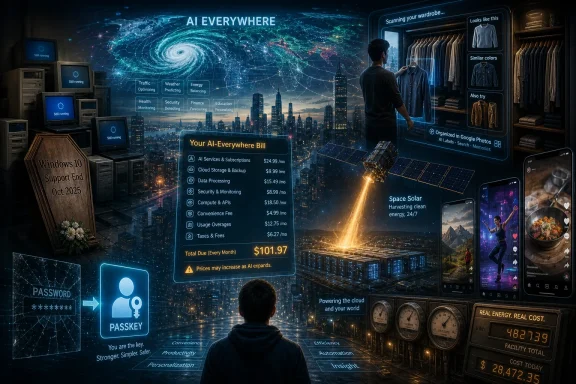
This week’s technology news was dominated by AI’s expanding reach into jobs, phones, photos, cloud infrastructure, operating systems, and energy, while Windows 10’s looming support deadline inspired a symbolic French funeral accusing Microsoft of turning still-usable PCs into electronic waste. The stories look scattered only if you read them as product announcements. Read together, they show the same pressure system moving across the industry: software companies are making bigger promises, shifting more costs onto users, and asking infrastructure to absorb the consequences. The joke is that AI is everywhere; the reality is that everywhere now has a bill.
The old product-launch rhythm was simple enough: a company announced a device, an app, a version number, or a subscription tier, and everyone argued about whether the new thing was better than the old thing. This week’s news had a different shape. AI was not merely a feature inside products; it was the justification for energy deals, layoffs, cloud negotiations, privacy creep, and interface redesigns.
Sam Altman’s latest public reassurance that AI will “augment and elevate” people rather than replace them landed in an environment where many workers no longer hear that as a prediction. They hear it as corporate weather. It may be sunny in the long run, but today’s forecast still includes layoffs, restructuring, and the familiar spectacle of companies praising human creativity while automating the work that used to pay for it.
That tension matters because the AI argument has moved beyond technical capability. The question is no longer whether models can write, summarize, code, generate images, or operate across business tools. The question is who captures the value when they do — the worker, the platform, the cloud provider, the chipmaker, or the company sitting on the pile of human-generated data.
Reddit is one of the cleaner examples. Steve Huffman’s comment that Reddit is “the fuel” for AI bots is blunt in a way the industry often avoids. The platform does not need to build the definitive chatbot to profit from the chatbot era; it needs to own enough human conversation that model builders find it difficult to ignore. In the AI economy, the archive is the mine, the API is the toll booth, and the users are still writing for free.
Windows 10 reaches end of support in October 2025, and Microsoft’s Extended Security Updates program gives some users a paid path to more time. That helps, but it does not answer the deeper objection. Environmental groups see the Windows 11 hardware cutoff not as normal platform hygiene but as a forced acceleration of e-waste, especially for machines that are functionally adequate but fail Microsoft’s security-era hardware requirements.
Microsoft’s defense is not frivolous. Windows 11 was designed around a more modern baseline, including TPM requirements and stronger assumptions about firmware, virtualization-based security, and processor support. In an age of ransomware, firmware attacks, and supply-chain compromise, “it still boots” is not a complete security argument.
But the activists’ critique lands because Microsoft has never been merely another app vendor. Windows defines the practical lifespan of hundreds of millions of PCs. When Redmond changes the floor, the rest of the market feels the tremor: schools, charities, small businesses, local governments, refurbishers, and home users who do not experience an unsupported operating system as an elegant lifecycle milestone. They experience it as a bill.
The Windows 10 funeral also exposes an uncomfortable contradiction in modern computing. The industry markets sustainability, repairability, and carbon goals while tying useful software support to hardware gates that many users cannot negotiate. The result is a PC ecosystem where a machine can be fast enough, clean enough, and paid for — but still treated as a corpse because the support calendar says so.
Samsung has spent years building an ecosystem story around Galaxy phones, tablets, watches, earbuds, and foldables. Windows laptops sit awkwardly inside that story. They can be beautifully designed, well-integrated in places, and technically impressive, but the emotional center of the experience still belongs to Microsoft.
An Android-based Galaxy Book would be an attempt to make the laptop behave more like the rest of Samsung’s hardware family. The upside is obvious: interface consistency, tighter device handoff, shared services, and a cleaner story for consumers already living inside One UI. The downside is just as obvious: the laptop market still runs on desktop-class software expectations, and Android has never fully escaped the shadow of “good tablet OS, compromised PC OS.”
That is why the rumor matters even if the product never ships in the dramatic form being imagined. Windows is no longer the inevitable center of personal computing in the way it was two decades ago. It remains huge, entrenched, and essential, especially in enterprise environments. But phone-first ecosystems have taught consumers to expect continuity across devices, and Microsoft does not fully control that continuity anymore.
The utility is real. Many people already use their camera roll as a memory prosthetic: meals, receipts, parking spots, outfits, pets, hotel rooms, medicine labels, whiteboards, and screenshots of things they do not want to forget. Turning that chaotic archive into something searchable and actionable is exactly the kind of task AI is good at.
The privacy tradeoff is also real. A photo library is not just a folder of images; it is a behavioral map. It records where people go, who they meet, what they buy, what they wear, what they own, what they discard, and sometimes what they would rather not have categorized by a machine. A digital wardrobe sounds harmless because clothes are ordinary, but ordinary things are often the richest data.
Google will likely frame this as convenience, and for many users it will be. The danger is not that Wardrobe is secretly sinister. The danger is that the industry has become very good at turning intimate archives into features before users have fully understood the new category of inference being created.
The app no longer merely stores the photo of you wearing the jacket. It knows the jacket, classifies the jacket, pairs the jacket, and may eventually recommend what to buy when the jacket no longer fits the algorithmic version of your taste. That is not science fiction. That is retail, advertising, and identity management collapsing into the camera roll.
Passkeys are not magic, but they are a structural improvement. They reduce the usefulness of phishing, remove the need for users to invent and remember secrets, and shift authentication toward cryptographic proof bound to devices and accounts. For mainstream users, the best security technology is the one that asks them to do less stupid stuff under pressure.
The problem is that the passkey transition is still messy. Support varies by website, platform, browser, device ecosystem, and recovery flow. A user who lives entirely inside one modern ecosystem may find passkeys delightful. A user juggling old devices, work machines, shared computers, and inconsistent services may find them confusing in a new and exciting way.
That does not make the direction wrong. It means the industry has to resist declaring victory too early. Passwords became universal because they were crude, portable, and conceptually simple. Passkeys will become universal only when they feel less like a platform feature and more like plumbing.
Age verification sounds narrow when framed around adult content, child safety, or platform accountability. But the machinery required to enforce it can become broad very quickly. Once services must verify age, they must either collect sensitive data, rely on third-party identity providers, or build systems that create new records of what people tried to access.
The Open Rights Group’s concern about millions handing over personal data is not abstract. Identity systems tend to expand. A tool introduced for one category of content can become a template for others, especially when lawmakers discover that the infrastructure already exists.
Utah’s approach adds another layer by targeting circumvention through VPNs. That moves the policy fight from “what content should minors access?” to “what privacy tools may adults use without triggering liability?” It is a dangerous migration. VPNs are used for many reasons, including security on hostile networks, evading censorship, and protecting routine browsing from surveillance.
The child-safety argument is emotionally powerful, and platforms have often invited regulation through negligence. But the internet has a long memory for security shortcuts. Build identity checkpoints everywhere, and eventually someone will use them for something beyond the original promise.
There is a reasonable product argument here. Netflix has a discovery problem. Its catalog is vast, its thumbnails are over-optimized, and users often spend more time browsing than watching. Short clips can help people sample tone, cast, jokes, action, and pacing more efficiently than static tiles.
But the larger trend is depressing because it suggests that all media interfaces are converging on the same behavioral loop. Scroll, sample, react, save, repeat. A movie service becomes a short-video service to persuade you to watch long videos, while long videos themselves are increasingly shaped by the grammar of short ones.
Netflix is not alone in this. Spotify, YouTube, Instagram, Amazon, and app stores have all absorbed pieces of the same interface logic. The vertical feed has become the default answer to uncertainty: if users do not know what they want, show them an endless slot machine of possibilities until the algorithm finds a nerve.
The charitable reading is that this is exactly what wealthy technology companies should be doing: underwriting speculative infrastructure that may eventually expand clean energy capacity. If AI is going to consume staggering amounts of electricity, then pushing investment into new generation and storage is better than simply plugging more loads into already strained grids.
The skeptical reading is that the industry has made its appetite so large that even space solar now appears on the menu. Data centers were already controversial when the debate centered on land, water, tax incentives, and grid capacity. AI has intensified that conflict by making future demand feel both enormous and uncertain.
Long-duration storage is the less cinematic but more immediately important half of the story. Solar and wind are useful only to the extent that grids can handle their variability, and storage measured in days rather than hours could reshape how renewable-heavy systems operate. Still, the headline-grabbing orbital component tells us where the conversation has gone: the data center is no longer a building full of servers. It is an energy strategy with a software logo on top.
The uncomfortable point is that AI companies increasingly ask the public to accept enormous infrastructure buildouts on faith. The promised benefits are diffuse: better assistants, faster coding, medical discovery, enterprise productivity, creative tools, and perhaps scientific breakthroughs. The costs are local, physical, and measurable: power lines, substations, water use, land deals, and higher competition for electricity.
An OpenAI phone would not be interesting merely because it has a chatbot. Every phone now has, or soon will have, some version of that. The interesting question is whether OpenAI can design a device where agents are not bolted onto apps but operate as the organizing layer of the experience.
That is a difficult leap. Smartphones are not blank canvases. They are mature, brutally optimized products with entrenched ecosystems, app stores, developer models, carrier relationships, privacy expectations, and consumer habits. Even brilliant hardware can fail if it asks users to abandon too much muscle memory.
The recent AI hardware graveyard should make everyone cautious. Dedicated AI gadgets have struggled because phones are already excellent sensors, screens, microphones, wallets, cameras, and notification hubs. To justify new hardware, OpenAI would need more than novelty. It would need a reason for users to trust an AI-native device with the most personal surface in computing.
The multi-cloud angle is equally important. OpenAI’s amended relationship with Microsoft, allowing broader cloud availability while keeping Azure central, points to a company trying to avoid being perceived as a subsidiary of any one infrastructure empire. If OpenAI wants to sell agents everywhere, it cannot look trapped inside one cloud.
Creative professionals live in toolchains, not chat windows. Adobe, Autodesk, Ableton, Blender, and similar platforms are where work happens. An AI assistant that cannot see the project, understand the asset pipeline, or respect professional context is just a clever intern trapped outside the studio door.
That is why connectors matter. They turn AI from a destination into a layer. The assistant becomes useful not because it has a charming answer box but because it can operate near the files, formats, timelines, and workflows where people already spend their day.
Microsoft’s willingness to bring Anthropic models into parts of Microsoft 365 Copilot is also a hedge against monoculture. OpenAI may remain central to Microsoft’s AI strategy, but enterprise customers increasingly want model diversity for performance, risk, regulatory, and bargaining reasons. The future of office AI may look less like one assistant and more like a routing layer that chooses among models depending on task, cost, and policy.
That could be good for customers if it creates competition. It could also make accountability harder. When a document is rewritten by a productivity suite using a third-party model accessed through a cloud platform under enterprise policy controls, the sentence “the AI did it” becomes less an explanation than a supply-chain diagram.
There is a version of AI on the desktop that could be genuinely useful: local search that understands intent, accessibility tools that adapt to users, system troubleshooting that reads logs without uploading them, development help that respects private code, and administrative assistants that explain configuration without hallucinating destructive commands. That version requires restraint.
There is also a bad version, and users know it. It is the desktop as billboard, telemetry sponge, and cloud upsell surface. Linux users have spent decades choosing their tools partly to avoid that model. If Ubuntu wants AI to feel native rather than invasive, it has to make privacy and control part of the architecture, not just the marketing.
The end of standard Expanded Security Maintenance for Ubuntu 16.04 LTS under Ubuntu Pro is a reminder that Linux has lifecycle pressure too. The difference is cultural as much as technical. Linux users expect old systems to be maintainable, auditable, and in some cases stubbornly alive far beyond the comfort zone of mainstream vendors.
Canonical’s challenge is to modernize without sounding like it has adopted the worst habits of the platforms Linux users left behind. AI can help Ubuntu feel smarter. It can also make it feel less trustworthy if the balance is wrong.
Rufus remains beloved because it solves a real problem without pretending to be a lifestyle platform. Boot media, Windows installation tweaks, Windows To Go fixes, and removal of unwanted bundled apps are not glamorous. They are useful in the direct, sysadmin-approved sense of the word.
ShareX hitting version 20 matters for similar reasons. Screenshot tools are part of the working vocabulary of modern computing. People document bugs, write tutorials, capture receipts, annotate UI problems, and communicate visually because a screenshot often explains what a paragraph cannot.
Intel’s Wi-Fi and Bluetooth driver updates are the kind of news that only sounds boring until your laptop refuses to maintain a stable connection during a meeting. NVIDIA’s driver cadence is similarly mundane and essential. The PC ecosystem is a tower of dazzling abstractions balanced atop firmware, radios, thermal limits, ports, cables, controllers, and drivers that must all cooperate.
That is why hardware reviews still cut through the AI fog. A Thunderbolt 5 dock that ships with a cable unable to deliver the advertised experience is not a philosophical concern; it is a purchasing problem. A rugged SSD enclosure without a convenient latch is not a platform strategy; it is a tiny annoyance repeated every time someone opens the case.
The Steam Deck proved that Valve could make Linux-based PC gaming feel approachable in handheld form. That success gives the company permission to try again in the living room, where the original Steam Machine effort fizzled under the weight of confusing hardware, immature software, and unclear consumer purpose.
This time, the environment is different. Proton is stronger, handheld gaming PCs have normalized console-like PC experiences, and cloud saves plus storefront ecosystems make device switching less painful. But the living room remains unforgiving. Consoles succeed because they hide complexity. PCs succeed because they expose it. Every living-room PC device has to decide which inheritance to betray.
The ROG Xbox Ally and Ally X updates show Microsoft and partners circling the same territory from another direction. Windows handhelds are powerful, flexible, and sometimes awkward. The more Microsoft can make Windows behave like a gaming appliance when needed, the more credible this category becomes.
The winner may not be the device with the most teraflops or the cleverest controller. It may be the one that best understands when to stop reminding users that a PC is underneath.
Source: Neowin 7 Days: Funeral for Windows 10, AI-powered Wardrobe, and solar energy without Sun
 The Week AI Stopped Being a Feature and Became the Weather
The old product-launch rhythm was simple enough: a company announced a device, an app, a version number, or a subscription tier, and everyone argued about whether the new thing was better than the old thing. This week’s news had a different shape. AI was not merely a feature inside products; it was the justification for energy deals, layoffs, cloud negotiations, privacy creep, and interface redesigns.Sam Altman’s latest public reassurance that AI will “augment and elevate” people rather than replace them landed in an environment where many workers no longer hear that as a prediction. They hear it as corporate weather. It may be sunny in the long run, but today’s forecast still includes layoffs, restructuring, and the familiar spectacle of companies praising human creativity while automating the work that used to pay for it.
That tension matters because the AI argument has moved beyond technical capability. The question is no longer whether models can write, summarize, code, generate images, or operate across business tools. The question is who captures the value when they do — the worker, the platform, the cloud provider, the chipmaker, or the company sitting on the pile of human-generated data.
Reddit is one of the cleaner examples. Steve Huffman’s comment that Reddit is “the fuel” for AI bots is blunt in a way the industry often avoids. The platform does not need to build the definitive chatbot to profit from the chatbot era; it needs to own enough human conversation that model builders find it difficult to ignore. In the AI economy, the archive is the mine, the API is the toll booth, and the users are still writing for free.
Windows 10 Gets a Coffin Because the PC Upgrade Cycle Has Become Political
The French protest staging a symbolic funeral for Windows 10 was theatrical, but it was not unserious. A coffin is a blunt prop, and perhaps an irresistible one for photographers, but the complaint underneath it is familiar to anyone who has managed hardware fleets: Microsoft is ending mainstream support for an operating system that still runs acceptably on a vast number of machines.Windows 10 reaches end of support in October 2025, and Microsoft’s Extended Security Updates program gives some users a paid path to more time. That helps, but it does not answer the deeper objection. Environmental groups see the Windows 11 hardware cutoff not as normal platform hygiene but as a forced acceleration of e-waste, especially for machines that are functionally adequate but fail Microsoft’s security-era hardware requirements.
Microsoft’s defense is not frivolous. Windows 11 was designed around a more modern baseline, including TPM requirements and stronger assumptions about firmware, virtualization-based security, and processor support. In an age of ransomware, firmware attacks, and supply-chain compromise, “it still boots” is not a complete security argument.
But the activists’ critique lands because Microsoft has never been merely another app vendor. Windows defines the practical lifespan of hundreds of millions of PCs. When Redmond changes the floor, the rest of the market feels the tremor: schools, charities, small businesses, local governments, refurbishers, and home users who do not experience an unsupported operating system as an elegant lifecycle milestone. They experience it as a bill.
The Windows 10 funeral also exposes an uncomfortable contradiction in modern computing. The industry markets sustainability, repairability, and carbon goals while tying useful software support to hardware gates that many users cannot negotiate. The result is a PC ecosystem where a machine can be fast enough, clean enough, and paid for — but still treated as a corpse because the support calendar says so.
Samsung’s Rumored Android Laptop Dream Is a Warning Shot, Not a Revolution
Reports that Samsung is considering a Galaxy Book future built around Android and One UI rather than Windows should not be mistaken for a guaranteed divorce. Hardware vendors test ideas constantly, and Samsung’s relationship with Microsoft remains commercially significant. Still, the rumor is useful because it captures a strategic frustration every major device maker faces: Windows gives reach, but it also limits identity.Samsung has spent years building an ecosystem story around Galaxy phones, tablets, watches, earbuds, and foldables. Windows laptops sit awkwardly inside that story. They can be beautifully designed, well-integrated in places, and technically impressive, but the emotional center of the experience still belongs to Microsoft.
An Android-based Galaxy Book would be an attempt to make the laptop behave more like the rest of Samsung’s hardware family. The upside is obvious: interface consistency, tighter device handoff, shared services, and a cleaner story for consumers already living inside One UI. The downside is just as obvious: the laptop market still runs on desktop-class software expectations, and Android has never fully escaped the shadow of “good tablet OS, compromised PC OS.”
That is why the rumor matters even if the product never ships in the dramatic form being imagined. Windows is no longer the inevitable center of personal computing in the way it was two decades ago. It remains huge, entrenched, and essential, especially in enterprise environments. But phone-first ecosystems have taught consumers to expect continuity across devices, and Microsoft does not fully control that continuity anymore.
Google Photos Turns the Closet Into a Dataset
Google’s AI-powered Wardrobe feature for Google Photos is clever, plausible, and slightly unnerving in the way the best consumer AI ideas often are. It promises to scan a user’s photo library, identify clothing, assemble a digital closet, and let people mix, match, and virtually try on outfits. It is Clueless by way of cloud computer vision.The utility is real. Many people already use their camera roll as a memory prosthetic: meals, receipts, parking spots, outfits, pets, hotel rooms, medicine labels, whiteboards, and screenshots of things they do not want to forget. Turning that chaotic archive into something searchable and actionable is exactly the kind of task AI is good at.
The privacy tradeoff is also real. A photo library is not just a folder of images; it is a behavioral map. It records where people go, who they meet, what they buy, what they wear, what they own, what they discard, and sometimes what they would rather not have categorized by a machine. A digital wardrobe sounds harmless because clothes are ordinary, but ordinary things are often the richest data.
Google will likely frame this as convenience, and for many users it will be. The danger is not that Wardrobe is secretly sinister. The danger is that the industry has become very good at turning intimate archives into features before users have fully understood the new category of inference being created.
The app no longer merely stores the photo of you wearing the jacket. It knows the jacket, classifies the jacket, pairs the jacket, and may eventually recommend what to buy when the jacket no longer fits the algorithmic version of your taste. That is not science fiction. That is retail, advertising, and identity management collapsing into the camera roll.
The Cloud Wants Your Passwords Gone, but the Replacement Is Still Unevenly Distributed
The UK National Cyber Security Centre’s updated guidance favoring passkeys over passwords is one of the week’s least flashy but most important developments. Passwords have been the weakest ritual in computing for decades: reused, phished, guessed, leaked, reset, and taped under keyboards in offices that otherwise claim to take security seriously.Passkeys are not magic, but they are a structural improvement. They reduce the usefulness of phishing, remove the need for users to invent and remember secrets, and shift authentication toward cryptographic proof bound to devices and accounts. For mainstream users, the best security technology is the one that asks them to do less stupid stuff under pressure.
The problem is that the passkey transition is still messy. Support varies by website, platform, browser, device ecosystem, and recovery flow. A user who lives entirely inside one modern ecosystem may find passkeys delightful. A user juggling old devices, work machines, shared computers, and inconsistent services may find them confusing in a new and exciting way.
That does not make the direction wrong. It means the industry has to resist declaring victory too early. Passwords became universal because they were crude, portable, and conceptually simple. Passkeys will become universal only when they feel less like a platform feature and more like plumbing.
Age Verification Is Becoming the Internet’s New Border Check
The UK’s Children and Schools Wellbeing Bill and Utah’s VPN-adjacent age-verification push belong to the same global pattern: governments are trying to impose age gates on online spaces that were never architected for identity checks at scale. The political motivation is easy to understand. The implementation risk is where the fight begins.Age verification sounds narrow when framed around adult content, child safety, or platform accountability. But the machinery required to enforce it can become broad very quickly. Once services must verify age, they must either collect sensitive data, rely on third-party identity providers, or build systems that create new records of what people tried to access.
The Open Rights Group’s concern about millions handing over personal data is not abstract. Identity systems tend to expand. A tool introduced for one category of content can become a template for others, especially when lawmakers discover that the infrastructure already exists.
Utah’s approach adds another layer by targeting circumvention through VPNs. That moves the policy fight from “what content should minors access?” to “what privacy tools may adults use without triggering liability?” It is a dangerous migration. VPNs are used for many reasons, including security on hostile networks, evading censorship, and protecting routine browsing from surveillance.
The child-safety argument is emotionally powerful, and platforms have often invited regulation through negligence. But the internet has a long memory for security shortcuts. Build identity checkpoints everywhere, and eventually someone will use them for something beyond the original promise.
Netflix Discovers TikTok Because Nobody Escapes the Vertical Feed
Netflix adding a vertical Clips feed to its mobile app is not surprising. It is almost wearyingly inevitable. Every consumer app eventually looks at TikTok and concludes that the problem with its own interface is insufficient thumb hypnosis.There is a reasonable product argument here. Netflix has a discovery problem. Its catalog is vast, its thumbnails are over-optimized, and users often spend more time browsing than watching. Short clips can help people sample tone, cast, jokes, action, and pacing more efficiently than static tiles.
But the larger trend is depressing because it suggests that all media interfaces are converging on the same behavioral loop. Scroll, sample, react, save, repeat. A movie service becomes a short-video service to persuade you to watch long videos, while long videos themselves are increasingly shaped by the grammar of short ones.
Netflix is not alone in this. Spotify, YouTube, Instagram, Amazon, and app stores have all absorbed pieces of the same interface logic. The vertical feed has become the default answer to uncertainty: if users do not know what they want, show them an endless slot machine of possibilities until the algorithm finds a nerve.
Meta’s Space Solar Deal Shows AI Has Outgrown the Data Center Brochure
Meta’s dealmaking around space-based solar power and long-duration energy storage sounds like something from a grant proposal that escaped into a hyperscaler procurement meeting. Satellites in geosynchronous orbit collecting uninterrupted sunlight and beaming energy back to Earth are not normal data-center fare. They are a sign that AI infrastructure demand has pushed Big Tech into stranger territory.The charitable reading is that this is exactly what wealthy technology companies should be doing: underwriting speculative infrastructure that may eventually expand clean energy capacity. If AI is going to consume staggering amounts of electricity, then pushing investment into new generation and storage is better than simply plugging more loads into already strained grids.
The skeptical reading is that the industry has made its appetite so large that even space solar now appears on the menu. Data centers were already controversial when the debate centered on land, water, tax incentives, and grid capacity. AI has intensified that conflict by making future demand feel both enormous and uncertain.
Long-duration storage is the less cinematic but more immediately important half of the story. Solar and wind are useful only to the extent that grids can handle their variability, and storage measured in days rather than hours could reshape how renewable-heavy systems operate. Still, the headline-grabbing orbital component tells us where the conversation has gone: the data center is no longer a building full of servers. It is an energy strategy with a software logo on top.
The uncomfortable point is that AI companies increasingly ask the public to accept enormous infrastructure buildouts on faith. The promised benefits are diffuse: better assistants, faster coding, medical discovery, enterprise productivity, creative tools, and perhaps scientific breakthroughs. The costs are local, physical, and measurable: power lines, substations, water use, land deals, and higher competition for electricity.
OpenAI’s Hardware Ambition Is Really an Ecosystem Ambition
Reports that OpenAI is working on an AI-powered smartphone with major chip and manufacturing partners should be treated carefully, but the strategic logic is obvious. If AI agents become a primary computing interface, the company that controls the device has a major advantage. Apple understood this with the iPhone. Google understood it with Android. Microsoft learned the hard way what happens when you miss the mobile control point.An OpenAI phone would not be interesting merely because it has a chatbot. Every phone now has, or soon will have, some version of that. The interesting question is whether OpenAI can design a device where agents are not bolted onto apps but operate as the organizing layer of the experience.
That is a difficult leap. Smartphones are not blank canvases. They are mature, brutally optimized products with entrenched ecosystems, app stores, developer models, carrier relationships, privacy expectations, and consumer habits. Even brilliant hardware can fail if it asks users to abandon too much muscle memory.
The recent AI hardware graveyard should make everyone cautious. Dedicated AI gadgets have struggled because phones are already excellent sensors, screens, microphones, wallets, cameras, and notification hubs. To justify new hardware, OpenAI would need more than novelty. It would need a reason for users to trust an AI-native device with the most personal surface in computing.
The multi-cloud angle is equally important. OpenAI’s amended relationship with Microsoft, allowing broader cloud availability while keeping Azure central, points to a company trying to avoid being perceived as a subsidiary of any one infrastructure empire. If OpenAI wants to sell agents everywhere, it cannot look trapped inside one cloud.
Anthropic and Microsoft Show the Model War Is Becoming a Procurement War
Anthropic’s Claude for Creative Work and its integration into Microsoft 365 Copilot underline a shift in the AI market. The next phase is not just model-versus-model benchmarking. It is procurement, connectors, compliance, subprocessors, and the quiet politics of which model is allowed to touch which document.Creative professionals live in toolchains, not chat windows. Adobe, Autodesk, Ableton, Blender, and similar platforms are where work happens. An AI assistant that cannot see the project, understand the asset pipeline, or respect professional context is just a clever intern trapped outside the studio door.
That is why connectors matter. They turn AI from a destination into a layer. The assistant becomes useful not because it has a charming answer box but because it can operate near the files, formats, timelines, and workflows where people already spend their day.
Microsoft’s willingness to bring Anthropic models into parts of Microsoft 365 Copilot is also a hedge against monoculture. OpenAI may remain central to Microsoft’s AI strategy, but enterprise customers increasingly want model diversity for performance, risk, regulatory, and bargaining reasons. The future of office AI may look less like one assistant and more like a routing layer that chooses among models depending on task, cost, and policy.
That could be good for customers if it creates competition. It could also make accountability harder. When a document is rewritten by a productivity suite using a third-party model accessed through a cloud platform under enterprise policy controls, the sentence “the AI did it” becomes less an explanation than a supply-chain diagram.
Ubuntu’s Local-First AI Pitch Is the Sensible Version of the Hype
Canonical’s embrace of generative AI in Ubuntu is notable precisely because the company is trying to sound careful. “Local-first” is the phrase that matters. In a Linux context, especially among Ubuntu’s mix of desktop users, developers, and enterprise administrators, AI features that spray context into distant services will meet deserved suspicion.There is a version of AI on the desktop that could be genuinely useful: local search that understands intent, accessibility tools that adapt to users, system troubleshooting that reads logs without uploading them, development help that respects private code, and administrative assistants that explain configuration without hallucinating destructive commands. That version requires restraint.
There is also a bad version, and users know it. It is the desktop as billboard, telemetry sponge, and cloud upsell surface. Linux users have spent decades choosing their tools partly to avoid that model. If Ubuntu wants AI to feel native rather than invasive, it has to make privacy and control part of the architecture, not just the marketing.
The end of standard Expanded Security Maintenance for Ubuntu 16.04 LTS under Ubuntu Pro is a reminder that Linux has lifecycle pressure too. The difference is cultural as much as technical. Linux users expect old systems to be maintainable, auditable, and in some cases stubbornly alive far beyond the comfort zone of mainstream vendors.
Canonical’s challenge is to modernize without sounding like it has adopted the worst habits of the platforms Linux users left behind. AI can help Ubuntu feel smarter. It can also make it feel less trustworthy if the balance is wrong.
Drivers, Utilities, and Docks Still Matter Because Reality Has Ports
The week’s smaller updates — Rufus 4.14, ShareX 20, Intel wireless drivers, NVIDIA’s Game Ready release, Logitech’s Enhanced Easy-Switch, and the usual parade of hardware reviews — are easy to overlook beside space solar and AI phones. They should not be. This is the layer where computing either works or wastes your afternoon.Rufus remains beloved because it solves a real problem without pretending to be a lifestyle platform. Boot media, Windows installation tweaks, Windows To Go fixes, and removal of unwanted bundled apps are not glamorous. They are useful in the direct, sysadmin-approved sense of the word.
ShareX hitting version 20 matters for similar reasons. Screenshot tools are part of the working vocabulary of modern computing. People document bugs, write tutorials, capture receipts, annotate UI problems, and communicate visually because a screenshot often explains what a paragraph cannot.
Intel’s Wi-Fi and Bluetooth driver updates are the kind of news that only sounds boring until your laptop refuses to maintain a stable connection during a meeting. NVIDIA’s driver cadence is similarly mundane and essential. The PC ecosystem is a tower of dazzling abstractions balanced atop firmware, radios, thermal limits, ports, cables, controllers, and drivers that must all cooperate.
That is why hardware reviews still cut through the AI fog. A Thunderbolt 5 dock that ships with a cable unable to deliver the advertised experience is not a philosophical concern; it is a purchasing problem. A rugged SSD enclosure without a convenient latch is not a platform strategy; it is a tiny annoyance repeated every time someone opens the case.
Gaming Hardware Keeps Chasing the Living Room That PCs Never Fully Won
Valve’s second-generation Steam Controller timing, the continuing hints around Steam Machine and Steam Frame, and ASUS’s ROG Xbox Ally updates all point at the same old dream: PC gaming without the PC gaming furniture. The industry has been trying to civilize the couch PC for years, and it keeps getting closer without fully closing the gap.The Steam Deck proved that Valve could make Linux-based PC gaming feel approachable in handheld form. That success gives the company permission to try again in the living room, where the original Steam Machine effort fizzled under the weight of confusing hardware, immature software, and unclear consumer purpose.
This time, the environment is different. Proton is stronger, handheld gaming PCs have normalized console-like PC experiences, and cloud saves plus storefront ecosystems make device switching less painful. But the living room remains unforgiving. Consoles succeed because they hide complexity. PCs succeed because they expose it. Every living-room PC device has to decide which inheritance to betray.
The ROG Xbox Ally and Ally X updates show Microsoft and partners circling the same territory from another direction. Windows handhelds are powerful, flexible, and sometimes awkward. The more Microsoft can make Windows behave like a gaming appliance when needed, the more credible this category becomes.
The winner may not be the device with the most teraflops or the cleverest controller. It may be the one that best understands when to stop reminding users that a PC is underneath.
The Week’s Signal Is Buried in the Absurdity
The temptation with a roundup like this is to treat it as a carnival: Windows funerals, AI closets, solar satellites, TikTok Netflix, OpenAI phones, Ubuntu copilots, and gaming controllers tumbling past in a caffeinated blur. But the absurdity is the signal. The industry is no longer arguing about whether AI will be added to existing products; it is reorganizing hardware, energy, identity, labor, and operating-system strategy around the assumption that it will.- Windows 10’s funeral in France turned a support deadline into a public argument about e-waste, security baselines, and who pays when software moves on.
- Google Photos’ Wardrobe feature shows how consumer AI will mine private archives for convenience, turning ordinary memories into structured personal data.
- Meta’s space-solar ambitions make clear that AI infrastructure is now an energy problem as much as a software problem.
- Passkeys are becoming the preferred replacement for passwords, but the transition will succeed only if recovery and cross-platform use become less confusing.
- Age-verification laws are expanding from child-safety debates into broader fights over privacy, identity, and the legitimacy of circumvention tools.
- OpenAI, Anthropic, Microsoft, Canonical, and Samsung all point toward a computing market where model choice, ecosystem control, and local trust matter as much as raw features.
Source: Neowin 7 Days: Funeral for Windows 10, AI-powered Wardrobe, and solar energy without Sun
