

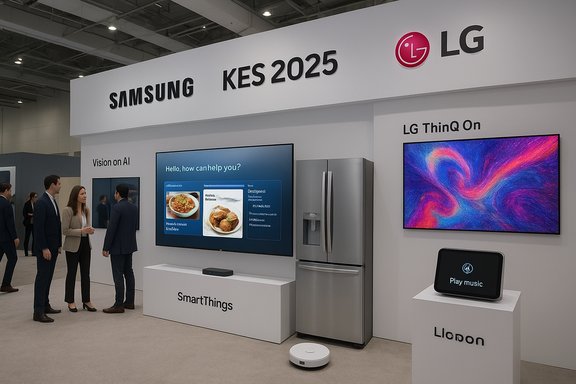
The Korea Electronics Show (KES 2025) opened at COEX in Seoul with an unmistakable message: the next wave of consumer electronics is less about singular gadgets and more about AI-first living spaces where TVs, appliances, phones and signage act together as an ambient intelligence layer that helps run daily life. Samsung and LG — long rivals in displays and home appliances — used their KES show floors to turn that message into concrete demos, from Samsung’s Vision AI Companion and Micro RGB display concepts to LG’s ThinQ On home hub, generative “Kinetic LED” signage and new cleaning and bathroom appliance concepts.
KES bills itself as the Korean counterpart to CES, and this year it doubled as a showcase for how South Korea’s two biggest consumer-electronics exporters plan to militarize AI across everyday product categories. Both companies framed their exhibits around the same promise: make AI useful in the places people actually live, learn and shop — not just on phones or in cloud apps. Samsung foregrounded Vision AI Companion and a new family of display technologies to position the TV as the central AI surface for the household. LG presented a large “LG AI Gallery” built around LG ThinQ On — an integrated AI home hub — plus a suite of appliances and novel form factors that demonstrate AI-driven automation and personalization. These shows are significant not because they debuted purely revolutionary hardware, but because they stitch together device-level features, edge AI, cloud agents and home-automation routines into coherent, demonstrable user scenarios: cooking with a fridge that recognizes ingredients, a TV that answers contextual questions, or a laundry system that adjusts based on room conditions. That systems-level framing is the main news: both vendors are selling an ecosystem, not just a device.
Why this matters: for buyers who want very large rooms, high sustained brightness and accurate color without the price/size limitations of true microLED walls, Micro RGB attempts a middle path. For display nerds, the headline points are granular local dimming, claims of wide color coverage and gaming features (high refresh rates and VRR). But those claims should be judged against independent reviews once shipping models are available.
Two broader trends to watch:
For consumers and IT-minded buyers, the smart move is pragmatic curiosity: test the experiences in person, verify vendor support policies, and be explicit about privacy settings. These technologies can reduce small daily frictions in meaningful ways, but they require deliberate setup and informed consent to deliver value without unintended costs.
Source: 매일경제 The Korea Electronics Show (KES 2025), dubbed the "Korean version of CES," opened at COEX in Seoul o.. - MK
 Background / Overview
KES bills itself as the Korean counterpart to CES, and this year it doubled as a showcase for how South Korea’s two biggest consumer-electronics exporters plan to militarize AI across everyday product categories. Both companies framed their exhibits around the same promise: make AI useful in the places people actually live, learn and shop — not just on phones or in cloud apps. Samsung foregrounded Vision AI Companion and a new family of display technologies to position the TV as the central AI surface for the household. LG presented a large “LG AI Gallery” built around LG ThinQ On — an integrated AI home hub — plus a suite of appliances and novel form factors that demonstrate AI-driven automation and personalization. These shows are significant not because they debuted purely revolutionary hardware, but because they stitch together device-level features, edge AI, cloud agents and home-automation routines into coherent, demonstrable user scenarios: cooking with a fridge that recognizes ingredients, a TV that answers contextual questions, or a laundry system that adjusts based on room conditions. That systems-level framing is the main news: both vendors are selling an ecosystem, not just a device.Samsung at KES 2025: Vision AI Companion, Micro RGB and the AI Home
Vision AI Companion — TV as the ambient assistant
Samsung’s marquee at KES emphasized Vision AI Companion, a unified on‑screen assistant that blends local perceptual features (object/actor recognition, live subtitle translation and AI-driven picture/sound tuning) with cloud-based conversational agents such as Microsoft Copilot and other partners. The company framed the TV as an “ambient console” that answers follow-up questions, controls SmartThings devices and surfaces contextual cards for cast, recipes or shopping. Key customer-facing features demonstrated at KES included:- Natural language Q&A and multi-turn conversations from the couch.
- Click-to-Search / object recognition: identify an on-screen item and get instant context or purchase options.
- Live Translate and improved accessibility captions.
- Integration with SmartThings to trigger automations (e.g., set house modes or check camera feeds).
Micro RGB: a new backlight approach, not microLED per se
Samsung also showcased a new premium picture engine called Micro RGB: an array of tiny red/green/blue diodes placed behind an LCD panel that promises much finer color control than white mini‑LED backlights. The company positions Micro RGB to narrow the gap between large, bright LCD screens and self‑emissive technologies (OLED, microLED) by improving color fidelity and HDR precision at very large sizes. Importantly, Micro RGB is still a backlit LCD architecture — not a self‑emissive microLED tile — and that distinction carries technical tradeoffs around absolute black level and local dimming behavior.Why this matters: for buyers who want very large rooms, high sustained brightness and accurate color without the price/size limitations of true microLED walls, Micro RGB attempts a middle path. For display nerds, the headline points are granular local dimming, claims of wide color coverage and gaming features (high refresh rates and VRR). But those claims should be judged against independent reviews once shipping models are available.
AI Home: SmartThings automation, AI Vision Inside and energy savings
Samsung’s “AI Home” zone highlighted how SmartThings acts as the connective tissue:- SmartThings Automation Routine demos showed air conditioners and robot vacuums responding to presence and context.
- AI Vision Inside for refrigerators recognized ingredients and suggested recipes.
- AI Saving Mode promised measurable energy reductions by optimizing appliance behavior based on usage patterns. Samsung’s product pages and SmartThings documentation describe AI energy optimization modes that can reduce consumption by adapting temperatures and cycles, though real‑world savings vary by model and use case.
Galaxy AI Class: Z Flip 7 / Z Fold 7 demos
Samsung used the event to show how the latest Galaxy foldables integrate with this living ecosystem: the Galaxy Z Flip 7 and Z Fold 7 were demonstrated running generative editing, Gemini Live and other One UI 8 features that offload some AI tasks to cloud services while keeping latency-sensitive interactions on device. These phones are part of Samsung’s wider strategy to have continuity between mobile and TV experiences — screen sharing, synchronized Copilot contexts and quick device handoffs. Hardware specs and launch details for the foldables have been covered by major outlets and Samsung’s own announcements.Commercial displays and signage: Samsung VXT, Color E‑paper and The Moving Style
Samsung exhibited a range of commercial and retail-oriented displays at KES:- Samsung VXT — a digital signage platform aimed at retail and experiential installations.
- Color E‑paper — ultra‑low power displays suitable for price tags, signage and information panels.
- The Moving Style — a mobile screen/form-factor concept that blurs wearable and portable display use cases for retail/brand experiences.
LG at KES 2025: ThinQ On, AI Gallery and category creativity
LG AI Gallery and the ThinQ On home hub
LG presented a large LG AI Gallery under the theme “Applicationate Intelligence,” centered on LG ThinQ On — an integrated AI home hub that acts as the voice and orchestration layer for LG appliances and third‑party IoT. The company staged an eye‑catching Kinetic LED installation that converted selfies into generative pop-art, showcasing how signage can mix generative AI and motion design. ThinQ On demo highlights:- Voice-activated scene modes (“Hi LG, run outing mode”) that sequence lights, appliances and pet settings.
- Profile-aware automations that change HVAC and device behavior based on who’s home.
- Visual interfaces that unify appliance controls and content playback in a single hub.
New appliances and robots: Hidden Station, Objet Station, Whisen and more
LG used KES to surface multiple in‑market and near‑market appliance concepts:- An AI‑enhanced laundry/drying system with an AI DD motor and smart sensing functions.
- LG Whisen smart HVAC that adjusts airflow by recognizing room temperature and occupant location.
- Two types of cleaning robots: the built‑in Hidden Station (a docked solution) and a free‑standing Objet Station for the first time on the Korean show floor.
- Novel products like LG Bath Air System (bathroom air circulation solution) and LG Moodmate — a 3‑in‑1 smart projector/lighting/ambience device.
Radio Optimism and participatory brand experiences
LG also used the trade show to promote its global Radio Optimism campaign — a music-led brand platform that integrates generative audio creation tools for visitors, asking them to create bespoke tracks aligned to the “Life’s Good” message. This is a clear example of marketing mixing with product demos to generate participatory content and social buzz.Technical and UX analysis: what’s genuinely new — and what’s marketing
The meaningful innovations
- System-level integration: Both vendors moved beyond device demos to show how multiple devices and services can work as an integrated AI home. That systems framing is the step most distributors and integrators have waited for.
- TV-as‑platform: Embedding cloud agents (Microsoft Copilot) inside TV UIs transforms the television into a household interface that supports multi-turn dialog and continuity with mobile devices. This is more than a novelty — it’s a legitimate shift in interface paradigm.
- New display engineering: Micro RGB represents a meaningful engineering attempt to improve color granularity at large sizes, and LG’s wireless video advances (wireless 4K/144Hz in the M5 family) push form-factor flexibility. These are real technical advances, not marketing slogans — though real-world performance must be validated in independent labs.
Where caution and skepticism are warranted
- Vendor claims around energy savings and “AI modes” often rely on controlled internal testing and assumptions about user behavior. Expect variation in real homes; the published numbers should be considered indicative, not guaranteed. Samsung’s AI Saving Mode documentation explicitly notes that savings depend on usage patterns and that activation requires user consent and monitoring.
- Generative features and multi-agent UIs can confuse less tech-savvy users. Too many overlapping assistants (Bixby, Copilot, third-party agents) on the same screen risks fragmenting the user experience unless intelligently orchestrated by the platform.
- Micro‑RGB is not a magic bullet: while it enhances color control, it remains a backlit approach and therefore cannot fully replicate the pixel-perfect black levels of self‑emissive panels. Marketing language often blurs that detail; buyers should test models in person.
Privacy, security and interoperability: hard tradeoffs
Data flows and account linkages
These demos work because devices collect and share contextual signals: presence, voice, image snapshots and usage telemetry. Vendors say much processing happens locally, with optional cloud sign‑ins unlocking personalization and cross‑device memory. Still, the practical effect is that users may need to link Microsoft, Samsung or LG accounts to enable the full suite of conveniences, which creates concentration points for identity-based risks. The vendor documentation and industry coverage emphasize single‑sign‑on QR workflows for low-friction setup, but those same conveniences make credential hygiene and account protection critical.Attack surface: appliances with screens
Adding screens, full OS stacks and third‑party agents to fridges, ovens and washers expands the attack surface. Samsung has publicly extended its Knox security story into appliances and promised longer software support windows for connected devices; that commitment is positive, but it also requires rigorous update processes and transparency about vulnerability disclosures. If routine updates falter, the stabilized home ecosystem could become a long‑lived vector for compromise.Privacy trade-offs
- Voice and vision features raise clear privacy questions: are microphone activations recorded? Where are image/ingredient recognitions routed for processing? Both vendors state that local-first processing is preferred for latency-sensitive tasks, but actual telemetry policies and retention windows are vendor-defined and require scrutiny. Consumers concerned about privacy should review account settings, local processing toggles and the scope of cloud permissions during setup.
Consumer impact: who benefits, and who should hold off
Winners
- Households seeking convenience: Families and busy professionals who value automated routines (pet comfort when out, optimized laundry/dryer cycles, fridge-based recipe suggestions) will find immediate, tangible benefits from these integrations.
- Early adopters and enthusiasts: Tech-savvy buyers who already use Samsung or LG ecosystems will appreciate continuity and the cross-device AI experiences.
- Businesses and retailers: Generative signage and low‑power color e‑paper open low-cost, dynamic content solutions for stores and hospitality.
Those who should be cautious
- Privacy-first users: If you prefer minimal cloud linkages, many of the headline features (personalized memory, cross-device continuity and Copilot agents) will be less useful unless you accept account linkages.
- Buyers who favor long-term value over first-wave features: Initial kernels of functionality may improve significantly via software updates; those on tight budgets might wait for broader rollouts and independent reviews rather than being first in line.
Practical takeaways and buying checklist
If you’re planning a purchase or smart-home upgrade in the next 12 months, consider the following practical checklist:- Confirm software support and update commitments (years of updates, patch cadence).
- Evaluate which ecosystems you already use (Samsung SmartThings, LG ThinQ, Microsoft account) and prioritize devices that minimize new account fragmentation.
- Test the human factors: try the voice interface, check how assistants handle follow-ups, and assess whether the AI-driven automations are intuitive in real-life scenarios.
- Review privacy settings: can processing be restricted to local-only? How are images and voice data stored or deleted?
- Validate energy-saving claims with independent reviews and, where possible, run vendor demo modes in realistic home conditions rather than showroom demos.
Broader industry implications
KES 2025 reinforced a clear industry trajectory: consumer electronics are transitioning from single-purpose devices into an ambient intelligence layer that blends local sensing with cloud reasoning. This shift benefits vendors that can control experience continuity across multiple categories — Samsung and LG naturally lead in Korea because they sell both displays and appliances at scale.Two broader trends to watch:
- AI Everywhere, Federated: The most useful experiences will combine local, low-latency AI with cloud reasoning and third‑party agents. Hybrid architectures and robust identity models will be essential.
- Ecosystem competition shifts: Partnerships with major cloud AI providers (e.g., Microsoft Copilot) reshape the competitive map — expect more deals that place a cloud assistant into home surfaces. That raises competition questions around data portability, lock-in and cross-platform standards.
Conclusion
KES 2025 offered a practical preview of the AI-first home: televisions that answer context-rich questions and trigger routines, fridges that suggest recipes, washers that tune themselves and signage that becomes generative art. Samsung’s Vision AI Companion and Micro RGB hardware, and LG’s ThinQ On and appliance concepts, demonstrate complementary strategies toward the same goal: make everyday life easier through systems-level AI. Those demonstrations are more than hype when they are demonstrably integrated into an ecosystem — but they come with real tradeoffs in privacy, complexity and security.For consumers and IT-minded buyers, the smart move is pragmatic curiosity: test the experiences in person, verify vendor support policies, and be explicit about privacy settings. These technologies can reduce small daily frictions in meaningful ways, but they require deliberate setup and informed consent to deliver value without unintended costs.
Source: 매일경제 The Korea Electronics Show (KES 2025), dubbed the "Korean version of CES," opened at COEX in Seoul o.. - MK
