

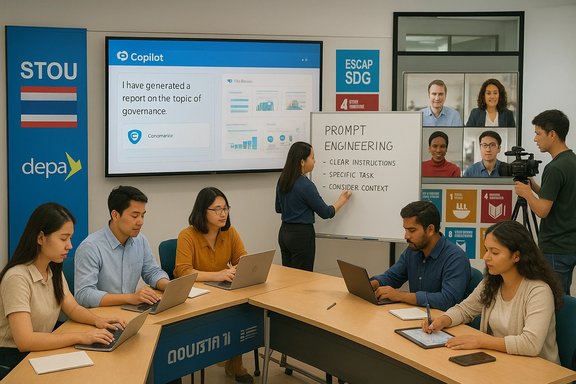
Microsoft Thailand’s new “AI for Social Impact” training, run with the United Nations Economic and Social Commission for Asia and the Pacific (ESCAP), the Collaborative Center for Digital Development Knowledge Management (CCDKM) at Sukhothai Thammathirat Open University (STOU) and the Digital Economy Promotion Agency (depa), is an ambitious, vendor-led attempt to put generative AI tools and prompt engineering into the hands of civil-society leaders and practitioners — a program that promises practical productivity gains while raising urgent questions about governance, sustainability and data protection.
The program is positioned as part of Microsoft’s broader regional skilling agenda and local “Elevate” efforts to accelerate AI adoption across education, government and social sectors. Microsoft developed the curriculum, supplied access to Microsoft Copilot and related productivity tools, and partnered with ESCAP to bring a regional development frame to the initiative; CCDKM and STOU serve as the academic and operational bridges to the social sector, while depa provides national-level policy and outreach support.
Training dates and delivery: the initiative is scheduled as a continuous run of on-site and online sessions from November 2025 through March 2026, with modular workshops covering Generative AI basics, systematic prompt engineering, Copilot workflows for data handling, content creation and field-data analysis. The public-facing launch events and early cohorts were run in late 2025 and feature hands-on sessions and follow-on self-paced materials.
At scale, this activity sits within a suite of Microsoft commitments in Thailand — including teacher- and workforce-focused programs and a national THAI Academy effort — that aim to deliver mass AI literacy and role-based skilling to hundreds of thousands or even millions of learners across sectors. Those broader programs frame the social-impact training as one targeted track among many.
To convert promise into durable change, civil-society leaders, funders and program designers should insist on transparent impact metrics, robust data safeguards, vendor-agnostic literacy modules and a commitment to long-term mentoring and infrastructure support. With those guardrails in place, the initiative can become a model for how targeted AI skilling helps social-sector organizations do more, better, and more responsibly — not simply adopt new tools, but strengthen the systems that make their social missions sustainable.
Source: Microsoft Source AI for Social Impact: Microsoft, ESCAP, CCDKM, STOU & depa Advance AI Skills Training to Empower Civil Society and Support Sustainable Digital Growth - Source Asia
 Background / Overview
The program is positioned as part of Microsoft’s broader regional skilling agenda and local “Elevate” efforts to accelerate AI adoption across education, government and social sectors. Microsoft developed the curriculum, supplied access to Microsoft Copilot and related productivity tools, and partnered with ESCAP to bring a regional development frame to the initiative; CCDKM and STOU serve as the academic and operational bridges to the social sector, while depa provides national-level policy and outreach support.Training dates and delivery: the initiative is scheduled as a continuous run of on-site and online sessions from November 2025 through March 2026, with modular workshops covering Generative AI basics, systematic prompt engineering, Copilot workflows for data handling, content creation and field-data analysis. The public-facing launch events and early cohorts were run in late 2025 and feature hands-on sessions and follow-on self-paced materials.
At scale, this activity sits within a suite of Microsoft commitments in Thailand — including teacher- and workforce-focused programs and a national THAI Academy effort — that aim to deliver mass AI literacy and role-based skilling to hundreds of thousands or even millions of learners across sectors. Those broader programs frame the social-impact training as one targeted track among many.
What the program offers: curriculum, tools and delivery model
Core curriculum pillars
- Generative AI fundamentals: conceptual grounding in what generative models can and cannot do, plus ethical considerations.
- Prompt engineering: structured methods for crafting prompts to achieve repeatable, verifiable outputs.
- Microsoft Copilot workflows: hands-on use cases for Copilot to accelerate writing, reporting, presentation design and exploratory data work.
- Social-media and campaign content: writing social posts, scripting short videos, campaign ideation and planning with AI assistance.
- Field-data organization and analysis: using AI to clean, synthesize and prioritize qualitative and quantitative field inputs.
Tools and platforms
- Microsoft Copilot and Microsoft 365 productivity stack are central to applied workshops — the curriculum emphasizes live demonstrations of Copilot for drafting, summarizing and ideation. This is consistent with Microsoft’s regional approach to couple skilling with tool access so learners can immediately test new workflows.
- AI Skills Navigator / THAI Academy resources: participants are pointed to the AI Skills Navigator and associated self-study portals for ongoing learning; Microsoft has publicly highlighted “over 200” Thai-language AI courses in its learning stack, while some affiliated program materials cite higher adaptation counts (e.g., 280+), suggesting active localization and periodic updates. Readers should note this range when assessing training depth and breadth.
Partners and roles
- Microsoft Thailand: curriculum development, platform access, trainers and facilitation.
- ESCAP: regional policy framing and alignment with Sustainable Development Goals to ensure the program’s outcomes support inclusive growth objectives.
- CCDKM & STOU: logistical host, knowledge transfer hub and academic validation in the social sector.
- depa: government outreach, national skills coordination and public-sector integration support.
Verifying the claims: what we can confirm (and what needs care)
- The program’s multi-partner structure and launch events are publicly documented across Microsoft and partner communications, and local academic partners have posted launch coverage describing workshops and stakeholder participation.
- The training window (November 2025 — March 2026) and the mix of on‑site plus online delivery are consistently stated in official materials.
- Microsoft’s role in providing Copilot-based training and the pedagogical emphasis on prompt engineering and content-production workflows is explicitly part of the curriculum description. That alignment between tool and curriculum is characteristic of Microsoft’s regional skilling playbook.
- Claims around catalog size and localization show variance: Microsoft communications mention “over 200” Thai-language AI courses while other program summaries and partner briefings refer to numbers near 280. This discrepancy likely reflects different counts (e.g., core courses vs. all adapted modules) and active localization; it should be treated as a near-term reporting inconsistency rather than a fundamental contradiction, and program participants should validate which specific modules are available for civil-society use at the time of enrollment.
- High-level objectives — freeing worker time, improving reporting and outreach, and contributing to SDG progress — are aspirational but grounded in realistic, short-term productivity outcomes when training is paired with immediate access to productivity tools. Independent, longitudinal evaluation of sustained organizational impact is not yet publicly available and should be considered an important next step.
Strengths: why this could matter for civil society
- Practical, role-based learning: the program focuses on concrete, repeatable tasks (grant writing, reports, social media content), making outcomes easy to translate into day‑to‑day productivity gains. Early Microsoft case examples from neighboring projects show time savings and higher output quality when staff apply Copilot-style assistants to routine documentation.
- Partnership model that spans academia, government and development bodies: CCDKM and STOU provide credible academic grounding and a venue for field-testing curricula, while ESCAP brings an SDG lens and regional legitimacy that can help scale best practices beyond Thailand’s borders.
- Language and localization focus: delivering Thai-language modules and locally contextualized exercises lowers the barrier to entry for community organizations that lack English fluency — an important equity consideration for national reach.
- Access to modern productivity tools: pairing training with Copilot access enables immediate experimentation. When learners can apply new skills on the same day, adoption and retention rates typically improve compared with purely theoretical skilling.
- Alignment with national digital strategies: integrating depa and government channels increases the chance that civil-society adoption is recognized and supported within wider public-sector modernization programs.
Risks and limitations: the trade-offs civil society must manage
1) Vendor dependency and potential lock-in
Training that is tightly coupled to one vendor’s toolset — here, Microsoft Copilot — can accelerate adoption but risks creating long-term operational dependencies. Civil-society organizations may see rapid short-term gains, but should weigh procurement choices, interoperability and the ability to switch tools if necessary. Programs should include vendor-agnostic modules (e.g., fundamentals of model limitations, data lifecycle concepts) so organizations retain governance flexibility.2) Data protection, privacy and consent
Using cloud-based assistants and productivity AI in the nonprofit context raises specific concerns about beneficiary data: what is uploaded, what is logged, and how long data is retained. Workshops must include mandatory data-classification, anonymization best practices and local legal compliance checks before field data is processed with external AI services. Absent strong safeguards, organizations risk exposing sensitive beneficiary information.3) Metrics and impact measurement
Certificates and completion counts are useful outputs, but they are not substitutes for verified program outcomes. Donors and leaders should insist on measurable KPIs: time saved on repeat tasks, improved beneficiary reach, increased fundraising conversion rates, or error reductions in reporting. Programs without a defined 3/6/12‑month impact-review cadence can produce optimistic but unsupported claims of benefit.4) Digital divide and resource constraints
Civil-society groups in rural or underserved areas may lack reliable broadband, devices or IT support to practice what they learn. Training that is not coupled with hardware access plans or low‑connectivity options risks widening capability gaps between urban and rural NGOs. Program designers should plan for offline-friendly curricula and lightweight toolchains when possible.5) Sustainability and institutional adoption
Short workshops can change individual capacity but rarely embed new workflows into organizational processes. Without allocated time, sponsor buy-in, and follow-on mentorship or “AI champion” networks within NGOs, skills can fade and pilots can stall. A durable plan requires on-the-job projects, mentor cohorts, and policy changes that allow staff to apply AI responsibly.Practical guidance for civil-society organizations participating in the program
- Map high-frequency tasks where AI can reduce time drain (e.g., recurring reports, donor proposals, monitoring summaries). Prioritize 2–3 use cases per team to pilot with Copilot.
- Establish a data-classification checklist before uploading any field data to cloud tools: personally identifiable information (PII), sensitive health details, and similar records should be anonymized or kept out of external tools. Make these rules non-negotiable.
- Create a vendor-agnostic training module that explains generative AI limitations, hallucination risk, and verification methods — so staff can validate outputs regardless of software vendor.
- Define measurable KPIs for each pilot (time saved per task, increased outreach messages produced, error rate reduction) and schedule 3/6/12-month evaluations to capture sustained benefit.
- Designate AI champions who will receive advanced support and act as internal trainers and governance focal points. These champions help sustain skills beyond the course window.
- Negotiate data and access terms with vendors or training partners where possible: seek clarity on data residency, logging and access controls for organizational accounts. If a formal Data Processing Agreement (DPA) is not available, be cautious about high-risk data use.
Policy, evaluation and governance: what funders and partners should demand
- Transparent reporting: public programs should publish the methodology behind participation and completion counts, the distinction between sign-ups and certified completions, and concrete impact case studies. This reduces the risk of inflated metrics being misinterpreted as impact.
- Vendor-agnostic governance curriculum: include modules on procurement, ethical AI principles, and open standards to balance tool-specific training; build procurement roadmaps that evaluate alternatives and total cost of ownership.
- Local infrastructure investments: align training with national efforts to expand devices and connectivity; training without hardware and connectivity plans will limit equitable outcomes.
- Independent evaluation: funders should commission third-party evaluations that measure real-world outcomes (e.g., saved staff hours, improved beneficiary outcomes, cost efficiencies) rather than relying solely on completion certificates.
Cross-regional implications and ESCAP’s role
ESCAP’s involvement brings a deliberate development frame: the commission’s mandate and convening power can help translate local lessons into regional best practices for civil society adoption of AI, and supports alignment with Sustainable Development Goals such as quality education and reduced inequality. This regional dimension is important because civil-society organizations often replicate models across borders; lessons learned in Thailand can inform programs across Southeast Asia. However, ESCAP’s role is facilitative rather than operational — they provide standards and policy alignment more than day-to-day program delivery.A realistic outlook: what success will look like
Successful outcomes for the “AI for Social Impact” program will be concrete, evidence-based and reproducible:- Short term: civil-society teams report measurable time savings for routine tasks, improved quality in fundraising and communications, and initial pilots that demonstrate reduced administrative burden.
- Medium term: trained staff integrate AI into regular workflows with governance checklists in place, and organizations publish case studies showing improved beneficiary outcomes or increased operational capacity.
- Long term: the program supports a sustainable skilling pipeline, with national partners embedding AI fluency into sectoral training and independent evaluations showing net positive social return on investment. This requires ongoing funding, mentor networks and measurable KPIs tracked beyond certificate counts.
Conclusion
“AI for Social Impact” represents a timely opportunity for Thailand’s civil society to harness productivity-enhancing AI tools and build prompt-engineering skills that can free up human capacity for mission-critical work. The program’s strengths are its practical focus, multi-stakeholder partnerships and localized learning pathway. However, real value will depend on how well partners address data governance, avoid vendor lock-in, measure real operational impact and close hardware and connectivity gaps that limit equitable access.To convert promise into durable change, civil-society leaders, funders and program designers should insist on transparent impact metrics, robust data safeguards, vendor-agnostic literacy modules and a commitment to long-term mentoring and infrastructure support. With those guardrails in place, the initiative can become a model for how targeted AI skilling helps social-sector organizations do more, better, and more responsibly — not simply adopt new tools, but strengthen the systems that make their social missions sustainable.
Source: Microsoft Source AI for Social Impact: Microsoft, ESCAP, CCDKM, STOU & depa Advance AI Skills Training to Empower Civil Society and Support Sustainable Digital Growth - Source Asia
