
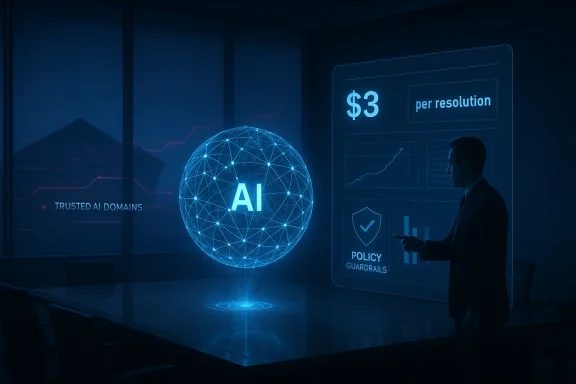
The U.S. government’s tug-of-war with Anthropic, a new class of malware tradecraft that weaponizes web-capable AI assistants, and a blunt forecast from Gartner that generative AI may cost more than the human agents it was supposed to replace together mark a turning point: AI is now a cross-cutting governance problem that touches national security, enterprise security operations, procurement, and the economics of customer experience. Over the past month these three developments — the Pentagon pressing Anthropic to relax Claude’s ethical limits, Check Point Research demonstrating how Grok and Microsoft Copilot can be abused as covert command-and-control relays, and Gartner’s prediction that GenAI cost-per-resolution will top $3 by 2030 — have forced a re-think in boardrooms and SOCs. The headline is simple but consequential: the technical promise of AI is colliding with political leverage, emerging attacker tradecraft, and hard financial realities, and organizations that treat AI as a tactical add-on will pay for that mistake.
Anthropic, Claude, and a Pentagon standoff
This is not a narrow procurement quibble. Two practical consequences make this a high‑stakes negotiation:
For CIOs, CISOs, procurement leads, and CX executives the imperative is immediate and practical: stop treating AI as a one‑line item. Treat it as an enterprise program with legal exposure, a defined threat model, and a robust financial plan. Do the inventory, harden egress, renegotiate contracts, and pivot KPIs from simple headcount reduction to long-term customer value. Those who do will unlock real advantage; those who don’t will be surprised by the political, security, and financial shocks that the headlines this month have only begun to reveal.
Source: Computerworld Pentagon-Anthropic Clash, Grok/Copilot C2 Abuse, Costly Support AI | Ep. 51
 Background
Anthropic, Claude, and a Pentagon standoff- In February 2026 senior Pentagon officials pressed Anthropic’s leadership over company-imposed limits on how its Claude model may be used by the U.S. Department of Defense. The DoD insisted on broader “lawful use” terms; Anthropic has publicly resisted enabling fully autonomous weapons or tools designed for mass domestic surveillance.
- Reporting across major outlets shows the dispute escalated to threats of punitive procurement measures, including designating Anthropic as a “supply chain risk” and even invoking the Defense Production Act (DPA) as a theoretical lever to compel cooperation.
- Anthropic’s posture — building models with explicit ethical guardrails and publishing usage policies that forbid certain military or surveillance uses — has put it at odds with parts of the national security establishment that prioritize operational flexibility.
- Security researchers at Check Point Research outlined a realistic technique that turns web-enabled assistants’ browsing or URL-fetch features into a stealthy, bidirectional command-and-control (C2) channel. Demonstrations targeted prominent assistants with web access (notably xAI’s Grok and Microsoft Copilot).
- The technique bypasses API keys and authenticated accounts by using unauthenticated web browsing flows, disguises C2 within routine encrypted AI traffic to trusted domains, and relies on the assistant to fetch attacker-controlled content and return it as a summarized command payload to a compromised host.
- The result is a “living off trusted sites” pattern: adversaries hide control traffic in the same encrypted streams enterprises increasingly whitelist for legitimate AI use.
- Gartner’s January 2026 prediction stunned many CX and IT leaders: by 2030, the cost per resolution for generative AI in customer service will exceed $3, a level higher than many offshore human agents. Gartner attributes this to rising data-center and inference costs, the end of vendor-subsidized workloads, more token-hungry and complex use cases, and regulatory pressures that increase assisted service volume.
- The headline conclusion: many organizations should stop assuming AI will automatically cut headcount and costs; instead, AI will more often be used to boost engagement, personalisation, and loyalty — outcomes that can justify higher spend but not headcount reduction alone.
Pentagon vs. Anthropic: what’s actually at stake
The core dispute, in plain terms
At the center of the conflict are two competing imperatives. The Pentagon argues that tools procured for national defense must be usable for any lawful purpose the military requires. Anthropic contends that the company — like some other AI labs — has a corporate responsibility to prevent certain classes of harm and therefore will not enable uses it judges to be dangerous, such as fully autonomous lethal systems or domestic mass surveillance.This is not a narrow procurement quibble. Two practical consequences make this a high‑stakes negotiation:
- Anthropic’s Claude has already been integrated into classified DoD networks, which complicates any immediate disentanglement.
- A supply‑chain designation or forced divestment would ripple across defense contractors and their subcontractors, forcing widespread migration or replacement of integrated tooling.
Legal and political constraints
Public reporting shows the Pentagon discussed the DPA and supply-chain risk designation as tools to compel compliance. Those are powerful levers, but neither is straightforward:- The DPA has rarely been used to compel a U.S. commercial firm to alter product policy; doing so would be legally novel and politically fraught.
- Labeling a domestic vendor a “supply chain risk” would be unprecedented at scale and would likely trigger litigation and Congressional scrutiny.
Why procurement teams should care now
This standoff is an object lesson: vendor ethics and public policy posture are now material risk factors in long-term supplier relationships. Practical actions procurement and legal teams must take immediately include:- Re-assess vendor policies on restricted use cases and add contractual clauses that specify permitted uses, escalation paths, and exit plans.
- Model scenario-based business continuity: what happens if a vendor is designated restricted or a key model is suddenly removed?
- Treat ethical guardrails — and the potential for public confrontation — as part of vendor due diligence, not as PR framing.
Grok and Copilot as covert C2 relays: the attack, the limits, and the fixes
How the technique works (step-by-step)
Check Point Research’s analysis — corroborated by multiple security outlets and researcher write-ups — outlines a concise attack flow:- Initial compromise: an attacker obtains a foothold on a target host using conventional malware or phishing.
- Local proxy: the malware invokes a local browser component or embedded WebView (for example, WebView2) to access a web-based AI assistant’s browsing feature.
- Fetch-and-summarize: the assistant is prompted to fetch content at an attacker-controlled URL and return a concise summary. That summary encodes the next command for the implant.
- Bidirectional flow: the implant sends status or exfiltrated fragments via the same mechanism (e.g., posting data in a URL or embedding it in a page the assistant fetches), and the assistant’s responses act as the delivery channel.
- Camouflage: because traffic goes to high‑reputation AI domains over HTTPS, it blends into whitelisted enterprise traffic and evades many standard proxies and detections.
Why this is a serious operational shift
- No API keys, no authenticated accounts: the attack can operate over unauthenticated web flows, meaning account-based revocations are ineffective.
- Trusted-domain egress: organizations commonly permit outbound HTTPS to mainstream AI domains; adversaries exploit that trust.
- Adaptive malware behavior: by outsourcing decision-making to a model, implants can evolve tactics at runtime without changing malicious binaries.
Key technical caveats and what the research does — and doesn’t — prove
- Prerequisite compromise: the attack does not grant initial access; it is an escalation and stealth technique. In other words, it amplifies post-compromise stealth, not initial intrusion.
- Detection surface exists: despite the camouflage, observability is possible. High-fidelity telemetry at the endpoint (process trees, WebView launches, parent-child relationships), application-layer logging, and careful egress monitoring can reveal anomalous patterns.
- The model itself is not being “hacked” in most variants; instead, adversaries abuse legitimate features (web browsing, summarization) in ways the product designers did not intend.
Immediate mitigations every SOC should consider
Security pros should treat assistant browsing as high-risk egress. Recommended mitigations:- Inventory and classification: map which hosts, users, and roles can reach web-capable assistants and whether browsing is enabled.
- Egress control and proxies: enforce proxying or gatewaying of assistant traffic for high-risk hosts, and sanitize or neutralize fetched content before it reaches internal endpoints.
- Endpoint controls: detect and block non-interactive use of embedded browsers (e.g., WebView2 launched by non-user processes), enforce application allowlists, and monitor for headless or automated browser patterns.
- Logging and correlation: forward AI-domain telemetry into the SIEM and correlate with endpoint and identity signals to detect anomalous sequences (for example, a low-privilege desktop process invoking a browser and making repeated short fetch-summarize operations).
- Red-team exercises and playbooks: add AI-assisted C2 to tabletop and incident response plans and practice containment exercises that simulate the pattern.
Gartner’s cost warning: the math, drivers, and practical implications
What Gartner actually predicted
Gartner’s Customer Service & Support practice stated plainly: by 2030 the cost per resolution for generative AI (GenAI) will exceed $3, a level that surpasses many offshore human-agent costs. The prediction is accompanied by further forecasts — notably that regulatory changes will increase assisted-service volume by 30% by 2028 and that a subset of Fortune 500 firms will increase customer-service spend to use AI for hyper-personalized, proactive experiences.Why the cost curve bends upward
Gartner lists three primary drivers:- Real infrastructure economics: AI inference and data-center costs are rising. Models that once enjoyed subsidized pricing are seeing margins prioritized, and cloud providers and AI vendors are passing real costs through.
- Complexity and tokens: real-world customer-service scenarios increasingly demand longer, more context-rich interactions and domain-specific fine-tuning, both of which increase token consumption and specialist labor (for prompt engineering, data curation, and model oversight).
- Regulation and assisted service: customer protections and “human-in-the-loop” mandates increase assisted volumes and reduce the theoretical savings from full automation.
Why the headline doesn’t mean “never use AI”
The Gartner forecast is a warning, not a prohibition. The practical takeaway for CX and IT leaders:- Reframe KPIs: measure AI ROI not solely by labor reduction but by value creation metrics — lifetime value (LTV), retention, conversion uplift, and net promoter score (NPS).
- Design hybrid flows: use AI to augment agents (reducing handle time, improving first-contact resolution, prepopulating case context) rather than to replace them outright.
- Model total cost of ownership conservatively: include inference costs, monitoring and governance, human oversight, compliance, fine-tuning, and contingency staffing.
Tactical steps for CX and procurement
- Run a true TCO exercise: include projected inference normalization, vendor pass-throughs, human oversight, model governance, and fallback human-agent costs.
- Pilot narrow, high-value use cases: prioritize parts of the journey where AI demonstrably increases revenue or retention rather than where it merely answers routine requests.
- Negotiate pricing levers: require transparent pricing, transition protection clauses, and data portability in contracts to avoid sudden spend shocks as vendor pricing normalizes.
- Re-skill and retool agents: invest in agent augmentation tools so humans can handle higher-value, complex interactions while AI handles repetitive inputs.
The connective tissue: why these three stories matter as a set
These three developments are not isolated headlines. They form an internal logic that changes how organizations must treat all things AI.- Political risk bleeds into procurement risk: the Anthropic-Pentagon standoff shows that vendor policy and geopolitics can create sudden supplier instability. Procurement must anticipate policy-driven supply-chain disruption.
- Security risk reshapes operational deployment: the Check Point attack vector makes it clear that any feature which gives an assistant runtime web access becomes an egress and C2 risk if not governed and monitored properly.
- Economic risk forces strategy change: Gartner’s forecast removes a convenient narrative that AI will instantly pay for itself via headcount reductions; instead, leaders must plan hybrid models that justify AI expenditure through customer lifetime value and experience improvements.
Practical checklist: what IT, security, and CX leaders should do this quarter
- Board and executive briefings
- Prepare a clear, two-page briefing that links vendor policy exposure, potential supply-chain designations, and contingency plans for mission-critical systems.
- Governance and procurement
- Add ethical-use disclosures, price-transition clauses, and exit/switch plans to AI procurement templates.
- Build vendor risk dashboards that include public policy posture as a risk factor.
- Security operations
- Inventory web-enabled AI assistants and flag hosts with elevated privileges.
- Implement egress controls for high-risk hosts and forward AI-domain telemetry to central logging.
- Add AI-assisted C2 to incident response playbooks and simulate attacks.
- CX strategy
- Recalculate ROI using conservative inference-cost scenarios; prioritize use cases where AI drives revenue uplift or retention.
- Design hybrid human+AI workflows that emphasize escalation and oversight.
- Legal and compliance
- Assess regulatory obligations that may require human opt-outs or audit trails; ensure contracts support auditability and data portability.
Risks and trade-offs to watch
- Politicization of procurement: using national-security levers against domestic vendors risks fracturing the market and creating unpredictable vendor behavior.
- Monitoring inflation of costs: if multiple vendors normalize pricing to reflect true inference costs, organizations that implemented large-scale GenAI playbooks relying on subsidy pricing may face painful budget corrections.
- Operational blind spots: widespread adoption of AI without proper egress controls and endpoint telemetry creates a new category of stealthy adversary activity that is harder to detect with legacy approaches.
Conclusion
The converging headlines about Anthropic and the Pentagon, Check Point’s AI-as-C2 research, and Gartner’s sobering cost forecast present a unified message: AI’s second phase is organizational, not merely technical. The era of pilots and permissive experimentation is ending. Now comes institutionalization — the hard work of governance, legal hedging, security controls, cost modeling, and strategic CX design.For CIOs, CISOs, procurement leads, and CX executives the imperative is immediate and practical: stop treating AI as a one‑line item. Treat it as an enterprise program with legal exposure, a defined threat model, and a robust financial plan. Do the inventory, harden egress, renegotiate contracts, and pivot KPIs from simple headcount reduction to long-term customer value. Those who do will unlock real advantage; those who don’t will be surprised by the political, security, and financial shocks that the headlines this month have only begun to reveal.
Source: Computerworld Pentagon-Anthropic Clash, Grok/Copilot C2 Abuse, Costly Support AI | Ep. 51
