

Generative AI chatbots for business are no longer novelty toys — they're a strategic layer of the modern workplace, and choosing the right one for the right job now determines whether an organization realizes productivity gains or inherits new legal, security and operational headaches.
Generative AI assistants first landed in enterprises as point solutions to speed tasks like drafting emails, summarizing documents and automating routine queries. Over the last two years that entry point has evolved into a crowded market of generalist copilots and specialist agents — each with differing capabilities around context length, data governance, identity integration and compliance certifications. Analysts expect these assistants to migrate from simple productivity helpers to task-specific “agents” embedded inside enterprise apps, reshaping how work is executed across teams.
The result: IT leaders are no longer asking whether to adopt AI — they are asking which blend of tools, vendor ecosystems and in‑house capabilities will deliver measurable ROI while satisfying security, privacy and compliance requirements. The vendor matrix now includes Microsoft 365 Copilot, OpenAI ChatGPT Enterprise, Anthropic’s Claude Enterprise, Google Gemini Enterprise, Amazon Q (built on Bedrock), Mistral’s Le Chat, Perplexity Enterprise, Slack AI and xAI’s Grok Business, among others. Each is intentionally different in scope, controls and risk posture.
Key fit:
Key fit:
Key fit:
Key fit:
Key fit:
Key fit:
Key fit:
Key fit:
Key fit:
Strengths:
Source: TechTarget Battle of the bots: Best GenAI chatbots for business | TechTarget
 Background
Generative AI assistants first landed in enterprises as point solutions to speed tasks like drafting emails, summarizing documents and automating routine queries. Over the last two years that entry point has evolved into a crowded market of generalist copilots and specialist agents — each with differing capabilities around context length, data governance, identity integration and compliance certifications. Analysts expect these assistants to migrate from simple productivity helpers to task-specific “agents” embedded inside enterprise apps, reshaping how work is executed across teams.The result: IT leaders are no longer asking whether to adopt AI — they are asking which blend of tools, vendor ecosystems and in‑house capabilities will deliver measurable ROI while satisfying security, privacy and compliance requirements. The vendor matrix now includes Microsoft 365 Copilot, OpenAI ChatGPT Enterprise, Anthropic’s Claude Enterprise, Google Gemini Enterprise, Amazon Q (built on Bedrock), Mistral’s Le Chat, Perplexity Enterprise, Slack AI and xAI’s Grok Business, among others. Each is intentionally different in scope, controls and risk posture.
Overview: What enterprises must demand from a GenAI chatbot
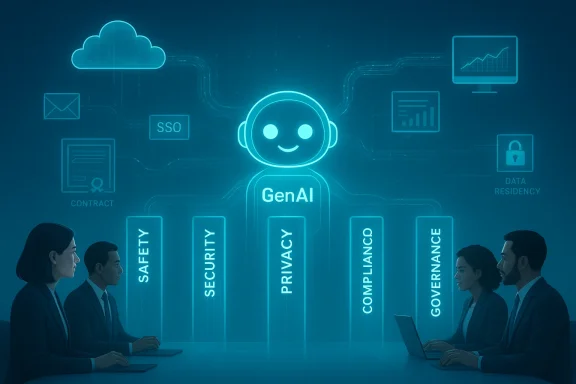
When assessing an enterprise GenAI chatbot, corporate decision-makers should treat every deployment as a regulated project. Across interviews and vendor documentation, five recurring evaluation pillars emerge:- Safety and accuracy — Does the model handle hallucination risk, and are there guardrails for unsafe outputs?
- Security and identity — Is access governed by SSO, directory sync (SCIM) and tenant scoping? How is encryption, key management and audit logging handled?
- Data privacy and residency — Does the vendor promise no-training on your data, customizable retention windows, and options for regional or on‑prem hosting?
- Compliance and certifications — Is the service SOC 2, ISO or sector-certified and does it provide contractual DPAs and BAAs where required?
- Legal and governance — Can legal, compliance and security teams audit model behavior, provenance of outputs and third‑party connectors?
Vendor snapshots: strengths, fit and caveats
This section summarizes the most common enterprise options, their strategic fit, and the trade-offs every IT buyer should weigh. All vendor claims below are verified against product documentation and independent reporting where possible.Microsoft 365 Copilot — deep productivity integration, governed by Microsoft Graph
Microsoft positions Microsoft 365 Copilot as an assistant embedded directly inside Word, Excel, Outlook and Teams — grounded by Microsoft Graph and scoped to tenant data. Prompts are pre‑grounded with tenant context, and access follows Azure Active Directory permissions; Copilot’s architecture explicitly emphasizes tenant scoping and Graph-based grounding to reduce data leakage risk. This makes Copilot a compelling first choice for organizations already anchored in the Microsoft ecosystem. However, heavy reliance on one vendor's stack raises vendor‑lock concerns and requires careful governance around which connectors and agentic automations are permitted.Key fit:
- Best for organizations standardized on Microsoft 365.
- Strong for document drafting, inbox triage, meeting summarization and spreadsheet analysis.
- Caveat: deep integration increases switching cost and required governance posture.
OpenAI ChatGPT Enterprise — widely adopted, broad connectors and non-training guarantees
ChatGPT Enterprise remains the default generalist assistant for many teams, offering broad connectors (SharePoint, Google Drive, GitHub) and explicit enterprise privacy controls: OpenAI states it does not train on Enterprise customers’ data by default and provides SSO, SCIM and SOC 2 assurances. Its familiarity and developer ecosystem make it fast to pilot and integrate, but buyers must still build governance (use‑case scoping, approval flows and monitoring) to prevent shadow usage.Key fit:
- Best for multi‑platform teams that need a familiar, high-capacity assistant and API extensibility.
- Strong for content creation, code assistance and exploratory analysis.
- Caveat: enterprise-grade controls exist but enterprises still must operationalize governance and logging.
Anthropic Claude Enterprise — long‑context reasoning and compliance posture
Anthropic’s Claude Enterprise is positioned for document-heavy workflows — long contracts, compliance reviews and technical documentation. Anthropic emphasizes long-context capabilities, role-based access controls, SCIM provisioning, SSO and contractual data handling protections that appeal to regulated industries. For legal and compliance teams worried about traceability and auditability, Claude often appears as a safer choice for lengthy reasoning tasks.Key fit:
- Best for legal, compliance, regulated research and long-form document analysis.
- Strong on traceability and enterprise governance.
- Caveat: pricing and integration patterns can differ from hyperscaler offerings; pilots are recommended.
Google Gemini Enterprise — multimodal and Workspace-native
Gemini Enterprise integrates tightly with Google Workspace and emphasizes native multimodal capabilities (text, image, video) and large context windows that Google advertises for enterprise use. For companies that use Drive, Docs and Gmail heavily, Gemini reduces context switching and supports in‑document creation and analysis. Google’s enterprise promises include SOC-style compliance and admin controls. However, enterprises must evaluate data-handling timelines (retention and use for model improvement) and admin controls carefully.Key fit:
- Best for Google Workspace-first organizations that need multimodal analysis.
- Strong for research teams, product, and marketing workflows that use video or images.
- Caveat: enterprise admin controls and retention policies should be validated for regulated use.
Amazon Q (Bedrock) — AWS‑native with identity and data‑source connectors
Amazon Q, built on Amazon Bedrock, plugs into AWS identity and data sources like S3 and (via connectors) SharePoint. AWS documentation highlights IAM Identity Center federation and SCIM-like provisioning for personalized experiences. For AWS-first shops, Amazon Q delivers a familiar identity model and the option to keep data and model interactions tightly within AWS accounts — attractive where cloud residency and account isolation matter.Key fit:
- Best for AWS-centric shops seeking integrated identity and data residency controls.
- Strong when corporate data already sits in S3 and other AWS services.
- Caveat: enterprise features and maturity compared to Copilot/ChatGPT vary by region and integration complexity.
Mistral Le Chat / Le Chat Enterprise — European privacy posture, self‑hostable weights
Mistral’s Le Chat and Le Chat Enterprise emphasize a GDPR-aligned product posture and self‑hosting options; Mistral releases several models under permissive licenses and offers on‑prem or private cloud deployments. For European organizations facing cross-border data concerns or a desire to self‑host open‑weight models, Mistral offers a legal and technical path to minimize exposure to non‑EU jurisdictional risks. That said, smaller context windows (on some models) and differing feature sets mean buyers should pilot for key tasks before broad rollout.Key fit:
- Best for EU organizations with strict data residency or regulatory requirements.
- Strong for self-hosted use cases and when open-weight models are required.
- Caveat: operational burden for self-hosting and model lifecycle management.
Perplexity Enterprise — citation‑aware research and knowledge discovery
Perplexity’s enterprise offering markets itself as an answer engine and research tool rather than a free‑form chatbot. Its strength is returning answers with sources and citations — a valuable property for teams that require traceability and research integrity. Perplexity Enterprise also supports SOC 2 and provisioning controls, making it suitable where provenance and auditable answers are required.Key fit:
- Best for research, knowledge discovery and cases that need source attribution.
- Strong for analyst teams, competitive intelligence and legal research.
- Caveat: not optimized for creative content generation or agentic automations.
Slack AI — workspace-constrained assistant for conversation and meeting workflows
Slack AI (the evolution of Slackbot) operates inside Slack and is intentionally constrained to workspace data — it does not pull from the open web. That design is a benefit for customers who want assistants that only use internal messages and files. Slack supports enterprise provisioning (SCIM) and admin controls; however, Slack AI is only relevant if Slack is already your team's collaboration layer and you accept its workspace-limited scope.Key fit:
- Best for organizations that want quick wins inside Slack for summaries, meeting prep and message search.
- Strong for team productivity and meeting-related automation.
- Caveat: not a substitute for enterprise‑wide copilots that stitch multiple data sources together.
xAI Grok Business — large context and social-signal differentiation
xAI’s Grok Business positions itself with large context windows and access to X’s sentiment streams — useful for monitoring public sentiment or social signals tied to brand monitoring. xAI emphasizes encryption and enterprise controls; however, the platform has had notable safety incidents that raise governance questions for risk-averse CIOs. Enterprises should weigh the unique public‑signal advantage against governance and reputational risk.Key fit:
- Best for social-media-aware teams that need sentiment and public signal monitoring.
- Strong for PR, comms and crisis monitoring.
- Caveat: safety incidents and the novelty of long-term enterprise support require cautious pilots.
Build, buy or blend? Practical decision framework
Enterprises typically land on one of three strategies: buy an off‑the‑shelf copilot, build custom assistants on platform APIs, or blend both (buy core copilots and build specialist agents). The correct approach depends on three constraints: privacy and compliance needs, strategic differentiation, and total cost of ownership (TCO).- If the goal is immediate productivity gains (email drafting, meeting summaries), buying off-the-shelf copilots (Copilot, ChatGPT Enterprise, Gemini in Workspace) usually delivers fastest time-to-value.
- If the use case is transformational and differentiating (proprietary drug discovery, competitive trading strategies), building a custom agent — possibly hosting models in‑tenant or with private deployments — preserves IP and gives control over training and model management.
- For most organizations, the practical route is blend: use vendor copilots for common productivity tasks and reserve custom-built agents for high-value, sensitive workflows.
- Clear success metrics (time saved, errors reduced, cost per use)
- A limited production boundary and rollout phases
- Legal and security sign-off gates
- Monitoring for model drift, hallucination rates and usage patterns
Governance and risk: what too‑fast adoption misses
Generative AI adoption without governance is the biggest avoidable risk. Common failure modes we see across pilots and early rollouts:- Shadow usage: employees use consumer tools for work data, exposing IP and PII.
- Data exfiltration via connectors inadvertently opened to external APIs.
- Model hallucination causing inaccurate legal or financial outputs that are acted upon.
- Regulatory exposure from data residency or cross‑border access (e.g., CLOUD Act considerations) that the vendor’s controls don’t fully mitigate.
- Operational drift: models behaving differently over time due to hidden retraining or updated base models.
- Enforce SSO + SCIM and domain verification for enterprise apps.
- Use no‑training or contractual guarantees where regulatory access to training data is unacceptable.
- Log all prompt/response interactions centrally and monitor for hallucination or sensitive content.
- Define escalation paths and human-in-the-loop approval flows for high‑risk outputs.
- Require vendor DPAs, SOC/ISO reports and, when needed, BAAs for healthcare data.
Implementation playbook: 7 steps to a production‑grade deployment
- Define the business problem and measurable KPI (time saved, tickets resolved, cycle time improvement).
- Choose a small pilot group and map data sources, roles and connectors.
- Run a sandboxed proof of concept with explicit data retention and red-team testing.
- Complete legal and security assessments against the five evaluation pillars.
- Instrument logging, provenance and alerting for model outputs and drift.
- Run a phased rollout with training for end users and support for escalation.
- Measure and iterate — safeguard against model drift, and maintain A/B testing between candidate models.
Critical analysis: strengths and the hard trade-offs
Generative AI chatbots are powerful productivity multipliers, but that power comes with trade-offs that vendors and buyers are still learning to manage.Strengths:
- Rapid productivity gains for repetitive knowledge work (drafting, summarization, search).
- New capabilities like long-context reasoning and multimodal inputs expand problem sets that AI can assist with.
- Enterprise connectors and identity integrations (SSO/SCIM) reduce friction for large deployments.
- Vendor claims about context windows or compliance are meaningful but often nuanced; context window size helps in long‑document tasks but does not alone guarantee accurate multi‑document reasoning.
- Certification badges (SOC 2, ISO) are useful baseline signals but do not replace contract-level guarantees around data usage, retention and legal jurisdiction.
- Open-weight and self-host options (Mistral) lower regulatory risk but shift operational burden to IT teams for patching, monitoring and scaling.
- The ecosystem is shifting fast; analyst projections (e.g., Gartner’s predictions) underline the pace of change, but decisive governance decisions must be made on current controls and contractual assurances rather than promises about future roadmaps.
Practical vendor match guide (quick reference)
- Choose Microsoft 365 Copilot for native Office/Windows-first deployments and deep Graph-based context.
- Choose ChatGPT Enterprise for broad cross-platform use, developer extensibility and rapid adoption.
- Choose Claude Enterprise for long-form legal and compliance reasoning with enterprise governance emphasis.
- Choose Gemini Enterprise for Google Workspace-native multimodal tasks and integrated media analysis.
- Choose Amazon Q for AWS-first shops that want to keep data and identity inside AWS accounts.
- Choose Mistral Le Chat when EU‑centric privacy, self‑hosting and open weights are priorities.
- Choose Perplexity Enterprise when source-attributed research and knowledge discovery are core needs.
- Choose Slack AI for Slack-first teams that need chat-embedded assistance without web scraping.
- Choose Grok Business for social-signal and sentiment-aware scenarios, after rigorous safety review.
Conclusion
The modern enterprise AI landscape is not about picking a single “best” chatbot — it’s about composing a controlled, governed toolset that aligns to business needs and regulatory constraints. Vendors now provide a rich menu of choices: hyperscaler copilots with deep product integration, specialist models for long-form reasoning, and open-weight players that permit self-hosting for privacy‑sensitive workloads. The mature approach is neither naive optimism nor reflexive avoidance; it is a staged, evidence-based program that pairs the right tool with the right use case, backed by explicit security, privacy and legal gates. For IT leaders, the task ahead is operational: run disciplined pilots, require contractual clarity on data usage, instrument model behavior, and build a governance loop that keeps AI delivering measurable value without becoming an unmanaged source of risk.Source: TechTarget Battle of the bots: Best GenAI chatbots for business | TechTarget
