

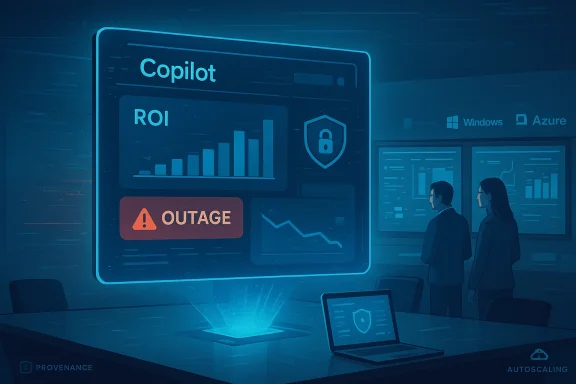
Microsoft’s biggest AI bet is wobbling: enterprise customers paying for Copilot are reporting accuracy problems, sluggish responses, and deployment headaches that together are shrinking the product’s halo and forcing CIOs to ask whether the $30-per-seat math ever made sense.
Microsoft launched Copilot as the centerpiece of an “AI-first” pivot: embed large language models across Windows, Microsoft 365, Teams and developer tooling so that generative assistants become the everyday interface for knowledge work. That strategy promised to convert Microsoft’s enormous installed base into a recurring revenue stream—seat subscriptions for Copilot plus inference-driven Azure consumption—while locking AI into the Office-to-Cloud workflow that billions of users already rely on.
By Microsoft’s public accounts, Copilot has reached headline scale: the company has reported millions of paid Copilot seats and broad distribution across product surfaces. Yet multiple independent snapshots and investigative reports reveal a more complicated reality: paid-seat penetration remains a small fraction of the Mibase, active adoption is uneven, and a rising chorus of enterprise complaints points to operational fragility, inconsistent outputs, and unclear ROI.
Competition matters for two reasons:
That said, Microsoft has the assets to recover: deep enterprise relationships, broad platform integration, massive cloud capacity investments, and the ability to move engineering resources at scale. The path forward is suiability, make defaults conservative and auditable, simplify product naming and SKUs, and publish concrete operational commitments that procurement teams can buy against.
Source: WebProNews Microsoft’s Copilot Stumbles: Inside the Technical Failures Threatening the AI Revolution’s Flagship Product
 Background
Microsoft launched Copilot as the centerpiece of an “AI-first” pivot: embed large language models across Windows, Microsoft 365, Teams and developer tooling so that generative assistants become the everyday interface for knowledge work. That strategy promised to convert Microsoft’s enormous installed base into a recurring revenue stream—seat subscriptions for Copilot plus inference-driven Azure consumption—while locking AI into the Office-to-Cloud workflow that billions of users already rely on. By Microsoft’s public accounts, Copilot has reached headline scale: the company has reported millions of paid Copilot seats and broad distribution across product surfaces. Yet multiple independent snapshots and investigative reports reveal a more complicated reality: paid-seat penetration remains a small fraction of the Mibase, active adoption is uneven, and a rising chorus of enterprise complaints points to operational fragility, inconsistent outputs, and unclear ROI.
What customers are actually seeing
Accuracy and “hallucinations”: the usefulness gap
A central technical limitation that repeatedly surfaces in customer reports and independent audits is model hallucination—confident-seeming but factually incorrect outputs. When Copilot is used for summarization, meeting notes, legal or regulated content, or anything that requires precise provenance, hallucinations crea”: time saved drafting is lost to verification and correction. Independent journalistic audits and broadcaster tests found significant error rates across mainstream assistants, underscoring that this is a cross-vendor problem rather than a Microsoft-only bug.- The BBC / European Broadcasting Union audit examined thousands of news-oriented queries to multiple assistants and found a large share of responses contained significant problems—sourcing fail or outright errors—demonstrating the real reputational risk when assistants stand in for human-verified content.
- Hands‑on reviews of Copilot Vision and agentic flows documented misidentifications, brittle behavior when confronted with messy real‑world inputs, and outputs that required manual, often time-consuming corrections.
Performance and availability: autoscaling is not free
Copilot’s delivery chain stitches together client front-ends (desktop, web, mobile), global edge routing, identity controls, orchestration microservices and GPU-backed model endpoints. That complexity makes synchronous features (document edits, meeting summaries, Copilot Actions) vulnerable to autoscaling, routing and control-plane issues.- A high-visibility incident in December 2025 (logged internally as CP1193544)uilot functionality in the United Kingdom and parts of Europe. Microsoft’s initial postmortem cited an unexpected surge in traffic and subsequent autoscaling/load‑balancer pressure; engineers manually scaled capacity and adjusted routing to stabilize service. For enterprises that had woven Copilot into daily workflows, the outage translated into missed summaries, failed automations and a spike in support tickets.
Fragmentation and confusing branding
“Copilot” is not a single monolithic product; it’s a family: Microsoft 365 Copilot, Windows Copilot, GitHub Copilot, Copilot Studio, and consumer-facing Copilot chat surfaces. That multiplicity is a strategic strength on paper—but in practice it’s produced buyer confusion, fractured UX expectations, and procurement friction. Sales and IT teams struggle to map a business problem to a specific Copilot SKU, slowing decisions and campaign momentum.The financial calculus: $30 per seat and the ROI problem
Microsoft priced Microsoft 365 Copilot as a premium offering—reportedly around $30 per user per month in the enterprise. That number is simple enough to state but harder to justify in spreadsheets when:- Adoption is shallow: puurveys show that a small proportion of Microsoft 365 commercial users have active Copilot licenses or use Copilot as their primary assistant. Where Microsoft has touted headline metrics—tens of millions of seats and hundreds of millions of interactions—penetration relative to the total M365 base is modest and concentrated in pilots and early adopter groups.
- Usage is inconsistent: recon analytics and market-tracking snapshots cited in investigative reporting showed that the share of Copilot subscribers who listed Copilot as their primary tool six‑ to seven‑month window, while rivals like Google’s Gemini gained share—evidence that buyers are experimenting but not necessarily committing.
- Hidden costs multiply: making Copilot usable at scale requires tenant configuration, sensitivity labeling, governance policies, custom connectors, and continued monitoring to prevent oversharing or data leakage. Those integration and compliance costs erode the headline ROI for seat-based licenses.
Technical anatomy of the failures
To understand why Copilot falters in production, you must look at where generative assistants are weakest when moved from lab to live environments.Retrieval + reasoning = brittle composition
Most production assistants combine a retrieval layer (fetching corporate documents or web content) and a generation layer (the LLM). Problems appear when retrieval returns partial, stale or restricted documents and the model synthesizes an answer without proper provenance cues. The result: an authoritative-sounding response that lacks verifiable sources. Journalistic audits show this failure ms tasks; enterprise data introduces amplified governance and privacy concerns.Agentic execution and UI context
Copilot’s promise includes agentic flows—multi-step actions that manipulate documents, change settings, or execute workflows. Those flows require accurate UI state awareness, deterministic sequencing, and robust permission checks. When the assistant mirchestration plane drops a step, automation fails or takes incorrect actions—precisely the sort of failure that erodes trust faster than a simple conversational flub. Independent hands-on testing reproduced such agentic brittleness in several high-profile demonstrations.Latency and warm pools
Real-time inference at scale depends on pre-warmed compute and careful capacity planning. Warm pools reduce latency, but they cost money to maintain and are sensitive to sudden traffic spikes. When an autoscaler is conservative or regional quotas bite, the result can be a visible slowdown or timeout for synchronous tasks. The December CP1193544 incident illustrated these dynamics: a localized demand surge stressed warm capacity and exposed load-balancing fragilities.Security, compliance and data governance
Enterprise Copilot’s value proposition hinges on safe access to corporate data. But that is precisely what keeps security teams worried.- If a tenant’s sensitivity labels and permissions are not bulletproof, Copilot’s retrie or summarize content that should remain private, creating regulatory exposure for healthcare, finance, public sector and other regulated industries. Analysts and CIOs have cited these concerns in buyer feedback, and Gartner-sourced reporting surfaced delays and hesitancy linked to oversharing risk.
- Features that index or remember user context (e.g., screen-capture timelines and Recall-like functionality) can increase surface area for leaks; Microsoft has had to pause, redesign and relaunch such features with opt‑in defaults and strontections after community and regulator pushback. Those product changes are necessary but costly and time-consuming to implement across a vast, heterogenous install base.
Customer support, training and the pilot‑to‑production gap
Organizations report that Copilot pilots often succeed under curated conditions (clean data, narrowly scopedtoring) but fail to scale. The reasons are procedural as much as technical:- Support expectations: customers buying an enterprise-priced product expect rapid, solution-focused support; many have found documentation sparse and response times slower than expected given the premium pricing.
- Training and prompt literacy: employees need more than a how‑to—they need coaching on prompt design, output validation, and when not to rely on the assistant. Without primary training, user confidence collapses and the assistant sits unused on many licensed seats.
- Partner implementation costs: Microsoft has leaned on its partner ecosystem to deliver Copilot customization and tenant integration. Those services are valuable but add to TCO and reduce the net benefit of a seat license for many mid‑market buyers.
Competitive pressure: rivals aren’t standing still
Microsoft’s Copilot sits in a crowded field. Google’s Gemini, OpenAI’s ChatGPT, Anthropic and specialized vendors have improved their products aggressively, and in many user comparisons those alternatives are preferred for specific tasks. Recent market tracking and journalistic reporting show that Copilot has lost share among some paid users while Gemini and ChatGPT have gained traction in the consumer and developer mindshare—an important sentiment indicator for enterprises deciding which assistant to standardize on.Competition matters for two reasons:
- It accelerates feature parity and forces Microsoft to improve rapidly.
- ble alternatives when Copilot’s operational or financial case weakens—weakening Microsoft’s leverage with large enterprise procurement teams.
Microsoft’s response strategy — repair, refine, repeat
Miced problems publicly and appears to be pursuing a three-track response:- Incremental model and service improvements aimed at accuracy and latency.
- Governance tooling and Copilot Studio features to let enterprises tailor assistants and add human-in-the-loop (HITL) safeguards.
- Expanded partner services to help customers implement cy labeling and observability.
- Start small and measure: run 4–8 week pilots focused on 1–3 high-value workflows. Define clear KPIs (time savings, error rate, edits per draft).
- Treat Copilot as advisory, not authoritative: require human verification on outputs for regulated or high-risk tasks and enforce retention and audit trails.
- Harden governance before scale: sensitivity labeling, connectos and tenant-wide defaults should be automated and auditable.
- Negotiate operational SLAs: seek explicit uptime commitments for synchronous Copilot features and require post-incident summaries for any outage that affects your tenant.
- B and training: factor partner implementation, change management, and ongoing prompt-literacy training into the total cost of ownership, not just license fees.
Why Copilot still matters — and what’s at stake
Despite the current troubles, Copilot remains strategically important to Microsoft and consequential for the enterprise AI market:- Platform integration is a real advantage. Copilot can, in theory, leverage Microsoft Graph, tenant identity, and Office file context in ways standalone assistants cannot—if those integrations work reliably and are governed correctly.
- Hybrid inference and Copilot+ hardware could deliver meaningful latency and privacy benefits where on‑device models are feasible, but that vision depends on cross-vendor hardware parity and developer tooling that today r The stakes are large: Microsoft’s AI thesis ties per-seat and per-inference revenue expectations to Azure capacity planning and long-term partner economics. If Copilot fails to become a durable revenue stream, those architectural bets will require re-evaluation.
A candid assessment
Copilot’s problems are not one-off h a single model upgrade. They are the product of multiple, interacting weaknesses: generative model limits (hallucinations), complex orchestration and autoscaling demands, fragmented product identity, governance shortfalls, and the difficult pilot‑to‑production transition in large organizations. Many of these issues are systemic—they require engineering hardening, clearer product taxonomy, and enterprise-grade governance features to fix.That said, Microsoft has the assets to recover: deep enterprise relationships, broad platform integration, massive cloud capacity investments, and the ability to move engineering resources at scale. The path forward is suiability, make defaults conservative and auditable, simplify product naming and SKUs, and publish concrete operational commitments that procurement teams can buy against.
Conclusion
Copilot’s current slide from “revolutionary promise” to “enterprise headache” is a sobering lesson in what it takes to operationalize generative AI at scale. For organizations, the imperative is clear: approach Copilot with rigorous pilots, hardened governance and explicit performance metrics—not blind enthusiasm. For Microsoft, the path back to credibility runs through reliability and usable governance rather than marketing spectacle. If the company can close the integrity, availability and compliance gaps, Copilot can still deliver meaningful productivity gains. If not, the story of Copilot will be a cautionary case about the gap between the promise of LLMs and the hard, slow engineering work of making them dependable where business risk is real.Source: WebProNews Microsoft’s Copilot Stumbles: Inside the Technical Failures Threatening the AI Revolution’s Flagship Product
