

Microsoft’s AI story is no longer a simple tale of platform advantage and partner bet — it has become a layered debate about execution, capital intensity, and whether the company that seeded the modern enterprise AI era still deserves to be called the leader.
Microsoft arrived at the generative-AI era with three rare structural advantages: an installed base of productivity customers through Microsoft 365, massive cloud scale in Azure, and an exclusive commercial relationship with OpenAI that gave it early access to some of the most capable foundation models. Those advantages underpinned a bullish narrative: embed AI across Office, Windows and developer tools; convert free integrations into paid seats; and monetize inference on Azure at scale.
But the execution path has been noisy. Over the past 18 months Microsoft has reorganized parts of its leadership, spun up a standalone AI leadership team under Mustafa Suleyman, and publicly signaled a move toward “true AI self-sufficiency” — meaning more internal model development and less exclusive reliance on OpenAI — even as deep contractual ties and shared infrastructure persist. These strategic shifts reflect both opportunity and anxiety inside Redmond.
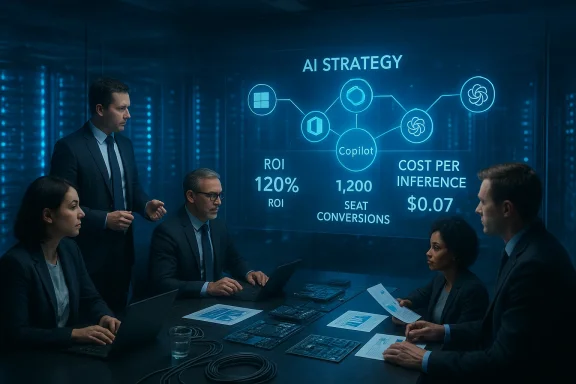
That line of argument is blunt: Microsoft’s assets are real, but the timing and unit economics of enterprise AI monetization are the problem. If seat conversions lag, or if inference costs stay stubbornly high, Microsoft’s enormous AI-related spending could pressure margins and extend the time until the market rewards the investment.
Put simply: product integration has been fast and broad; commercial monetization has been slower and more concentrated. That mismatch is central to the Seeking Alpha critique and to the caution many investors and IT leaders are voicing.
Different outlets and executive comments place the magnitude of Microsoft’s long-term AI spend in overlapping but not identical terms, which is normal for evolving capital programs. Still, the direction is clear: Microsoft is betting scale and custom hardware will lower the cost-per-inference over time; the timeline and degree of that improvement remain the core uncertainty.
The question for Microsoft is execution discipline: can newly formed AI units align with sales, commercial packaging and Azure resource allocation fast enough to drive predictable revenue growth? The Seeking Alpha analysis makes the explicit point that leadership and organization matter as much as raw technology.
Competition is not just about model performance — it is also about developer experience, go-to-market, pricing and the economics of inference. A vendor that finds the right mix of accuracy, latency, pricing and enterprise packaging can win large market share quickly. That reality is precisely why Microsoft’s execution timing matters so much.
At the same time, calling Microsoft “out of the race” is premature. The company’s distribution, enterprise trust, engineering heft and balance-sheet capacity give it a second chance — and often more — to iterate toward better economics. If Microsoft’s custom silicon, datacenter engineering and improved software reliability deliver within a predictable horizon, the reward for patient shareholders and enterprise customers could be substantial.
Source: Seeking Alpha Microsoft Stock's Lack Of Leadership In AI, Wait (NASDAQ:MSFT)
 Background
Microsoft arrived at the generative-AI era with three rare structural advantages: an installed base of productivity customers through Microsoft 365, massive cloud scale in Azure, and an exclusive commercial relationship with OpenAI that gave it early access to some of the most capable foundation models. Those advantages underpinned a bullish narrative: embed AI across Office, Windows and developer tools; convert free integrations into paid seats; and monetize inference on Azure at scale.But the execution path has been noisy. Over the past 18 months Microsoft has reorganized parts of its leadership, spun up a standalone AI leadership team under Mustafa Suleyman, and publicly signaled a move toward “true AI self-sufficiency” — meaning more internal model development and less exclusive reliance on OpenAI — even as deep contractual ties and shared infrastructure persist. These strategic shifts reflect both opportunity and anxiety inside Redmond.
What the Seeking Alpha piece argues
The Seeking Alpha analysis that sparked many of the recent conversations frames Microsoft as a high-quality business that nevertheless faces execution risk: cloud price and mix competition, uncertain payback on massive AI infrastructure capex, and limited evidence that Copilot and other AI offerings are converting enough customers to justify the valuation premium. The author’s valuation work points to a scenario in which Microsoft’s upside is meaningful only if several operational levers — seat conversion, inference economics, capex utilization and custom silicon timing — move decisively in the company’s favor.That line of argument is blunt: Microsoft’s assets are real, but the timing and unit economics of enterprise AI monetization are the problem. If seat conversions lag, or if inference costs stay stubbornly high, Microsoft’s enormous AI-related spending could pressure margins and extend the time until the market rewards the investment.
Where the data converge — and where they don’t
Copilot adoption and monetization are visible but incomplete
Microsoft has rolled Copilot into a broad set of products — M365, Teams, Outlook, Dynamics and GitHub — and publicly cites adoption metrics in absolute terms. But independent reporting and market analysis suggest adoption of paid Copilot subscriptions remains a modest fraction of the total Microsoft 365 installed base. Recent coverage shows Microsoft reporting millions of paid Copilot seats, yet those paid users represent a small percentage of the hundreds of millions of commercial M365 seats overall. That gap matters because the long‑term revenue thesis depends on converting embedded usage into incremental, recurring paid subscriptions.Put simply: product integration has been fast and broad; commercial monetization has been slower and more concentrated. That mismatch is central to the Seeking Alpha critique and to the caution many investors and IT leaders are voicing.
Capital intensity and inference economics
Microsoft’s investment in AI infrastructure — GPUs, custom silicon, datacenter build-outs and related power/cooling capacity — is enormous by any measure. Public reporting and multiple trade outlets describe multi‑billion dollar annual commitments aimed at scaling training and inference capacity. The financial calculus is straightforward: the company must turn infrastructure utilization into revenue at favorable per‑unit economics to preserve margins. If inference costs per query remain high, the path to attractive returns lengthens considerably.Different outlets and executive comments place the magnitude of Microsoft’s long-term AI spend in overlapping but not identical terms, which is normal for evolving capital programs. Still, the direction is clear: Microsoft is betting scale and custom hardware will lower the cost-per-inference over time; the timeline and degree of that improvement remain the core uncertainty.
OpenAI: partnership, dependency and strategic hedge
Microsoft’s early and deep partnership with OpenAI was a defining advantage. It purchased preferential access to leading foundation models and integrated them throughout the product stack. But the relationship has evolved: both sides have sought more operational independence, and Microsoft is now investing more in internal models and strategic relationships with other model vendors. That evolution hedges the company’s exposure to any single partner but also removes the protection of an almost-exclusive moat. Critical corporate statements and FT reporting confirm both the depth of the partnership and the company’s parallel investments in homegrown models.Leadership, organization and the product bottleneck
Executive structure and focus
Satya Nadella’s public positioning has emphasized product leadership on AI; internally, Microsoft has restructured to concentrate AI talent under Mustafa Suleyman and create an internal “AI startup” within the company. That approach aims to accelerate productization and model development, but it also introduces governance and coordination challenges across Azure, M365, Windows and commercial teams. Several recent reports document this churn and Nadella’s unusually hands‑on role for a CEO at this company scale.The question for Microsoft is execution discipline: can newly formed AI units align with sales, commercial packaging and Azure resource allocation fast enough to drive predictable revenue growth? The Seeking Alpha analysis makes the explicit point that leadership and organization matter as much as raw technology.
Product reliability and real-world task completion
Beyond seat counts, enterprise customers judge AI by real task success rates. Independent studies and internal customer feedback indicate that AI assistants frequently fail on complex, multi-step tasks or require significant human oversight. These real-world failure modes — hallucination, context loss, brittle integrations — directly affect willingness-to-pay by enterprises. Microsoft has acknowledged product gaps and has focused engineering effort on improving robustness, but the pace of that improvement is a critical input into the company’s monetization thesis.Competitive landscape: not a two‑horse race
Microsoft’s competitors are numerous and serious. Google continues to develop Gemini and strong cloud AI integration; AWS is building a “Bedrock” style model marketplace and pushing optimized inference offerings; specialist firms like Anthropic and Mistral are innovating on model safety and efficiency; and hardware makers and chip startups are reshaping the economics of AI compute. Microsoft’s in-house ambitions and its continued investments in external partners are both responses to that competitive pressure.Competition is not just about model performance — it is also about developer experience, go-to-market, pricing and the economics of inference. A vendor that finds the right mix of accuracy, latency, pricing and enterprise packaging can win large market share quickly. That reality is precisely why Microsoft’s execution timing matters so much.
Strengths that still matter
- Distribution and installed base. Microsoft reaches hundreds of millions of commercial and consumer endpoints across Windows and M365, which is the kind of distribution most AI startups can only dream of. That distribution lowers customer acquisition cost and creates natural upsell opportunities.
- Azure scale and enterprise trust. Azure’s global datacenter footprint, compliance certifications and enterprise relationships remain strong selling points for customers who want AI but also need security, governance and support. That trust is a competitive moat for large enterprises.
- Engineering and capital depth. Microsoft’s willingness to fund massive infrastructure investment and to build or buy capabilities (from custom silicon to acquisitions) gives it optionality across the stack. If those investments deliver the expected unit-cost improvements, Microsoft could reassert durable leadership.
Real risks the Seeking Alpha piece highlights (and why they’re valid)
- Capex payback uncertainty. Microsoft’s heavy spending on GPUs, datacenters and custom chips must be amortized against revenue that arrives at uncertain timing. Poor utilization or suboptimal pricing would compress margins.
- Copilot conversion limits. Embedded Copilot usage doesn’t automatically equal revenue. If enterprises resist paying for premium AI seats at scale, the revenue ramp slows and unit economics worsen. Independent reporting suggests paid seats remain a small fraction of potential users today.
- Execution fragmentation. Multiple internal AI initiatives, an expanded leadership layer and coordination challenges across product groups raise the odds of duplicated effort and misaligned priorities. That in turn slows product maturity.
- Regulatory and competitive headwinds. Antitrust scrutiny, data privacy rules and emerging AI regulation could constrain bundling approaches or require expensive compliance changes. At the same time, competitors and new entrants could undercut pricing or offer superior inference economics.
- Dependency paradox. The OpenAI relationship gave Microsoft a head start; reducing that dependency is sensible strategically, but it also means Microsoft must re-create or acquire model differentiation internally — a difficult and expensive undertaking. The move toward internal models is explicit in recent leadership statements.
Strengths and opportunities the market often underweights
- Microsoft’s enterprise relationships are sticky; once Copilot features are embedded into a corporate workflow and governance processes are established, switching costs rise. That stickiness can enable long, predictable revenue streams if Microsoft nails the commercial model.
- Custom hardware and operations expertise can be a multi-year advantage. If Microsoft’s custom accelerators and datacenter optimizations materially reduce cost-per-inference, the company can expand margins even if revenue growth is linear. That’s a higher-risk, higher-reward engineering bet — but it is one Microsoft is positioned to pursue.
- Integration across Windows, Office and developer tooling (Visual Studio / GitHub) creates compound value: AI that helps create, test and deliver software can pay back more in developer productivity than a pure consumer-facing assistant. Microsoft controls many of those touchpoints.
What Microsoft must do next (practical, product and financial steps)
- Double down on demonstrable ROI for enterprise buyers. Focus sales and product engineering on vertical proofs where Copilot measurably reduces hours, costs or headcount risk in ways CFOs accept. Show the math.
- Simplify packaging and pricing. Move away from a seat-by-seat maze that impedes buying decisions. Offer clear, outcome-based pricing for flagship enterprise scenarios.
- Accelerate inference cost improvements with transparency. If Microsoft can publish meaningful improvements in cost-per-inference and latency tied to custom silicon or datacenter optimizations, it will remove a major investor and procurement objection.
- Harden product reliability and trust signals. Prioritize auditability, safety guardrails, and reproducible task completion for high-value enterprise workflows. Reduce hallucination and improve traceability so legal and procurement teams can approve deployments.
- Clarify partner strategy publicly. A mixed message — deep partnership with OpenAI while building internal models and investing in other model vendors — breeds uncertainty. Microsoft should communicate the economic and strategic contours of that approach clearly to investors and customers.
A measured verdict
The Seeking Alpha thesis is a sober counterweight to the often breathless AI bulls: Microsoft has a superior asset base, but the new game in town is not just capability — it’s the timing and economics of converting that capability to recurring, profitable revenue. The risks are real and measurable: capex payback, seat conversion, inference economics and execution alignment. Those are not speculative — they are operational levers Microsoft must drive down to acceptable levels.At the same time, calling Microsoft “out of the race” is premature. The company’s distribution, enterprise trust, engineering heft and balance-sheet capacity give it a second chance — and often more — to iterate toward better economics. If Microsoft’s custom silicon, datacenter engineering and improved software reliability deliver within a predictable horizon, the reward for patient shareholders and enterprise customers could be substantial.
Final takeaway for IT leaders and WindowsForum readers
- Treat Microsoft’s AI transition as a long-duration program: product improvements, commercial motions and unit-economics will evolve over multiple quarters, not overnight. Plan pilots that measure real ROI, not just novelty.
- Don’t equate brand announcements with durable product maturity. Ask for metrics: task completion success rate, average time saved per user, audit logs, compliance certifications and per‑unit inference costs for your use-case. Those are the figures procurement teams can act on.
- Watch execution signals, not just headlines. Leadership reorganizations, custom silicon milestones and consistent improvements in enterprise conversion rates will be real inflection points for Microsoft’s AI narrative. Absent those signals, the stored value in Microsoft’s asset base is still there — but the timing of its monetization is the open question Investors and CIOs alike should monitor.
Source: Seeking Alpha Microsoft Stock's Lack Of Leadership In AI, Wait (NASDAQ:MSFT)
