

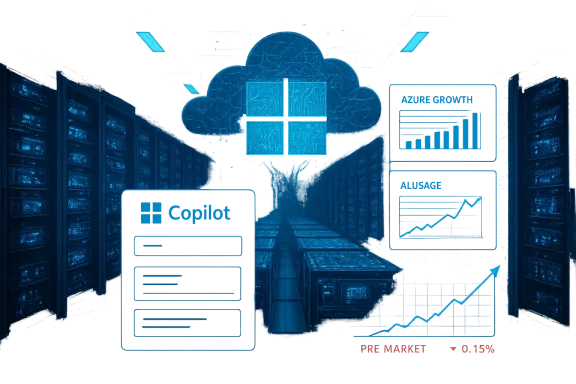
Microsoft’s latest quarterly report delivered another headline-grabbing mix: impressive top-line growth driven by cloud and AI demand, paired with a sharp jump in capital expenditures and an Azure growth rate that barely cleared street expectations—enough to send the stock lower in pre-market trading and reopen the long-running debate about scale, capital intensity, and the pace of monetization in the cloud-era AI race.
Microsoft’s fiscal second-quarter report (quarter ended December 31, 2025) reinforced a familiar theme: the company is growing fast, and the engine is Azure and AI. The headline figures are clear and verifiable: revenue of $81.3 billion, up 17% year-over-year, with non-GAAP diluted EPS of $4.14, and reported GAAP net income reflecting one-time accounting effects tied to investments in AI partners.
But the release also disclosed a $37.5 billion quarter in capital expenditures—an eye-popping number that dwarfs normal seasonal patterns and reflects an aggressive buildout for GPU-dense compute and new datacenter capacity. Analysts and investors seized on the capex spike and on Azure’s sequential momentum to reassess near-term returns and margin trajectories, producing a sharp market reaction despite a strong underlying result.
This is the context that matters: hyperscalers are in an infrastructure arms race to host, train, and serve large AI models; Microsoft is both a consumer and supplier of that capacity—and the financial trade-offs from that dual role are now plainly visible in quarterly reporting and market sentiment.
But the market’s reaction was also rational. When a business that has historically been valued for its steady cash flow suddenly signals a step-change in capital intensity, investors re-evaluate multiples and time horizons. In this quarter, Azure’s growth was robust but not so far beyond expectations that it instantly offset concerns about near-term cash conversion after record capex. The result: a market pullback that reflects recalibrated expectations rather than an indictment of the strategy itself.
For readers and customers, the takeaway is pragmatic:
Microsoft’s numbers are clear and the strategic rationale is intact; the debate now centers on timing and execution. Watch the next set of guidance and management commentary for whether capex begins to normalize relative to revenue growth, and whether Azure consumption metrics—especially paid seats and ARPU for Copilot and related services—turn the heavy investment back into sustainable, high-margin recurring cash flows.
Conclusion: strong quarter, strategic clarity, and a market that demands proof that billions in AI infrastructure will translate into proportionate, recurring returns.
Source: Seeking Alpha Microsoft delivers strong Q2, but surging capex, in-line Azure growth prompts pullback: analysts
 Background
Microsoft’s fiscal second-quarter report (quarter ended December 31, 2025) reinforced a familiar theme: the company is growing fast, and the engine is Azure and AI. The headline figures are clear and verifiable: revenue of $81.3 billion, up 17% year-over-year, with non-GAAP diluted EPS of $4.14, and reported GAAP net income reflecting one-time accounting effects tied to investments in AI partners. But the release also disclosed a $37.5 billion quarter in capital expenditures—an eye-popping number that dwarfs normal seasonal patterns and reflects an aggressive buildout for GPU-dense compute and new datacenter capacity. Analysts and investors seized on the capex spike and on Azure’s sequential momentum to reassess near-term returns and margin trajectories, producing a sharp market reaction despite a strong underlying result.
This is the context that matters: hyperscalers are in an infrastructure arms race to host, train, and serve large AI models; Microsoft is both a consumer and supplier of that capacity—and the financial trade-offs from that dual role are now plainly visible in quarterly reporting and market sentiment.
The numbers that matter: verified facts and what they mean
Revenue, earnings and Azure growth
- Total revenue: $81.3 billion, +17% YoY.
- Non-GAAP diluted EPS: $4.14.
- Microsoft Cloud revenue: exceeded $50 billion, up roughly 26% YoY.
- Azure and other cloud services growth: ~39% YoY (the company reported Azure-related growth in the high‑thirties). This figure was slightly above some consensus models but down or roughly flat compared with very recent sequential quarters—enough to prompt investor focus.
Capital expenditures: the headline number
Microsoft reported capex of $37.5 billion for the quarter, a sharp acceleration year‑over‑year and the most discussed line item of this release. That level of spending reflects two distinct buckets:- Short-lived compute purchases (primarily high-end GPUs and accelerators) that are consumed or depreciated quickly and whose costs map more directly to current AI demand.
- Long-lived datacenter investments (land, shells, power/cooling, networking) that will be amortized over a long horizon.
Market reaction — measured and immediate
The market’s response was swift: pre-market and after-hours moves of roughly 6–7% lower in Microsoft shares were reported by multiple outlets as investors parsed Azure’s growth and the capex headline. That reacple truth in today’s tech market: when earnings beat on the top line but reveal capital commitments that extend payback horizons materially, negative price action is common—even when the strategic rationale is strong.Why analysts and investors were split
Analysts and portfolio managers took essentially two positions on the print.- The bullish view sees Microsoft’s spending as necessary and defensible: build scale now, win enterprise customers for multi-year AI consumption, embed Copilot and other AI capabilities across the Microsoft stack, and realize long-term returns that justify short-term capital intensity. This view emphasizes ecosystem lock-in, cross-sell opportunities, and the company’s differentiated commercial relationships (including a deep partnership with OpenAI and recent broader compute collaborations).
- The cautious vieending and Azure’s near-term trajectory as sources of risk: infrastructure can be underutilized if enterprise adoption lags, GPU supply and pricing remain volatile, and the accounting around OpenAI-related gains complicates the clean picture of recurring free cash flow. For near-term investors focused on free‑cash‑flow yield and margins, the capex number raises a legitimate question about timing and returns.
Deep dive: Azure, AI revenue, and monetization mechanics
What’s driving Azure’s growth—and why “in-line” matters
Azure’s growth remains impressive in absolute terms, but the market evaluates it relative to very high expectations. A single percentage point of deceleration can imply material differences in future cash flow when applied to Microsoft’s multi-hundred-billion-dollar revenue base.- A meaningful portion of Azure’s growth this quarter came from AI-related services—Microsoft reported strong AI consumption signals, including higher commercial bookings and usage tied to Copilot, Azure OpenAI services, and other enterprise AI workloads.
- However, non-AI Azure services showed mixed performance, and capacity constraints at some data centers limited the degree to which Microsoft could convert immediate demand into billable hours—effectively putting a cap on upside in the quarter. Management commented that demand exceeded available capacity in places, which is part of the rationale behind heavy capex.
Monetization levers and the AI mix
Microsoft’s AI monetization is multi-channel:- Consumption-based revenues (GPU-hours, inference calls) on Azure.
- Seat-based monetization (Microsoft 365 Copilot, GitHub Copilot).
- Platform fees, enterprise contracts, and long-term commercial commitments (remaining performance obligatment disclosed a growing RPO backlog and highlighted large multiyear commitments—some tied to OpenAI and similar partners—which create forward revenue visibility but also embed accounting complexities (including one-time GAAP gains). These elements help explain why revenues and reported GAAP net income can move in different directions quarter-to-quarter.
CapEx: build now, monetize later — the risks and the potential returns
The strategic case for aggressive investment
There are sound strategic reasons for Microsoft’s spending profile:- Latency and proximity matter for large language models; customers prefer lower-latency inference near their users and data. Owning datacenters and colocated GPU clusters is a product advantage.
- Supply-chain control reduces exposure to GPU shortages and pricing volatility—critical when your product depends on consistent access to accelerators.
- First-mover scale is a moat: the companies that achieve the lowest cost-per-inference at scale win more enterprise contracts and better margins over time.
The financial risk vectors
But there are real financial and operational risks:- Utilization risk: idle GPUs and empty racks are expensive. Utilization must ramp to justify the outlay; if enterprise adoption slows or competitors capture share with lower-cost alternatives, payback lengthens.
- Supply and pricing volatility: dependence on a narrow set of accelerator suppliers (historically NVIDIA and similar vendors) exposes Microsoft to procurement risk and pricing cycles.
- Long payback horizon for part of capex: land and datacenter shells are amortized over a long period, which shifts the break-even calculation and ties capital to a long-term demand forecast.
- Accounting noise from partnerships: non-recurring gains tied to investments in AI ventures can mask the core cash generation from core operations, complicating investor assessment.
Competitive landscape: AWS, Google, and cloud-native challengers
Microsoft is not building in a vacuum. The hyperscaler competition is intense:- AWS continues to push specialized chips and new services for large models.
- Google Cloud is leveraging internal model and silicon efforts and emphasizes integrated AI capabilities across its stack.
- Niche and regional players—including some Chinese providers and open-source model hosting firms—threaten to undercut pricing for specific workloads.
Analyst takeaways and the street’s framing
Analysts framed the quarter around two central questions:- Is Microsoft’s capex cadence prudent, or is it an over-commitment that will pay off only if AI adoption accelerates rapidly?
- How sticky and scalable is AI consumption—can Microsoft convert pilot workloads into sustained, high‑margin production usage that justifies near-term capital intensity?
What to watch next — indicators that will matter to markets and customers
- CapEx guidance and mix: Investors will parse future guidance closely—how much is short-lived compute vs. long-lived datacenter build? Management’s tone on pacing will be decisive.
- Sequential Azure gon metrics: Even small percentage moves matter; look for commentary on capacity saturation, utilization rates, and average revenue per unit of compute.
- Copilot / seat-based adoption metrics: Concrete indicators of seat growth and ARPU for Microsoft 365 Copilot and GitHub Copilot will help bridge the gap between platform investment and recurring revenue.
- Commercial bookings and RPO composition: The size and composition of remaining performance obligations provide visibility into future contracted revenue and can offset some utilization concerns.
- Competitive pricing and supplier dynamics: Any sign that competitors are offering materially cheaper or faster capacity—or that GPU pricing is shifting—would matter materially to unit economics.
Practical takeaways for investors, IT buyers, and WindowsForum readers
- For long-term investors focused on platform leadership, Microsoft’s aggressive buildout is consistent with a strategy to capture the AI infrastructure layer and embed services across a massive installed base. That thesis assumes continued, durable AI adoption across enterprises and developers.
- For value and dividend-focused investors, the near-term hit to free cash flow metrics and elevated capex means shorter-term volatility and potential multiple compression. Close attention to capex pacing and management guidance is warranted.
- For enterprise IT buyers and Windows/Office customers, the good news is improved performance and proximity for AI workloads, plus tighter integration of AI features into Microsoft 365, Windows, and development tools—features that can materially improve productivity but may come with higher service consumption costs.
- For cloud customers considering multi-cloud strategies, Microsoft’s scale is a double-edged sword: excellent integration and enterprise fit on one hand; potential spot-price sensitivity and capacity constraints on the other. Design your architecture for portability where critical workloads require vendor flexibility.
Strengths, weaknesses, and the balance sheet of conviction
Notable strengths
- Scale and integration: Microsoft’s combination of Azure, Office, GitHub, and enteis a unique competitive bundle that accelerates adoption of AI features.
- Strategic partnerships: Deep ties with OpenAI and other AI ventures provide both preferential access and co-investment advantages.
- Product momentum: AI features embedded across Microsoft’s stack can increase average revenue per user and stickiness over time.
Potential risks
- Capital intensity: Sustained high capex raises the bar for utilization and ROI, and it introduces greater sensitivity to short-term adoption variability.
- Supplier concentration and pricing: Heavy reliance on accelerator suppliers exposes Microsoft to procurement cycles and pricing shifts.
- Regulatory and geopolitical headwinds: As AI and cloud become strategically important, regulatory scrutiny, export controls, and cross-border data issues could complicate deployments and partnerships.
Final analysis — framing Microsoft’s quarter for Windows enthusiasts and investors
Microsoft’s fiscal Q2 showed a decisive corporate posture: invest heavily now to secure infrastructure leadership for AI, while monetizing across a broad-based software and services ecosystem. That posture is strategic and, in many respects, correct for a company that needs to ensure low-latency, high-performance hosting for foundation models and enterprise AI workloads.But the market’s reaction was also rational. When a business that has historically been valued for its steady cash flow suddenly signals a step-change in capital intensity, investors re-evaluate multiples and time horizons. In this quarter, Azure’s growth was robust but not so far beyond expectations that it instantly offset concerns about near-term cash conversion after record capex. The result: a market pullback that reflects recalibrated expectations rather than an indictment of the strategy itself.
For readers and customers, the takeaway is pragmatic:
- Expect better AI performance and broader feature availability over time as Microsoft brings more capacity online and continues to integrate AI across its products.
- Expect near-term volatility in the stock and a period of close scrutiny on capex pacing and utilization signals.
Microsoft’s numbers are clear and the strategic rationale is intact; the debate now centers on timing and execution. Watch the next set of guidance and management commentary for whether capex begins to normalize relative to revenue growth, and whether Azure consumption metrics—especially paid seats and ARPU for Copilot and related services—turn the heavy investment back into sustainable, high-margin recurring cash flows.
Conclusion: strong quarter, strategic clarity, and a market that demands proof that billions in AI infrastructure will translate into proportionate, recurring returns.
Source: Seeking Alpha Microsoft delivers strong Q2, but surging capex, in-line Azure growth prompts pullback: analysts
