

Microsoft’s Beat Was Real, but the Question Changed Under Its Feet
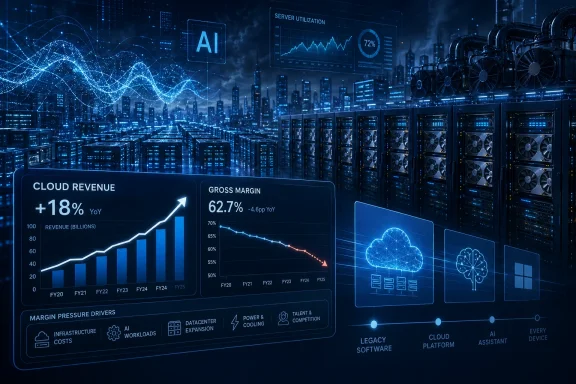
There is no honest way to call Microsoft’s quarter weak. Revenue rose 18 percent year over year, operating income climbed 20 percent to $38.4 billion, net income reached $31.8 billion, and diluted earnings per share hit $4.27. For most companies, that combination would end the conversation.
For Microsoft, it starts a new one. The market has largely accepted that demand for AI-linked cloud services is real, at least among enterprises with budgets large enough to experiment at scale. What investors are now testing is not whether customers want AI capacity, but whether the economics of supplying it resemble the old software business or something much closer to industrial infrastructure.
That distinction matters because Microsoft is not merely adding a feature to Office or sprinkling Copilot branding over Windows. It is buying GPUs, leasing and building data centers, expanding power-hungry cloud regions, hiring AI talent, and absorbing the cost of usage patterns that can be much heavier than traditional SaaS. The company’s own filings say the quiet part plainly: gross margin percentage fell because of continued investment in AI infrastructure and growing AI product usage.
That is the entire story in one accounting line. Microsoft is growing quickly, but it is also spending heavily to make that growth possible.
The Cloud Engine Is Carrying More Than Cloud
The strongest part of the report is still Microsoft Cloud. At $54.5 billion for the quarter, it is now a business so large that many former tech giants would envy it as a standalone company. Azure and other cloud services grew 40 percent, a number that puts Microsoft firmly in the front rank of hyperscale AI infrastructure winners.
But Microsoft Cloud is no longer just a neat segment for investor decks. It is becoming the company’s operating system for revenue growth. Microsoft 365, Azure, Dynamics, LinkedIn’s commercial pieces, GitHub, security, and AI services increasingly feed one another. A customer that adopts Azure OpenAI may also buy GitHub Copilot, Microsoft 365 Copilot, Purview, Defender, Fabric, and more Azure capacity.
That is Microsoft’s strategic advantage: it can amortize AI across a sprawling enterprise estate rather than depending on a single chatbot subscription to pay the bills. This is why its AI story is stronger than OpenAI’s standalone consumer economics and more defensible than many AI start-ups chasing usage without distribution.
Still, scale cuts both ways. When Microsoft says its AI business surpassed a $37 billion annual revenue run rate, up 123 percent year over year, it is an extraordinary claim of traction. It also raises the bar. A $37 billion run-rate business cannot be evaluated like a promising pilot. It must now be judged as a major capital allocation decision.
AI Has Become a Margin Story, Not a Demo Story
The first phase of generative AI was about spectacle. ChatGPT could write, Copilot could summarize, image models could generate, and executives could tell shareholders they had a strategy. That phase is over for Microsoft.
The next phase is accounting. Every prompt costs something. Every enterprise deployment creates support, compliance, security, latency, storage, and compute obligations. Every “agentic” workflow sounds elegant on stage but may require multiple model calls, retrieval steps, permissions checks, and orchestration layers behind the scenes.
This is why investors are paying attention to Microsoft Cloud gross margin falling to 66 percent. That number is still enviable by the standards of most industries, but the direction matters. Microsoft’s historic magic has been selling software at enormous incremental margins. AI risks bending that model toward a world where revenue growth demands constant physical expansion.
The company can offset some of that pressure with better utilization, custom silicon, model optimization, and pricing power. It can also push customers toward higher-value bundles where AI is not sold as raw compute but as business productivity. Yet the burden of proof has shifted. Microsoft must now show not only that AI can increase revenue, but that it can do so without permanently diluting the economics that made Microsoft one of the world’s most profitable companies.
Capex Is the New Product Roadmap
The most important Microsoft product roadmap may no longer be Windows, Office, or even Copilot. It may be capital expenditure.
Microsoft reported additions to property and equipment of roughly $30.9 billion in the quarter, compared with about $16.7 billion in the year-earlier period. For the first nine months of fiscal 2026, that figure was about $80.1 billion, up from roughly $47.5 billion a year earlier. That is not a side project. That is a generational infrastructure bet.
The composition of that spending matters. On the earnings call, Microsoft said roughly two-thirds of quarterly capex went toward short-lived assets, primarily GPUs and CPUs. That is a crucial detail because servers and accelerators do not behave like office buildings. They depreciate faster, become obsolete faster, and must be refreshed as model architectures and accelerator platforms evolve.
This is the uncomfortable part of the AI boom. The infrastructure required to serve demand is not only expensive; it is perishable. A data center shell may have a long life, but the chips inside it live on a much tighter competitive clock. If Microsoft overbuilds, margins suffer. If it underbuilds, Azure growth is constrained and customers may look elsewhere. If it builds just right, it still has to prove the returns exceed what shareholders could have earned from a less capital-intensive business.
That is why the “playing catch-up” anxiety has resonance. Even when Microsoft spends from a position of strength, it may still be reacting to demand curves, GPU availability, OpenAI needs, and rivals’ buildouts. The company is wealthy enough to run this race. The question is whether the race itself becomes less attractive as everyone accelerates.
Windows Is No Longer the Center of Gravity
For WindowsForum readers, the most striking part of this earnings cycle is how little Windows defines the Microsoft story now. Windows OEM revenue declined. Devices revenue declined. Xbox content and services revenue declined. Yet the company still posted a monster quarter because cloud and AI overwhelmed those weaknesses.
This does not mean Windows is irrelevant. Windows remains a strategic endpoint, a distribution layer for Copilot, a management surface for enterprise IT, and the platform through which Microsoft can normalize AI experiences for hundreds of millions of users. But financially, Windows is no longer the engine that explains Microsoft’s valuation.
That shift has been happening for years, but AI sharpens it. Microsoft’s future profit pool is increasingly tied to whether enterprises run workloads on Azure, whether Microsoft 365 customers pay for AI-assisted workflows, whether developers use GitHub and Azure AI tooling, and whether security and data products become mandatory plumbing for AI governance.
The PC still matters as the place where work happens. But the money is moving upward into subscriptions, cloud consumption, identity, compliance, and compute. Windows is becoming a client in a much larger Microsoft system.
Copilot Must Become More Than an Upsell
Microsoft’s AI business is not one product, and that is both a strength and a measurement problem. Azure AI consumption, GitHub Copilot, Microsoft 365 Copilot, security Copilots, Dynamics features, Windows integrations, and OpenAI-related economics all sit under the broader AI umbrella in different ways. That makes the $37 billion run-rate figure impressive, but also hard to dissect.
For enterprise customers, the issue is more practical. Copilot has to justify itself against real budgets, not conference demos. A $30-per-user add-on can look small inside a large Microsoft agreement, but at enterprise scale it becomes a board-level software expense. CIOs will ask whether it reduces headcount, shortens sales cycles, improves code quality, lowers support costs, or merely makes meetings slightly easier to search.
Microsoft’s best argument is that Copilot is not a separate app but an interface layer across the Microsoft stack. If AI becomes how workers query documents, write code, summarize Teams meetings, generate reports, inspect security alerts, and automate workflows, Microsoft can charge for productivity in a way few competitors can match.
The risk is that AI becomes expected rather than premium. If customers come to see summarization and drafting as table stakes, Microsoft may face pressure to include more AI in existing subscriptions while still paying the compute bill. That would be the margin nightmare: AI as a cost of doing business rather than a durable pricing tier.
OpenAI Is an Asset, a Dependency, and an Accounting Complication
Microsoft’s OpenAI relationship remains one of the most important strategic bets in modern tech. It gave Microsoft an early lead in generative AI, transformed Azure’s market perception, and gave the company a story that competitors had to answer. But it also complicates the financial narrative.
The company’s non-GAAP earnings presentation adjusts for the impact of OpenAI investments, which is useful for showing underlying operating performance but also reminds investors that the partnership has real financial consequences. In the March quarter, the reported OpenAI-related hit to net income was small compared with the prior-year period, but the broader issue is not a single quarter’s adjustment.
The deeper question is how much of Microsoft’s AI economics depend on OpenAI’s model roadmap, customer demand, and infrastructure appetite. Microsoft has its own models, its own AI tooling, and its own distribution. But OpenAI remains central to the brand and to Azure’s positioning as a premier AI cloud.
That relationship can be mutually reinforcing. It can also create investor anxiety because OpenAI’s own economics have been under scrutiny, and the cost of frontier model development is not falling fast enough to make the debate disappear. Microsoft is better insulated than OpenAI because it owns enterprise channels and cloud infrastructure, but insulation is not immunity.
The Old Microsoft Could Scale Without Pouring Concrete
The reason investors obsess over AI capex is that it challenges the cleanest version of Microsoft’s business model. Classic Microsoft sold copies of Windows and Office, then subscriptions to Microsoft 365, with astonishing operating leverage. Once software was built, every additional seat was highly profitable.
Cloud changed that equation, but in a manageable way. Azure required data centers, but it also served broad enterprise workloads with relatively predictable demand. AI adds a new intensity. Training, inference, token generation, vector search, and agentic workflows increase the compute burden, and many of the most valuable use cases require low latency and high reliability.
This does not make AI a bad business. It makes it a different business. Microsoft is trying to preserve software-like economics on top of hardware-heavy infrastructure. The company can succeed, but the path runs through utilization, pricing discipline, custom chips, model efficiency, and enterprise lock-in.
That is why a strong quarter did not silence the skeptics. Microsoft has shown demand. It has shown revenue. It has shown operating income growth. What it has not yet fully shown is the mature-state margin profile of AI at hyperscale.
Enterprise IT Will Pay, but It Will Also Measure
The enterprise market is Microsoft’s great advantage because businesses do not buy technology the way consumers do. They buy through contracts, compliance reviews, procurement cycles, security requirements, and integration roadmaps. Microsoft knows that world better than almost anyone.
That gives the company time. A CIO who already runs Microsoft 365, Entra ID, Defender, Teams, SharePoint, Intune, and Azure is not likely to rip everything out because a start-up has a clever AI assistant. Microsoft can bundle, discount, integrate, and wait. It can turn AI adoption into another chapter in the enterprise agreement.
But enterprise patience is not the same as blank-check enthusiasm. IT departments are already being asked to prove AI return on investment. Security teams worry about data exposure. Legal teams worry about retention and hallucination. Finance teams worry about paying premium prices for tools employees may use unevenly.
This is where Microsoft’s profitability challenge meets customer reality. The company needs broad adoption, but not all adoption is equally profitable. Power users may generate heavy compute costs. Casual users may resist premium pricing. Regulated customers may require extra controls. The best AI business is not the one with the most demos; it is the one where customers pay consistently for high-value workflows whose infrastructure cost declines over time.
The Xbox and Devices Weaknesses Are a Warning From the Edges
The declines in Devices and Xbox content revenue are not the center of Microsoft’s earnings story, but they are not meaningless. They show what happens when Microsoft competes in markets where it lacks the same structural advantages it has in enterprise cloud. Hardware is cyclical, gaming content is hit-driven, and consumer attention is expensive.
Those businesses can still matter strategically. Surface can showcase Windows hardware ideas, and Xbox can feed subscriptions, cloud gaming experiments, and consumer services. But they do not set the direction of Microsoft’s profit engine.
The contrast is revealing. In consumer hardware and gaming, Microsoft faces demand volatility and platform competition. In enterprise cloud and AI, it faces capital intensity and margin pressure. The first problem is about growth; the second is about returns.
Microsoft has clearly chosen the second problem. It would rather spend heavily to defend and expand its enterprise cloud position than chase lower-margin consumer hardware growth. That is rational, but it concentrates the company’s future around the success of AI infrastructure.
Wall Street Is Asking the Right Question, Even If It Sounds Ungrateful
It can seem absurd for investors to look at $82.9 billion in quarterly revenue and $31.8 billion in net income and complain. Most companies would be thrilled to have Microsoft’s “problem.” But markets price futures, not trophies.
The future being priced into Microsoft is no longer merely that cloud grows. It is that AI becomes a profit amplifier across the entire stack. That means Azure keeps gaining share, Microsoft 365 Copilot becomes a material paid layer, GitHub Copilot remains sticky with developers, security AI improves monetization, and infrastructure spending eventually produces operating leverage rather than permanent margin compression.
The bear case is not that AI is fake. The more serious bear case is that AI is real but expensive, competitive, and less profitable than the software businesses it is supposed to enhance. In that scenario, Microsoft still grows, but the market may not reward it with the same valuation multiple.
The bull case is that Microsoft is front-loading the buildout for a platform shift as important as cloud itself. If the company can turn today’s capex into tomorrow’s high-utilization, high-margin services, this quarter will look like an early chapter in a much larger compounding story. The difference between those two cases is not demand. It is return on invested capital.
The Numbers That Should Survive the Earnings Hype
Microsoft’s quarter contains enough moving parts to support almost any quick take. The more useful read is narrower: the company is executing extremely well while asking shareholders to tolerate a larger and riskier capital cycle than the old Microsoft required.
- Microsoft’s fiscal Q3 2026 results were strong by any normal standard, with revenue, operating income, net income, and earnings per share all growing double digits.
- Microsoft Cloud is now the company’s decisive growth engine, and Azure’s 40 percent growth shows that AI demand is translating into real cloud consumption.
- AI infrastructure is already pressuring gross margin, which means the market is right to focus on profitability rather than revenue growth alone.
- Capital expenditure has become a strategic variable for Microsoft, not a back-office line item, because AI capacity determines how much demand the company can actually serve.
- Windows, Devices, and Xbox matter strategically, but they no longer explain Microsoft’s financial center of gravity.
- The next phase of Microsoft’s AI story will be judged by durable margin dollars, not by Copilot demos or annualized AI revenue run-rate milestones.
Microsoft has earned the benefit of the doubt more than most companies in tech, but it has not earned a permanent exemption from arithmetic. The company is trying to turn AI from an infrastructure arms race into a software-margin platform, and the March 2026 quarter shows both why that bet is credible and why it remains unresolved. If Microsoft can make the cost curve bend while customers keep spending, this will look like the quarter when AI moved from promise to operating leverage; if not, it will be remembered as the moment investors stopped applauding growth and started reading the bill.
References
- Windows Central Windows Central