

Microsoft’s latest earnings cycle turned the spotlight back on a blunt truth: sustained leadership in generative AI requires buying the future — and investors are growing restless while the bills come due.
Microsoft’s January 29, 2025 quarter crystallized a tension that has been building across Big Tech for more than a year: revenue and product momentum remain solid, but capital spending and the timing of AI monetization are testing market patience. The company reported $69.6 billion in revenue for the quarter, with Azure growth at roughly 31% and capital expenditures of $22.6 billion, numbers management walked investors through on the earnings call.
At the same time, Reuters and other outlets captured investor reaction: shares slipped in after-hours trading when guidance and the magnitude of AI-related spending didn’t align with the market’s near-term expectations. That slump was explained as a direct consequence of a mismatch between Microsoft’s required long-term infrastructure buildout and investors’ shorter-term return horizons.
This piece unpacks the numbers, the commercial strategy behind them (notably the OpenAI tie-up and Copilot rollouts), the competitive and geopolitical dynamics that complicate Microsoft’s path, and the concrete signals investors and IT leaders should watch next. I cross-checked Microsoft’s own filings and transcripts with independent reporting to ensure claims and figures are corroborated.
Independent reporting confirmed the shape of the dilemma: Azure growth remains material but slowed relative to the heady expansion that investors had earlier priced into Microsoft’s valuation; meanwhile capex jumped materially, compressing free cash flow in the near term.
This nuance matters: investors aren’t simply looking at top-line growth — they’re asking whether growth is diversifying across business lines or concentrated in capital‑intensive AI compute consumption that yields lower margins today.
Independent reports echoed the spike in capex and the investor unease it created, particularly because free cash flow was compressed in the near term. Reuters and Bloomberg summarized market responses and highlighted that the scale of spending is comparable to prior historical infrastructure buildouts across tech.
This diversification by OpenAI is important because it changes Microsoft’s competitive calculus: preferential co‑development still yields product advantages, but the capacity economics and long-term host revenue are now more fungible than they were when the relationship was effectively exclusive.
The core struggle is behavioral: embedding AI into everyday workflows changes how people work. It's not just a software upgrade — it’s a process and training change, and therefore adoption curves are inherently slower than in simple SaaS seat expansions. That delay directly affects how quickly seat-based revenue scales and converts into margin expansion.
Yet the market’s patience is finite. Small misses in Azure growth expectations or the visibility of increased capex are magnified because investors are being asked to accept a multi‑year payoff window for very large capital commitments. Reuters’ coverage of the earnings reaction captured this sentiment succinctly.
For IT leaders and Windows users, the practical outcome is likely beneficial: richer AI features will continue to be woven into mainstream products, but procurement teams must plan for new cost models and governance needs. For investors, Microsoft’s path is not binary — it is a multi-year transformation with measurable upside and matched execution risks. The next several quarters will read less like technology show-and-tell and more like a financial scoreboard: capital discipline, improved unit economics, and demonstrable seat-based monetization will decide whether Microsoft’s AI bet is the strategic masterstroke management believes it to be — or an expensive lesson in how quickly model economics and competitive landscapes can evolve.
Source: Techzine Global Microsoft's AI offensive clashes with investors' patience
 Background
Microsoft’s January 29, 2025 quarter crystallized a tension that has been building across Big Tech for more than a year: revenue and product momentum remain solid, but capital spending and the timing of AI monetization are testing market patience. The company reported $69.6 billion in revenue for the quarter, with Azure growth at roughly 31% and capital expenditures of $22.6 billion, numbers management walked investors through on the earnings call. At the same time, Reuters and other outlets captured investor reaction: shares slipped in after-hours trading when guidance and the magnitude of AI-related spending didn’t align with the market’s near-term expectations. That slump was explained as a direct consequence of a mismatch between Microsoft’s required long-term infrastructure buildout and investors’ shorter-term return horizons.
This piece unpacks the numbers, the commercial strategy behind them (notably the OpenAI tie-up and Copilot rollouts), the competitive and geopolitical dynamics that complicate Microsoft’s path, and the concrete signals investors and IT leaders should watch next. I cross-checked Microsoft’s own filings and transcripts with independent reporting to ensure claims and figures are corroborated.
Overview: Why Microsoft is spending like a hyperscaler
Microsoft’s rationale is simple and structural: to host and deliver modern large language models and related AI services at scale you need:- vast data-center capacity,
- fast GPU/accelerator fleets,
- persistent memory and networking investments, and
- software and sales motion work to convert pilots into enterprise contracts.
Independent reporting confirmed the shape of the dilemma: Azure growth remains material but slowed relative to the heady expansion that investors had earlier priced into Microsoft’s valuation; meanwhile capex jumped materially, compressing free cash flow in the near term.
Azure: growth is still strong — but the bar is higher
What the numbers show
Azure grew about 31% year-over-year in the quarter, an impressive rate by historical standards but slightly below the consensus Street estimate. Microsoft said AI contributed about 13 percentage points of Azure’s growth during the period, underscoring that the cloud’s current expansion is disproportionately driven by AI workloads.This nuance matters: investors aren’t simply looking at top-line growth — they’re asking whether growth is diversifying across business lines or concentrated in capital‑intensive AI compute consumption that yields lower margins today.
Why growth appears to be slowing
Three linked factors are at play:- Capacity constraints: building the physical facilities and installing GPU farms is time-consuming; Microsoft reiterated that some of the benefits from new builds will arrive over quarters, not weeks.
- Customer behavior: enterprises are experimenting across multiple cloud providers and taking more time to commit to seat-based or consumption models for AI services. Microsoft’s own commentary and external analyst notes point to more cautious procurement cycles.
- Comparables: Wall Street’s expectations were set during an earlier, more exuberant phase of cloud growth; at this scale, even a small deceleration feels large in dollar terms.
The infrastructure bill: CapEx, chips and the cost of being first
The raw figures
Microsoft reported capital expenditures of $22.6 billion in the quarter, with management emphasizing that more than half of cloud- and AI-related capex is in long-lived assets intended to support monetization for many years. The company also called out server purchases (CPUs and GPUs) as part of the spend, with cash paid for property, plant, and equipment reported separately.Independent reports echoed the spike in capex and the investor unease it created, particularly because free cash flow was compressed in the near term. Reuters and Bloomberg summarized market responses and highlighted that the scale of spending is comparable to prior historical infrastructure buildouts across tech.
The compute stack and unit economics
Running leading LLMs at scale is costly. Costs come from:- inference and training GPU-hours (accelerators such as NVIDIA H100/GB200 and alternatives),
- power and facility OPEX,
- specialized networking and memory systems,
- amortization of long-lived data-center builds,
- R&D and model engineering costs.
The OpenAI relationship: advantage, dependency and a changing landscape
Strategic benefits
Microsoft’s early and deep commercial relationship with OpenAI is a major strategic asset. It has enabled preferential access, co‑engineering pathways and a visible route to integrating advanced models into products like Bing, Copilot, and Azure AI services. The company has publicly pointed to large Azure bookings tied to OpenAI commercial engagements.The changing terms and competition for capacity
The relationship, however, is not static. Over 2024–2025 OpenAI announced partnerships and capacity deals with other large infrastructure players — notably Oracle and the broader “Stargate” data‑center initiatives — which signaled an evolution from exclusivity to right of first refusal or more multi‑provider sourcing. That shift reduces Microsoft’s structural exclusivity advantage and makes some future revenue more contestable. CNBC and other outlets reported that Microsoft’s exclusive-hosting status for OpenAI models was effectively diluted as OpenAI broadened its infrastructure partners.This diversification by OpenAI is important because it changes Microsoft’s competitive calculus: preferential co‑development still yields product advantages, but the capacity economics and long-term host revenue are now more fungible than they were when the relationship was effectively exclusive.
Copilot: product strategy and the hard task of monetizing productivity AI
From platform to seat-based revenue
Microsoft’s product play is to embed AI into existing software businesses where long‑standing annuity revenue streams already exist. That’s where Microsoft 365 Copilot sits: packaged as a seat-based add-on and integrated into Word, Excel, Outlook and other apps, Copilot is the company’s primary experiment in turning AI features into structural software revenue rather than pure cloud consumption. Management reported ARPU improvements driven by Copilot and rising Microsoft 365 seat adoption.Pricing and adoption friction
Copilot’s commercial pricing has been notable: Microsoft introduced $30-per-user-per-month seat pricing for commercial Copilot (with alternative tiers and Copilot Pro options for consumers and SMBs). That price point and the product’s integration model make Copilot both a high-value upsell and a potential obstacle in price-sensitive enterprise environments. Early reporting from CNBC and other outlets documented slow-but-steady adoption patterns and the launch of lower‑barrier consumption options to broaden the funnel.The core struggle is behavioral: embedding AI into everyday workflows changes how people work. It's not just a software upgrade — it’s a process and training change, and therefore adoption curves are inherently slower than in simple SaaS seat expansions. That delay directly affects how quickly seat-based revenue scales and converts into margin expansion.
Competition: price, models and the geopolitical dimension
Low-cost competitors and a potential price war
Anxiety about price competition is real. Chinese AI providers and some nimble startups pointed to lower-cost models that could undercut the high incremental costs of running current LLMs. Media and analyst coverage amplified concerns that cheaper models could compress pricing for inference and hosting services — a direct threat to hyperscalers that have front‑loaded infrastructure investments. Reuters, Nasdaq, and various analyst notes flagged this dynamic as a near-term risk.The Stargate/Oracle development
OpenAI’s capacity diversification included large-scale deals involving Oracle and partners in “Stargate” initiatives, which were widely reported by the Financial Times, Bloomberg and others. Those deals represent a parallel source of AI capacity and are strategically significant because they demonstrate that model hosts can now aggregate multiple hyperscale providers and bespoke facilities, reducing lock-in to any single cloud.Why Microsoft’s scale still matters
Despite these risks, Microsoft retains structural advantages:- one of the broadest enterprise sales channels and installed bases,
- deep integration into Windows, Office, Teams and Dynamics,
- an expanding partner and ISV ecosystem,
- long-term enterprise contracts and compliance certifications that matter in regulated industries.
What investors are watching: measurable signals and red flags
Investors should monitor a short list of concrete metrics to judge whether Microsoft’s AI investments are on a sustainable trajectory.- Quarterly capital expenditures and cash paid for PP&E: look for capex normalization or clear improvements in the ratio of revenue to capex over consecutive quarters. A multi‑quarter capex spike without improving monetization is a red flag.
- Azure growth excluding AI: if non‑AI Azure growth deteriorates while AI is lumpy, the business is concentrating risk in AI consumption.
- Copilot seat ARPU, adoption rates and churn: durable seat economics matter far more than early trials. Microsoft has highlighted ARPU benefits, but consistent, disclosed metrics would reduce investor anxiety.
- Commercial bookings and remaining performance obligations (RPO): Microsoft reported a 67% increase in commercial bookings (driven heavily by Azure/OpenAI contracts). Track whether that growth becomes more broadly distributed across customers and verticals.
- GPU/accelerator pricing and supply trends: declining accelerator prices improve unit economics rapidly; supply tightness keeps costs elevated. Independent chip-market reporting and Nvidia guidance are useful cross-checks.
- OpenAI capacity deals/partnerships: any additional OpenAI capacity agreements with other hosts reduce Microsoft’s exclusivity and therefore future host revenues. Continued diversification would be a strategic shift to watch.
Risks and counterarguments
Real and material risks
- Execution complexity: global data-center builds, supply chain constraints for chips and materials, and the pace of software optimization create multiple operational failure points. If any substantial part of capacity is misallocated or delayed, Microsoft could face stranded assets.
- Price compression from low-cost models: if inference costs fall dramatically or open-source models reach parity at much lower cost, hyperscalers may see margin erosion and reduced pricing power. Media and analyst attention to Chinese providers and startup claims underscore this risk — many of which deserve skeptical scrutiny because cost claims sometimes omit amortization or ancillary expenses.
- Dependency concentration: heavy revenue exposure tied to a limited set of large customers (e.g., OpenAI) can create concentration risk if those partners diversify capacity or change commercial terms. Microsoft’s exposure through large Azure bookings is visible in its booking and RPO disclosures.
Why the strategy can still work
- Platform leverage: Microsoft can monetize AI in multiple ways beyond raw GPU hours — seat add‑ons (Copilot), improved Microsoft 365 ARPU, managed services, skilling and verticalized solutions. These productized levers can compound value even if pure infrastructure margins are pressured.
- Financial strength and optionality: Microsoft’s balance sheet and stable software annuities give it the runway to pursue a multi-year transformation rather than being forced into short-term retrenchment. Historically, Microsoft has executed long horizon transformations successfully.
- Engineering and product synergies: deep integration into Office and Windows offers a unique distribution advantage for productivity AI that competitors cannot replicate easily. If Copilot materially raises ARPU and retention, that alone could justify a large portion of the AI spend.
Tactical implications for enterprise IT and Windows users
- Procurement discipline: IT teams should demand clearer TCO comparisons between seat-based Copilot buys and bespoke/best-of-breed AI solutions. Short pilots should include explicit measures of productivity gains and re-skilling costs.
- Hybrid and multi-cloud readiness: given vendor competition for model hosting, enterprises should design AI workloads to be cloud-agnostic where possible to avoid vendor lock-in and to take advantage of competitive pricing or specialization.
- Governance and risk management: more AI features mean more governance overhead; expect procurement to push for contractual SLAs, data-residency guarantees and clearer model-risk protections in enterprise contracts.
How to read the next quarters
The market’s verdict over the coming 12–24 months will hinge less on theory and more on measurable finance:- Does capex run-rate stabilize and begin to convert into higher gross margins for cloud and Microsoft Cloud gross margin percentage?
- Do Copilot and other productized AI offerings show consistent ARPU growth and stickiness across customer cohorts?
- Does Azure sustain growth that’s not entirely AI‑consumption driven, indicating broader cloud demand and reduced concentration risk?
- Do GPU prices and supply move in a direction that materially improves unit economics?
Final assessment: deliberate long game, but the market wants checkpoints
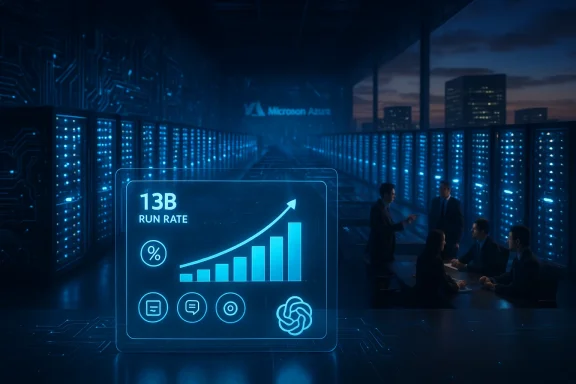
Microsoft’s AI offensive is both strategically coherent and capital‑intensive. The company built a layered strategy: exclusive early model relationships and co‑engineering with OpenAI, massive infrastructure investments to host models, and productized AI features like Copilot to monetize downstream. Management presented an emerging AI revenue base above a $13 billion run rate and pointed to Copilot-driven ARPU improvements — concrete signs that this is not pure optimism.Yet the market’s patience is finite. Small misses in Azure growth expectations or the visibility of increased capex are magnified because investors are being asked to accept a multi‑year payoff window for very large capital commitments. Reuters’ coverage of the earnings reaction captured this sentiment succinctly.
For IT leaders and Windows users, the practical outcome is likely beneficial: richer AI features will continue to be woven into mainstream products, but procurement teams must plan for new cost models and governance needs. For investors, Microsoft’s path is not binary — it is a multi-year transformation with measurable upside and matched execution risks. The next several quarters will read less like technology show-and-tell and more like a financial scoreboard: capital discipline, improved unit economics, and demonstrable seat-based monetization will decide whether Microsoft’s AI bet is the strategic masterstroke management believes it to be — or an expensive lesson in how quickly model economics and competitive landscapes can evolve.
Source: Techzine Global Microsoft's AI offensive clashes with investors' patience
