

Microsoft's latest quarterly results have delivered a classic Silicon Valley paradox: blockbuster top-line growth driven by cloud and AI, paired with record-breaking capital expenditures that left Wall Street questioning whether the company’s massive AI bet will pay off quickly enough to justify the cost.
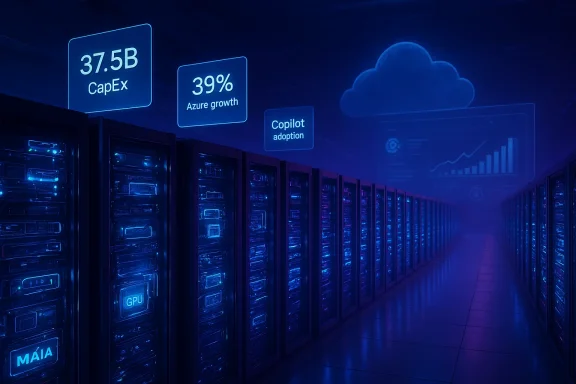
Microsoft disclosed that capital expenditures (CapEx) rose to an unprecedented level of $37.5 billion in the October–December quarter, an increase of roughly two-thirds year‑on‑year and driven largely by purchases of short‑lived compute inventory (GPUs and CPUs) for AI training and inference.
At the same time the company reported Azure and other cloud services grew about 39% in the quarter — a very healthy pace in absolute terms but only a hair above Street expectations, which amplified investor sensitivity to the capex number.
On the earnings call CEO Satya Nadella and other executives disclosed fresh usage metrics for Microsoft’s AI products — notably that M365 Copilot has reached 15 million annual users — and reiterated that AI adoption remains in the “early innings.”
The market reaction was immediate: Microsoft shares slipped sharply in after‑hours trading as investors digested the scale of near‑term spending relative to the pace of monetization. Multiple outlets reported that shares fell by roughly 6–6.5% during extended trading.
Internal summaries and community analyses that tracked the quarter’s narrative capture the same tension: strong cloud revenue and accelerating AI adoption, but a new era of capital intensity that raises the bar for demonstrable monetization and margin recovery.
At the same time, the scale and timing of the spending — and the reliance on consumption economics that can be volatile — mean the company must prove faster monetization and margin recovery to satisfy risk-averse investors. The market’s reaction reflects a narrowing runway: scale gives Microsoft the opportunity to dominate AI infrastructure and experiences, but it also magnifies the cost of missteps.
For WindowsForum readers, the practical conclusion is straightforward: expect faster, deeper AI integration across Microsoft products and prepare to manage both the technical and financial implications in enterprise environments. Watch the next quarters for utilization metrics, Copilot monetization details, and how Microsoft manages hardware cost inflation — those will determine whether today’s capex becomes tomorrow’s durable moat or a prolonged drag on margins.
Microsoft’s latest quarter is a landmark moment in the cloud‑AI transition: it offers compelling evidence of product adoption and scale, but also forces the industry to grapple with capital intensity and timing of returns. For practitioners and decision‑makers in the Windows ecosystem, the rule is to prepare: architect for AI‑enabled workflows, build cost‑conscious pilots, and set governance guardrails — because AI is moving from experiment to enterprise staple, and Microsoft is clearly betting everything on being the backbone for that shift.
Source: Latest news from Azerbaijan Microsoft AI spending jumps, cloud growth disappoints | News.az
 Background: what Microsoft reported and why the market paused
Microsoft disclosed that capital expenditures (CapEx) rose to an unprecedented level of $37.5 billion in the October–December quarter, an increase of roughly two-thirds year‑on‑year and driven largely by purchases of short‑lived compute inventory (GPUs and CPUs) for AI training and inference. At the same time the company reported Azure and other cloud services grew about 39% in the quarter — a very healthy pace in absolute terms but only a hair above Street expectations, which amplified investor sensitivity to the capex number.
On the earnings call CEO Satya Nadella and other executives disclosed fresh usage metrics for Microsoft’s AI products — notably that M365 Copilot has reached 15 million annual users — and reiterated that AI adoption remains in the “early innings.”
The market reaction was immediate: Microsoft shares slipped sharply in after‑hours trading as investors digested the scale of near‑term spending relative to the pace of monetization. Multiple outlets reported that shares fell by roughly 6–6.5% during extended trading.
Internal summaries and community analyses that tracked the quarter’s narrative capture the same tension: strong cloud revenue and accelerating AI adoption, but a new era of capital intensity that raises the bar for demonstrable monetization and margin recovery.
Overview: the numbers that matter
Short, verifiable pull‑outs from the quarter are essential for understanding the debate:- Total quarterly CapEx: $37.5 billion (up ~66% YoY), with about two‑thirds allocated to compute inventory (GPUs/CPUs) and AI infrastructure.
- Azure and cloud growth: roughly 39% year‑over‑year growth for the quarter.
- Total revenue: Microsoft posted strong overall top‑line growth (the company reported revenue of $81.3 billion for the quarter as widely reported).
- New Copilot metric: 15 million annual users for M365 Copilot, a first direct usage disclosure for Microsoft’s flagship AI assistant.
- Forward guidance: Microsoft forecast Azure revenue growth of 37–38% for the next quarter, roughly in line with market consensus but not enough to quell investor concerns.
- Cumulative AI spending claim: management materials and reporting noted the company has spent more than $200 billion on AI‑related efforts since the start of fiscal 2024, a figure that has been widely repeated in reporting and conference call commentary. This figure aggregates multiple categories of investment and is treated cautiously by analysts because it blends CapEx, strategic investments, and operating costs.
Why the capex spike matters — and how to read it
The $37.5 billion quarterly CapEx is more than a headline; it’s a structural signal about how hyperscalers are building for AI.What Microsoft is buying, and why it’s expensive
- Microsoft is buying high‑end GPUs and custom silicon, short‑lived compute inventory, and expanding datacenter capacity optimized for AI workloads. These purchases drive immediate cash outlays but will be depreciated over time.
- About two‑thirds of the quarter’s capex was driven by compute inventory purchases rather than long‑lived datacenter shells, meaning a large chunk of the spend hits near‑term cost-of‑goods and working capital dynamics.
The economics are different in an AI world
AI workloads drive a consumption model: revenue can scale with GPU‑hours, inference calls, and premium AI features like Copilot seats, but the cost base is also GPU‑heavy. That creates a timing mismatch:- Upfront buying of accelerators (GPUs) is immediate cash outflow.
- Revenue recognition and margin benefits depend on sustained utilization, price per inference, and enterprise adoption curves.
Investors worry about whether utilization and pricing will keep up with the pace of hardware investment.
Memory‑chip and component cost risk
Microsoft flagged that rising memory‑chip prices could compress cloud margins. Supply dynamics for high‑bandwidth memory (HBM) and GPUs remain volatile, and when your product cost is hardware‑intensive, price inflation can materially alter gross margins.Azure growth: strong, but not invulnerable
Azure’s ~39% growth is a substantive achievement — the cloud still grows at a pace that would be enviable for most enterprise businesses — but market expectations have become hypersensitive.Why 39% feels both good and disappointing
- It’s an impressive absolute rate for a business the size of Azure.
- It nudged above consensus rather than comfortably beating expectations; for a company spending at scale to secure AI capacity, investors wanted clearer proof that the spending was accelerating monetization.
Where growth is coming from
- A meaningful portion of Azure’s growth is tied to AI workloads and services like Azure OpenAI, AI Foundry, and enterprise Copilot deployments.
- Microsoft’s integrated strategy — bundling Azure with Microsoft 365, Dynamics 365, GitHub, and industry vertical solutions — creates multiple monetization vectors for AI adoption.
Competitive pressure
- New large models from rivals (Google’s Gemini, Anthropic’s Claude, specialized providers) are narrowing Microsoft’s first‑mover lead. When competitors secure marquee contracts or win on features, the perception of Azure’s unstoppable growth softens.
M365 Copilot and product‑level monetization: adoption signals
Microsoft disclosed that M365 Copilot has 15 million annual users, which is notable because management has historically been conservative about disclosing usage for newly monetized AI features.Why the Copilot number matters
- It demonstrates paid adoption at scale for a premium AI productivity product (Copilot is sold as a subscription add‑on), which suggests that enterprises are willing to pay for AI functionality embedded directly in productivity workflows.
- It gives investors a more granular view of how much of Microsoft’s productivity revenue is shifting from legacy seat licenses to higher‑value AI services.
Limits of the disclosure
- The “15 million” metric is an annual‑user figure, not a daily active user count or a revenue disclosure. Analysts rightly ask how many seats are paid vs. trial, and what average revenue per seat looks like over time.
The investor calculus: risk, patience, and the timeline for ROI
Investors are essentially asking three questions:- Can Microsoft ramp utilization quickly enough to amortize the hardware investment?
- Will AI monetization (Copilot seats, Azure consumption, model licensing) scale faster than incremental cost?
- Is concentration risk — especially the company’s exposure to OpenAI — manageable?
Concentration and counterparty risk
Microsoft acknowledged that a significant portion of its contracted backlog and remaining performance obligations is tied to OpenAI-related commitments; reporting suggested roughly 45% of RPO linked to OpenAI. Heavy reliance on a single large partner creates execution and concentration risk if that partner’s strategy changes.Time horizon matters
This is not a one‑quarter story. Transformative infrastructure investments for AI are multi‑year plays. Microsoft is positioning for multi‑year revenue streams from AI, but investors increasingly demand clearer medium‑term milestones showing margin recovery and cash flow conversion.Strengths in Microsoft’s position — why this is still a plausible path to leadership
Despite near‑term worries, Microsoft has several durable advantages:- Integrated platform and enterprise relationships. Microsoft’s deep enterprise penetration and installed base of Office and Azure customers creates a high‑quality distribution channel for Copilot and Azure AI services.
- Strategic OpenAI alignment. The partnership gives Microsoft preferential access to leading model capabilities and is a springboard for differentiated product experiences — albeit with concentration tradeoffs.
- Silicon and software stack investments. Microsoft has invested across the stack (datacenters, custom Maia chips, VM types optimized for AI) which can incrementally improve price/performance and drive stickiness. Microsoft highlighted first‑party accelerators and Maia VMs as examples.
- Diversified monetization levers. Beyond raw compute hours, Microsoft can monetize through seat‑based Copilot subscriptions, premium enterprise features in Dynamics 365, GitHub Copilot for developers, and industry vertical solutions.
Risks and potential downsides to watch
Even with strengths, there are material risks and scenarios that could alter the payoff.1. Hardware cost and supply risk
Rising memory and GPU prices can compress margins; prolonged high prices or supply shocks would extend the payback period. Microsoft explicitly warned memory‑chip costs could weigh on cloud margins.2. Intensifying competition on model quality and price
If competitors deliver models with similar capability at materially lower cost or better ergonomics, the industry could see price pressure on inference and hosting fees. That would challenge the consumption economics that underpin Azure AI monetization.3. Execution and utilization risk
Even with huge capacity, unused GPU time is wasted capital. Microsoft must keep utilization high across a diverse mix of customers and workloads to amortize the investment. Failure to hit utilization targets will materially harm margins.4. Regulatory and reputational risk
Heightened scrutiny of generative AI — from safety, hallucination risks, to prre — can introduce regulatory headwinds that slow enterprise deployments or raise compliance costs. These issues are increasingly on regulators’ radars and could translate into new obligations for providers.5. Concentration risk with OpenAI
A large share of contracted backlog tied to a single partner increases earnings and execution risk; if OpenAI’s strategy changes or the economics of their commitments shift, Microsoft could face material revenue and operational exposure.What this means for IT professionals, Windows admins, and enterprise buyers
WindowsForum readers — many of whom manage Windows fleets, AD, Azure subscriptions, or enterprise deployments — should care about more than just stock‑market gyrations. This transition shapes product roadmaps and pricing.Practical implications
- Expect more AI features within Windows and Microsoft 365 ecosystems; these will often require Azure back‑end services and may introduce new management tasks (license management, nete configuration).
- Budget cycles should start to account for incremental consumption charges when rolling out AI features at scale (Copilot seats, backend inference calls).
- Security and governance: AI introduces new attack surfaces (data sent to models, prompt injection risks). Plan for policy, logging, and data governance controls.
Recommendations for IT teams
- Inventory: identify workflows and user groups that will most benefit from Copilot or Azure AI services.
- Pilot with cost controls: run scoped pilots with strict telemetry on usage and per‑seat costs to build accurate TCO models.
- Governance framework: define data classification and acceptable‑use policies for model interactions.
- Negotiate enterprise terms: where possible, secure enterprise pricing or committed consumption terms to reduce unit economics volatility.
Investor and corporate strategy takeaways
For investors and corporate strategists, the quarter crystallizes the trade‑offs inherent in building AI infrastructure at hyperscale.- Short run: heightened capex and hardware purchases will pressure near‑term margins and free cash flow.
- Medium run: monetization depends on utilization, product differentiation, and pricing power.
- Long run: if Microsoft sustains high utilization, extracts premium pricing for integrated AI experiences, and amortizes infrastructure efficiently, the investment could compound into durable advantages across productivity, cloud, and developer tools.
- Copilot ARR/ARPU progression and churn metrics.
- Azure AI utilization rates and price per inference trends.
- CapEx cadence and how much is long‑lived facility vs. short‑lived compute inventory.
- How Microsoft diversifies contracted backlog away from single‑partner concentration.
Bottom line: a decisive pivot with a narrow runway for proof
Microsoft’s results show a company rapidly scaling for an AI future: record capex, near‑40% Azure growth, and meaningful paid Copilot adoption. Those facts support the thesis that Microsoft is a central player in enterprise AI.At the same time, the scale and timing of the spending — and the reliance on consumption economics that can be volatile — mean the company must prove faster monetization and margin recovery to satisfy risk-averse investors. The market’s reaction reflects a narrowing runway: scale gives Microsoft the opportunity to dominate AI infrastructure and experiences, but it also magnifies the cost of missteps.
For WindowsForum readers, the practical conclusion is straightforward: expect faster, deeper AI integration across Microsoft products and prepare to manage both the technical and financial implications in enterprise environments. Watch the next quarters for utilization metrics, Copilot monetization details, and how Microsoft manages hardware cost inflation — those will determine whether today’s capex becomes tomorrow’s durable moat or a prolonged drag on margins.
Quick checklist: what to watch next (for readers and IT decision‑makers)
- Monitor Microsoft updates on Copilot seat revenue and ARPU (should be disclosed more granularly if the product is to justify the capex).
- Watch Azure AI utilization signals in earnings and guidance — utilization is the primary lever for capex payback.
- Track CapEx cadence: is the $37.5B quarter a peak or the new base? Microsoft’s commentary on upcoming quarter capex and memory‑chip prices is telling.
- Observe competitive wins for Google Gemini, Anthropic, and other models — customer migrations or lost deals can put pressure on pricing.
- Review contract concentration disclosures (OpenAI exposure) to assess counterparty risk.
Microsoft’s latest quarter is a landmark moment in the cloud‑AI transition: it offers compelling evidence of product adoption and scale, but also forces the industry to grapple with capital intensity and timing of returns. For practitioners and decision‑makers in the Windows ecosystem, the rule is to prepare: architect for AI‑enabled workflows, build cost‑conscious pilots, and set governance guardrails — because AI is moving from experiment to enterprise staple, and Microsoft is clearly betting everything on being the backbone for that shift.
Source: Latest news from Azerbaijan Microsoft AI spending jumps, cloud growth disappoints | News.az
