

AI in regulated industries is no longer an abstract future — it’s a present-day operational challenge that forces a hard reckoning between speed and restraint. In practice, organizations that move fastest with AI without building governance, provenance, and identity-first protections are already paying a price; those that succeed do so by treating AI as a new class of infrastructure that must be governed as rigorously as payments systems, medical records, or confidential government data.
Regulated sectors — financial services, healthcare, government, utilities, and critical infrastructure — face three simultaneous pressures: the promise of dramatic productivity gains from generative AI and agentic assistants; the legal and reputational fallout from mismanaged data and automated decisions; and emergent operational risks posed by partially autonomous agents. In the last 18 months industry vendors and regulators have moved from guidance to concrete controls: multinational cloud providers are offering in‑country processing options, DLP systems now block sensitive text entered into LLM prompts, and international standards and regulatory frameworks are being enacted that explicitly target general‑purpose AI and high‑risk systems.
At the same time, real incidents — configuration errors, unexpected model behaviors, and prompt‑level data exposure — have shown how brittle naive deployments can be. These events are not hypothetical. They illustrate how assumptions like “cloud vendor default settings are safe for regulated data” are no longer acceptable without demonstrable controls and continuous assurance.
Yet implementation experience reveals several realities:
Practical helper‑first playbook:
Emerging research and vendor capabilities are beginning to address the most painful technical gaps — authenticated workflows, runtime policy attestation, and immutable provenance — but many of these techniques are nascent. Until they are mature and standardized, regulated organizations must design layered defenses and operational guardrails that make AI useful without making the enterprise brittle.
The choice for regulated organizations is not between innovation and safety; it’s how fast you can move when you insist on both. Build the playbook, instrument everything, and treat AI as a mission‑critical system that earns trust through auditable controls and steady, measured deployments. When you do that, the productivity benefits of Copilot and agentic assistants are real — and sustainable inside the guardrails regulators and citizens expect.
Source: MSDynamicsWorld.com Copilot Chronicles, February 2026: Implementing AI in Regulated Industries — Innovation Inside the Guardrails
 Background
Regulated sectors — financial services, healthcare, government, utilities, and critical infrastructure — face three simultaneous pressures: the promise of dramatic productivity gains from generative AI and agentic assistants; the legal and reputational fallout from mismanaged data and automated decisions; and emergent operational risks posed by partially autonomous agents. In the last 18 months industry vendors and regulators have moved from guidance to concrete controls: multinational cloud providers are offering in‑country processing options, DLP systems now block sensitive text entered into LLM prompts, and international standards and regulatory frameworks are being enacted that explicitly target general‑purpose AI and high‑risk systems.At the same time, real incidents — configuration errors, unexpected model behaviors, and prompt‑level data exposure — have shown how brittle naive deployments can be. These events are not hypothetical. They illustrate how assumptions like “cloud vendor default settings are safe for regulated data” are no longer acceptable without demonstrable controls and continuous assurance.
Why regulated environments are different
The governance delta: compliance vs. innovation
Regulated organizations operate under statutory obligations that can carry civil penalties, criminal exposure, or license revocation. This creates a governance delta: risk tolerances are lower and decision-making layers are higher. Where a consumer app team can A/B test feature rollouts with minimal exposure, a bank or hospital needs documented risk assessments, legal sign‑offs, and auditable controls before a system that influences decisions is allowed to reach production.- Decision traceability is required for audits and incident investigations.
- Data residency matters: cross‑border transfers can violate national law or sectoral rules.
- Explainability and contestability are expected where automated decisions materially affect individuals.
The new perimeter: models, agents, prompts
Traditional security focused on networks, endpoints, and privileged accounts. Today, models and agents are a new class of runtime with their own attack surface:- Prompt injection lets adversaries coax systems into leaking secrets or performing unauthorized actions.
- Agentic loops (planning → action → tool use → reflection) can amplify small errors into large operational impacts.
- Shadow AI — unsanctioned tools bought by business teams — erodes central visibility and control.
Regulatory and standards landscape (what matters right now)
Regulated organizations must design for a layered compliance reality: national privacy laws (e.g., GDPR), sectoral rules (e.g., HIPAA for health data), and AI‑specific obligations.- The EU’s AI regulatory framework has moved from concept to phased implementation. Key dates require organizations to prepare for transparency and governance obligations for general‑purpose AI and broader high‑risk controls within the next two years. These transition timelines mean European operations must mature controls fast to avoid enforcement when the next phases take effect.
- International standards such as ISO/IEC 42001 (AI management systems) are available and increasingly used as a blueprint for internal AI governance and third‑party attestations.
- Major cloud and SaaS vendors are publishing responsible‑AI and assurance programs (including third‑party audit evidence) intended to help customers meet regulatory requirements — but vendor assurances are a component, not a substitute, for tenant controls inside customer environments.
The Microsoft Copilot moment: practical controls and recent lessons
Large enterprise vendors, notably Microsoft, have introduced controls designed for regulated customers: in‑country processing options for Copilot interactions, enhanced Purview DLP that blocks sensitive data in prompts, and Copilot governance tooling intended to manage agents and policy enforcement. These features are specifically aimed at public sector and compliance‑heavy tenants.Yet implementation experience reveals several realities:
- Built‑in protections reduce risk but do not eliminate it. Operational bugs can bypass protections if configuration or code errors occur; recent incidents exposed how sensitivity labels can be misapplied or software defects can cause labeled content to be processed incorrectly. Such incidents underscore the need for independent verification, monitoring, and rapid patching processes.
- Sovereign controls — local processing and data residency — materially reduce cross‑border legal complexity for many deployments, but they are not a panacea for governance. Residency does not remove the need for access controls, auditing, or contractual assurances about model training and retention.
- Blocking prompt content with DLP is an important baseline control, but it must be combined with identity management, privilege separation, and runtime governance for agentic workflows. In other words, stop data at the input and control what agents can do with data once they have it.
Operational model: what “helper‑first” looks like in practice
The panel insight that “helper‑first” may beat “AI‑first” is not an academic preference — it’s an operational prescription. Helper‑first means designing AI implementations to augment, not replace, human workflows at first; the emphasis is on bounded, auditable tasks that deliver clear ROI while keeping risk exposure low.Practical helper‑first playbook:
- Start with read‑only augmentation: search, summarization, and extraction workflows that surface information to humans but do not autorun actions.
- Apply strict scoping: limit agents to single‑task capabilities and set hard ceilings for action types (e.g., read-only database queries, report generation).
- Enforce human‑in‑the‑loop (HITL) for any high‑impact action: approvals are required for financial transfers, legal notifications, or medical treatment changes.
- Iterate to bounded automation once telemetry proves reliability and controls are mature.
Technical safeguards that must be non‑negotiable
Deploying AI in a regulated context requires layered technical controls that combine existing security best practices with AI‑specific mitigations.- Identity‑first governance
- Treat agents as identities. Apply conditional access, granular roles, credential rotation, and per‑agent policies.
- Enforce attestations for elevated actions and require multi‑party approval for critical operations.
- Prompt and input controls
- Deploy DLP that inspects prompts in real time and blocks sensitive data from reaching model endpoints.
- Use client‑side input sanitization and metadata tagging to prevent inadvertent exposure.
- Data residency and isolation
- Where law or risk demands, use in‑country processing or sovereign cloud regions.
- Architect isolation for regulated datasets: separate tenants, VPCs, or physically separated processing where needed.
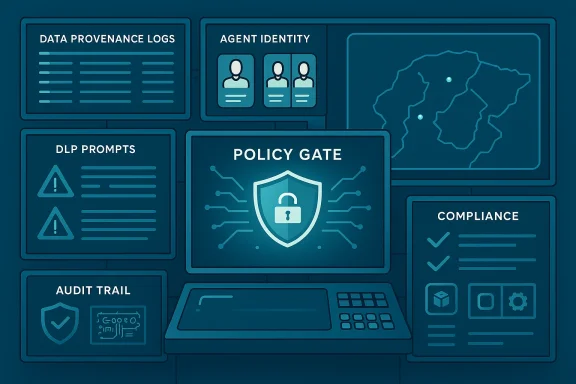
- Provenance and immutable audit trails
- Record every prompt, model call, tool invocation, and agent action in tamper‑evident logs with cryptographic timestamps.
- Ensure logs can be associated with business identities for auditability.
- Tool and connector controls
- Limit and vet the connectors agents can use. Require agent actions that touch systems of record to use signed, auditable APIs.
- Sandboxing and approval gates for any third‑party tool integrations.
- Runtime policy languages and attestation
- Use or define policy languages that can express dynamic, contextual constraints (for example: “this agent may query customer records only if user X is part of the request and only for IDs Y”).
- Where feasible, adopt cryptographic attestations to prove that an action conformed to policy at runtime — emerging research in authenticated workflows points this way.
- Model management
- Version models and control training/finetuning — maintain datasets and provenance to satisfy transparency and explainability obligations.
- Define ingestion policies for third‑party content to prevent training data poisoning.
- Red team, continuous testing, and monitoring
- Conduct adversarial testing (prompt injection, jailbreak attempts, tool‑chain manipulation) before production.
- Monitor for drift, anomalous behavior, and patterns indicating exfiltration or policy violations.
Organizational and cultural realities: resistance, rogue operators, and skills
Deploying AI is as much a people problem as a technology problem.- Admin resistance often arises because IT and security fear losing control as business units push for rapid deployment. Confronting this requires a clear governance charter and demonstrable guardrails that allow empowered experimentation without erosion of controls.
- Rogue operators and shadow AI — business teams using unvetted public tools — are common in firms under pressure to innovate. The remedy is a dual strategy: tighten detection and blocking for unapproved apps, and create rapid, low‑friction sanctioned paths so business units don’t have to resort to shadow options.
- Skills gap: regulated AI programs need interdisciplinary teams that include AI product managers, ML engineers, security architects who understand model risk, compliance officers versed in AI regulations, privacy engineers, and operational reliability engineers.
- Run short, cross‑functional AI “sprints” that produce production‑ready, security‑vetted prototypes.
- Invest in AI literacy training for business and security teams; make the value and limits of AI explicit.
- Create an escalation path for “this feels risky” that includes legal, compliance, and the responsible‑AI office.
A governance checklist for regulated AI adoption
- Executive sponsorship and a defined AI governance board.
- An AI risk register with mapped legal obligations and business impact levels.
- Formal supplier risk assessments for model and agent vendors.
- Data classification and prompt‑level DLP rules.
- Identity and lifecycle management for agents.
- Tamper‑evident telemetry and audit trail retention policies.
- Red‑team/penetration testing that includes prompt injection and agent manipulation scenarios.
- Human approval gates for all high‑impact decisions.
- Incident response playbook that covers model misbehavior and data leakage scenarios.
- Continuous review cycle that re‑validates controls as models and threat landscapes change.
A practical rollout playbook for regulated organizations
- Define use cases and risk tiers. Rank candidate AI uses by business value and regulatory sensitivity.
- Pilot helper‑first scenarios. Start with low‑risk augmentations (summaries, retrieval augmented generation for internal docs).
- Instrument end‑to‑end telemetry. Capture prompts, model responses, agent tool calls, and user approvals.
- Harden the stack. Implement DLP, identity controls, and connector gating as part of the pilot.
- Run adversarial validation. Simulate attacks and misconfigurations; iterate controls until acceptable.
- Document impact and create templates. Build pre‑approved policy templates, legal clauses, and technical blueprints.
- Scale to bounded automation. Move to agents that can act automatically only after achieving specific reliability and audit thresholds.
- Establish continuous assurance. Automate drift detection, policy compliance checks, and retraining governance.
Benefits and measurable wins
Deployed responsibly, AI delivers concrete outcomes:- Faster case triage in customer service and compliance workflows.
- Time saved for knowledge workers through automated summarization and document drafting.
- Improved operational efficiency for reconciliation, claims processing, and regulatory reporting.
- Better decision hygiene: consistent application of policy via agent‑assisted checklists and automated evidence capture.
Key risks that still demand vigilance
- Data leakage through prompts or agent actions — even with DLP, configuration errors or software defects can expose sensitive material.
- Regulatory non‑conformance — misclassification of a system as low‑risk when it actually affects rights or legal statuses can trigger fines and remedial orders.
- Emergent agent behaviors — agentic systems can chain external tools or create subagents unpredictably; containment and circuit breakers are essential.
- Supply chain/model governance — opaque model training pipelines or unvetted third‑party models introduce provenance and IP risks.
- Human error and social engineering — attackers can target users or admins to bypass controls; identity-first defenses and training are critical.
Skills, roles, and org structure needed
- AI Risk Lead / Responsible AI Officer — owns the AI risk register and cross‑functional policy alignment.
- AI Product Managers — define safe, useful product requirements and acceptance criteria for AI features.
- ML Engineers / MLOps — responsible for model lifecycle, versioning, monitoring, and retraining governance.
- Security Architects — extend identity, access, and network controls to agents and model endpoints.
- Privacy & Compliance Specialists — map laws and standards to technical controls and incident readiness.
- SRE / Platform Engineers — operationalize telemetry, high availability, and secure infrastructure.
- Audit & Assurance — capability to perform internal audits and evidence collection for regulators.
Conclusion — innovation inside the guardrails
AI in regulated industries can be transformative, but success is rarely the product of a single tool or vendor feature. It requires a discipline that combines clear governance, identity‑centric security, provenance of data and models, procedural human oversight, and continuous testing. The safest path is pragmatic: pursue helper‑first deployments that are strictly scoped and auditable, invest early in identity and DLP controls, and formalize an operating model that keeps legal, compliance, and security at the table.Emerging research and vendor capabilities are beginning to address the most painful technical gaps — authenticated workflows, runtime policy attestation, and immutable provenance — but many of these techniques are nascent. Until they are mature and standardized, regulated organizations must design layered defenses and operational guardrails that make AI useful without making the enterprise brittle.
The choice for regulated organizations is not between innovation and safety; it’s how fast you can move when you insist on both. Build the playbook, instrument everything, and treat AI as a mission‑critical system that earns trust through auditable controls and steady, measured deployments. When you do that, the productivity benefits of Copilot and agentic assistants are real — and sustainable inside the guardrails regulators and citizens expect.
Source: MSDynamicsWorld.com Copilot Chronicles, February 2026: Implementing AI in Regulated Industries — Innovation Inside the Guardrails
