

Loyens & Loeff has rolled out Microsoft 365 Copilot and Surface Laptop 7 devices to 1,600 employees across its legal and tax practice, using Microsoft Purview, Defender for Cloud, and SharePoint Advanced Management to govern AI adoption in a highly regulated cross-border advisory business. The headline number is not the hardware refresh or even the million-plus prompts logged in six months. It is that a risk-averse professional services firm decided the safest way to adopt generative AI was not to quarantine it in a lab, but to embed it in the daily fabric of work. That is a useful signal for every CIO still treating Copilot as a pilot project waiting for permission to become real.
For much of the last two years, generative AI in legal work has been discussed in two incompatible registers. The first is the boardroom fantasy: a machine that digests case law, drafts contracts, summarizes meetings, and turns expensive human hours into polished work product at near-zero marginal cost. The second is the compliance nightmare: hallucinated citations, accidental disclosure, uncontrolled data access, and a tool that may be too fluent for its own good.
The Loyens & Loeff deployment sits in the more interesting space between those extremes. Microsoft’s customer story describes a firm that already delivered high-quality advice but saw friction in the surrounding workflow: document review, research setup, meeting summaries, client communications, and cross-jurisdictional coordination. In other words, the target was not “replace the lawyer.” It was “compress the administrative drag around expert judgment.”
That distinction matters because it is where enterprise AI is actually landing. The first wave of generative AI hype implied that professional knowledge work could be automated wholesale. The second wave is more prosaic and more consequential: taking software that already knows where a firm’s documents, meetings, messages, and permissions live, and asking it to become a connective tissue between them.
Legal and tax work is a particularly demanding test case. It is collaborative, document-heavy, deadline-driven, and often distributed across jurisdictions. It also has a low tolerance for confidentiality errors and factual sloppiness. If Microsoft 365 Copilot can become normal inside that environment, it will not be because AI suddenly became magical. It will be because the platform around it became governable enough for serious firms to trust.
This is Microsoft’s strongest argument in the AI productivity market. It does not need Copilot to be the most dazzling model interface on every benchmark if it can be the one a regulated business can deploy without rebuilding its operating model from scratch. For law firms, banks, insurers, consultancies, and government agencies, the question is rarely “Can the AI write?” It is “Can we prove who had access to what, under which policy, with what safeguards, and with what audit trail?”
Loyens & Loeff’s deployment leaned on Microsoft Purview for labeling, monitoring, and protecting sensitive data; Defender for Cloud for security posture; and SharePoint Advanced Management for stronger content governance. Those details are easy to skim past, but they are the bones of the story. Copilot does not become enterprise software because it generates text. It becomes enterprise software when it inherits the permissions, retention policies, sensitivity labels, and operational discipline of the environment around it.
That is also why the Surface Laptop 7 rollout matters more than it might first appear. A device refresh attached to an AI deployment can look like procurement theater. But for IT teams, endpoint consistency is a form of risk reduction. If every employee receives the same AI-ready hardware foundation, the support model becomes simpler, the security baseline becomes cleaner, and the user experience becomes less dependent on local improvisation.
A year of validation is expensive, slow, and politically difficult. It means internal champions must keep momentum alive while skeptics ask sensible questions about data, accuracy, liability, and workflow fit. It means IT has to test not only whether the tool works, but whether the organization can absorb it without creating a shadow layer of risky habits.
That timeline also exposes one of the uncomfortable truths about Copilot adoption. The license is only the beginning. The real deployment is a data hygiene project, a permission review, a training campaign, a support model, a security exercise, and a cultural negotiation. Firms that skip those steps may still produce impressive demos. They are less likely to produce durable adoption.
Loyens & Loeff’s reported 94 percent active user rate is striking precisely because it suggests Copilot did not remain a novelty. The firm recorded more than one million prompts between September 1, 2025, and February 27, 2026. Prompt volume is not the same as business value, but it is evidence of habitual use. For enterprise software, habit is the beginning of transformation.
Those figures should not be dismissed, but they should be read like enterprise AI numbers rather than physics constants. The phrase “case analysis” can cover a wide range of work, from initial triage to final legal reasoning. A 10-minute AI-assisted overview is not the same as a defensible client memo. A 90 percent accuracy figure may be excellent for surfacing a starting point and unacceptable for final advice if the missing 10 percent contains the issue that matters.
The more plausible interpretation is also the more important one. Copilot is collapsing the time needed to get from blank page to structured draft, from document pile to working outline, from meeting transcript to usable summary, and from scattered inputs to an initial research map. That does not eliminate professional work. It changes where the professional starts.
For lawyers and tax advisers, that shift is profound. A junior associate who previously spent hours organizing source material may instead spend more time validating the AI’s synthesis, checking edge cases, and refining the argument. A partner may receive a more structured first pass earlier in the process. A cross-border team may coordinate faster because the friction of producing shared summaries and status reports falls.
The danger is that executives hear “four days to under 10 minutes” and conclude the human contribution has vanished. Loyens & Loeff’s own framing pushes the other way. The firm’s people remain responsible for final output; Copilot is an additional layer of help. That framing is not corporate modesty. It is the difference between a productivity tool and a malpractice machine.
For a legal and tax firm, that is the natural battleground. The hard work is not merely summarizing a single document. It is connecting a client question to prior work, applicable law, internal expertise, jurisdiction-specific nuance, transaction history, and the current state of a matter. No general-purpose AI assistant can safely do that without access to the right information and guardrails.
Researcher-style capabilities are Microsoft’s attempt to make Copilot less like a floating chat window and more like a task-aware knowledge worker. That is appealing in any information-heavy industry, but it is especially attractive in legal services, where the difference between useful and dangerous output often depends on whether the tool can show its work well enough for a human to interrogate it.
Still, agentic AI raises the stakes. A summary tool that gets something wrong may waste time. An agent that confidently sequences research, prioritizes authorities, or drafts analysis can shape the user’s thinking before the user realizes it. The more capable the system becomes, the more important it is that firms train employees not just to use AI, but to argue with it.
That is why the best AI adoption programs will look less like software training and more like professional methodology training. Users need to know when to ask for a summary, when to demand citations or source grounding, when to cross-check against primary materials, and when to stop using the tool entirely. Copilot can accelerate judgment, but it can also launder uncertainty into fluent prose.
But much of the hesitation is technical and operational rather than emotional. If an AI tool can access documents a user should not see, summarize confidential material into the wrong context, or blur client boundaries, the problem is not that lawyers fear innovation. The problem is that the tool is unsuitable for the environment.
That is why Microsoft’s governance stack is central to the Loyens & Loeff story. Sensitivity labels, access controls, monitoring, content management, and client-specific restrictions are not bureaucratic add-ons. They are the conditions under which AI becomes deployable in a business where confidentiality is not optional.
The firm also had to account for clients who preferred that their information not be processed by AI. That point deserves more attention than it usually gets. AI adoption in professional services is not only an internal IT decision; it is part of the client relationship. Some clients will welcome efficiency. Others will demand restrictions. Many will ask for disclosure, assurances, or contractual commitments.
This is where law firms may become early models for enterprise AI governance. They are used to managing walls, conflicts, confidentiality rules, and matter-specific obligations. Translating that discipline into AI controls is hard, but it is not alien. The firms that succeed will not be those that treat AI as a toy. They will be those that make AI another governed component of professional practice.
The Loyens & Loeff case is framed around client outcomes, clarity, and freeing advisers from manual steps. That is the argument Microsoft wants the market to absorb. Copilot is not pitched as a substitute for expertise, but as a way to let experts spend more time on the parts of work clients actually value.
There is a credible version of that argument. Clients rarely want to pay premium rates for status summaries, formatting, first-pass document triage, or repetitive drafting. If AI reduces the time spent on those tasks while preserving quality, the firm can improve responsiveness without eroding the professional judgment at the center of the engagement. Faster does not automatically mean worse; in many legal workflows, faster access to structure can improve decision-making.
But the economics will eventually force harder conversations. If a task that once took three hours now takes one, how is that reflected in billing models? Does the firm keep the margin, pass savings to clients, move toward more fixed-fee work, or redeploy time into deeper analysis? AI productivity gains are not just operational gains. They are business model pressure.
This is where legal AI may become more disruptive than legal tech vendors admit. The billable hour has survived decades of attempted reform because complexity, risk, and professional scarcity supported it. If AI makes portions of knowledge work more measurable, repeatable, and compressible, clients will ask why pricing has not changed accordingly. The firms that can answer that question honestly will have an advantage.
That template is showing up across professional services, finance, consulting, telecom, and Microsoft’s own internal legal operations. The point is not simply that Copilot can write emails or summarize meetings. The point is that Microsoft wants to define the standard enterprise AI migration path: productivity suite first, governance stack underneath, agents on top, and business process integration next.
For WindowsForum readers, the significance is broader than one Benelux law firm. Microsoft is using Copilot to pull together parts of its portfolio that have often been bought and managed separately. Microsoft 365, Teams, SharePoint, Purview, Defender, Surface, Dynamics 365, and partner systems like iManage all become pieces of the same modernization argument. AI is the shiny object; platform consolidation is the commercial engine.
That has advantages. A unified stack can reduce integration friction and make security controls easier to reason about. It also has risks. The more Copilot becomes embedded in everyday work, the more dependent organizations become on Microsoft’s interpretation of AI governance, licensing, data access, and product direction.
This is not a new trade-off. Enterprises have been making it with Microsoft for decades. What is new is the layer being consolidated. Office documents and email were already business-critical. AI assistants that synthesize, prioritize, and generate work product may become something closer to a cognitive operating layer for the organization. That gives the platform provider more influence over how work itself is performed.
It is not sufficient.
Human control can become a comforting slogan if the workflow subtly encourages overreliance. A busy adviser who receives a polished summary from a trusted enterprise tool may review it less aggressively than a messy junior draft. A team under deadline pressure may accept an AI-generated structure because it looks complete. A manager may mistake usage volume for maturity.
Real human control requires time, incentives, and skepticism. If AI is introduced with productivity targets but without corresponding validation practices, the human becomes a rubber stamp. If employees are praised for speed but punished for slowing down to verify, governance exists mainly on slides. If clients are promised efficiency without a clear explanation of how AI-assisted work is reviewed, trust becomes fragile.
The better model is not “human in the loop” as a checkbox. It is human accountability designed into the workflow. That means clear rules about which outputs can be used directly, which require source verification, which require senior review, and which are off-limits for AI assistance. It also means training users to document how AI contributed to work product when that matters for quality, auditability, or client disclosure.
The legal profession is unusually well suited to this discipline because it already understands review chains. Drafts are marked up. Authorities are checked. Advice is signed off. The task now is to make AI fit that culture rather than letting AI’s convenience erode it.
AI can help here in a way that goes beyond personal productivity. Meeting summaries, matter updates, research overviews, and document comparisons are all coordination artifacts. They help distributed teams stay aligned. If those artifacts become faster and more consistent, the firm’s ability to operate as one organization improves.
This is the less glamorous but more durable value of Copilot. The biggest gains may not come from any single lawyer saving an hour on a client email. They may come from reducing the accumulated friction of hundreds of small handoffs across teams, offices, and practice groups. In complex advisory work, alignment is a competitive asset.
The firm’s interest in deeper integration across Dynamics 365, Teams, iManage, and SharePoint points in that direction. Once AI is embedded in the productivity layer, the next frontier is process. Matter intake, client relationship management, knowledge retrieval, document management, and reporting all become candidates for AI-assisted modernization.
That is also where governance becomes harder. Summarizing a meeting inside Teams is one thing. Connecting client data, matter files, document repositories, and business workflows across systems is another. The promise is a more intelligent firm. The risk is a more complicated attack surface and a more subtle set of permission problems.
Loyens & Loeff’s rollout narrows that gap. The firm did not merely buy AI licenses; it paired them with modern Windows hardware across the workforce. That makes the endpoint part of the adoption architecture: secure device, consistent performance, standardized support, and a user experience designed around the modern Microsoft stack.
This matters because enterprise AI is not experienced as an abstract cloud service. It is experienced through keyboards, cameras, meetings, documents, battery life, device management, authentication prompts, and the everyday reliability of Windows. If the endpoint is old, inconsistent, or poorly managed, the AI experience feels like another layer of friction. If the endpoint is standardized and secure, AI feels more like a natural extension of work.
For sysadmins, this is both opportunity and burden. AI adoption will pull device management, identity, data governance, and application support closer together. The days when the endpoint team could treat productivity software as someone else’s problem are fading. Copilot makes the desktop, the document repository, the meeting platform, and the compliance layer part of one user experience.
That convergence is classic Microsoft. It is also why Windows remains strategically important even when the most advanced AI processing happens in the cloud. The operating system is no longer the whole platform, but it is still the place where the platform becomes work.
Adoption means people are using the tool. Transformation means the organization has changed how it delivers value, prices work, manages risk, trains staff, and measures quality. The Loyens & Loeff story suggests the firm has built the foundation for transformation. It does not prove the end state has arrived.
That is not a criticism. In fact, it is the right order. Too many AI programs try to declare transformation before users have formed durable habits. The more disciplined path is to build trust, scale usage, identify valuable workflows, improve governance, and then redesign processes around what the organization has learned.
The next test for Loyens & Loeff will be whether Copilot remains a general productivity enhancer or becomes a deeper operating capability. Does it improve knowledge reuse across jurisdictions? Does it reduce duplication of research? Does it help standardize quality without flattening professional nuance? Does it change how the firm scopes matters and communicates value to clients?
Those are harder metrics than prompt counts. They are also the ones that will determine whether AI modernization becomes a competitive advantage or simply another subscription line in the IT budget.
Source: Microsoft Loyens & Loeff modernizes the legal and tax industry with Microsoft 365 Copilot | Microsoft Customer Stories
 The Legal Sector’s AI Moment Has Moved From Experiment to Estate Planning
For much of the last two years, generative AI in legal work has been discussed in two incompatible registers. The first is the boardroom fantasy: a machine that digests case law, drafts contracts, summarizes meetings, and turns expensive human hours into polished work product at near-zero marginal cost. The second is the compliance nightmare: hallucinated citations, accidental disclosure, uncontrolled data access, and a tool that may be too fluent for its own good.The Loyens & Loeff deployment sits in the more interesting space between those extremes. Microsoft’s customer story describes a firm that already delivered high-quality advice but saw friction in the surrounding workflow: document review, research setup, meeting summaries, client communications, and cross-jurisdictional coordination. In other words, the target was not “replace the lawyer.” It was “compress the administrative drag around expert judgment.”
That distinction matters because it is where enterprise AI is actually landing. The first wave of generative AI hype implied that professional knowledge work could be automated wholesale. The second wave is more prosaic and more consequential: taking software that already knows where a firm’s documents, meetings, messages, and permissions live, and asking it to become a connective tissue between them.
Legal and tax work is a particularly demanding test case. It is collaborative, document-heavy, deadline-driven, and often distributed across jurisdictions. It also has a low tolerance for confidentiality errors and factual sloppiness. If Microsoft 365 Copilot can become normal inside that environment, it will not be because AI suddenly became magical. It will be because the platform around it became governable enough for serious firms to trust.
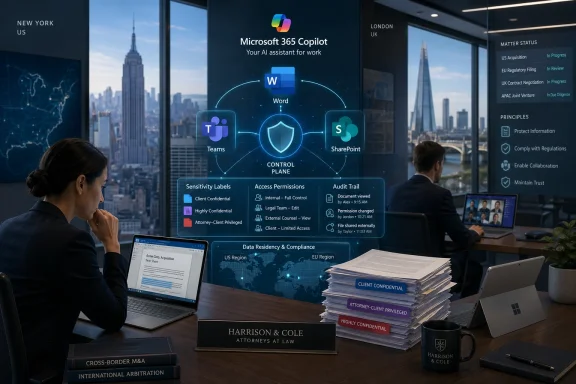
Microsoft’s Real Pitch Is Not the Chatbot, but the Control Plane
The most revealing part of the Loyens & Loeff story is not Copilot’s ability to summarize a 300-page document. That is useful, but it is now table stakes for modern AI assistants. The deeper pitch is that Microsoft can wrap Copilot in the same identity, compliance, device, document, and security architecture that many firms already use to run the rest of their business.This is Microsoft’s strongest argument in the AI productivity market. It does not need Copilot to be the most dazzling model interface on every benchmark if it can be the one a regulated business can deploy without rebuilding its operating model from scratch. For law firms, banks, insurers, consultancies, and government agencies, the question is rarely “Can the AI write?” It is “Can we prove who had access to what, under which policy, with what safeguards, and with what audit trail?”
Loyens & Loeff’s deployment leaned on Microsoft Purview for labeling, monitoring, and protecting sensitive data; Defender for Cloud for security posture; and SharePoint Advanced Management for stronger content governance. Those details are easy to skim past, but they are the bones of the story. Copilot does not become enterprise software because it generates text. It becomes enterprise software when it inherits the permissions, retention policies, sensitivity labels, and operational discipline of the environment around it.
That is also why the Surface Laptop 7 rollout matters more than it might first appear. A device refresh attached to an AI deployment can look like procurement theater. But for IT teams, endpoint consistency is a form of risk reduction. If every employee receives the same AI-ready hardware foundation, the support model becomes simpler, the security baseline becomes cleaner, and the user experience becomes less dependent on local improvisation.
A One-Year Validation Period Says More Than a Launch Event Ever Could
The firm reportedly spent about a year testing Microsoft 365 Copilot before scaling it across the organization. That is the sentence that should calm some readers and frustrate others. It is not the behavior of an organization blindly chasing a vendor trend. It is also not the behavior of a firm that believes AI can be left to individual curiosity and unmanaged experimentation.A year of validation is expensive, slow, and politically difficult. It means internal champions must keep momentum alive while skeptics ask sensible questions about data, accuracy, liability, and workflow fit. It means IT has to test not only whether the tool works, but whether the organization can absorb it without creating a shadow layer of risky habits.
That timeline also exposes one of the uncomfortable truths about Copilot adoption. The license is only the beginning. The real deployment is a data hygiene project, a permission review, a training campaign, a support model, a security exercise, and a cultural negotiation. Firms that skip those steps may still produce impressive demos. They are less likely to produce durable adoption.
Loyens & Loeff’s reported 94 percent active user rate is striking precisely because it suggests Copilot did not remain a novelty. The firm recorded more than one million prompts between September 1, 2025, and February 27, 2026. Prompt volume is not the same as business value, but it is evidence of habitual use. For enterprise software, habit is the beginning of transformation.
The Million-Prompt Milestone Is Impressive, but the Time-Savings Claims Need Adult Supervision
The numbers Microsoft highlights are attention-grabbing. Legal case analysis reportedly dropped from four days to under 10 minutes. Drafting client communications saves around one hour per task. Case law research fell from three hours to one. Meeting summaries and monthly practice group reports dropped from one hour to 15 minutes. Contract and research analysis achieved 90 percent lawyer-level accuracy using the Researcher agent.Those figures should not be dismissed, but they should be read like enterprise AI numbers rather than physics constants. The phrase “case analysis” can cover a wide range of work, from initial triage to final legal reasoning. A 10-minute AI-assisted overview is not the same as a defensible client memo. A 90 percent accuracy figure may be excellent for surfacing a starting point and unacceptable for final advice if the missing 10 percent contains the issue that matters.
The more plausible interpretation is also the more important one. Copilot is collapsing the time needed to get from blank page to structured draft, from document pile to working outline, from meeting transcript to usable summary, and from scattered inputs to an initial research map. That does not eliminate professional work. It changes where the professional starts.
For lawyers and tax advisers, that shift is profound. A junior associate who previously spent hours organizing source material may instead spend more time validating the AI’s synthesis, checking edge cases, and refining the argument. A partner may receive a more structured first pass earlier in the process. A cross-border team may coordinate faster because the friction of producing shared summaries and status reports falls.
The danger is that executives hear “four days to under 10 minutes” and conclude the human contribution has vanished. Loyens & Loeff’s own framing pushes the other way. The firm’s people remain responsible for final output; Copilot is an additional layer of help. That framing is not corporate modesty. It is the difference between a productivity tool and a malpractice machine.
Researcher Agent Shows Where Copilot Is Headed
The specific mention of the Researcher agent is significant because it points beyond the original Copilot pitch. The early version of Microsoft 365 Copilot was largely understood as an assistant embedded in Word, Outlook, Teams, PowerPoint, and Excel. The newer direction is more agentic: tools that can navigate larger bodies of information, break tasks into steps, and produce more structured outputs inside business workflows.For a legal and tax firm, that is the natural battleground. The hard work is not merely summarizing a single document. It is connecting a client question to prior work, applicable law, internal expertise, jurisdiction-specific nuance, transaction history, and the current state of a matter. No general-purpose AI assistant can safely do that without access to the right information and guardrails.
Researcher-style capabilities are Microsoft’s attempt to make Copilot less like a floating chat window and more like a task-aware knowledge worker. That is appealing in any information-heavy industry, but it is especially attractive in legal services, where the difference between useful and dangerous output often depends on whether the tool can show its work well enough for a human to interrogate it.
Still, agentic AI raises the stakes. A summary tool that gets something wrong may waste time. An agent that confidently sequences research, prioritizes authorities, or drafts analysis can shape the user’s thinking before the user realizes it. The more capable the system becomes, the more important it is that firms train employees not just to use AI, but to argue with it.
That is why the best AI adoption programs will look less like software training and more like professional methodology training. Users need to know when to ask for a summary, when to demand citations or source grounding, when to cross-check against primary materials, and when to stop using the tool entirely. Copilot can accelerate judgment, but it can also launder uncertainty into fluent prose.
Governance Is the Product Feature Lawyers Actually Bought
The legal industry’s AI anxiety is often described as cultural resistance. There is some truth to that. Law firms are conservative institutions, and for good reason. Their product is trust, and trust is hard to scale back once damaged.But much of the hesitation is technical and operational rather than emotional. If an AI tool can access documents a user should not see, summarize confidential material into the wrong context, or blur client boundaries, the problem is not that lawyers fear innovation. The problem is that the tool is unsuitable for the environment.
That is why Microsoft’s governance stack is central to the Loyens & Loeff story. Sensitivity labels, access controls, monitoring, content management, and client-specific restrictions are not bureaucratic add-ons. They are the conditions under which AI becomes deployable in a business where confidentiality is not optional.
The firm also had to account for clients who preferred that their information not be processed by AI. That point deserves more attention than it usually gets. AI adoption in professional services is not only an internal IT decision; it is part of the client relationship. Some clients will welcome efficiency. Others will demand restrictions. Many will ask for disclosure, assurances, or contractual commitments.
This is where law firms may become early models for enterprise AI governance. They are used to managing walls, conflicts, confidentiality rules, and matter-specific obligations. Translating that discipline into AI controls is hard, but it is not alien. The firms that succeed will not be those that treat AI as a toy. They will be those that make AI another governed component of professional practice.
The Client Experience Argument Is Stronger Than the Cost-Cutting Argument
Every AI deployment in professional services carries a shadow question: is this about better work, or cheaper labor? Vendors prefer to talk about freeing experts for higher-value tasks. Finance departments often hear a different tune. Employees are not wrong to listen carefully.The Loyens & Loeff case is framed around client outcomes, clarity, and freeing advisers from manual steps. That is the argument Microsoft wants the market to absorb. Copilot is not pitched as a substitute for expertise, but as a way to let experts spend more time on the parts of work clients actually value.
There is a credible version of that argument. Clients rarely want to pay premium rates for status summaries, formatting, first-pass document triage, or repetitive drafting. If AI reduces the time spent on those tasks while preserving quality, the firm can improve responsiveness without eroding the professional judgment at the center of the engagement. Faster does not automatically mean worse; in many legal workflows, faster access to structure can improve decision-making.
But the economics will eventually force harder conversations. If a task that once took three hours now takes one, how is that reflected in billing models? Does the firm keep the margin, pass savings to clients, move toward more fixed-fee work, or redeploy time into deeper analysis? AI productivity gains are not just operational gains. They are business model pressure.
This is where legal AI may become more disruptive than legal tech vendors admit. The billable hour has survived decades of attempted reform because complexity, risk, and professional scarcity supported it. If AI makes portions of knowledge work more measurable, repeatable, and compressible, clients will ask why pricing has not changed accordingly. The firms that can answer that question honestly will have an advantage.
Microsoft Is Turning Customer Stories Into Industry Playbooks
Microsoft’s customer story format is marketing, but it is also a map of how the company wants entire industries to adopt AI. The sequence is becoming familiar: identify manual workflows, validate Copilot with a controlled group, clean up governance, deploy at scale, measure usage, highlight time savings, and expand into agents and adjacent business applications.That template is showing up across professional services, finance, consulting, telecom, and Microsoft’s own internal legal operations. The point is not simply that Copilot can write emails or summarize meetings. The point is that Microsoft wants to define the standard enterprise AI migration path: productivity suite first, governance stack underneath, agents on top, and business process integration next.
For WindowsForum readers, the significance is broader than one Benelux law firm. Microsoft is using Copilot to pull together parts of its portfolio that have often been bought and managed separately. Microsoft 365, Teams, SharePoint, Purview, Defender, Surface, Dynamics 365, and partner systems like iManage all become pieces of the same modernization argument. AI is the shiny object; platform consolidation is the commercial engine.
That has advantages. A unified stack can reduce integration friction and make security controls easier to reason about. It also has risks. The more Copilot becomes embedded in everyday work, the more dependent organizations become on Microsoft’s interpretation of AI governance, licensing, data access, and product direction.
This is not a new trade-off. Enterprises have been making it with Microsoft for decades. What is new is the layer being consolidated. Office documents and email were already business-critical. AI assistants that synthesize, prioritize, and generate work product may become something closer to a cognitive operating layer for the organization. That gives the platform provider more influence over how work itself is performed.
The Human-in-Control Mantra Is Necessary, but Not Sufficient
Every responsible AI deployment now includes a version of the same reassurance: people remain in control. Loyens & Loeff says advisers are responsible for the final output. Microsoft says Copilot works within enterprise controls. Leaders emphasize judgment, validation, and professional standards. All of that is necessary.It is not sufficient.
Human control can become a comforting slogan if the workflow subtly encourages overreliance. A busy adviser who receives a polished summary from a trusted enterprise tool may review it less aggressively than a messy junior draft. A team under deadline pressure may accept an AI-generated structure because it looks complete. A manager may mistake usage volume for maturity.
Real human control requires time, incentives, and skepticism. If AI is introduced with productivity targets but without corresponding validation practices, the human becomes a rubber stamp. If employees are praised for speed but punished for slowing down to verify, governance exists mainly on slides. If clients are promised efficiency without a clear explanation of how AI-assisted work is reviewed, trust becomes fragile.
The better model is not “human in the loop” as a checkbox. It is human accountability designed into the workflow. That means clear rules about which outputs can be used directly, which require source verification, which require senior review, and which are off-limits for AI assistance. It also means training users to document how AI contributed to work product when that matters for quality, auditability, or client disclosure.
The legal profession is unusually well suited to this discipline because it already understands review chains. Drafts are marked up. Authorities are checked. Advice is signed off. The task now is to make AI fit that culture rather than letting AI’s convenience erode it.
Cross-Border Work Is Where the Productivity Gains Become Strategic
Loyens & Loeff’s cross-border context is more than scenery. Multi-jurisdictional work is where coordination costs multiply. Different legal systems, languages, tax regimes, document conventions, and client expectations create a constant need to translate complexity into shared understanding.AI can help here in a way that goes beyond personal productivity. Meeting summaries, matter updates, research overviews, and document comparisons are all coordination artifacts. They help distributed teams stay aligned. If those artifacts become faster and more consistent, the firm’s ability to operate as one organization improves.
This is the less glamorous but more durable value of Copilot. The biggest gains may not come from any single lawyer saving an hour on a client email. They may come from reducing the accumulated friction of hundreds of small handoffs across teams, offices, and practice groups. In complex advisory work, alignment is a competitive asset.
The firm’s interest in deeper integration across Dynamics 365, Teams, iManage, and SharePoint points in that direction. Once AI is embedded in the productivity layer, the next frontier is process. Matter intake, client relationship management, knowledge retrieval, document management, and reporting all become candidates for AI-assisted modernization.
That is also where governance becomes harder. Summarizing a meeting inside Teams is one thing. Connecting client data, matter files, document repositories, and business workflows across systems is another. The promise is a more intelligent firm. The risk is a more complicated attack surface and a more subtle set of permission problems.
The Windows Angle Is the Endpoint Becoming Part of the AI Stack
The inclusion of Surface Laptop 7 in this deployment is not incidental for the Windows ecosystem. Microsoft has spent the past two years pushing the idea of the AI PC, not only as a consumer category but as a managed enterprise endpoint for the next phase of work. In many organizations, however, the AI PC story still feels disconnected from the cloud-based reality of Microsoft 365 Copilot.Loyens & Loeff’s rollout narrows that gap. The firm did not merely buy AI licenses; it paired them with modern Windows hardware across the workforce. That makes the endpoint part of the adoption architecture: secure device, consistent performance, standardized support, and a user experience designed around the modern Microsoft stack.
This matters because enterprise AI is not experienced as an abstract cloud service. It is experienced through keyboards, cameras, meetings, documents, battery life, device management, authentication prompts, and the everyday reliability of Windows. If the endpoint is old, inconsistent, or poorly managed, the AI experience feels like another layer of friction. If the endpoint is standardized and secure, AI feels more like a natural extension of work.
For sysadmins, this is both opportunity and burden. AI adoption will pull device management, identity, data governance, and application support closer together. The days when the endpoint team could treat productivity software as someone else’s problem are fading. Copilot makes the desktop, the document repository, the meeting platform, and the compliance layer part of one user experience.
That convergence is classic Microsoft. It is also why Windows remains strategically important even when the most advanced AI processing happens in the cloud. The operating system is no longer the whole platform, but it is still the place where the platform becomes work.
The Numbers Point to Adoption, Not Yet Transformation
A 94 percent active user rate is a strong signal. More than one million prompts in roughly six months is another. The reported time savings are meaningful. But adoption and transformation are not synonyms.Adoption means people are using the tool. Transformation means the organization has changed how it delivers value, prices work, manages risk, trains staff, and measures quality. The Loyens & Loeff story suggests the firm has built the foundation for transformation. It does not prove the end state has arrived.
That is not a criticism. In fact, it is the right order. Too many AI programs try to declare transformation before users have formed durable habits. The more disciplined path is to build trust, scale usage, identify valuable workflows, improve governance, and then redesign processes around what the organization has learned.
The next test for Loyens & Loeff will be whether Copilot remains a general productivity enhancer or becomes a deeper operating capability. Does it improve knowledge reuse across jurisdictions? Does it reduce duplication of research? Does it help standardize quality without flattening professional nuance? Does it change how the firm scopes matters and communicates value to clients?
Those are harder metrics than prompt counts. They are also the ones that will determine whether AI modernization becomes a competitive advantage or simply another subscription line in the IT budget.
The Copilot Deployment Loyens & Loeff Actually Proved
The practical lessons from this rollout are not that every organization should copy the same vendor stack or expect the same savings. The lesson is that broad AI adoption in regulated work depends on boring foundations done well.- Loyens & Loeff treated Copilot as an enterprise deployment rather than a side experiment, validating it for about a year before scaling it to all 1,600 employees.
- The firm paired AI access with governance tools such as Microsoft Purview, Defender for Cloud, and SharePoint Advanced Management instead of assuming user discretion would be enough.
- The strongest early productivity gains appear around first-pass structure, summarization, research preparation, client communications, and meeting/reporting workflows.
- The deployment’s 94 percent active user rate and million-plus prompts suggest Copilot became part of ordinary work rather than remaining a showcase tool for enthusiasts.
- The firm’s insistence that advisers remain responsible for final output is not a caveat to the AI story; it is the condition that makes the AI story credible.
- The next phase will be less about prompting and more about integration across document management, client systems, knowledge repositories, and matter workflows.
Source: Microsoft Loyens & Loeff modernizes the legal and tax industry with Microsoft 365 Copilot | Microsoft Customer Stories
