

AI is entering a new phase: after years of experimentation, 2026 looks set to be the year artificial intelligence moves from tool to teammate, reshaping how organizations operate, how researchers discover, and how everyday Windows users experience their PCs. Microsoft’s roundup of “seven trends to watch in 2026” frames this shift as practical, infrastructure-driven, and governed — and it’s already visible across healthcare, developer workflows, cloud infrastructure and even quantum research.
Microsoft’s source article lays out seven connected trends that together describe an AI era where agents, systems and humans collaborate across work and life. Those trends emphasize: AI as a force multiplier for teams; agent identity and security; healthcare amplification; research assistants; denser, smarter AI infrastructure; repository- and context-aware software development; and quantum‑class compute breakthroughs. The piece is both a situational briefing and a product signal — it links strategic product efforts (Copilot, Copilot Studio, Azure AI Foundry, agent management) with practical examples and technical roadmaps. This feature unpacks those seven trends, verifies key technical claims where possible, and assesses practical strengths, adoption barriers, and security and governance risks IT teams must manage. The goal is to give Windows-focused IT professionals, developers, and power users a clear, actionable view of what to expect and how to prepare as AI becomes an organizational capability rather than an experimental add‑on.
That said, the shift from instrument to partner raises governance, security and regulatory demands that organizations must treat as first‑order problems. Pilot smart, instrument all agent actions, and adopt interoperability standards only after authentication, signing, and observability are in place. For Windows users and IT professionals, the practical path is clear: lean into pilot deployments that deliver measurable business outcomes, but insist on the controls that make those outcomes safe and repeatable.
AI in 2026 will not be an abstract promise — it will be an operational reality. The choice facing organizations is not whether to adopt AI, but how to adopt it responsibly: with identity, governance, cost controls and domain validation built in from day one. The technology is advancing fast; the job now is to match that pace with disciplined practices that protect data, people and the mission.
Source: Microsoft Source What’s next in AI: 7 trends to watch in 2026
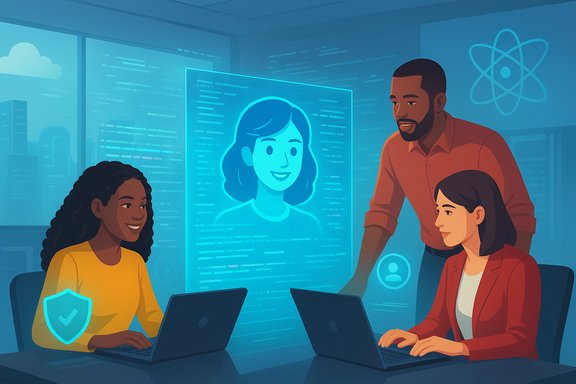 Background / Overview
Microsoft’s source article lays out seven connected trends that together describe an AI era where agents, systems and humans collaborate across work and life. Those trends emphasize: AI as a force multiplier for teams; agent identity and security; healthcare amplification; research assistants; denser, smarter AI infrastructure; repository- and context-aware software development; and quantum‑class compute breakthroughs. The piece is both a situational briefing and a product signal — it links strategic product efforts (Copilot, Copilot Studio, Azure AI Foundry, agent management) with practical examples and technical roadmaps. This feature unpacks those seven trends, verifies key technical claims where possible, and assesses practical strengths, adoption barriers, and security and governance risks IT teams must manage. The goal is to give Windows-focused IT professionals, developers, and power users a clear, actionable view of what to expect and how to prepare as AI becomes an organizational capability rather than an experimental add‑on.1. AI will amplify what people can achieve together
What Microsoft says
Microsoft positions 2026 as the year teams start treating AI as a collaborator that multiplies human capability rather than replacing it. The company’s product leaders argue that small teams can scale to global outcomes by delegating data work, personalization, and production tasks to AI while humans steer strategy and creativity.Independent corroboration
This team-centric framing matches industry moves toward “agentic” workflows: Microsoft and other major vendors are building agent frameworks that plug into collaboration tools, enabling copilots to participate in meetings, summarize threads, and produce artifacts for teams to iterate on. Industry reporting and platform documentation show the same trajectory toward experience-first AI (agents that live in Teams, Outlook, and IDEs) rather than model-first marketing.Strengths
- Real productivity gains are plausible when AI handles routine data work (summaries, templated outputs, personalization) and humans keep decision-making and risk control.
- Team-centered agents reduce duplication: one agent in a shared channel can keep shared context and act as the group’s memory or workflow runner, lowering friction in multi-disciplinary work.
Risks and caveats
- Shared context creates new privacy and leakage risks: when an agent becomes “the group’s memory,” access controls and audit trails must be airtight or you create a single point where sensitive data can propagate.
- Overreliance on automation can degrade institutional knowledge if organizations don’t codify rationale or exception handling.
Practical takeaways for Windows and IT teams
- Treat copilots and agents as first‑class team members in identity and lifecycle planning (see section on agent identity and governance below).
- Invest in role-based guardrails and logging now — agentic features scale quickly but so do operational surprises.
2. AI agents will get new safeguards as they join the workforce
What Microsoft says
As agents take on actions on behalf of users, Microsoft argues each agent must have secure identity, scoped permissions, lifecycle management and auditability — essentially, treat agents like employees. The company is building product primitives (agent directory entries, Entra/identity integrations, Copilot Studio authoring, and governance planes) to make agents discoverable, auditable and governable at scale.Verification and context
Microsoft’s platform work (Copilot Studio, Agent Store, Entra Agent ID, Agent 365) and the Azure AI Foundry runtime are concrete examples of these primitives. Industry coverage of Microsoft’s Build and Ignite announcements documents both the feature set and the push to adopt interoperability standards such as the Model Context Protocol (MCP) to make tools and agents interoperable. Independent coverage also highlights the rapid uptake of MCP across vendors — an important interoperability milestone — but warns of fresh attack surfaces.Strengths
- Formalizing agent identity and permissions reduces the “shadow agent” problem and lets security teams subject agents to the same lifecycle and compliance controls as human identities.
- Centralized governance planes and agent catalogs make discovery and policy enforcement practical at enterprise scale.
Risks and caveats
- Introducing identity for software agents multiplies the attack surface: credential theft, token replay, and poorly scoped connectors can turn benign agents into exfiltration vectors.
- Interoperability protocols like MCP simplify integrations but introduce systemic risks if servers and connectors are not signed, vetted, and monitored.
Practical steps
- Map where agents will access enterprise data and enforce least privilege via Entra/AD and conditional access.
- Require signed MCP servers and strong tool‑level authentication before enabling external tools for agents.
- Build audit trails and alerting for agent actions — agent decisions must be explainable and reversible where possible.
3. AI is poised to shrink the world’s health gap
What Microsoft says
Microsoft frames AI as a meaningful tool to close health access gaps: its Diagnostic Orchestrator (MAI‑DxO) and Copilot health features are examples where AI is moving from research to scaled consumer and clinical tools, with the potential to help millions. Microsoft cites tests where MAI‑DxO reached high diagnostic accuracy on complex case benchmarks.Verification and critical context
Microsoft publicly reported MAI‑DxO experiments showing high accuracy on curated benchmarks of complex cases (Microsoft reports up to ~85.5% in specific evaluations), and multiple outlets and analyses covered that result while cautioning about limits: the benchmark cases are curated, and real clinical deployment requires regulatory approval, prospective clinical trials, and safety guardrails. The World Health Organization’s projection of an ~11 million health-worker shortfall by 2030 provides the policy context that makes scalable AI tools worth exploring — but not as a turnkey substitute for trained clinicians.Strengths
- AI can scale diagnostic access and triage capabilities, especially in low-resource settings where specialist coverage is scarce.
- Orchestrated multi‑model approaches (chain-of-debate or panel‑style orchestration) show promise at synthesizing complex evidence and reducing oversight burden.
Risks and caveats
- Benchmarks are not clinical validation. Results on curated NEJM cases are encouraging but do not guarantee safety, bias mitigation, or outcomes in live settings.
- Legal, ethical and regulatory frameworks vary globally; responsibility and liability remain with clinicians and providers, not the model vendor.
Recommendations for healthcare IT
- Treat AI outputs as decision support: require human sign-off and integrate verification steps into workflows.
- Run controlled pilots with pre-specified outcome metrics and a plan to escalate false positives/negatives to clinicians for review.
4. AI will become central to the research process
What Microsoft says
AI will stop being a passive summarizer and instead become an active research partner: generating hypotheses, running instrumented lab workflows, orchestrating experiments, and scaling domain knowledge across teams and labs. Microsoft positions repository intelligence and agentic tool integration as key enablers for a scientist’s “AI lab assistant.”Independent signals
Academic and industry projects now routinely use AI for literature triage, design of experiments, and materials simulations. Microsoft’s Azure‑backed tooling and Foundry features (research templates, grounding, tool catalogs) are explicit attempts to make those workflows enterprise-ready. Peer-reviewed publications and vendor blogs show successful early uses in materials design and molecular dynamics — but integration into regulated laboratory pipelines requires careful validation and reproducibility controls.Strengths
- AI can compress literature review cycles and surface novel hypotheses, accelerating discovery timelines.
- Programmatic experiments (agents that orchestrate lab instrumentation and data capture) reduce human error in repetitive protocols and free researchers for higher-level design.
Risks and caveats
- Reproducibility and experiment provenance are critical. If an agent’s chain-of-reasoning or experimental parameters aren’t stored immutably, results become difficult to audit.
- Automated suggestion loops can amplify subtle biases (e.g., overfitting to historical experiment patterns), so human domain review is mandatory.
Practical guidance for research teams
- Deploy agentic research helpers behind gated experiments with records for each step: inputs, models used, parameters, and raw outputs.
- Integrate reproducibility checks and independent replication runs as part of any AI‑driven experiment pipeline.
5. AI infrastructure will get smarter and more efficient
What Microsoft says
Microsoft argues the next wave of AI isn’t only bigger clusters; it’s about efficiency: smarter routing of workloads across distributed compute, denser packing of GPU resources, and new datacenter designs that reduce carbon footprints while raising performance. The company highlights new Azure VM families and datacenter innovations intended to lower cost and waste.Verification: hardware and sustainability claims
- Azure’s ND GB200 v6 VMs and related announcements show Microsoft moving to NVIDIA Blackwell (GB200) platforms for exascale‑style racks and higher throughput for training and inference. Microsoft documentation and Azure HPC posts describe ND GB200 v6 public previews and GA entries, confirming new VM classes built on NVIDIA Blackwell architecture.
- On the sustainability side, Microsoft confirmed building two data centers in Virginia that incorporate cross‑laminated timber (CLT) to reduce embodied carbon — an industry‑novel approach validated by industry reporting. These hybrid CLT sites are designed to lower embodied emissions by substantial percentages compared with traditional steel or concrete builds.
Strengths
- New GPU platforms and rack designs yield major throughput improvements (Blackwell systems are orders of magnitude faster per rack than last‑gen), which lowers runtime and can reduce energy per token when well optimized.
- Construction and site design choices (CLT and low‑carbon materials) address embodied-carbon concerns, a major sustainability leverage point for big cloud providers.
Risks and caveats
- Faster hardware can increase demand and overall power consumption if not paired with routing and utilization improvements — raw efficiency gains are not the same as net energy reduction.
- Supply chain and cost pressures remain: next‑gen GPUs are high‑demand and can raise customer bills without clear cost‑management strategies (billing controls, message meters, capacity packs).
IT operational advice
- Treat cloud AI infrastructure as capex/opex planning: use capacity packs, telemetry, and tenant controls to avoid unexpected runaways.
- Prioritize platform-level optimizations (model routing, batching, mixed precision) to convert raw GPU throughput into cost savings.
6. AI is learning the language of code — and the context behind it
What Microsoft says
Microsoft and GitHub position 2026 as a year of “repository intelligence.” AI systems will understand not only code tokens but repository relationships, commit histories, semantic links and architecture diagrams — enabling smarter code suggestions, automated refactoring, and higher-quality automated fixes.Industry corroboration
GitHub activity metrics and independent reporting show rising use of AI in developer workflows. Tools and SDKs (including GitHub Copilot’s agent mode and integrations in IDEs) are already enabling more ambitious assistance: multi-step code changes, test generation, and context-aware refactors. At the platform level, MCP and agent frameworks create a secure way for assistants to access repo contents and runtime contexts.Strengths
- Repository-aware AI reduces context misunderstanding: code suggestions that respect historical changes and architecture intent are more likely to be correct and auditable.
- Automating routine bug fixes and tests frees engineers to focus on system design and complex problems.
Risks and caveats
- Code‑generation errors can be silent and subtle. Blindly accepting AI patches without code reviews introduces risk.
- Supply-chain attacks and credential exposure through tool connectors deserve special scrutiny when agents have write access to repositories.
Recommended practices for dev teams
- Require human review on all AI‑generated code before merge.
- Use agent permissions that limit write actions until a defined trust threshold is met.
- Instrument automated changes with provenance metadata and CI checks that validate behavioral equivalence.
7. The next leap in computing is closer than most people think (quantum + hybrid compute)
What Microsoft says
Microsoft argues quantum advantage is now a nearer‑term possibility because of hybrid approaches: quantum machines working in tandem with AI and classical supercomputers. The company highlights Majorana 1 — a topological‑qubit prototype — as evidence of progress toward more error‑resistant qubits and a path to scalable, fault‑tolerant quantum hardware.External verification and context
Microsoft publicly announced Majorana 1 (a topological qubit prototype) and published accompanying technical material; mainstream outlets covered the claim and noted the potential and the scientific debate. Microsoft’s roadmaps and DARPA participation indicate an aggressive timeline, but the broader research community emphasizes cautious optimism: the step from prototype qubits to general-purpose, error-corrected quantum advantage remains non‑trivial.Strengths
- Topological qubits — if realized at scale — promise dramatically lower error rates and simpler quantum error correction overhead.
- Hybrid approaches that combine AI, HPC and quantum processors can deliver novel algorithms for materials, chemistry and optimization that classical compute struggles with today.
Risks and caveats
- Scientific claims of “years, not decades” remain contentious among some researchers; scaling, manufacturability and integrated control systems remain hard engineering challenges.
- Quantum also has near‑term cybersecurity implications: long‑lived secrets (archived encrypted data) may be at risk once large‑scale quantum decryption becomes feasible — organizations must begin crypto agility planning now.
Practical planning for enterprises
- Start crypto‑agility assessments: inventory long‑lived encrypted assets and plan for PQC (post‑quantum cryptography) transitions where necessary.
- Track quantum‑cloud offerings for specialized workloads (chemistry, optimization) and pilot hybrid workflows that integrate Azure HPC + quantum simulation to get operational experience.
Cross‑cutting themes: governance, interoperability and the economics of AI
Across these trends several cross‑cutting themes dominate planning and procurement decisions.- Governance is non‑negotiable. Agent identity, fine‑grained permissions, consent models, and immutable audit trails are core controls to enable safe scale. Microsoft’s agent and governance primitives illustrate this shift, but customers must implement policy enforcement and monitoring.
- Interoperability raises both opportunity and risk. Protocols like MCP unlock much easier integrations between models and tools, accelerating innovation. But open protocols mean attackers can exploit poorly built connectors, so vetting, signing and observability are essential.
- Cost management becomes an operational discipline. High throughput GPUs, long context windows and always‑on agents can drive exponential costs. Expect vendors to provide billing constructs (message meters, capacity packs, tenant caps) — but the onus is on procurement and engineering to design cost‑efficient deployments.
- Sustainability matters. Hardware efficiency and low‑carbon datacenter builds (e.g., CLT) are explicit efforts to reduce emissions, but net environmental outcomes depend on utilization, cooling, and lifecycle management.
Concrete checklist for IT leaders and Windows admins (actionable, prioritized)
- Identity and agent lifecycle
- Treat agents as identities: create directories, conditional access policies and lifecycle reviews for agent accounts.
- Pilot and governance
- Run narrow, measurable pilots with defined KPIs and fallbacks. Use Agent 365 / Copilot Studio capabilities to enforce tenant-level controls.
- Security posture
- Require signed MCP servers, audit connectors, and endpoint monitoring for agent-enabled actions.
- Cost and capacity management
- Cap spend with billing policies; use Azure capacity packs and telemetry to avoid runaway inferencing costs.
- Developer discipline
- Enforce code review on AI-generated code, provenance metadata for changes, and CI validation for agentic commits.
- Healthcare and regulated industries
- Deploy only under regulatory oversight and with clinician-in-the-loop workflows; treat AI outputs as decision support.
- Quantum readiness
- Inventory long-term encrypted assets and plan for PQC migration where necessary; stay current on quantum‑hybrid pilot opportunities.
Strengths and the practical upside
- Enterprise-grade agent frameworks and identity models make scaling practical: Microsoft’s product push from Copilot Studio to Azure AI Foundry demonstrates a path from proof-of-concept to productionized agent ops. These platforms reduce the errors that come from ad-hoc integrations and provide a governance surface for IT teams to control risk.
- New hardware (NVIDIA Blackwell platforms in Azure ND GB200 v6) gives developers the compute they need to train and host larger reasoning models cost‑effectively, while datacenter sustainability experiments show a supply‑chain and construction-level push toward lower embodied carbon.
- Domain‑specific wins are real: healthcare triage and diagnostic augmentation, repository intelligence for dev teams, and agentic automation in finance and utilities show measurable ROI when pilots are well-scoped and governed.
Risks, unknowns and where to be cautious
- Benchmarks do not equal clinical deployment: results like MAI‑DxO’s strong benchmark performance are promising but not a substitute for clinical trials and regulatory review.
- Interoperability without security is dangerous: MCP and similar protocols are useful but open the door to new attack patterns (prompt injection, connector hijack, token theft) that require hardened implementation and monitoring.
- Hype vs. delivery in quantum: announcements about Majorana 1 and topological qubits are significant, but scaling from prototype qubits to general-purpose fault‑tolerant quantum systems is still an engineering hurdle. Treat quantum as strategic R&D and pilot area, not immediate production infrastructure.
- Cost risk: faster hardware can paradoxically increase cloud spend if models are not routed and managed properly. Design cost controls and capacity planning into any AI rollout.
Final verdict: practical optimism with rigorous controls
The seven trends Microsoft highlights describe a credible arc: models become agents, agents become team members, infrastructure becomes denser and smarter, and novel compute classes (quantum) begin to surface as complement rather than competitor. These are not mutually exclusive phenomena — they reinforce one another. When agents have robust identity and governance, they can be safely integrated into workflows; when infrastructure is efficient, organizations can afford to scale meaningfully; and when domain models (healthcare, code) improve with context, they deliver real value.That said, the shift from instrument to partner raises governance, security and regulatory demands that organizations must treat as first‑order problems. Pilot smart, instrument all agent actions, and adopt interoperability standards only after authentication, signing, and observability are in place. For Windows users and IT professionals, the practical path is clear: lean into pilot deployments that deliver measurable business outcomes, but insist on the controls that make those outcomes safe and repeatable.
AI in 2026 will not be an abstract promise — it will be an operational reality. The choice facing organizations is not whether to adopt AI, but how to adopt it responsibly: with identity, governance, cost controls and domain validation built in from day one. The technology is advancing fast; the job now is to match that pace with disciplined practices that protect data, people and the mission.
Source: Microsoft Source What’s next in AI: 7 trends to watch in 2026
