

Microsoft’s short list of seven AI trends for 2026 crystallizes a single theme: artificial intelligence is moving from tool to teammate, and the surrounding ecosystem — security, infrastructure, developer workflows and even the fundamental hardware of computation — is being reorganized to treat AI as a first-class, production-grade capability.
Microsoft published a compact, forward-looking set of trends arguing that 2026 will be a turning point in how organizations, researchers, and everyday users work with AI. The trends cover: AI as a powerful collaborator; the rise of agentic systems that must be secured; AI’s role in closing healthcare gaps; AI as a partner in scientific discovery; smarter, denser AI infrastructure (“AI super factories”); repository-aware developer tooling; and the accelerating arrival of practical quantum computing. These takeaways were summarized and amplified in regional press and syndicated outlets, and are mirrored in Microsoft’s own Source / newsroom coverage. This article verifies the major technical claims where possible, cross-references independent reporting, and offers a critical assessment of what each trend means for Windows users, IT teams, developers, and enterprise decision-makers. It highlights practical steps organizations should take now — governance, identity control for agents, and staged infrastructure investments — while flagging the places where timelines or numeric claims deserve caution.
Microsoft’s seven trends provide a practical roadmap for organizations that want to harness AI’s potential while avoiding the operational and regulatory pitfalls that come when powerful systems are deployed without governance. These are real technological inflection points — verifiable in GitHub activity, Microsoft engineering publications, and independent reporting — but their benefits will accrue to organizations that combine experimentation with discipline.
Source: Cyprus Shipping News - Cyprus Shipping News
 Background
Microsoft published a compact, forward-looking set of trends arguing that 2026 will be a turning point in how organizations, researchers, and everyday users work with AI. The trends cover: AI as a powerful collaborator; the rise of agentic systems that must be secured; AI’s role in closing healthcare gaps; AI as a partner in scientific discovery; smarter, denser AI infrastructure (“AI super factories”); repository-aware developer tooling; and the accelerating arrival of practical quantum computing. These takeaways were summarized and amplified in regional press and syndicated outlets, and are mirrored in Microsoft’s own Source / newsroom coverage. This article verifies the major technical claims where possible, cross-references independent reporting, and offers a critical assessment of what each trend means for Windows users, IT teams, developers, and enterprise decision-makers. It highlights practical steps organizations should take now — governance, identity control for agents, and staged infrastructure investments — while flagging the places where timelines or numeric claims deserve caution.Trend 1 — AI establishing itself as a more powerful collaborator
What Microsoft says
Microsoft frames 2026 as the year AI stops being a passive assistant and starts acting like a colleague: AI agents will take on data analysis, content generation, and personalization, making it feasible for small teams to execute complex, global work in days rather than months. The company points to rising Copilot usage and agent workflows as evidence of this shift.Why this matters
- Productivity multiplier. When AI handles repetitive analysis and drafts, humans can focus on decisions and creativity. That reallocation can accelerate campaigns, shorten R&D cycles, and compress release cadences.
- Operational change. Teams will reorganize around human + agent workflows. Job descriptions, SLAs and service-level objectives will need updates to reflect AI contributions.
- User experience. Windows and Microsoft 365—already integrating Copilot experiences—are natural delivery vectors for AI teammates. Expect deeper system‑wide integrations in the OS and productivity stack.
Caveats
AI-as-colleague accelerates work, but also morphs risk. If organizations treat AI outputs as authoritative without verification, errors can amplify quickly. The psychological effect — delegating core judgment to opaque systems — must be managed with training, review gates, and change control.Trend 2 — Proliferation of AI agents with built-in security
What Microsoft says
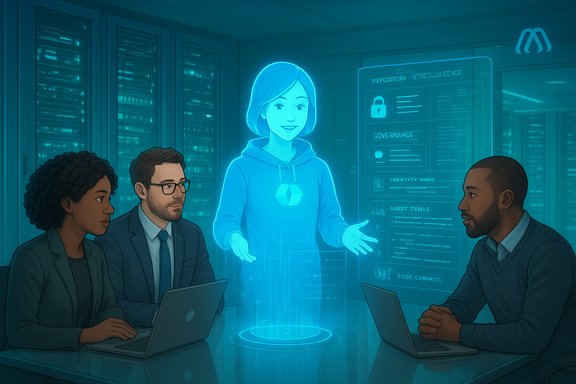
As agents become digital coworkers, Microsoft emphasizes agent security as a priority. Each agent should have an identity, scoped privileges, audit trails, and autonomous protections — security must be built in, not bolted on.Why this matters
- Agents as identities. Treating agents like service accounts or identities enables role-based access control, credential rotation, and least-privilege enforcement.
- Attack surface increase. More agents means more credentials, more tokens, and more potential points of compromise; every agent that accesses data or systems is a persistence vector for attackers.
- Supply-chain implications. Third-party agents and connectors introduce dependency risk. A misbehaving plugin could leak data or execute undesired actions.
Practical steps
- Enforce fine-grained identity and token management for agents.
- Log and trace every agent action; instrument provenance metadata to enable audits and rollbacks.
- Create an “agent review board” for production deployments — a cross-functional team that vets agent scope, data access, and human-review checkpoints.
Risks and unknowns
Regulatory regimes (healthcare, finance, public sector) are already signalling higher oversight for algorithmic decision-making. Organizations must plan for audits, explainability requirements, and consent flows when agents touch regulated data.Trend 3 — AI helping close healthcare gaps
What Microsoft says
Microsoft’s AI Healthcare leadership argues AI will expand beyond diagnostics into symptom triage, treatment planning and scaled generative services that patients can use directly — shifting some care tasks out of constrained clinical settings and into consumer-friendly tools.Evidence and verification
Microsoft points to prototype models and pilot projects that combine multi‑modal models with clinical workflows. Independent reporting and industry pilots show the same movement: AI copilots are being tested for clinical documentation, imaging triage, and patient-facing triage bots. However, rigorous clinical validation and regulatory clearance remain prerequisites for operational deployment.Benefits
- Broader access in areas with clinician shortages.
- Faster triage and documentation reduction for clinicians.
- Potential for personalized, longitudinal care nudges.
Critical concerns
- Clinical validation: Models must be validated on representative populations and evaluated for bias, calibration, and harm.
- Regulatory oversight: FDA, EMA and other agencies expect validation and monitoring for tools that influence clinical decision-making.
- Liability: Who bears responsibility when an agent‑enabled triage misses signs of serious illness?
Trend 4 — AI as a scientific research partner
Microsoft’s framing
Microsoft expects AI to move from literature synthesis and lab‑automation aids to active hypothesis generation and experiment orchestration — effectively participating in scientific discovery across physics, chemistry and biology. Microsoft highlights models that design materials and simulate molecular dynamics as precursors to more integrated workflows.Independent corroboration
Multiple research teams and private labs already use AI for molecular design, climate modeling, and materials simulation. Companies building domain-specific foundation models and simulation pipelines report accelerated iteration cycles. These moves are visible in both commercial announcements and peer-reviewed studies.Strengths
- Speed: AI augments lab throughput by proposing experiments, narrowing parameter spaces, and optimizing simulations.
- New ideas: Models can suggest non‑intuitive compound combinations or experimental setups.
Risks
- Overreliance on model suggestions without adequate experimental replication risks artifacts becoming accepted knowledge.
- Intellectual property boundaries become blurred when models trained on proprietary datasets propose patentable inventions.
Trend 5 — Emergence of “AI super factories” (smarter, flexible infrastructure)
What Microsoft says
The next phase of AI infrastructure is not just bigger data centers but smarter, more efficient, and more connected computing fabrics — “AI super factories.” Microsoft positions efficiency, sustainability and flexible, distributed deployment as the core evaluation criteria for next‑gen infrastructure. Mark Russinovich frames the shift as measuring AI by quality of intelligence, not raw scale.How this differs from “more GPUs”
- Density + orchestration: Instead of uncoordinated GPU sprawl, super factories emphasize dense, interconnected compute with software orchestration that balances workloads across regions and device classes.
- Heterogeneous computing: Expect more hybrid mixes: GPUs for training and large‑model inference, NPUs for on‑device latency‑sensitive tasks, and new accelerators (including analog optical or specialized inference ASICs).
- Sustainability: Carbon‑aware scheduling and energy-optimized model placement will be competitive differentiators.
Independent indicators
Azure and other cloud providers have already launched specialized AI VM families and announced carbon‑aware tools. Analysts note a shift in procurement from purely training-centric spend to inference-optimized infrastructure, supporting Microsoft’s thesis.Operational guidance
- Prioritize workload characterization before committing to large hardware buys.
- Start small with flexible capacity commitments and evaluate the emergence of composable, multi‑region fabrics.
- Factor sustainability metrics (PUE, carbon intensity) into procurement scorecards.
Trend 6 — Repository intelligence: AI understanding code context and history
Microsoft’s claim
AI will stop being a single-file autocomplete and gain repository intelligence: it will analyze commit history, change rationale, and development patterns to make smarter suggestions, detect regressions early, and even propose automated fixes. Microsoft cites GitHub activity as evidence that repository-scale patterns now exist at scale and can be mined.Facts and confirmation
GitHub’s Octoverse 2025 data shows record developer activity — an average of 43.2 million pull requests merged per month and nearly 1 billion commits over the Octoverse period — establishing the volume of structured historical signals repository intelligence needs. That Octoverse report is publicly available and widely covered.Practical impact
- Better code suggestions. Tools that understand why a change was made (issue references, PR descriptions) can recommend context-aware edits with fewer false positives.
- Faster triage. Historical patterns can prioritize security fixes or surface likely regressions.
- Automated maintenance. Routine fixes (dependency bumps, formatting) can be proposed and merged under controlled policies.
Developer responsibilities
- Treat AI-generated code as first draft: require CI, tests, and human review.
- Store rich metadata in PRs and commits—good message hygiene improves AI recommendations.
- Maintain contributor guides and claims about governance; repository intelligence is only as good as the trace data available.
Trend 7 — Quantum computing: “years, not decades”
Microsoft’s position
Microsoft argues that quantum computing is entering a “years, not decades” phase, driven by hybrid compute models that combine AI, supercomputers and quantum processors. The company points to Majorana 1 — a topological‑qubit based processor — as a milestone that shortens timelines toward practical quantum advantage. Jason Zander frames this as a structural shift, not just a speed gain.Verification and independent perspective
Microsoft has publicly announced the Majorana 1 processor and published technical details on Azure/Azure Quantum channels. Outlets including CNBC, Reuters and other major publishers reported on Majorana 1 and Microsoft’s roadmap, confirming the announcement and the company’s optimism about accelerated timelines. However, independent scientific commentary remains cautious: while Majorana‑style topological qubits promise intrinsic error resistance, the broader research community continues to stress engineering, error‑correction scaling, and reproducibility challenges before universal, fault‑tolerant quantum systems become widely practical.Balanced view
- Microsoft’s Majorana 1 is a significant engineering milestone and a credible advancement on the path to more stable qubits.
- “Years, not decades” should be read as conditional: real-world quantum advantage for specific problems might arrive within years, but general-purpose, fault‑tolerant quantum computing across many workloads still requires substantial engineering and verification.
- Organizations should monitor hybrid‑quantum research and engage in early, low‑risk pilots for niche problems (materials simulation, certain combinatorial optimization tasks) while avoiding wholesale migration bets.
Cross-cutting strengths in Microsoft’s thesis
- Coherence across layers. Microsoft’s trends connect user experiences (Copilot & agents), developer workflows (repository intelligence), infrastructure (super factories), and foundational research (quantum). That end-to-end view helps enterprises plan coordinated pilots.
- Evidence of market traction. GitHub’s Octoverse data demonstrates developer adoption and activity levels that make repository intelligence realistic.
- Real engineering advances. Majorana 1 and advances in infrastructure designs (analog optical compute experiments, specialized NPUs) are concrete technological signals rather than pure marketing claims.
Key risks and where to apply caution
- Numeric claims and timelines are directional. Big numbers (GPU counts, petaflops, estimated savings) are useful to forecast scale but are often preliminary and subject to revision. Treat them as directional evidence rather than contract-level commitments.
- Governance gap. Rapid adoption of agents without governance will amplify compliance, privacy, and safety risks — especially in regulated sectors.
- Quantum optimism vs. engineering reality. Majorana 1 is promising, but independent scientific validation, reproducibility, and scaling to fault-tolerant architectures are nontrivial. Expect continued debate and incremental validation steps.
- Operational cost and sunk investments. The push toward specialized infrastructure creates the risk of stranded capacity if workloads or regulatory constraints shift.
What Windows users and IT professionals should do next
Short term (0–6 months)
- Treat agents as identities: require authentication, assign scoped privileges, and log actions.
- Add provenance and audit trails to any AI-driven automation.
- Pilot repository intelligence with strict CI and human-review gates; do not auto‑merge critical changes without tests and approvals.
- Update incident response playbooks to cover agent compromise and AI‑driven error cascades.
Medium term (6–18 months)
- Re-architect application telemetry to capture trust signals (confidence, data provenance) from AI components.
- Evaluate hybrid infrastructure options and negotiate flexible cloud capacity rather than appliance-style ownership.
- For healthcare customers: engage clinical governance early and budget for post‑deployment monitoring and auditing.
Long term (18+ months)
- Keep quantum on the radar for domain-specific R&D: materials, chemistry and optimization problems are most likely to show early quantum advantage.
- Re-examine procurement models to favor composable, upgradeable AI fabrics rather than monolithic GPU farms.
A short governance checklist for deploying agentic AI
- Define agent identity and lifecycle policy.
- Enforce least privilege for every agent.
- Require an “explainability” or provenance tag on outputs used for decisioning.
- Build a human review threshold: any agent-based recommendation that crosses risk boundaries requires human signoff.
- Maintain immutable logs and test rollback procedures.
Final analysis — What to believe and what to test
Microsoft’s seven trends are not a disconnected set of marketing lines; they describe a web of interlocking shifts already visible in product roadmaps, developer telemetry and published research. The strongest signals are:- Developer and repo activity (GitHub Octoverse) that creates the raw historical data repository intelligence needs.
- Concrete engineering milestones (Majorana 1) that validate research paths toward more reliable quantum qubits, even while the community debates timelines.
- The rapid operationalization of agentic AI inside enterprise apps and productivity tools, making agent security a practical imperative.
Conclusion
The next phase of AI — where agents act like colleagues, repository intelligence shapes engineering, infrastructure becomes a coordinated “super factory,” and quantum enters the hybrid compute stack — is arriving as a set of interdependent transitions rather than a single event. For Windows users, developers and IT leaders, the imperative is clear: plan for agentic workflows, treat each AI actor as an identity, adopt robust provenance and human-review controls, and stage infrastructure investments so they remain flexible and verifiable.Microsoft’s seven trends provide a practical roadmap for organizations that want to harness AI’s potential while avoiding the operational and regulatory pitfalls that come when powerful systems are deployed without governance. These are real technological inflection points — verifiable in GitHub activity, Microsoft engineering publications, and independent reporting — but their benefits will accrue to organizations that combine experimentation with discipline.
Source: Cyprus Shipping News - Cyprus Shipping News
