

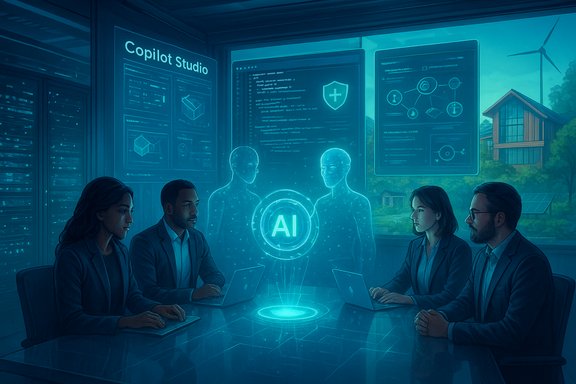
Microsoft’s latest prognosis — a seven‑point map of AI trends that the company says will shape the year ahead — marks a transition from AI as a toolbox to AI as a collaborator, an infrastructure redesign, and a new compute axis that includes quantum‑hybrid models.
Microsoft’s forecast frames 2026 (and the immediate years beyond) as a pivot point: agentic AI becomes mainstream, infrastructure shifts from raw scale to smarter efficiency, AI embeds more deeply into healthcare and scientific workflows, and new compute paradigms such as quantum‑hybrid systems begin to move from research into practical pilot stages. These themes were presented as a connected set of trends — not independent bullet points — illustrating how model capabilities, operational governance, datacenter architecture, developer workflows, and domain‑specific advances will reinforce one another.
Microsoft’s narrative echoes recent product and infrastructure launches: broader Copilot/agent functionality, the Azure AI Foundry and Copilot Studio toolsets, new GPU‑class Azure VMs, and quantum research milestones such as prototypes described by Microsoft’s Discovery & Quantum teams. These announcements are already showing up in enterprise pilots, partner commitments, and expanded Azure infrastructure roadmaps.
However, several claims deserve scepticism or cautious interpretation:
For Windows users and IT professionals, the immediate imperative is governance: treat agents like identities, instrument every AI action with robust provenance, and enforce human review for AI‑driven decisions. For developers, the promise of repository intelligence is huge — but it comes with the obligation to verify, test, and control automated changes. For executives, quantum and super‑factory investments are strategic but should be staged and measured, with clear business cases and rigorous risk assessments.
Microsoft’s seven trends sketch a credible near‑term future in which AI is a teammate, infrastructure is smarter, and compute is more diverse. The opportunity is vast; the work is governance, cost control, and careful validation. The next 12–24 months will show whether these trends deliver durable productivity gains or whether the industry’s real test will be its ability to scale AI safely and sustainably.
Source: Businesskorea Microsoft Unveils Seven Major AI Trends for Next Year
 Background
Microsoft’s forecast frames 2026 (and the immediate years beyond) as a pivot point: agentic AI becomes mainstream, infrastructure shifts from raw scale to smarter efficiency, AI embeds more deeply into healthcare and scientific workflows, and new compute paradigms such as quantum‑hybrid systems begin to move from research into practical pilot stages. These themes were presented as a connected set of trends — not independent bullet points — illustrating how model capabilities, operational governance, datacenter architecture, developer workflows, and domain‑specific advances will reinforce one another.Microsoft’s narrative echoes recent product and infrastructure launches: broader Copilot/agent functionality, the Azure AI Foundry and Copilot Studio toolsets, new GPU‑class Azure VMs, and quantum research milestones such as prototypes described by Microsoft’s Discovery & Quantum teams. These announcements are already showing up in enterprise pilots, partner commitments, and expanded Azure infrastructure roadmaps.
The seven trends, summarized
- AI will establish itself as a powerful collaborator — agents become digital colleagues.
- AI agents with built‑in security will proliferate, making governance and identity critical.
- AI will narrow healthcare gaps by moving beyond diagnostics into symptom classification and treatment support.
- AI as a scientific research partner will accelerate hypothesis generation, experiment orchestration, and discovery workflows.
- The rise of AI super‑factories — denser, smarter, more sustainable distributed compute platforms — will reshape economics and deployment models.
- Repository intelligence: AI will understand code in context, leveraging commit histories, pull requests, and repo topology to give smarter suggestions.
- Quantum and hybrid compute approaches will start to deliver practical advantage for selected problems, prompting early enterprise planning.
1. AI as a collaborator: agents move from assistant to team member
What Microsoft is projecting
Microsoft positions next‑year AI as not just a productivity plug‑in but as digital colleagues that can plan, execute, and operate tasks across data, campaigns, and operational workflows — effectively giving small teams global reach and scale. The company points to agent frameworks and Copilot Studio features as the execution path for this vision.Why this matters
Agents that understand context, hold memory, and autonomously perform multi‑step workflows reduce friction across operations. For Windows users and knowledge workers, this means Copilot experiences that are persistent across Microsoft 365, Outlook, Teams, and Edge — moving from ephemeral chats to long‑running, accountable assistants.Strengths
- Productivity multipliers: agents can compress multi‑day planning into hours.
- Democratization of complex workflows: non‑engineers can orchestrate automation via agent templates and low‑code connectors.
Risks and caveats
- Operational risk when agents act without human oversight: erroneous multi‑step actions can compound mistakes.
- Cost runaway: always‑on agents with long contexts and heavy inference can spike cloud bills unless capacity and message‑level controls are enforced.
Practical guidance (for IT and Windows admins)
- Treat agents as identities: enroll them in directory services, conditional access policies, and lifecycle reviews.
- Pilot narrow, measurable agent projects with strict rollback and audit trails.
2. AI agents with built‑in security: governance moves to the fore
The claim
Microsoft argues that as agents become routine collaborators, security and governance will shift from per‑model controls to agent lifecycle and identity management at scale. Built‑in safeguards, signed connectors, and fine‑grained permissions will become mandatory.Evidence and verification
This claim aligns with Microsoft’s product trajectory — launches like Security Copilot, Identity‑first Copilot connectors, and enterprise agent frameworks all emphasize auditability and signed connectors. Independent reporting in industry briefs and the company’s governance guidance reinforce that agent identity and permissioning are now primary controls.Strengths
- Better auditability and provenance for actions taken by software agents.
- The ability to scale automation with established enterprise controls mitigates insider‑risk scenarios.
Risks
- New attack surface: connectors and agent orchestration frameworks can be targeted for credential theft or supply‑chain tampering.
- Governance mismatch: regulators may require explainability and human‑in‑the‑loop guarantees that early agent deployments lack.
Recommended actions
- Require signed, auditable connectors and limit agent write permissions until trust thresholds are met.
- Instrument all agent actions with immutable logs and provenance metadata for post‑hoc review.
3. Healthcare: AI moves from research to patient‑centric services
The claim
Microsoft positions AI as moving beyond diagnosis into symptom classification, treatment planning, and generative services that could be used by millions of patients outside research contexts. Dominic King (Microsoft’s AI Healthcare VP) frames the shift as patient empowerment through accessible generative AI services.Verification and context
Healthcare is a heavily regulated space; Microsoft’s public statements and product efforts (including partnerships and clinical pilots) show active investment in clinician‑assisted workflows, triage tools, and evidence grounding. Independent reporting on enterprise pilots and regulatory guidance highlights both potential patient benefits and compliance hurdles.Strengths
- Scalability: AI can extend specialist knowledge to underserved regions at low marginal cost.
- Patient empowerment: conversational interfaces and explainable recommendations can increase patient engagement.
Risks and caveats
- Clinical validation: model outputs require prospective clinical trials or tightly scoped regulatory approval before they can safely influence treatment decisions.
- Liability and safety: incorrect or poorly contextualized suggestions pose real safety and legal risks.
Practical guidance for healthcare IT teams
- Deploy AI as decision‑support, not autonomous decision‑making. Keep clinicians in the loop and build audit trails for every recommendation.
- Start with non‑critical triage and patient education features, and plan regulated pilots with institutional review boards.
4. AI as a research partner: hypothesis, experiment orchestration, and reproducibility
The claim
Microsoft forecasts that AI will no longer be a passive summarizer but an active partner in scientific discovery, generating hypotheses, orchestrating instrumented workflows, and scaling domain knowledge.Evidence and corroboration
There is growing evidence across academia and industry that generative models can accelerate literature triage, propose experimental conditions, and even suggest chemical or material candidates. Microsoft’s research tooling and agent frameworks aim to make these capabilities enterprise‑grade, but independent voices urge strict reproducibility and provenance controls.Strengths
- Time compression: literature review and hypothesis generation that once took months can be reduced dramatically.
- Automation of routine experiment sequences reduces human error in repetitive lab tasks.
Risks
- Reproducibility: if an AI‑driven experiment’s reasoning and parameters aren’t stored immutably, results can’t be audited or replicated.
- Over‑optimization to historical data: models trained on past experiments may miss genuinely novel pathways.
Best practices for research groups
- Log model inputs, versions, parameters, and random seeds as immutable metadata for each experiment.
- Maintain independent replication runs before accepting AI‑generated discoveries.
5. AI super‑factories: smarter, denser, and greener infrastructure
The claim
Microsoft predicts the emergence of AI super‑factories — next‑generation distributed compute fabrics that prioritize density, routing efficiency, and sustainability over raw scale. Mark Russinovich (Microsoft Azure CTO) emphasizes evaluating AI by the quality of intelligence, not just scale.Verification and supporting data
Azure’s push to ND GB200 v6 VMs, adoption of NVIDIA Blackwell platforms, and new datacenter experiments (including cross‑laminated timber builds for embodied carbon reduction) corroborate the infrastructure pivot toward efficiency and sustainability. Industry reporting and Microsoft documentation show both hardware and site‑level innovations aimed at lowering cost per inference and carbon per token.Strengths
- Improved cost efficiency: smarter workload routing and denser racks can lower energy per useful computation.
- Sustainability: novel construction techniques and power delivery innovations can reduce embodied emissions.
Risks
- Demand rebound: efficiency gains can increase demand, leading to higher absolute energy consumption unless utilization is managed.
- Supply constraints and cost: next‑gen GPUs remain high‑demand and expensive — customers must design cost controls.
Operational checklist for CIOs and datacenter teams
- Implement capacity packs, billing caps, and telemetry to prevent runaway inference costs.
- Optimize models for routing, batching, and mixed precision to convert throughput gains into cost savings.
6. Repository intelligence: AI that understands code history and context
The claim
Microsoft and GitHub predict a shift to “repository intelligence,” where AI systems ingest not only code tokens but commit histories, PR rationale, architecture diagrams, and other semantic signals to provide far better suggestions, automated refactors, and safety checks. Git activity metrics — with sharp increases in merged PRs and commits — are cited as evidence that developer workflows are already changing around AI.Evidence and verification
Multiple internal reports and industry summaries reference rising GitHub activity and broader adoption of Copilot in developer toolchains. This trend supports the idea that models with access to historical repo context will produce higher‑quality, auditable changes. That said, the claimed raw numbers for PRs and commits should be treated carefully until confirmed by the original GitHub state reports.Strengths
- Smarter suggestions and automated refactors reduce review cycles and increase throughput.
- Provenance metadata for AI‑generated changes improves traceability.
Risks
- Silent bugs: automated code changes can introduce subtle logical errors that only surface in runtime.
- Security: agent write access to repositories multiplies the risk of secret leakage or malicious commits.
Developer governance recommendations
- Require human review for AI‑generated changes and enforce CI checks that validate behavioral equivalence.
- Add provenance metadata to commits created or modified by agents.
7. Quantum and hybrid compute: nearer‑term practical signals (with caveats)
The claim
Microsoft suggests practical quantum capability and quantum advantage may be achievable within years rather than decades, driven by hybrid compute strategies that combine quantum processors, supercomputers, and AI. The company highlights prototypes like Majorana 1 and topological qubit research as evidence of progress. Jason Zander argues that quantum advantage will reshape fields such as materials and medicine.Verification and caution
Microsoft’s announced prototypes and topological‑qubit research are real and notable in the quantum community. However, independent researchers and commentators caution against equating prototype milestones with near‑term, broadly usable quantum advantage. Scaling, error correction, control systems, and manufacturability are significant unresolved engineering hurdles — progress is meaningful but still iterative. Treat claims of “years, not decades” as optimistic roadmaps that require ongoing independent technical validation.Strengths
- Topological qubits, if realized at scale, could lower error rates and simplify error correction overhead.
- Hybrid workflows where quantum accelerators complement classical AI could unlock new algorithms for chemistry, materials, and optimization.
Risks
- Overpromising: claiming imminent general‑purpose quantum advantage risks misallocating enterprise R&D budgets.
- Security: quantum decryption timelines make long‑lived secrets a strategic risk; organizations must plan for post‑quantum cryptography now.
Practical planning for enterprises
- Begin crypto‑agility assessments: inventory long‑lived encrypted assets and plan migration pathways to post‑quantum algorithms.
- Pilot hybrid quantum workloads for niche problems (materials, specialized optimization) while monitoring research progress.
Cross‑cutting themes: governance, cost, interoperability, and sustainability
Across all seven trends, four themes repeat:- Governance — agent identity, lifecycle controls, and immutable audit trails are foundational to scaling AI safely.
- Cost control — the economics of always‑on agents and larger contexts require billing constructs like message meters and tenant caps.
- Interoperability — open protocols accelerate innovation but broaden the attack surface; signed connectors and observability are mandatory.
- Sustainability — hardware efficiency and low‑carbon datacenter builds are necessary but not by themselves sufficient to guarantee lower net emissions; utilization matters.
What the trends mean for Windows users, IT professionals, and developers
- Windows as a platform will see deeper Copilot integration across the shell and app stack, making agentic features more visible to end users and admins. Expect richer Copilot experiences in Windows 11 and enterprise SKUs.
- IT professionals must elevate AI governance to the same level as identity and device management: agents are identities and should be provisioned, monitored, and retired accordingly.
- Developers should adopt repository intelligence best practices: provenance metadata, mandatory human review of AI patches, and CI‑driven behavioral validation.
Short checklist: immediate next steps (for IT teams)
- Inventory current AI/agent pilots and map their data connectors and identities.
- Implement directory entries and conditional access for any agent accounts.
- Cap spend: set tenant billing limits and deploy telemetry to detect runaway inference.
- Require human review and CI validation for AI‑generated code changes.
- Start a crypto‑agility plan to inventory long‑lived secrets and prioritize PQC readiness.
Critical appraisal: strengths, blind spots, and where to be sceptical
Microsoft’s seven‑trend framework is compelling because it links product development (Copilot Studio, Azure AI Foundry), infrastructure upgrades (new VM classes, datacenter design), developer flows (repository intelligence), and long‑term compute bets (quantum) into a cohesive story. This integrated view is a legitimate strategic advantage — customers get a clear migration path from pilot to production within a single vendor stack.However, several claims deserve scepticism or cautious interpretation:
- Numbers and timelines cited publicly (for example, precise GitHub activity figures or quantum timelines) are sometimes presented as evidence without direct public raw datasets attached in the same statement. Treat such numbers as directional unless you can verify them against primary reports or the platform owner’s published metrics.
- Quantum timelines remain highly uncertain. Prototype breakthroughs (Majorana 1) are promising, but scaling to fault‑tolerant, general‑purpose systems remains an open engineering problem. Organizations should plan, but not pivot core business models on near‑term universal quantum availability.
- Agent adoption will surface governance, legal, and regulatory frictions — particularly in healthcare, finance, and public sector deployments. Expect regulators to require transparency and human oversight in many jurisdictions.
Final takeaways
Microsoft’s seven trends provide a practical blueprint for 2026: AI becomes more agentic and embedded, infrastructure priorities shift to smart efficiency and sustainability, repository‑aware developer tooling changes how software is built, and hybrid compute explorations (including quantum prototypes) redefine long‑range R&D. These are real, interlocking shifts, not mere marketing themes, and organizations should respond with governance, cost controls, and measured pilots.For Windows users and IT professionals, the immediate imperative is governance: treat agents like identities, instrument every AI action with robust provenance, and enforce human review for AI‑driven decisions. For developers, the promise of repository intelligence is huge — but it comes with the obligation to verify, test, and control automated changes. For executives, quantum and super‑factory investments are strategic but should be staged and measured, with clear business cases and rigorous risk assessments.
Microsoft’s seven trends sketch a credible near‑term future in which AI is a teammate, infrastructure is smarter, and compute is more diverse. The opportunity is vast; the work is governance, cost control, and careful validation. The next 12–24 months will show whether these trends deliver durable productivity gains or whether the industry’s real test will be its ability to scale AI safely and sustainably.
Source: Businesskorea Microsoft Unveils Seven Major AI Trends for Next Year
