

Artificial intelligence is no longer a promise on the horizon — 2025 marked the shift from dazzling demos to operational AI, with multimodal reasoning, long-running agents, and platform-level governance becoming the central battlegrounds for vendors, enterprises, and regulators alike.
The public conversation about AI in 2025 clustered around three enduring shifts: the move from single‑modal language models to multimodal systems that fuse text, images, audio and video; the rise of agentic AI — persistent, goal-driven systems that orchestrate tools and workflows; and the transition from single-model bragging rights to platforms and governance that make models safe, auditable and operational for enterprises.
Sam Altman’s repeated forecast that the next wave of systems could surprise skeptics captured the tenor of the year and coincided with OpenAI’s corporate pivot toward a public‑benefit structure — an institutional change as consequential as any model release. Those governance and funding moves were firmed up publicly as OpenAI and other players restructured to marry mission claims with capital needs. Windows-oriented communities and enterprise IT teams tracked a similar set of themes: Copilot integrations into productivity suites, the rise of private and hybrid model deployments, and a pragmatic focus on measurable pilots and governance before scale‑up. These operational imperatives — observability, provenance, and human‑in‑the‑loop controls — are now the criteria enterprise buyers use to separate marketing from deployable technology.
OpenAI’s corporate governance changes — the reorganization to a public‑benefit model with continued nonprofit oversight — and linked financing moves were widely reported and materially reshape incentives around transparency, funding and control. Multiple mainstream outlets and OpenAI’s own statements document this reorganization and the intent to secure capital while retaining mission governance. Practical implications for IT and procurement
For Windows users, IT leaders and developers the path forward is clear: pilot boldly but instrument thoroughly; demand reproducible benchmarks; and adopt hybrid deployment patterns that preserve control over sensitive data. The ROI is real for measured use cases, but the stakes rise dramatically when agents are allowed to act without human governance in environments that carry legal, safety, or ethical risk.
The era ahead rewards organizations that combine technical competence with procurement rigor and ethical discipline. The next wave of value will be harvested not by those who shout loudest about models, but by those who operationalize AI safely, measure outcomes honestly, and design systems that keep humans firmly in the verification loop.
Source: Qatar Tribune https://www.qatar-tribune.com/artic...r-ai-trends-expectations-for-2025-beyond/amp/
 Background / Overview
The public conversation about AI in 2025 clustered around three enduring shifts: the move from single‑modal language models to multimodal systems that fuse text, images, audio and video; the rise of agentic AI — persistent, goal-driven systems that orchestrate tools and workflows; and the transition from single-model bragging rights to platforms and governance that make models safe, auditable and operational for enterprises.Sam Altman’s repeated forecast that the next wave of systems could surprise skeptics captured the tenor of the year and coincided with OpenAI’s corporate pivot toward a public‑benefit structure — an institutional change as consequential as any model release. Those governance and funding moves were firmed up publicly as OpenAI and other players restructured to marry mission claims with capital needs. Windows-oriented communities and enterprise IT teams tracked a similar set of themes: Copilot integrations into productivity suites, the rise of private and hybrid model deployments, and a pragmatic focus on measurable pilots and governance before scale‑up. These operational imperatives — observability, provenance, and human‑in‑the‑loop controls — are now the criteria enterprise buyers use to separate marketing from deployable technology.
What shipped (and why it matters)
GPT‑5: “built‑in thinking” and model routing
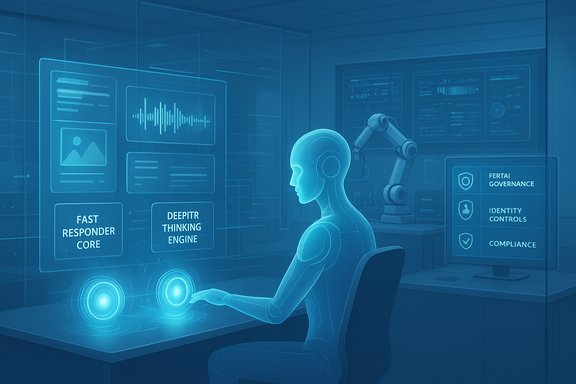
OpenAI’s August 7 announcement framed GPT‑5 as a single system that knows when to respond quickly and when to “think longer” — a practical architecture that balances latency and depth by routing requests between a fast responder and a deeper reasoning engine. This design explicitly addresses the tradeoff between responsiveness and factual accuracy in long, complex tasks. Why it matters- Enterprises implementing Copilots and automation can now route routine requests to fast modes and reserve the deeper, costlier reasoning model for high‑value use cases.
- The architecture formalizes a pattern that improves reproducibility: explicit model routing and thinking‑modes can be instrumented for audit and SLA controls.
- Vendor claims about hallucination reduction are promising but not decisive: independent benchmarking in domain‑specific workloads is required before treating “thinking” as a correctness guarantee. Early reporting documents the feature, but independent benchmarks must follow.
Anthropic’s Claude Sonnet 4.5: endurance and agentic coding
Anthropic’s Sonnet 4.5 was promoted as a frontier model for long‑running agents, coding, and continued alignment improvement — with the company and multiple outlets noting the model’s ability to sustain autonomous work for extended periods (reportedly up to 30 hours in some contexts). Sonnet 4.5 added agent SDKs, checkpoints for rollbacks, and stronger prompt‑injection resistance. Why it matters- Long‑running agent capability reduces the friction in building multi‑step automations (booking, orchestration, or multi‑tool workflows).
- Checkpoints and improved safety training are meaningful for regulated verticals where reproducibility and rollback matter.
- “30 hours of autonomy” is a measure of sustained context and state management demonstrated in specific internal tests — useful, but demanding independent reproduction under real‑world, safety‑critical constraints. Multiple outlets reported the claim; treat application‑level timelines conservatively until peer evaluations appear.
Microsoft Copilot wave and enterprise tooling
Microsoft’s 2025 release wave 2 emphasized role‑based Copilots, extended CRM and finance connectors, and Copilot Studio improvements geared to enterprise deployment patterns (role templates, governance controls, and deployment lifecycles). The release plan and subsequent product integrations tied Copilot to both Azure AI Foundry and the wider Microsoft 365 ecosystem. Microsoft also announced deeper integrations with newly available models such as GPT‑5 in Copilot experiences. Why it matters- Enterprises that already anchor on Microsoft stacks get a lower integration cost to deploy Copilot experiences, but must assess data residency, audit, and cost models.
- Role‑based Copilots reduce the “one‑assistant‑fits‑all” problem by tailoring capabilities to job functions (finance agents, sales assistants, developer copilots).
- Release plans provide a roadmap; feature parity and GA dates vary by region and SKU. Validate actual availability, limits and contractual terms before procurement.
Platforms, marketplaces and corporate governance
The conversation in 2025 matured from “which model wins” to “which platform makes models safe and sustainable.” Hyperscalers moved to offer model marketplaces and hosting that bundle frontier models with enterprise controls: identity, billing, audit logs, and isolation. This materially affects procurement: buyers evaluate ecosystems, not just model accuracy.OpenAI’s corporate governance changes — the reorganization to a public‑benefit model with continued nonprofit oversight — and linked financing moves were widely reported and materially reshape incentives around transparency, funding and control. Multiple mainstream outlets and OpenAI’s own statements document this reorganization and the intent to secure capital while retaining mission governance. Practical implications for IT and procurement
- Expect vendor SLAs to include observability and model telemetry.
- Insist on contractual clarity around IP, model updates, and the data Microsoft or other partners may retain for service improvement.
- Consider hybrid hosting (private models on-prem or in VNet + managed frontier models) as a pragmatic balance for sensitive workloads.
Enterprise use cases that scale (and those that don’t)
High‑value, early wins
- Knowledge search and summarization (with provenance): measurable, low‑risk efficiency gains.
- Ticket triage and first‑pass drafting: reduced human effort, measurable KPIs.
- Document automation in regulated flows (with human approval): cost and time savings when audit trails exist.
More aspirational, riskier areas
- Fully autonomous financial decisions (credit approvals without human oversight): raises regulatory and liability issues.
- Unsupervised agentic automations in biosecurity or clinical decisioning: high‑risk and often unsuitable without exhaustive validation and legal sign‑off. The community consensus is to pilot, validate, and fence off high‑risk usages.
Synthetic data, privacy and reproducibility
Synthetic data graduated from lab curiosity to mainstream toolset in 2025. Industry moves — acquisitions, vendor tooling and academic frameworks — show that enterprises use synthetic datasets to mitigate privacy risk and fill training gaps. Major vendors (NVIDIA, Google, Microsoft) invested in synthetic workflows and startups scaled to meet enterprise demand. However, the privacy/utility trade‑off is nontrivial: formal differentially private guarantees reduce fidelity and require rigorous testing. Best practices- Use a hybrid approach: combine high‑fidelity real data for critical edge cases with synthetic augmentation for scale and privacy.
- Apply independent privacy audits (membership inference and re‑identification testing).
- Maintain reproducible datasets and synthetic data generation logs for compliance and incident response.
Autonomous labs and research acceleration
“Self‑driving” labs — robotic, closed‑loop R&D platforms that iterate experiments and learn from streamed data — moved from demonstration projects into operational deployments in materials science, chemistry, and select biotech labs during 2025. Published papers and programs (academic, national lab and industry partnerships) documented throughput and data‑intensity improvements. These platforms compress discovery cycles and create new interfaces for scientist–agent collaboration. Practical considerations- Self‑driving labs demand domain‑specific validation and regulatory pathways when output translates into clinical or safety‑critical outcomes.
- Data provenance and experiment reproducibility must be engineered into pipelines — otherwise speed becomes brittle science.
Strengths, risks and the governance landscape
Notable strengths
- Multimodality and tool‑enabled models make AI practically useful across media‑rich workflows.
- No‑code agent builders and Copilot templates democratize automation for citizen developers.
- Synthetic data and self‑driving labs offer measurable gains in R&D throughput with the right safeguards.
Persistent risks
- Hallucinations and brittle reasoning remain material risks: “thinking” modes and larger context windows reduce but do not eliminate incorrect assertions.
- Vendor claims about time‑savings and productivity must be independently validated in domain contexts; vendor case studies are directional, not definitive.
- The regulatory and ethical frameworks continue to lag product capability in several jurisdictions, especially for agentic systems in finance, healthcare and bio R&D.
- Governments and multistakeholder bodies are accelerating rulemaking and audit frameworks; enterprises must plan for evolving obligations and build for compliance now, not later. Recent high‑profile corporate governance moves and public statements illustrate that corporate structure and accountability are now part of risk calculus.
Practical playbook for IT leaders and Windows administrators
- Start with low‑risk, measurable pilots:
- Choose use cases with clear KPIs (time saved, error reduction).
- Define human‑in‑the‑loop checkpoints before any automated action causes irreversible effects.
- Centralize governance:
- Maintain an approved‑model registry, version control for prompts and prompt‑templates, and retraining cadences.
- Require audit logs and identity‑bound agent actions.
- Build a testbed:
- Maintain a reproducible staging environment for model benchmarking and stress tests.
- Run independent red‑team exercises focused on hallucination, data leakage and prompt‑injection vectors.
- Budget for operational costs:
- Expect compute and data costs to be ongoing line items, not one‑time purchases; estimate for model inference, fine‑tuning and observability.
- Plan for workforce evolution:
- Reskill staff into “agent bosses” and verifier roles who can instruct, audit and synthesize AI outputs instead of relying solely on AI for answers.
What to believe — and what to treat cautiously
The 2025 product landscape includes verifiable releases (GPT‑5, Anthropic Sonnet 4.5, Microsoft Copilot wave updates) documented in vendor posts and multiple independent outlets. For example, OpenAI’s GPT‑5 announcement is published on the company site and covered widely; Anthropic’s Sonnet 4.5 has been reported in major press; Microsoft’s Copilot release roadmap is in its public release plans. These are firm, material milestones. On the other hand, anecdotal claims and colorful human‑facing narratives — items that imply emergent intent, personality, or independent “emotion” in systems — require skeptical treatment. Stories that lean on singular, unverifiable conversations or dramatic personal‑style outputs should be flagged until raw logs or reproducible evidence is provided. The community archives we maintain reflect both verified milestones and unverifiable anecdotes; rigorous adoption demands separating the two.Looking beyond 2025: five anchored expectations
- Platform maturity beats singular model hype
- Firms will buy ecosystems that offer identity, audit, and governance rather than chasing leaderboard wins.
- Multimodal agents will proliferate — but under controlled scopes
- Expect more tool‑enabled agents for scheduling, finance triage and developer assistance; mission‑critical autonomy remains gated.
- Synthetic data will become a mainstream compliance tool
- But formal privacy guarantees and independent evaluation frameworks will be necessary to scale across healthcare and finance.
- Self‑driving labs will spread into industrial and materials science, not generalized biology overnight
- They will produce strong gains in throughput for physical sciences with responsible, stage‑gated expansion into biotech.
- Corporate structures and public accountability will shape competitive dynamics
- The way organizations are capitalized and governed will affect IP, partnerships and long‑term market power. OpenAI’s transition is an inflectionary example.
Final assessment: cautious, evidence‑based optimism
The useful story of 2025 is not that machines suddenly replaced judgment, but that AI became a sophisticated partner — powerful when scaffolded with good engineering, governance and human oversight. The combination of multimodal reasoning, agentic automation, synthetic data workflows, and self‑driving labs points to a practical horizon where AI materially accelerates specific workflows while exposing real governance, safety and procurement challenges.For Windows users, IT leaders and developers the path forward is clear: pilot boldly but instrument thoroughly; demand reproducible benchmarks; and adopt hybrid deployment patterns that preserve control over sensitive data. The ROI is real for measured use cases, but the stakes rise dramatically when agents are allowed to act without human governance in environments that carry legal, safety, or ethical risk.
The era ahead rewards organizations that combine technical competence with procurement rigor and ethical discipline. The next wave of value will be harvested not by those who shout loudest about models, but by those who operationalize AI safely, measure outcomes honestly, and design systems that keep humans firmly in the verification loop.
Source: Qatar Tribune https://www.qatar-tribune.com/artic...r-ai-trends-expectations-for-2025-beyond/amp/
