

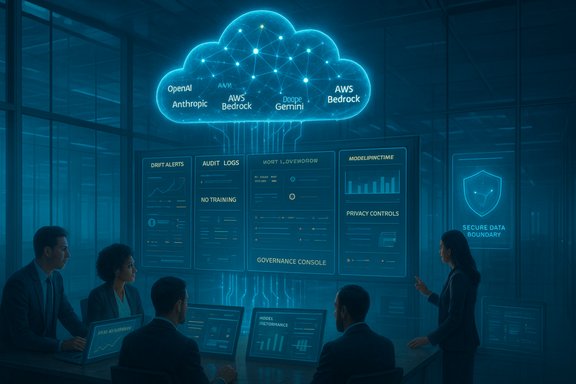
The rise of AI-as-a-Service (AIaaS) from an experimental set of APIs into the backbone of enterprise digital transformation is now unmistakable: today’s AI vendors sell not only models but full ecosystems for data, governance, and agentic automation, and choosing the right provider has become a strategic IT decision rather than a tactical pilot.
Background / Overview
AI-as-a-Service (AIaaS) removes the need for most organizations to build and maintain expensive, bespoke AI training stacks by offering pre‑trained foundation models, managed hosting, fine‑tuning, and agent orchestration via cloud APIs or private deployments. The vendor landscape that dominates this space in 2025 combines three elements: hyperscale cloud providers that supply global compute and managed model hosting; model-first startups that deliver frontier reasoning and safety features; and infrastructure vendors and systems integrators that supply the glue — runtime, governance, and integration into core business systems.This article examines the top AIaaS companies commonly cited as market leaders in 2026, verifies key technical and financial claims where public evidence exists, and offers practical guidance for IT leaders who must match capability to business risk, regulatory constraints, and cost controls.
How this ranking and verification were done
- Core vendor claims were verified against vendor blogs, formal product documentation, and reputable industry reporting.
- Where a vendor claim was numerical (revenue, valuation, pricing), at least two independent sources were consulted when available.
- Items that could not be independently confirmed are explicitly flagged and treated as vendor claims or market commentary.
- Practical guidance focuses on what enterprises should validate during procurement: capacity SLAs, data‑usage guarantees, governance tooling, exit portability, and pilot KPIs.
1) OpenAI — frontier models, huge reach, and rising cost pressures
OpenAI remains the company setting many of the expectations for generative AI at enterprise scale, driven by the GPT family and ChatGPT as both a developer platform and a mass consumer application. OpenAI publicly introduced GPT‑5.2 in December 2025 with distinct sub‑variants (Instant, Thinking, Pro) tailored for speed, deeper reasoning, and maximum reliability respectively — a clear reflection of the enterprise requirement to balance latency, cost, and accuracy. Key verifications and context:- GPT‑5.2 and its sub‑variants are documented on OpenAI’s site and reported by major outlets.
- OpenAI’s revenue run‑rate has been reported to jump from roughly $5.5B in December 2024 to an annualized $10B by mid‑2025; multiple business outlets cited the company’s growth in that window. These revenue figures are material to procurement and pricing negotiations.
- Product breadth and developer momentum: simple APIs, a broad partner ecosystem, and rapid product iteration make OpenAI the obvious choice for teams that prioritize cutting‑edge capability.
- Ecosystem distribution: partnerships (notably Microsoft) give enterprises options for regionally compliant hosting while leveraging Azure’s enterprise controls.
- Capital intensity and loss projections: independent reporting (including analysis by The Information) indicates OpenAI is planning large infrastructure investments and projects multi‑year losses that could reach multi‑billion dollars in the near term; this raises questions about future pricing stability and contractual guarantees. Such projections are supported by reporting of internal financial documents but vary by outlet — treat them as informed but evolving forecasts.
- Data handling and compliance: OpenAI offers enterprise controls and no‑training options, but enterprises must actively negotiate contractual protections and understand default data retention behaviors.
- Negotiate written no‑training and data deletion SLAs for sensitive workloads.
- Pilot with a narrow set of KPIs (accuracy, hallucination rate, cost per inference) and require vendor access logs and auditability.
2) Anthropic — safety‑first frontier models for regulated enterprise use
Anthropic has carved a compelling enterprise niche by prioritizing safety, interpretability, and controllability through Constitutional AI and a model family (Claude) designed for predictable behavior. Anthropic’s Claude 4.5 family (Opus, Sonnet, Haiku) and platform features such as Extended Thinking and a client‑side Memory tool address two major enterprise needs: controlled compute budgeting for complex reasoning, and long‑context agentic workflows. Anthropic’s Opus 4.5 release and documented pricing were published by the company and corroborated in its developer documentation. Key verifications:- Anthropic announced a $3.5B Series E at a $61.5B post‑money valuation in March 2025 and later a $13B Series F in September 2025 valuing the company at $183B; these rounds are documented in Anthropic’s press materials.
- Price points and model capabilities for Opus 4.5 (e.g., $5 per million input tokens and $25 per million output tokens) are published by Anthropic.
- Safety and alignment focus: constitutional training, extensive red‑teaming, and agent controls make Claude attractive to finance, healthcare, and legal customers.
- Enterprise feature set: extended computation control, context editing, and a memory API help reduce hallucination and support high‑value automated workflows.
- Higher per‑token costs for top‑tier models — acceptable for mission‑critical tasks but material for high‑volume deployments.
- Model choice tradeoffs: Anthropic’s alignment emphasis slightly shifts tradeoffs away from raw throughput/cost toward safer behavior; enterprises must decide which dimension matters most per workload.
- Choose Anthropic when predictability, auditability, and controlled agent behavior are non‑negotiable; demand proof‑of‑value pilots in your regulatory context.
3) Amazon Web Services (AWS) — breadth, accelerator choice, and Bedrock
AWS is the playbook for organizations that require global scale, multiple accelerator families, and a mature MLOps stack. Bedrock (for managed foundation models) and SageMaker (end‑to‑end ML lifecycle) remain AWS’s primary delivery vehicles for enterprise AI. AWS’s model‑agnostic approach gives organizations access to models from multiple providers while keeping control over their infrastructure and data flows. This positioning is well‑documented by independent market reporting and by AWS’s product announcements.Strengths:
- Compute variety: GPU instances, custom chips (Trainium/Inferentia), and global regions for data residency.
- Extensive partner network: large SI and ISV ecosystems to accelerate deployments.
- Complex pricing and integration work required to stitch modular services into production‑grade AI systems; capacity for top‑end GPUs can be regionally constrained in high‑demand windows.
- Negotiate committed GPU capacity or capacity reservations for large training jobs and use managed tooling (SageMaker Pipelines, Model Monitor) for automated governance.
4) Microsoft Azure AI and Microsoft Foundry — enterprise integration at scale
Microsoft’s differentiation is integration: embedding AI into productivity (Microsoft 365), development (GitHub), and line‑of‑business apps (Dynamics 365), while offering Foundry as a multi‑model platform that now provides both OpenAI GPT models and Anthropic Claude models in a single enterprise control plane. Microsoft announced Claude availability in Foundry in late 2025, making Azure the unique cloud where organizations can test both frontier model families under the same governance controls. Strengths:- End‑user reach: Copilot-style features provide rapid seat‑based value capture.
- Enterprise controls: identity, compliance, data residency, and Responsible AI tooling make Azure a natural choice for regulated customers.
- Seat‑based monetization and deep embedding can create lock‑in; verify integration and export options.
- If your environment is Microsoft‑centric, prioritize Azure Foundry pilots to leverage existing identity and data governance pathways and to test multi‑model strategies (Claude and GPT) on one platform.
5) Google Cloud (Vertex AI, Gemini) — multimodal research strength and TPUs
Google’s Vertex AI and Gemini model family emphasize natively multimodal reasoning and tight integration with BigQuery and data warehouses, a strong fit for analytics‑first enterprise teams. Google’s TPU hardware and Vertex integration offer performance and price efficiencies for certain workloads, and the company’s emphasis on interpretability and monitoring tools addresses enterprise governance needs.Strengths:
- Native multimodal models and data‑centric tooling that reduce RAG complexity.
- TPUs for optimized training on Google’s frameworks.
- If your stack is AWS/Azure‑centric, migration costs and toolchain adjustments may be material.
6) IBM watsonx — governance, hybrid deployment, and industry focus
IBM’s watsonx platform is engineered around enterprise governance and hybrid deployments: watsonx.ai for modeling, watsonx.data for unified lakehouse access, and watsonx.governance for lifecycle recordkeeping, drift detection, and audit artifacts. IBM’s positioning is explicitly aimed at organizations that must demonstrate regulatory compliance and explainability, with a model‑agnostic approach that lets enterprises run IBM’s models, open‑source models, or third‑party models while preserving consistent governance. IBM’s governance claims are well documented in IBM product literature and community resources. Why enterprises pick IBM:- Banking, healthcare, and regulated public‑sector clients who need explainability and audit trails will find watsonx’s governance tooling compelling.
- IBM’s models may not always lead benchmarks on raw frontier capability; the trade‑off is stronger control and integration with enterprise systems.
7) Cohere — enterprise‑first and data‑sovereignty deployments
Cohere has a strong enterprise position built on private deployment and data sovereignty: the company emphasizes deploy‑in‑customer‑environment options, including hybrid clouds and fully air‑gapped scenarios. Its North agent platform, the Command family models, and targeted partnerships (Oracle, Salesforce embeddings) support organizations that cannot or will not send sensitive data through public vendor APIs. Cohere’s acquisition of Ottogrid and the North product rollout are documented in respected outlets and corroborate the company’s enterprise pivot. Strengths:- True private deployment options for regulated or sovereign customers.
- Localization efforts and language models for specific markets (Japan, Korea) increase utility for multinationals.
- Smaller model ecosystem than hyperscalers; enterprises must evaluate performance and operational costs for very large workloads.
- Cohere is especially attractive for governments, defense, and highly regulated industries where data never leaving the customer network is a procurement requirement.
8) NVIDIA — the infrastructure company that became an AI platform
NVIDIA’s influence extends beyond chips. While best known for GPUs (H100, H200 and now Blackwell GB200), NVIDIA also offers software stacks (CUDA, TensorRT, NeMo) and fully managed cloud offerings (DGX Cloud) that turn hardware into a platform. MLPerf submissions and vendor‑backed benchmarks for GB200 validate the performance claims enterprises rely on when planning large training runs. The June 2025 large GB200 MLPerf submission (CoreWeave/NVIDIA/IBM) is evidence of the operational readiness of Blackwell in large clusters. Why monitor NVIDIA:- Availability and pricing of GPUs materially shape what AI deployments are technically and economically feasible.
- Ecosystem lock‑in: many frameworks and tools assume NVIDIA tooling; a multi‑vendor hardware strategy can reduce supply and cost concentration risks.
9) Salesforce Einstein & Agentforce — CRM as the AI operating surface
Salesforce has woven AI across CRM, ERP adjacencies, and now into autonomous agents with Agentforce. The company’s strategy—augmented by the acquisition of Informatica to strengthen data plumbing—focuses on converting Customer 360 data into reliable agent workflows and on protecting data via trust layers that limit third‑party model training on customer data. The Informatica transaction (~$8B announced in mid‑2025) and Salesforce’s Agentforce roadmap are well documented in multiple outlets. Strengths:- Deep embedding into sales and service workflows where agents can act directly on records.
- Data Cloud + Informatica creates a strong foundation for secure, governed RAG pipelines.
- Seat‑based pricing can create substantial per‑user costs; procure with explicit ROI metrics and pilot KPIs.
10) Oracle Cloud Infrastructure (OCI) — low‑latency networking and database integration
Oracle is a strong infrastructure choice for enterprises that prioritize latency, database integration, and distributed cloud choices. OCI’s competitive differentiator is an emphasis on ultra‑low‑latency networking for distributed GPU clusters (suitable for very large model training) and deep integration with Oracle Fusion Cloud applications where AI features have been embedded across ERP, HCM, and SCM. OpenAI’s Stargate program and Oracle’s role as an infrastructure partner are public: OpenAI announced the Stargate partnership and Oracle’s role in capacity expansion; reporting about project timelines and subsequent market commentary are available from both parties. Strengths:- Superior networking and direct database connectivity (zero‑ETL patterns) for enterprises with heavy operational data inside Oracle systems.
- Distributed cloud and dedicated region options for data sovereignty.
- Oracle’s enterprise licensing model is negotiation‑heavy; enterprises must compare total lifecycle TCO vs hyperscaler pay‑as‑you‑go models.
Cross‑cutting themes, risks, and buyer checklist
The vendors above show three consistent themes:- Enterprises want model choice: one model will not solve every problem. Tools that let organizations route workloads to the right model (fast/cheap vs deep/accurate) will win. Microsoft Foundry’s multi‑model approach is an example.
- Governance matters: the ability to produce audit trails, monitor drift, and lock down data usage is now a procurement prerequisite for regulated industries. IBM’s watsonx and Anthropic’s safety tooling are examples of this priority.
- Infrastructure constraints are strategic: GPU supply, networking latency, and chip vendor concentration (NVIDIA dominance but rising AMD/TPU alternatives) shape what is feasible technically and economically. Monitor hardware roadmaps closely.
- Insist on documented no‑training and data deletion terms for sensitive data.
- Require pilot KPIs (accuracy, hallucination rate, TCO per 1M tokens, throughput, latency) and at least two comparable customer references.
- Verify capacity SLAs for the GPU families you need and negotiate reserved capacity or committed use discounts.
- Demand export paths for models and data to avoid lock‑in (containerized artifacts, open‑format model checkpoints, or standardized vector stores).
- Implement continuous monitoring: drift detectors, fairness tests, and an incident response plan for hallucinations or data leak events.
Notable unverifiable or evolving claims — treat with caution
Several high‑profile financial and operational projections about the industry are still moving targets and should be treated as provisional:- OpenAI’s internal loss projections and multi‑year plans (figures such as potential $14B loss in 2026) were reported by investigative outlets but depend on assumptions about training cadence, capital investments, and commercial deals; these should be treated as informed reporting rather than settled fact until audited filings or formal disclosures appear.
- Rapid user‑count metrics for consumer products (ChatGPT weekly users) vary significantly across sources; use vendor disclosures and primary reporting for contractual planning, and treat public user counts as directional.
How to evaluate AIaaS vendors in procurement (step‑by‑step)
- Map workloads and classify data sensitivity (PII/PHI/PD/regulated).
- Choose candidate vendors based on workload profile:
- High‑volume low‑sensitivity: prioritize cost and latency (fast models, Cohere Haiku, Anthropic Haiku, lower‑tier GPTs).
- High‑risk/legal/clinical: prioritize safety, governance (Anthropic Opus, IBM watsonx).
- Enterprise packaged apps: pick vendor with deep integration (Salesforce Einstein, Azure Copilot).
- Run a 60–90 day proof‑of‑value with measurable KPIs and a data‑sovereignty proof (inbound/outbound logs).
- Demand contractual controls: no‑training clauses, data deletion, audit rights, and performance credits.
- Build an exit plan (artifact formats, vector store export, model portability).
Conclusion
The AIaaS market is no longer about which vendor has the smartest research lab; it is about which vendors can provide trustworthy, scalable, and governable AI that maps to real business outcomes. Leaders such as OpenAI, Anthropic, AWS, Microsoft, Google, IBM, Cohere, NVIDIA, Salesforce, and Oracle each own major parts of the value chain — from frontier models to chips, from governance to embedded business processes. The winning strategy for enterprises is a portfolio approach: match model capability to task, enforce governance and data protections, and plan for the operational realities of GPU supply and runaway consumption costs.Enterprises that pair pragmatic procurement (contractual protections, reserved capacity, pilot KPIs) with a disciplined operational setup (observability, drift detection, human‑in‑the‑loop checkpoints) will capture disproportionate value from AI while keeping regulatory and reputational risk in check. The vendors profiled here provide the foundation; the differential advantage will come from how effectively organizations integrate these foundations into measurable, governed workflows.
Source: inventiva.co.in Top 10 AI-as-a-Service Companies In 2026 - Inventiva
