

Microsoft’s marketing organization turned a chronic problem—scattered, ambiguous, and risky data—into a competitive advantage by adopting the Microsoft Purview Unified Catalog as its metadata backbone, and the results are a practical playbook for any large enterprise trying to make governance usable, not burdensome.
Data governance at scale is fundamentally a people-and-process problem amplified by technical complexity. As organizations grow, different teams create independent definitions for core concepts—what counts as a “customer,” which fields are sensitive, how conversions are calculated—leading to duplicated lists, hidden owners, and wasted analyst time. That exact pattern existed inside Microsoft’s marketing org: multiple versions of truth for customer lists, unclear ownership, and long delays while teams hunted for the right datasets. Purview’s Unified Catalog was introduced as the organizing layer to address those precise pain points.
The platform roots its value in three practical capabilities: automated discovery and classification, clear lineage and ownership, and integration with security and compliance controls. For Microsoft’s marketers that meant going from hours lost in data discovery to trusting curated data products surfaced by the catalog—while giving legal, compliance, and security teams the controls they needed.
Source: Microsoft Powering data governance at Microsoft with Purview Unified Catalog - Inside Track Blog
 Background
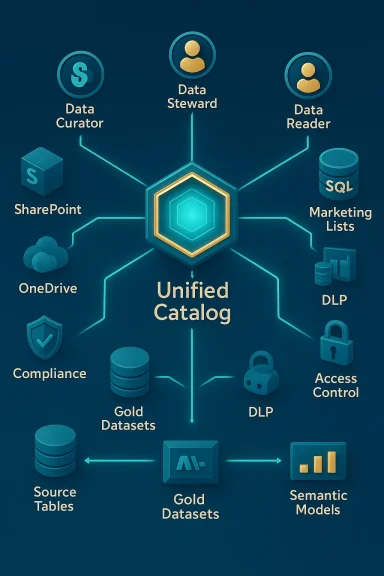
Data governance at scale is fundamentally a people-and-process problem amplified by technical complexity. As organizations grow, different teams create independent definitions for core concepts—what counts as a “customer,” which fields are sensitive, how conversions are calculated—leading to duplicated lists, hidden owners, and wasted analyst time. That exact pattern existed inside Microsoft’s marketing org: multiple versions of truth for customer lists, unclear ownership, and long delays while teams hunted for the right datasets. Purview’s Unified Catalog was introduced as the organizing layer to address those precise pain points.The platform roots its value in three practical capabilities: automated discovery and classification, clear lineage and ownership, and integration with security and compliance controls. For Microsoft’s marketers that meant going from hours lost in data discovery to trusting curated data products surfaced by the catalog—while giving legal, compliance, and security teams the controls they needed.
What the Purview Unified Catalog actually provides
Automated discovery and classification
Purview’s catalog automates scanning across a wide range of stores, identifying assets, and applying sensitivity or classification tags at scale. This reduces manual overhead and helps locate personally identifiable information (PII) or regulated content that would otherwise hide in SharePoint, OneDrive, ad hoc data stores, or analytics workspaces. The system supports trainable classifiers and Exact Data Match (EDM)-style lookups for high-precision detection.Lineage, ownership, and metadata
Beyond discovery, the catalog captures lineage so users can trace a KPI or dataset back to its source tables and ingestion pipelines. That lineage is not a “nice to have”—it’s the evidence auditors, legal teams, and data scientists need when questions arise about provenance, timeliness, or transformation logic. Purview also maps owners and stewards to artifacts, making responsibility explicit and enabling attestation workflows.Integration with security and compliance
Cataloged metadata is only useful when it’s actionable. Purview ties into sensitivity labels, DLP, and conditional access controls through the larger Microsoft compliance stack, helping ensure that governed assets are protected and that access decisions can be automated or reviewed. In Microsoft’s implementation, governance and security teams worked closely to align classifications with protective controls so marketing could use customer data safely.AI readiness
A major operational driver for robust governance is AI: models, Copilot experiences, and retrieval-augmented generation (RAG) rely on high-quality inputs. Purview helps make data AI-ready by enforcing gold-standard curated datasets, enabling teams to feed models with trustworthy context and making model outputs auditable through lineage and catalog metadata. This is especially important to avoid “garbage in, garbage out” failures when organizations scale AI across business units.Microsoft marketing’s adoption: an inside case study
The estate and the challenge
Microsoft’s marketing organization manages one of the company’s largest data estates—hundreds of Azure subscriptions and scores of analytics and lists across the stack. The symptoms were familiar: marketing teams spent hours hunting for the right customer lists, duplicate datasets proliferated, and compliance risk increased as teams used uncurated datasets for campaigns. The marketing team’s adoption of Purview aimed to solve three interlinked problems: discoverability, reliable definitions, and enforceable governance.What they implemented
- A unified catalog to consolidate metadata and replace multiple catalogs (the project unified five catalogs into one).
- Rapid onboarding of sources: around 250 data sources were onboarded in six months, accounting for roughly 10 million assets.
- Governance domains and role-based access: more than 50 governance domains were set up with defined roles (data curator, data reader, etc.) and reusable training materials for onboarding.
- A staged operating model: starting central and moving toward a federated stewardship model where business units take ownership of their data.
Business impact
Internally, the marketing org reported faster time-to-insight, reduced friction between IT, legal, and marketing, and the ability to enable self-service analytics with guardrails. The catalog converted previously hidden effort—like asking engineers for dataset provenance—into a short, auditable exploration inside Purview. The benefits extended beyond marketing: other teams saw improved confidence in shared definitions, easier compliance workflows, and more reliable inputs for analytics and AI.Governance operating model: central to federated
Centralized standards, federated execution
Microsoft’s marketing began with a centralized governance team to define standards, seed the catalog with existing dictionaries and process flows, and connect key systems. This “steward-first” model is a pragmatic way to bootstrap definitions while limiting disruption. Over time the plan is to transition to a fully federated model where individual groups own their Purview artifacts and attestation workflows. That shift distributes accountability and embeds governance in daily operations.Why federation matters
Federation reduces bottlenecks and increases domain knowledge at the owner level. Business teams are closest to the semantic meaning of their datasets; giving them stewardship responsibilities improves semantic fidelity and reduces the central team’s workload. Purview’s role-based constructs (curator, reader, steward) support this model by enabling fine-grained permissions and visibility into ownership.Governance-first but value-driven
A critical behavioral insight from Microsoft’s rollout: governance sticks when it’s value-driven rather than purely enforcement-focused. Early heavy-handed enforcement produced resistance; repositioning governance as a means to faster, safer work—helping teams find gold datasets and reduce manual reconciliation—improved adoption. This human-centered approach is a recurring pattern in successful governance programs.Technical integration patterns and architecture considerations
Catalog-first approach
Microsoft advocates starting with a lightweight catalog that documents owners, critical definitions, and sensitivity labels before moving to automated enforcement. This keeps governance business-led and avoids blocking legitimate work with premature denials. Typical architecture pairs Purview with a governed compute layer (Synapse or Fabric/OneLake) and identity controls provided by Entra ID (Azure AD).Medallion/semantic layering
A medallion architecture—bronze (raw), silver (cleaned), gold (curated)—combined with governed semantic layers (Power BI semantic models or Fabric semantic models) preserves raw data while making governed, business-ready datasets the default surface. This pattern enables experimentation with raw data while managing production reporting against gold datasets.Master Data Management (MDM) and canonical records
Resolving duplicate identities and entity mismatches (customers, products) requires MDM. Integrating MDM with operational systems (Dynamics 365, ERP) and feeding canonical records into the lake or warehouse dramatically reduces reconciliation effort for reporting and analytics. Purview’s catalog and lineage make it easier to identify which datasets are downstream of MDM feeds.Policy-as-code and IaC
Codifying policies via IaC (Bicep, Terraform) ensures repeatability and reduces configuration drift. Policy-as-code lets teams apply and audit resource-level constraints, tagging policies, and deployment patterns consistently across subscriptions and environments. This is crucial for large estates where manual configuration becomes unmanageable.Measurable outcomes and benchmarks
The marketing organization’s migration produced measurable artifacts that other teams can emulate:- Catalog consolidation: unified five separate catalogs into a single Unified Catalog.
- Rapid onboarding: ~250 data sources onboarded in six months, representing roughly 10 million cataloged assets.
- Governance domains: more than 50 governance domains established, supported by reusable training and onboarding materials.
Risks, trade-offs, and areas to watch
No large-scale governance program is risk-free. Microsoft’s experience highlights several trade-offs and operational pitfalls:- Vendor coupling: Deep adoption of Purview, Fabric, and OneLake eases integration but increases future migration costs. Design for portability where multi-cloud flexibility is required by using open table formats (Delta, Iceberg) and abstraction layers.
- Cost and FinOps: Cataloging, scanning, and data storage are consumptive activities. Without capacity planning and FinOps discipline, costs for storage, compute, and premium features can escalate. Pilot billing scenarios and model costs during PoV.
- People and process: Tools don’t replace stewardship. Expect to staff data stewards, define runbooks, and invest in role-based training to make governance sustainable. Short, role-specific workshops and runbooks reduce single-person dependency.
- Incomplete coverage: Third-party or non-Microsoft stores may not be fully discoverable or classified by Purview connectors; integration gaps create blind spots. Validate coverage in a PoC and map out an export/exit strategy for vendor-origin metadata.
- Model safety and data residency: GenAI and model inference raise issues around cross-border data flows and unintended exposure of sensitive content. Establish strict data access controls and test retrieval quality for RAG patterns.
Practical implementation playbook (step-by-step)
- Start small and focused
- Pick 3–5 high-value governance domains (e.g., customer master, campaign lists, financial reporting).
- Run a targeted data-health sprint (30–90 days) to identify top datasets and initial owners.
- Seed the catalog with existing artifacts
- Use current data dictionaries, glossaries, and process flows to bootstrap definitions—don’t reinvent definitions from scratch.
- Prove the connectors and sensitivity detection
- Validate discovery and classification across your main stores using a small pilot set to quantify false-positive/negative rates. Incorporate Exact Data Match or high-precision classifiers where needed.
- Establish a lightweight operating model
- Define roles (steward, curator, reader), attestation cadence, and escalation paths. Document runbooks for common workflows.
- Automate policy and guardrails
- Codify DLP, retention, and access policies as policy-as-code. Integrate with Entra ID for conditional access and Sentinel for audit telemetry.
- Move toward federation
- Once central standards are stable, shift stewardship to business units while central team retains guardrail responsibilities. Measure governance KPIs (time-to-insight, data-quality index, attestation compliance).
- Measure and iterate
- Use measurable outcomes (catalog coverage, onboarding rate, assets cataloged, stakeholder satisfaction) to refine scope, training, and tooling.
Recommendations for leaders and practitioners
- Make governance a business enabler: Demonstrate concrete time saved and risk reduced by showing business users how Purview shortens the path from question to trusted answer. Position stewardship as a productivity booster, not a compliance penalty.
- Invest in people: Hire or assign data stewards early. Short, role-based training accelerates adoption and reduces single-person dependencies.
- Run realistic PoCs: Validate discovery coverage, classifier precision, Lineage fidelity, and billing impact before broad rollout. Include legal and compliance in the scope.
- Design for portability: Use open formats and abstraction layers to avoid lock-in if multi-cloud flexibility is a strategic requirement.
- Link governance to AI safety: Cataloged lineage, sensitivity tags, and DLP must be prerequisites before exposing datasets to generative or retrieval-enabled AI. Governance is a precondition for safe, scalable AI.
Conclusion
Microsoft’s marketing organization shows that large-scale governance need not be a bureaucratic weight—it can be an operational enabler when implemented with pragmatism, staged adoption, and a focus on value. The Purview Unified Catalog provided the technical foundation—discovery, lineage, classification, and integration with security—but the real change came from a governance model that started central, seeded from existing artifacts, and moved toward federation while keeping business value front and center. The measurable outcomes—catalog consolidation, rapid onboarding of sources, and domain-driven governance—offer concrete benchmarks for other enterprises. Yet the path is not without traps: vendor coupling, cost management, and people/process investments are real and must be planned for. For organizations preparing to scale analytics and AI, the lesson is clear: build the catalog-first foundations now, invest in stewardship and policy-as-code, and treat governance as the engine that makes trusted, auditable, and scalable data possible.Source: Microsoft Powering data governance at Microsoft with Purview Unified Catalog - Inside Track Blog
